Today I went out for sushi with someone from a certain bike parts distributor.

In the image above, from left: green onion, bird clam, and yellowtail.
Below that: tamago egg and grilled shiitake mushroom.
I honestly couldn't tell what the tamago was at first.

Horse meat sashimi

Pickled vegetable roll and pressed eel sushi
Anyway, the conversation turned to Continental's Grand Prix 5000 WO tires—specifically how the all-black version and the so-called amber or brown sidewall version aren't just different colors but are essentially completely different models. So I'm going to write about that here.
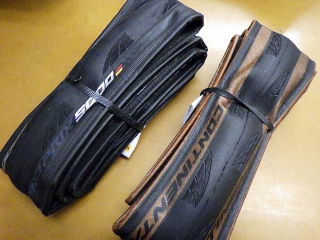
The current Grand Prix 5000 model has a later variant with a brown-colored tire sidewall
(this specification doesn't come in 23C—the 23C is only available in all-black).
Various manufacturers are making tires with beige or brown sidewalls, but broadly speaking, there are two types: those where the tire sidewall carcass is covered with rubber material that continues from the tread, and those where it isn't.
When the tire sidewall is covered in rubber and colored beige or brown, it's essentially just a cosmetic difference with almost no impact on performance
(if anything, non-black colors have slightly inferior weather resistance in strict terms). However, tires where the carcass is exposed have clearly different performance characteristics.
In the case of the Grand Prix 5000, it's a tire with exposed carcass, and the color name isn't something like "Tan" or "Beige" or "Classic"—it's "Transparent."
This is more accurately called a specification designation than a color name.
Though not for road bike tires, Continental's gravel tires like the Terra Speed and Terra Trail models do have thin beige sidewall variants, which are labeled with the color name "Cream" and have the sidewall covered in rubber. This is clearly distinguished from the Transparent specification.
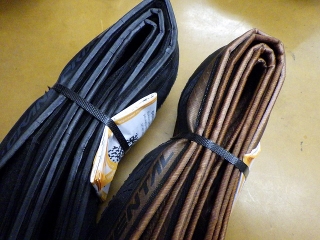
↑Black and Transparent in 25C.
They're strapped together with PP bands, but because the Transparent sidewall is thinner, the width of the strapped area is also narrower.
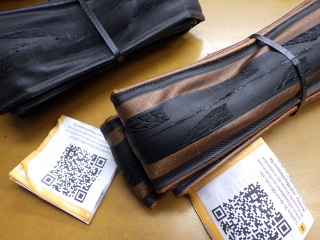
I pulled the instruction sheet out from the PP bands.
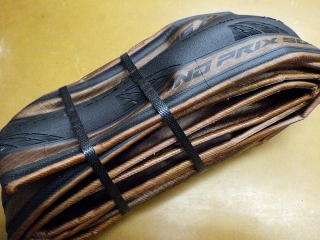
There was a tire that had two PP bands on it, so

I pulled one out and weighed it.
There's some individual variation in length, but you can figure each band is under 1g.

The instruction sheet was 8g.
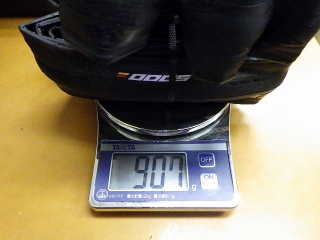
This is the weight of four all-black 25C tires with only one PP band each, after removing the instruction sheet.
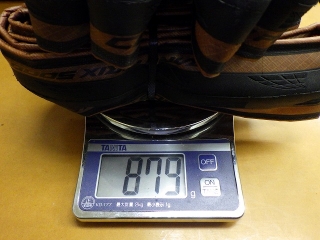
This is the weight of four Transparent 25C tires under the same conditions.
I thought there'd be a bigger difference.
The Transparent ones are lighter.
If you took 100 all-black and 100 Transparent tires and hunted through them to find the lightest all-black and the heaviest Transparent individual, you might find the all-black heavier. But on average, the Transparent version is clearly lighter.
Based on the ratio of those two images, roughly 31 all-black tires and 32 Transparent tires would weigh about the same.
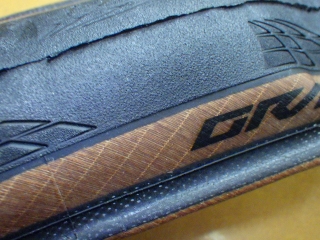
Now, about the Transparent tire sidewall—

When you hold it up to fluorescent light and look from inside the tire, you can see the sidewall is transparent.
If you press your finger against the outside of the tire, your finger's shadow is visible enough to show just how translucent it is.

When you look at the "Grand" part of "Grand Prix" from the inside, it looks like this.
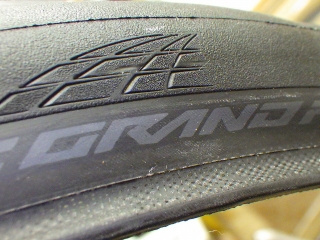
In contrast, with the all-black version—you can look anywhere really, but when you look at the "Grand" part of "Grand Prix" from the inside of the tire—
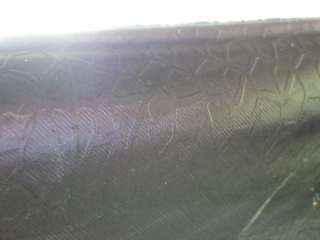
it looks like this. Not just for the Grand Prix 5000, but for any beige or brown-sided tire, you can distinguish the tire sidewall specification by whether it appears translucent when backlit.
Now, tires where the sidewall is just exposed carcass without rubber coverage have higher cornering limits and better ride feel if you get the air pressure right. On the other hand, they have lower sidewall durability and are more prone to sidewall cuts.
The answer to which is better depends on what performance the rider is looking for. But to avoid disappointment—like choosing an amber sidewall tire for looks and finding it has poor durability, or switching to a beige sidewall tire thinking it might feel different but discovering the sidewall is rubber-covered so it feels almost the same as all-black—I recommend choosing with awareness of not just the sidewall color but also the specification itself.

In the image above, from left: green onion, bird clam, and yellowtail.
Below that: tamago egg and grilled shiitake mushroom.
I honestly couldn't tell what the tamago was at first.

Horse meat sashimi

Pickled vegetable roll and pressed eel sushi
Anyway, the conversation turned to Continental's Grand Prix 5000 WO tires—specifically how the all-black version and the so-called amber or brown sidewall version aren't just different colors but are essentially completely different models. So I'm going to write about that here.

The current Grand Prix 5000 model has a later variant with a brown-colored tire sidewall
(this specification doesn't come in 23C—the 23C is only available in all-black).
Various manufacturers are making tires with beige or brown sidewalls, but broadly speaking, there are two types: those where the tire sidewall carcass is covered with rubber material that continues from the tread, and those where it isn't.
When the tire sidewall is covered in rubber and colored beige or brown, it's essentially just a cosmetic difference with almost no impact on performance
(if anything, non-black colors have slightly inferior weather resistance in strict terms). However, tires where the carcass is exposed have clearly different performance characteristics.
In the case of the Grand Prix 5000, it's a tire with exposed carcass, and the color name isn't something like "Tan" or "Beige" or "Classic"—it's "Transparent."
This is more accurately called a specification designation than a color name.
Though not for road bike tires, Continental's gravel tires like the Terra Speed and Terra Trail models do have thin beige sidewall variants, which are labeled with the color name "Cream" and have the sidewall covered in rubber. This is clearly distinguished from the Transparent specification.

↑Black and Transparent in 25C.
They're strapped together with PP bands, but because the Transparent sidewall is thinner, the width of the strapped area is also narrower.

I pulled the instruction sheet out from the PP bands.

There was a tire that had two PP bands on it, so

I pulled one out and weighed it.
There's some individual variation in length, but you can figure each band is under 1g.

The instruction sheet was 8g.

This is the weight of four all-black 25C tires with only one PP band each, after removing the instruction sheet.

This is the weight of four Transparent 25C tires under the same conditions.
I thought there'd be a bigger difference.
The Transparent ones are lighter.
If you took 100 all-black and 100 Transparent tires and hunted through them to find the lightest all-black and the heaviest Transparent individual, you might find the all-black heavier. But on average, the Transparent version is clearly lighter.
Based on the ratio of those two images, roughly 31 all-black tires and 32 Transparent tires would weigh about the same.

Now, about the Transparent tire sidewall—

When you hold it up to fluorescent light and look from inside the tire, you can see the sidewall is transparent.
If you press your finger against the outside of the tire, your finger's shadow is visible enough to show just how translucent it is.

When you look at the "Grand" part of "Grand Prix" from the inside, it looks like this.

In contrast, with the all-black version—you can look anywhere really, but when you look at the "Grand" part of "Grand Prix" from the inside of the tire—

it looks like this. Not just for the Grand Prix 5000, but for any beige or brown-sided tire, you can distinguish the tire sidewall specification by whether it appears translucent when backlit.
Now, tires where the sidewall is just exposed carcass without rubber coverage have higher cornering limits and better ride feel if you get the air pressure right. On the other hand, they have lower sidewall durability and are more prone to sidewall cuts.
The answer to which is better depends on what performance the rider is looking for. But to avoid disappointment—like choosing an amber sidewall tire for looks and finding it has poor durability, or switching to a beige sidewall tire thinking it might feel different but discovering the sidewall is rubber-covered so it feels almost the same as all-black—I recommend choosing with awareness of not just the sidewall color but also the specification itself.