A while back, I re-laced the front wheel with a 50mm-high rim of the current Ultegra tubeless wheel to the rear position(→here).
As I've written in the linked article,
the customer bought both C36 and C50 front wheels
with the intention of having us re-lace the C50 front wheel to the rear from the start.
As for the C36,
we don't keep it on hand for inspections or anything,
but it's a 24-spoke 2-cross lacing with equal-diameter spokes left and right, equal numbers of spokes left and right,
and it's laced without the final crossing woven on either side.
In other words, if there's any dissatisfaction,
there's still room for modifications.
Before these wheels, the customer was using
a Ρoyal CX50,
and while the C50 was with us being re-laced,
they tried using just the C36 front wheel,
and found that
"the Ultegra C36 rolls better than the CX50 front wheel"
"the CX50 is especially bad on downhill corners—it feels wobbly,
and even on non-downhill sections the steering feel is sluggish"—
improvements that don't require much tolerance to accept.
These are the customer's exact words, with no personal opinion from me.
Though I can't completely rule out the possibility that the customer's perception of wheels has already been distorted by a "Nomu Lab-style" wheel philosophy.
When we picked up the rear-laced C50,
we also inspected the front and rear wheels of the CX50
that was scheduled to be sold at auction.
If it would be advantageous, I even told them
they could write "inspected at Nomu Lab"
in the product description.
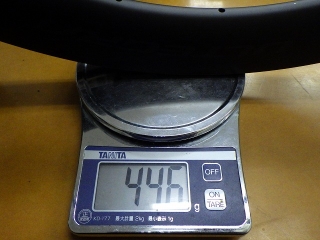
This is the rim weight of the C50 tubeless.
Note that this won't be archived anywhere.
It's about 10–15g heavier than the CL/CLX50 at the same rim height.
From my informal impressions while building the wheel, Shimano rims have
a feel of tensioning without vibration.

This is the actual measured weight of the front hub.
The actual measured weight of the R9270 front hub is(→here)
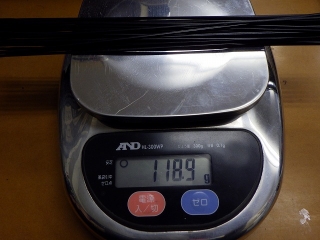
This is the actual measured weight of the spokes.
The spoke length is 272mm on both sides,
and the spoke specific gravity is 118.9÷24÷272÷0.0257
= 0.708710038..., so
roughly 71% is fine.
It's roughly the same as the results from the left and right spokes of the C36 rear wheel(→here).
If I line up spoke specific gravity from lightest to heaviest,
Dura-Ace spokes are 62%
CX-RAY or Aerolite are 65%
Ultegra spokes are 71%
CX Sprint or Aero Comp are 78%—
they've nicely deviated from the standard spokes with stable supply.
If spoke specific gravity differs by 5%,
it becomes difficult to mix as replacement spokes,
but it's unclear how stably the original spokes will be supplied going forward.
Are WH-7900 and WH-9000 spokes
currently obtainable with stable supply? The answer is of course NO.
Knowing spoke specific gravity is useful because
you can determine the weight of an unknown length of a known spoke quite accurately,
but it's also important when doing asymmetric lacing (or reverse asymmetric lacing)
because you can't do it without understanding the relative specific gravity of left and right spokes.
If you were to replace straight spokes on only one side
of an Ultegra front wheel while keeping the hub itself,
you'd install CX-RAY on the right side or CX Sprint on the left side,
but you can't make that decision without knowing
the spoke specific gravity of Ultegra spokes.
For equal-spoke-count disc brake front wheels
doing asymmetric lacing, if the only spokes available are
CX-RAY and CX Sprint,
writing left/right,
there's only one combination: CX Sprint / CX-RAY.
But when you add Dura-Ace and Ultegra spokes to this,
the combinations with consistent asymmetric lacing become six:
・CX Sprint / Ultegra or CX-RAY or Dura-Ace
・Ultegra / CX-RAY or Dura-Ace
・CX-RAY / Dura-Ace
CX-RAY / Dura-Ace and CX Sprint / Ultegra are so close in spoke specific gravity
that they seem not to make much difference.
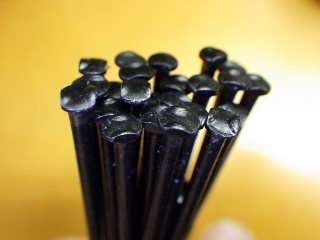
As I've noted in the linked article,
the Dura-Ace C36 and C50 spokes
seem to have reduced spoke specific gravity to 62% perhaps too carelessly,
so in my view, regarding tubeless rim wheels,
even accounting for the fact that the hub rotation is somewhat smoother,
Ultegra might actually be a wheel that rolls better
than Dura-Ace.
With aluminum spokes on rim brake wheels,
Shamal Ultra and Eurus have identical rims and spokes,
differing only in hub barrel material and bearing specifications,
but if Shamal Ultra were fitted with slightly thicker spokes on Eurus
just to make Shamal Ultra look lighter,
then Eurus would end up with greater rigidity and stiffness,
and some people might feel Eurus rolls better,
becoming a connoisseur's model with unintended character.
This kind of "differentiation for its own sake"
was done with spokes rather than with the hub (about 10g difference) or
the rim (probably the same thing, at least weight-wise),
causing unintended performance reversals
where the relative importance of factors has been misunderstood.
Both Dura-Ace and Ultegra use the same spoke gauge
for their respective C36 and C50,
but when it comes to C60, they adopt spokes with larger specific gravity
prioritizing rigidity.
The same thing is happening between
Dura-Ace and Ultegra wheels,
and there's a possibility that
we're in a situation where "the cheaper wheel actually rolls better."
As I've written in the linked article,
the customer bought both C36 and C50 front wheels
with the intention of having us re-lace the C50 front wheel to the rear from the start.
As for the C36,
we don't keep it on hand for inspections or anything,
but it's a 24-spoke 2-cross lacing with equal-diameter spokes left and right, equal numbers of spokes left and right,
and it's laced without the final crossing woven on either side.
In other words, if there's any dissatisfaction,
there's still room for modifications.
Before these wheels, the customer was using
a Ρoyal CX50,
and while the C50 was with us being re-laced,
they tried using just the C36 front wheel,
and found that
"the Ultegra C36 rolls better than the CX50 front wheel"
"the CX50 is especially bad on downhill corners—it feels wobbly,
and even on non-downhill sections the steering feel is sluggish"—
improvements that don't require much tolerance to accept.
These are the customer's exact words, with no personal opinion from me.
When we picked up the rear-laced C50,
we also inspected the front and rear wheels of the CX50
that was scheduled to be sold at auction.
If it would be advantageous, I even told them
they could write "inspected at Nomu Lab"
in the product description.

This is the rim weight of the C50 tubeless.
It's about 10–15g heavier than the CL/CLX50 at the same rim height.
From my informal impressions while building the wheel, Shimano rims have
a feel of tensioning without vibration.

This is the actual measured weight of the front hub.
The actual measured weight of the R9270 front hub is(→here)

This is the actual measured weight of the spokes.
The spoke length is 272mm on both sides,
and the spoke specific gravity is 118.9÷24÷272÷0.0257
= 0.708710038..., so
roughly 71% is fine.
It's roughly the same as the results from the left and right spokes of the C36 rear wheel(→here).
If I line up spoke specific gravity from lightest to heaviest,
Dura-Ace spokes are 62%
CX-RAY or Aerolite are 65%
Ultegra spokes are 71%
CX Sprint or Aero Comp are 78%—
they've nicely deviated from the standard spokes with stable supply.
If spoke specific gravity differs by 5%,
it becomes difficult to mix as replacement spokes,
but it's unclear how stably the original spokes will be supplied going forward.
Are WH-7900 and WH-9000 spokes
currently obtainable with stable supply? The answer is of course NO.
Knowing spoke specific gravity is useful because
you can determine the weight of an unknown length of a known spoke quite accurately,
but it's also important when doing asymmetric lacing (or reverse asymmetric lacing)
because you can't do it without understanding the relative specific gravity of left and right spokes.
If you were to replace straight spokes on only one side
of an Ultegra front wheel while keeping the hub itself,
you'd install CX-RAY on the right side or CX Sprint on the left side,
but you can't make that decision without knowing
the spoke specific gravity of Ultegra spokes.
For equal-spoke-count disc brake front wheels
doing asymmetric lacing, if the only spokes available are
CX-RAY and CX Sprint,
writing left/right,
there's only one combination: CX Sprint / CX-RAY.
But when you add Dura-Ace and Ultegra spokes to this,
the combinations with consistent asymmetric lacing become six:
・CX Sprint / Ultegra or CX-RAY or Dura-Ace
・Ultegra / CX-RAY or Dura-Ace
・CX-RAY / Dura-Ace
CX-RAY / Dura-Ace and CX Sprint / Ultegra are so close in spoke specific gravity
that they seem not to make much difference.

As I've noted in the linked article,
the Dura-Ace C36 and C50 spokes
seem to have reduced spoke specific gravity to 62% perhaps too carelessly,
so in my view, regarding tubeless rim wheels,
even accounting for the fact that the hub rotation is somewhat smoother,
Ultegra might actually be a wheel that rolls better
than Dura-Ace.
With aluminum spokes on rim brake wheels,
Shamal Ultra and Eurus have identical rims and spokes,
differing only in hub barrel material and bearing specifications,
but if Shamal Ultra were fitted with slightly thicker spokes on Eurus
just to make Shamal Ultra look lighter,
then Eurus would end up with greater rigidity and stiffness,
and some people might feel Eurus rolls better,
becoming a connoisseur's model with unintended character.
This kind of "differentiation for its own sake"
was done with spokes rather than with the hub (about 10g difference) or
the rim (probably the same thing, at least weight-wise),
causing unintended performance reversals
where the relative importance of factors has been misunderstood.
Both Dura-Ace and Ultegra use the same spoke gauge
for their respective C36 and C50,
but when it comes to C60, they adopt spokes with larger specific gravity
prioritizing rigidity.
The same thing is happening between
Dura-Ace and Ultegra wheels,
and there's a possibility that
we're in a situation where "the cheaper wheel actually rolls better."