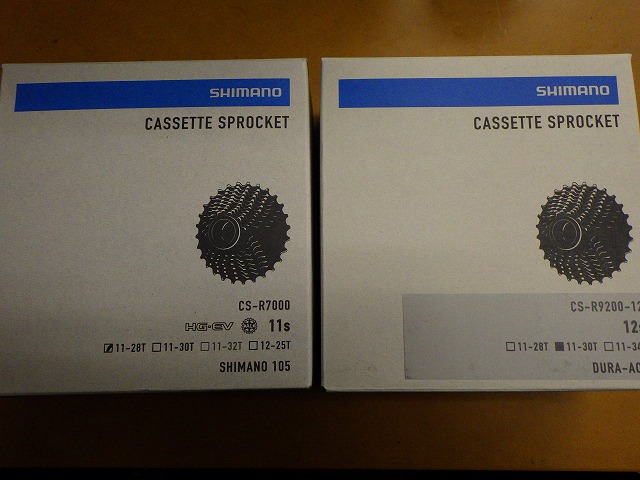
↑These are the boxes for Shimano's sprockets, the CS-R7000 and
CS-R9200.
The Dura-Ace version doesn't have any sense of luxury—
they've unified the design with a simple box.
Even the 9-speed sprocket CS-HG400, which costs less than 1/10th the price
of the CS-R9200, comes in the same box.
Until recently, Shimano's higher-grade products came in
shiny, glossy packaging that looked like
a goat would get an instant stomachache if it ate it—
apparently they stopped doing that because it contradicts the SDGs philosophy,
but using a simple box and
unifying the design so it all looks the same at first glance
aren't necessarily the same thing.
It's genuinely incompetent design.
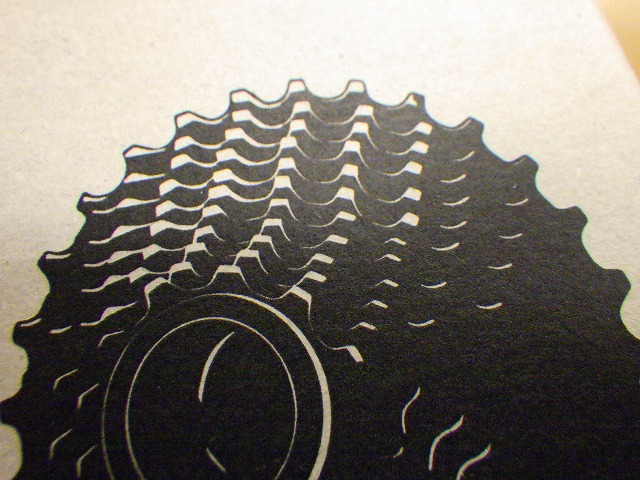
Regardless of how many speeds the sprocket inside has,
the illustration shows 11-speed.
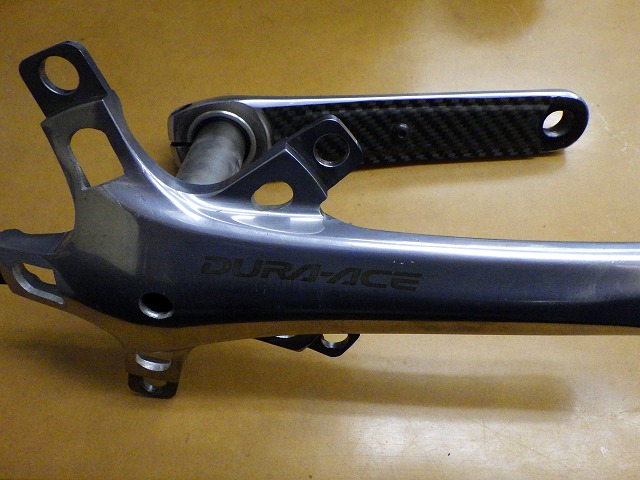
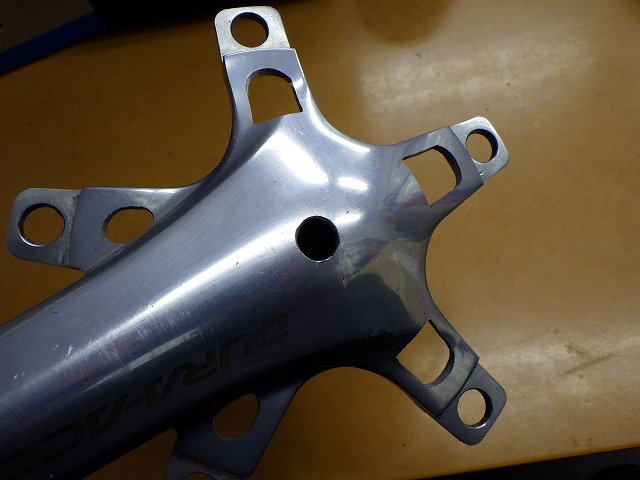
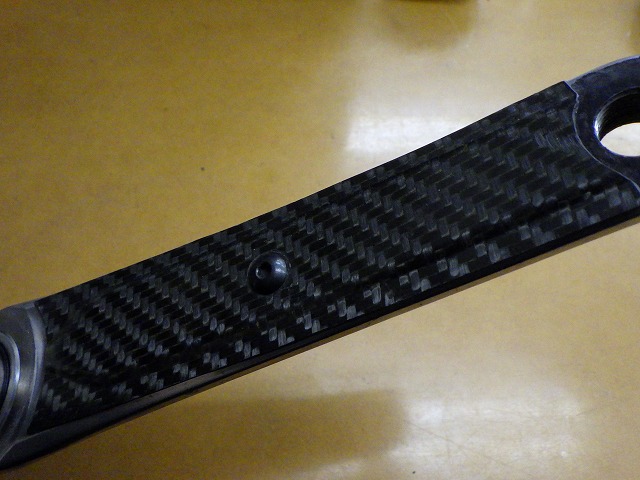
↑This is just my personal, unremarkable FC-7800.
It was the first road bike crankset
with Hollowtech II specification.
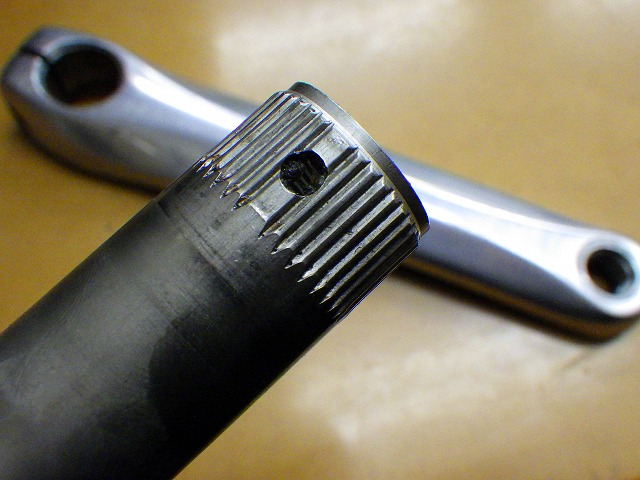
This crankset, timing-wise,
is extremely close to a first-lot unit, but it's not quite first-lot.
There's a bolt for taking up lateral play in the crankset,
and for emergencies when it loosens, there's a pin-pin type part
to prevent the left crank from falling off—
a hole for that pin is drilled in the crankshaft,
but the very earliest FC-7800 didn't have that pin part at all
and had no hole in the crankshaft.
In fact, I know someone who mounted an early-batch FC-7800 on their bike,
carried it on top of a car, and on the way back from a race
at Hiroshima Forest Park lost their left pedal and crank
on the highway (probably). If that pin had been there
and properly installed, the loss might have been prevented.
The left crank can be obtained as a spare part,
but pedals don't sell individual sides, so they had to buy a new pair.
And that's when I learned that Hollowtech II cranks
don't have individual right crank sales.
The right crank won't fall off easily if the chain is on it,
so loss or dropping happens less with the right than the left.
Back in the day, that would have been the end of it,
but since power meters became widespread,
this sales policy has caused a situation
where spare left cranks pile up everywhere
when people swap from a power meter-equipped left crank
to their original left crank.
For example, if you swap from a 105 left and right crank
to a Dura-Ace left crank with a power meter,
the original 105 left crank becomes spare.
Then if you want a full Dura-Ace crankset,
but right crank singles aren't available for sale,
you're forced to buy a full Dura-Ace crankset—
and now the non-power-meter Dura-Ace
left crank becomes spare.
I wonder if the ratio of left to right cranks
in every 105-level and higher crankset around the world
has become pretty skewed
since power meters became widespread.
If Shimano wants to show commitment to the SDGs principle
of "eliminating waste,"
I think selling individual right cranks for road bike Hollowtech II
would be better than simplifying boxes.
It would let users make more flexible, wasteless purchases.
SDGs really stands for Shimano Drive side Gear wheel solution
(Shimano's right crank solution)...!?
Considering the power meter situation, the total number
and total value of Shimano left cranks lying around spare
on bikes worldwide must be
absolutely astronomical.
By the way, the applause button for this article
should only be pressed by people who actually
have spare Shimano left cranks.
Update:
↓There are way more than I imagined!