A customer dropped off a Ksyrium (Mavic wheel) and Racing Zero (Shimano wheel) with me.
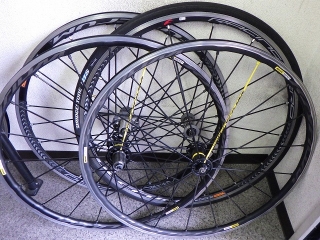
The Racing Zero was pretty much fine.
I was about to tell the customer that the rear wheel was probably off-center by about a sheet of paper on the freewheel side, thinking I'd nail the diagnosis of center drift from years of use, but when I checked, both the front and rear wheels were perfectly centered.
However, the end nut that holds the freewheel body in place—which is a reverse thread and often comes loose—was indeed loose, so at least there was some value in doing the inspection by tightening it.
With the Ksyrium, the rear wheel was, as usual, significantly off-center on the non-freewheel side, and the front wheel was also noticeably off, so I interpreted it as a bonus tightening opportunity and fixed it.
I didn't take photos since I showed the customer the situation.
The Ksyrium wasn't the customer's original owner, and the rubber seal that was always rubbing inside the FTS-L freewheel body had been removed.
When the interior of the freewheel body gets dirty, the hub rotation goes into a semi-slip state and transfers to the sprocket-equipped freewheel body, so if you put the bike on a stand with the rear wheel off the ground and manually turn the crank, the chain will keep spinning as if a ghost is pedaling afterward—that's also caused by that seal being missing. But the seal's job is also to prevent the freewheel-specific oil, which has a viscosity like lotion, from leaking out.
I explained the situation to the customer and asked whether they wanted to restore it to factory condition or leave it as-is, and they preferred the original state, so I installed a seal (which I happened to have in stock) into the hub body at the rear of the freewheel body and filled the cleaned pawl area with the freewheel-specific original oil (which I also happened to have in stock).
Before that, the hub rotation was rough and gritty. In this Ksyrium's case, I can pull out the hub shaft to the left without removing the left and right bearings, so I checked the rotation of both bearings without the hub shaft, and only the right side was noticeably rough and gritty. I confirmed this with the customer before replacing it.
The right-side bearing of the hub body for the FTS-L freewheel body is a bearing of a special size that masquerades as a 608 standard bearing.
A 608 is a bearing with an inner diameter of 8mm / outer diameter of 22mm / thickness of 7mm, but Mavic's rear right bearing has a spec where only the inner diameter is 9mm, which is difficult to source.
I happened to have a steel-ball bearing of that size in stock, so I replaced it.
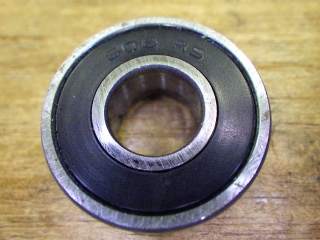
↑The bearing I replaced
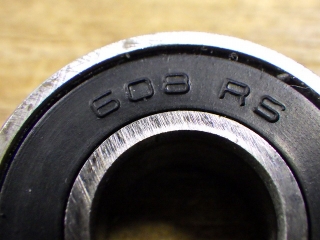
It says 608, but
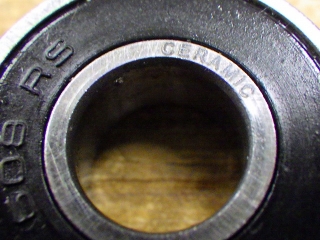
on the flipped-over inner race on one side only, it says it's a ceramic bearing, and

it's a Tni bearing.
A standard 8mm inner diameter 608 is too small as a size to use on a rear hub, and the inner diameter is too small for a front hub (it's rare to find an axle or hub shaft with an outer diameter of 8mm directly under the bearing), so it's not commonly used in bicycles or elsewhere.
For Mavic, this 608 variant is called "608-9" by Tni, meaning only the inner diameter is 9mm.
This Mavic hub's left bearing was the original contact-type sealed version.
Mavic wheels have zero waterproofing all the way to the bearings, so the bearing seals themselves are the final line of defense against dust and water. Converting contact-type bearings (not just ceramic ones) to non-contact types makes rotation lighter, but bearing life drops significantly.
Perhaps they thought only this 608 variant, being inside the freewheel body, wouldn't get submerged in water.
Though it's funny they had removed the seal at the rear of the freewheel body anyway.
With this bearing, water ingress probably wasn't the issue—I think it's simply that the hardness of the ball race was overcome by the hardness of the ceramic balls, causing spalling.
Among three-digit miniature bearings, the 608 has a large difference between inner and outer diameter, so the steel balls inside are also large, meaning it's unheard of for a Mavic original 608 variant to wear out and need replacement.
The fact that it sits as an eccentric-stress-free "roller" near the center of the hub shaft is probably another reason why it doesn't wear easily.
In my experience, the only reason to replace a Mavic 608 variant is to "restore it back from ceramic bearing damage."
These days I don't write articles about jobs this small.
Actually, today besides this I also straightened the wheels on a Racing Night and fixed a Loyal CL50 that got bent in a crash, but I didn't even take photos for an article.
Since they said it's okay to write about it, I will: this customer with the Ksyrium and Racing Zero came from O City in H Prefecture.
And how they found out about my shop was because last month someone brought in a WH-9000 for inspection, and that person is an acquaintance living in F City, H Prefecture.
I did take photos of that wheel at the time, but hadn't posted the article, so I'll put them up now.
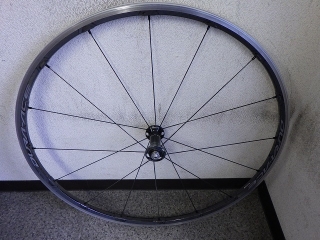
I received a WH-9000-C24 front wheel from a customer.
Since this wasn't the wheel's original owner, they requested an inspection.

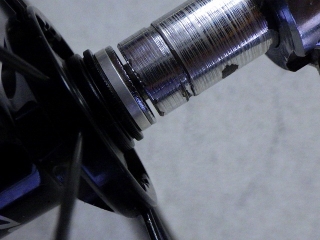
There's no way a stock Dura-Ace front wheel would be off-center like this, so it definitely has a history of attempted wheel truing.
I didn't take photos of the truing and centering results since I showed them to the customer.
There was play in the rear hub's ball bearing adjustment, and I think I installed a sprocket the customer had brought along after the work, but I didn't take photos of that either.
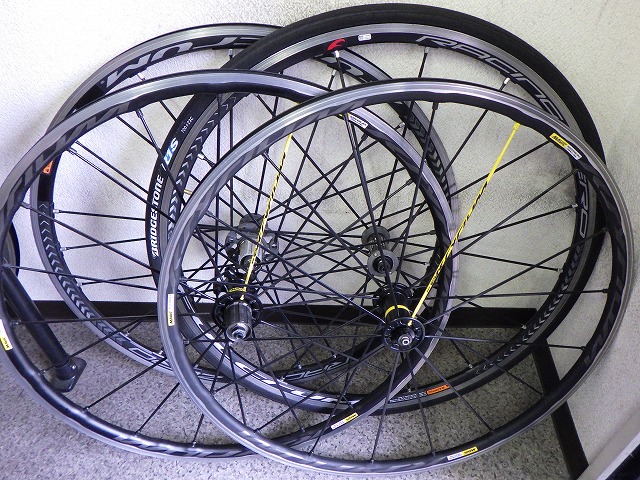
The Racing Zero was pretty much fine.
I was about to tell the customer that the rear wheel was probably off-center by about a sheet of paper on the freewheel side, thinking I'd nail the diagnosis of center drift from years of use, but when I checked, both the front and rear wheels were perfectly centered.
However, the end nut that holds the freewheel body in place—which is a reverse thread and often comes loose—was indeed loose, so at least there was some value in doing the inspection by tightening it.
With the Ksyrium, the rear wheel was, as usual, significantly off-center on the non-freewheel side, and the front wheel was also noticeably off, so I interpreted it as a bonus tightening opportunity and fixed it.
I didn't take photos since I showed the customer the situation.
The Ksyrium wasn't the customer's original owner, and the rubber seal that was always rubbing inside the FTS-L freewheel body had been removed.
When the interior of the freewheel body gets dirty, the hub rotation goes into a semi-slip state and transfers to the sprocket-equipped freewheel body, so if you put the bike on a stand with the rear wheel off the ground and manually turn the crank, the chain will keep spinning as if a ghost is pedaling afterward—that's also caused by that seal being missing. But the seal's job is also to prevent the freewheel-specific oil, which has a viscosity like lotion, from leaking out.
I explained the situation to the customer and asked whether they wanted to restore it to factory condition or leave it as-is, and they preferred the original state, so I installed a seal (which I happened to have in stock) into the hub body at the rear of the freewheel body and filled the cleaned pawl area with the freewheel-specific original oil (which I also happened to have in stock).
Before that, the hub rotation was rough and gritty. In this Ksyrium's case, I can pull out the hub shaft to the left without removing the left and right bearings, so I checked the rotation of both bearings without the hub shaft, and only the right side was noticeably rough and gritty. I confirmed this with the customer before replacing it.
The right-side bearing of the hub body for the FTS-L freewheel body is a bearing of a special size that masquerades as a 608 standard bearing.
A 608 is a bearing with an inner diameter of 8mm / outer diameter of 22mm / thickness of 7mm, but Mavic's rear right bearing has a spec where only the inner diameter is 9mm, which is difficult to source.
I happened to have a steel-ball bearing of that size in stock, so I replaced it.

↑The bearing I replaced
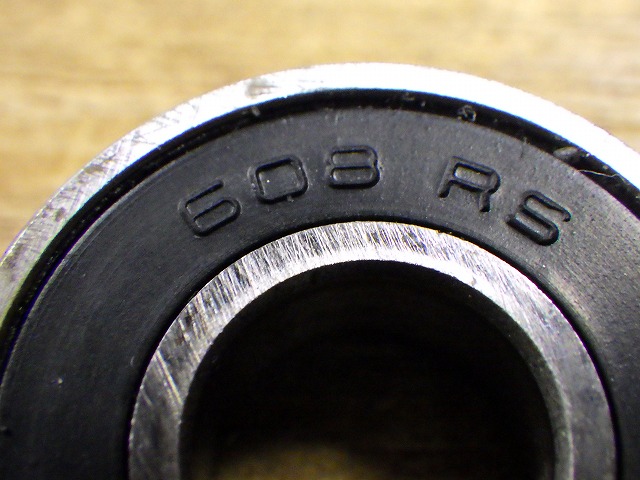
It says 608, but
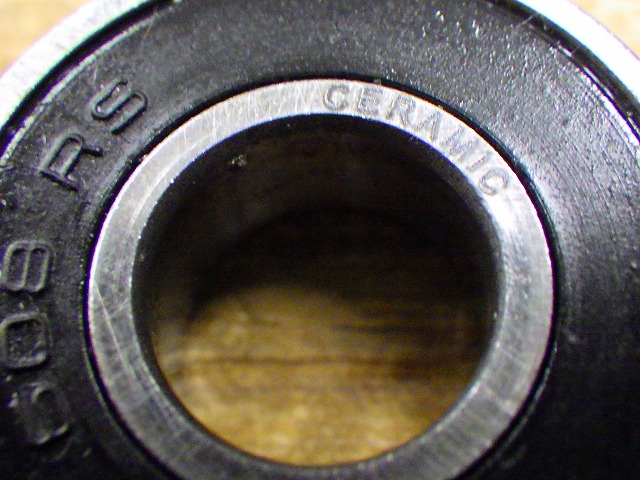
on the flipped-over inner race on one side only, it says it's a ceramic bearing, and
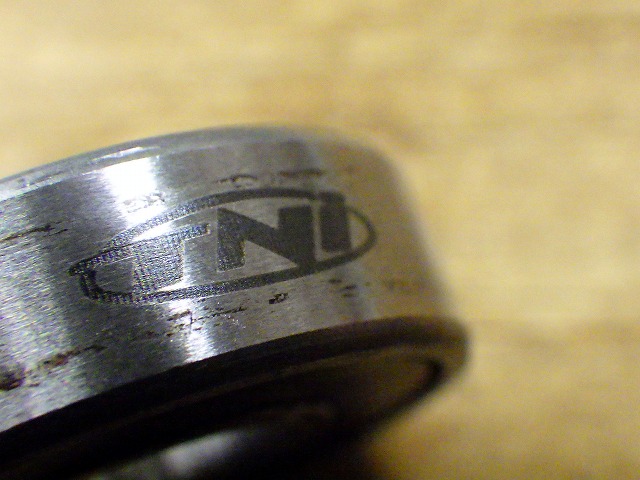
it's a Tni bearing.
A standard 8mm inner diameter 608 is too small as a size to use on a rear hub, and the inner diameter is too small for a front hub (it's rare to find an axle or hub shaft with an outer diameter of 8mm directly under the bearing), so it's not commonly used in bicycles or elsewhere.
For Mavic, this 608 variant is called "608-9" by Tni, meaning only the inner diameter is 9mm.
This Mavic hub's left bearing was the original contact-type sealed version.
Mavic wheels have zero waterproofing all the way to the bearings, so the bearing seals themselves are the final line of defense against dust and water. Converting contact-type bearings (not just ceramic ones) to non-contact types makes rotation lighter, but bearing life drops significantly.
Perhaps they thought only this 608 variant, being inside the freewheel body, wouldn't get submerged in water.
Though it's funny they had removed the seal at the rear of the freewheel body anyway.
With this bearing, water ingress probably wasn't the issue—I think it's simply that the hardness of the ball race was overcome by the hardness of the ceramic balls, causing spalling.
Among three-digit miniature bearings, the 608 has a large difference between inner and outer diameter, so the steel balls inside are also large, meaning it's unheard of for a Mavic original 608 variant to wear out and need replacement.
The fact that it sits as an eccentric-stress-free "roller" near the center of the hub shaft is probably another reason why it doesn't wear easily.
In my experience, the only reason to replace a Mavic 608 variant is to "restore it back from ceramic bearing damage."
These days I don't write articles about jobs this small.
Actually, today besides this I also straightened the wheels on a Racing Night and fixed a Loyal CL50 that got bent in a crash, but I didn't even take photos for an article.
Since they said it's okay to write about it, I will: this customer with the Ksyrium and Racing Zero came from O City in H Prefecture.
And how they found out about my shop was because last month someone brought in a WH-9000 for inspection, and that person is an acquaintance living in F City, H Prefecture.
I did take photos of that wheel at the time, but hadn't posted the article, so I'll put them up now.

I received a WH-9000-C24 front wheel from a customer.
Since this wasn't the wheel's original owner, they requested an inspection.
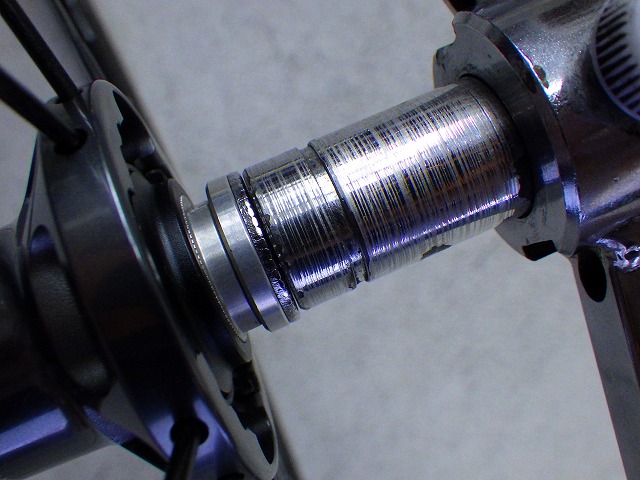
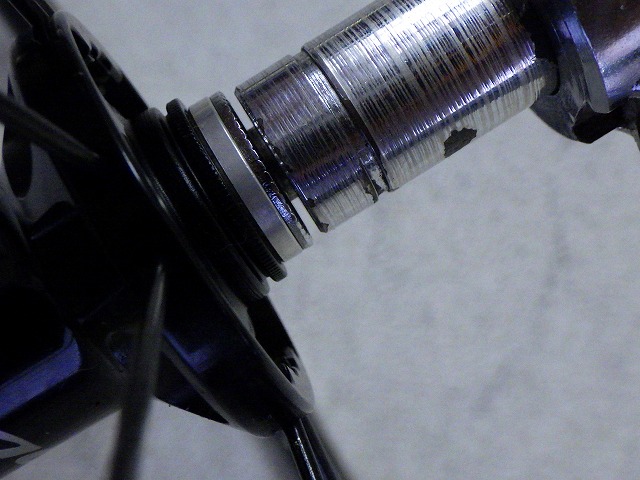
There's no way a stock Dura-Ace front wheel would be off-center like this, so it definitely has a history of attempted wheel truing.
I didn't take photos of the truing and centering results since I showed them to the customer.
There was play in the rear hub's ball bearing adjustment, and I think I installed a sprocket the customer had brought along after the work, but I didn't take photos of that either.