Another day of wheelbuilding (and so on). But first.
There was once a handlebar maker called ITM in Italy.
Unlike Deda, which moved production to Taiwan to offer products at lower prices
while maintaining an Italian brand image,
ITM pursued a strategy of all-Italian manufacturing,
even down to budget-grade components,
but that commitment led to bankruptcy.
ITM is short for Italmanubri,
where "Ital" means "Italian" and "manubri" means "handlebar,"
so in English it's "Italian Handlebar."
By the way, the current ITM is a different brand that bought the name from the old ITM.
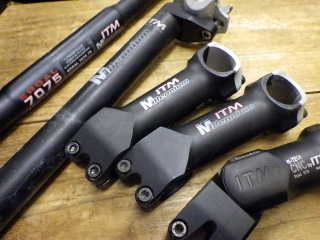
The old ITM had a series called "Millennium" that included handlebars, stems, and
seatposts.
There were also wheels and carbon forks in the lineup,
but I don't think much of it made it to Japan.


I personally think the Millennium stem represents the pinnacle of
aheadset stem design.

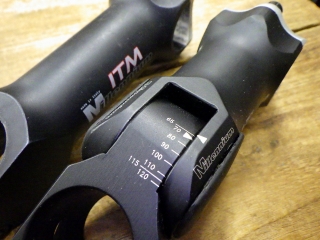
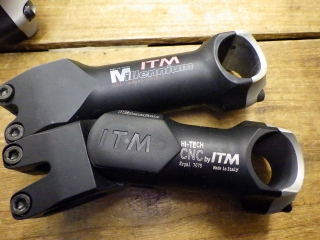
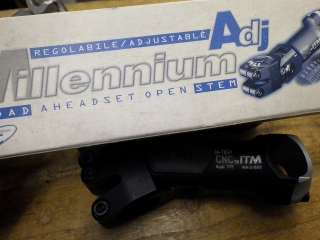
This is the Millennium Adjustable,
a rare stem with an angle-adjustment mechanism built in.
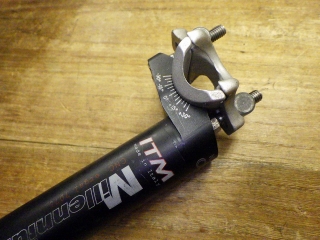
As for this Millennium seatpost,
it wasn't made by ITM.
It was made by Selcof,
another Italian seatpost maker that also insisted on all-Italian manufacturing.
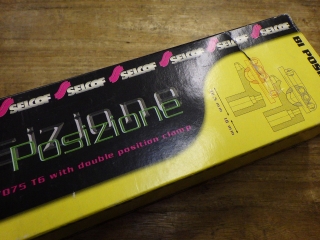
↑Selcof seatpost box
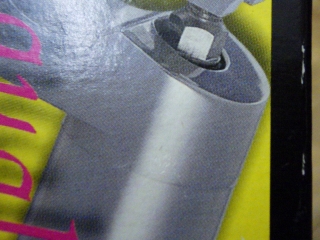
There's a distinct line where the seatpost tube and the seat lug join,
and with the stepless-adjustment seesaw-type front and rear bolts,
the front one is adjusted with an 8mm wrench while
loosening the rear one, but
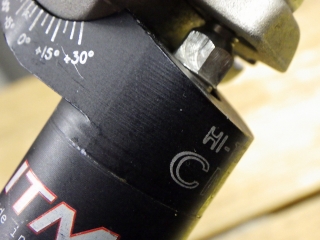
the Millennium seat lug has exactly the same shape.
Conversely, while less common,
there also exist handlebars and stems branded Selcof but made by ITM.
Knowing the design, you can spot them immediately as the same as ITM's stems.
Anyway, back to wheelbuilding.
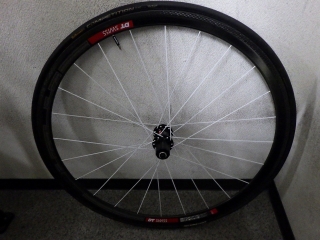
A customer left with me a rear wheel with a DT 32mm high rim.
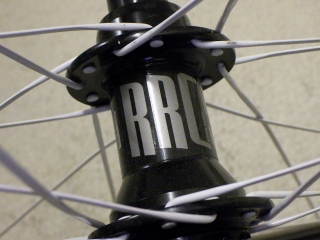
On the hub body of a hub equivalent to DT's 240S
is RRC

525
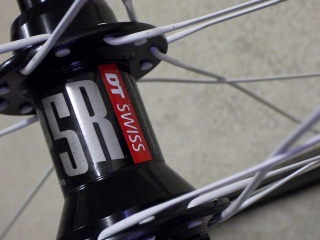
R written on it.
Among DT rims, the R (Road) and RR (Road Racing) designations follow the pattern where
the number that follows is the catalog weight.
MTB rims don't follow this rule, so
for example, the XR361 rim isn't necessarily 361g.
More precisely, when DT started their rim business,
the first aluminum rims were called RR1.1 and RR1.2.
Later versions with different names became RR415 and RR585 respectively,
and from then on the number equals weight.
This rear wheel's model name is RRC525R, which
also appears to simply use the nominal weight in the model name.
The third letter C doesn't mean clincher—it means carbon.
The matching front wheel built with the same rim
has the model name RRC425F,
so the R at the end of RRC525R indicates rear wheel.

24H white Aero Lite 4-4 lacing.
White or red Aero Lite with weak paint coating that cracks easily
came out for a period and was used on wheels like those from FF Yamaguchi,
but DT announced at the time that white and red Aero Lite
should not be woven in the final crossing.
So why is DT's own complete wheel built that way?
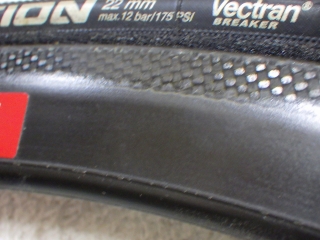
Looking at this rim... it's clearly
the same rim as Reynolds 32 or
the later version of Nomu Lab Wheel No. 6.
It even has what's called a swirl lip generator ridge on the inner edge.
In other words, this is a wheel that Reynolds
built using rims supplied by DT while DT was supplied hubs and spokes by Reynolds—
basically DT's version of Reynolds 32.
Seeing this reminded me of the old ITM and Selcof relationship,
which is why I wrote the opening story.
Regarding this DT version 32,
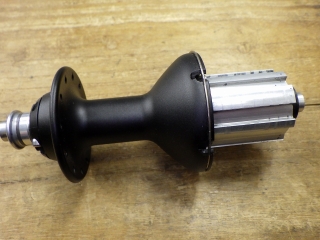
the customer requested that it be rebuilt with
this Campagnolo Proton rear hub.
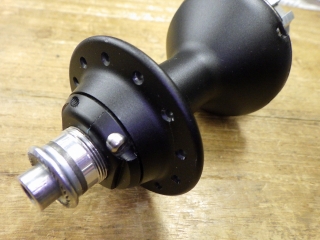
A hub specification sometimes seen on Campagnolo and Fulcrum rear wheels:
"straight spokes on one side only."
Some Racing 7 rear wheels from a certain period also had
straight spokes on one side, but
on those, the freehub side had universal flanges
and the non-drive side was forced radial lacing.
This Proton hub has the freehub side at forced 4-spoke equivalent
and the non-drive side with universal flanges.
On stock Protons, the non-drive side uses outpoke radial lacing.
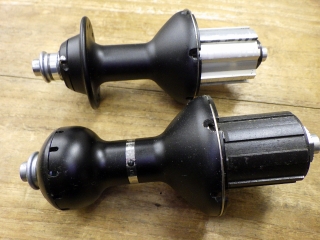
↑The bottom image is my personal Neutron hub from the same era as this Proton.
The Neutron, being Record-grade spec,
has a grease hole on the hub body
and comes with a C-ring cap to seal it.
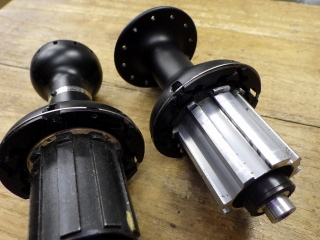

Neutron and Hyperon use equal spoke counts on both sides with
radial lacing on the non-drive side, but
with quite extreme asymmetric spoke counts left and right
and the left flange positioned quite far out as you can see,
there's no sense of low lateral stiffness.
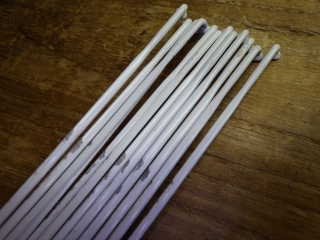
I disassembled the original wheel.
The upper image shows the 12 spokes on the non-drive side, which is the low-tension side,
and you can see the paint has chipped at the final crossing contact points.
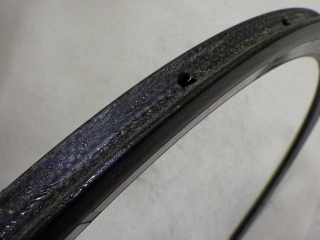
There was a rim cement bed on the rim,
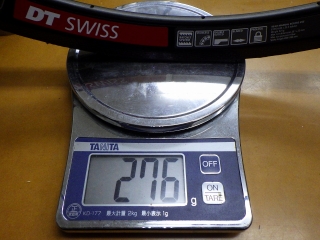
but it still came in under 280g. Same weight as
Reynolds 32 or the later Nomu Lab Wheel No. 6 rim.
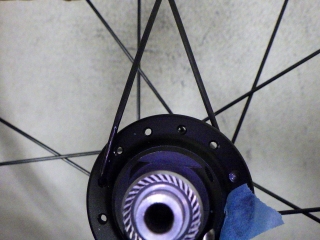
Reynolds 32 has no hole offset between left and right on the inner rim edge.
And for some reason, only the front wheel is built as reverse-rim.
Campagnolo equal-spoke-count wheels
are built as reverse-rim on both front and rear.
So I decided to build this rear wheel as reverse-rim as well.
It's already proven okay to build as reverse-rim
by the Reynolds front wheel.
The upper image shows after I finished the temporary freehub side lacing
and passed just one Italian final crossing through the non-drive side.

I stuck a tape marker on the back side of the flange hole where
the outpoke spoke passes through,
positioned to cover the adjacent flange hole.
These two spokes of the final crossing,
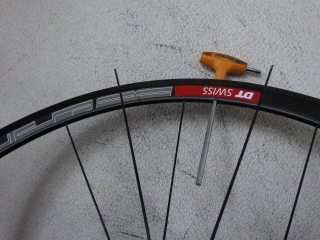
cross over the valve hole.
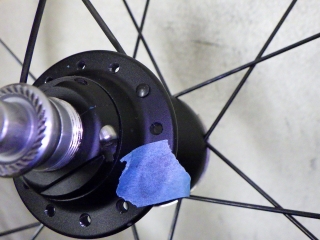
I shifted the final crossing spoke holes
forward by one.
The tape marker stays at the previous position.
This operation is equivalent to switching between
right-drop and left-drop when first threading spokes through
a universal-flange hub.
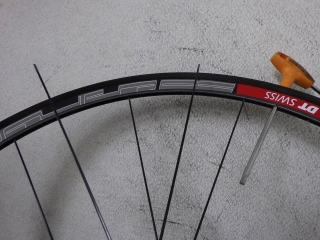
The left and right final crossing 1-pair 4-spoke bundles
don't cross the valve hole now—a reverse-rim build.

It's built.

Proton hub, 24H, black Champion straight / black CX Sprint,
4-6 lacing with wireings.
Since Compé straight spokes don't exist
(not that they're nonexistent, but hard to source),
this becomes a half-Compé with increased spoke weight ratio on both sides.
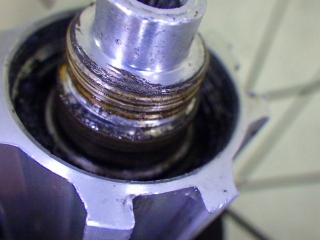
The customer asked to swap the freebody from Campagnolo
to Shimano spec, but when I removed the right end nut, there was prominent rust
and the freebody won't come out by hand.
Given the era, the hub shaft should be old-type unbatted,
but in that case, white-anodized aluminum freebolts can't be installed.
To install aluminum freebolts,
you need to swap to a new batted shaft (I have stock).
Steel freebolts can be installed on old shafts (I have stock).
To extract the freebody,
it's fastest to remove the hub shaft from the hub body, so
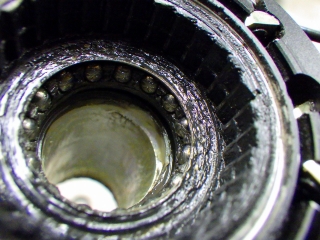
I removed the freebody-equipped hub shaft.
The freeside hub body bearing shows no damage, but
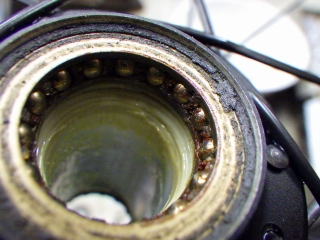
the balls on the non-drive side had taken on a rust color.
The hub rotation felt smooth though.
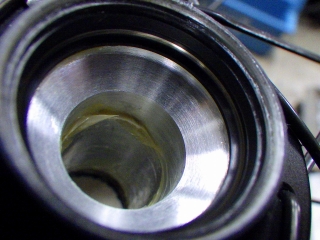
The cone too
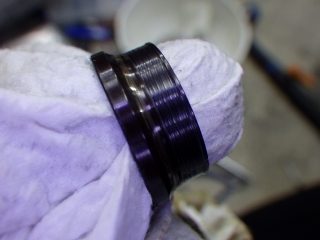
and the cup show nice wear patterns
with no pitting even in the early stages,
so just replacing the retainer bearings will do.
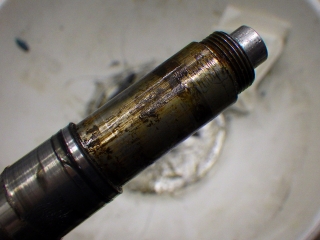
I removed the freebody from the hub shaft.
It was indeed an old unbatted shaft.
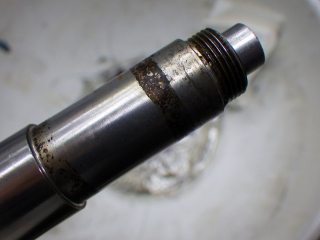
I wiped it clean.
It's also possible to polish and remove rust more thoroughly.
A secondary rust ring formed directly under the inner bearing races,
especially visible on the outside.
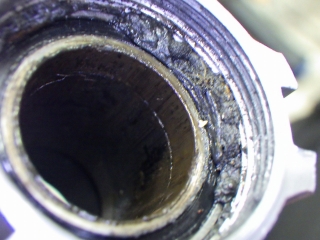
↑Freebody-side condition
Swapping the freebody or hub shaft shouldn't shift the wheel center,
but sometimes it does drift by about one paper thickness,
so after reassembling the hub I'll check and
correct if needed.
There was once a handlebar maker called ITM in Italy.
Unlike Deda, which moved production to Taiwan to offer products at lower prices
while maintaining an Italian brand image,
ITM pursued a strategy of all-Italian manufacturing,
even down to budget-grade components,
but that commitment led to bankruptcy.
ITM is short for Italmanubri,
where "Ital" means "Italian" and "manubri" means "handlebar,"
so in English it's "Italian Handlebar."
By the way, the current ITM is a different brand that bought the name from the old ITM.

The old ITM had a series called "Millennium" that included handlebars, stems, and
seatposts.
There were also wheels and carbon forks in the lineup,
but I don't think much of it made it to Japan.


I personally think the Millennium stem represents the pinnacle of
aheadset stem design.


This is the Millennium Adjustable,
a rare stem with an angle-adjustment mechanism built in.

As for this Millennium seatpost,
it wasn't made by ITM.
It was made by Selcof,
another Italian seatpost maker that also insisted on all-Italian manufacturing.

↑Selcof seatpost box

There's a distinct line where the seatpost tube and the seat lug join,
and with the stepless-adjustment seesaw-type front and rear bolts,
the front one is adjusted with an 8mm wrench while
loosening the rear one, but

the Millennium seat lug has exactly the same shape.
Conversely, while less common,
there also exist handlebars and stems branded Selcof but made by ITM.
Knowing the design, you can spot them immediately as the same as ITM's stems.
Anyway, back to wheelbuilding.

A customer left with me a rear wheel with a DT 32mm high rim.

On the hub body of a hub equivalent to DT's 240S
is RRC

525

R written on it.
Among DT rims, the R (Road) and RR (Road Racing) designations follow the pattern where
the number that follows is the catalog weight.
MTB rims don't follow this rule, so
for example, the XR361 rim isn't necessarily 361g.
More precisely, when DT started their rim business,
the first aluminum rims were called RR1.1 and RR1.2.
Later versions with different names became RR415 and RR585 respectively,
and from then on the number equals weight.
This rear wheel's model name is RRC525R, which
also appears to simply use the nominal weight in the model name.
The third letter C doesn't mean clincher—it means carbon.
The matching front wheel built with the same rim
has the model name RRC425F,
so the R at the end of RRC525R indicates rear wheel.

24H white Aero Lite 4-4 lacing.
White or red Aero Lite with weak paint coating that cracks easily
came out for a period and was used on wheels like those from FF Yamaguchi,
but DT announced at the time that white and red Aero Lite
should not be woven in the final crossing.
So why is DT's own complete wheel built that way?

Looking at this rim... it's clearly
the same rim as Reynolds 32 or
the later version of Nomu Lab Wheel No. 6.
It even has what's called a swirl lip generator ridge on the inner edge.
In other words, this is a wheel that Reynolds
built using rims supplied by DT while DT was supplied hubs and spokes by Reynolds—
basically DT's version of Reynolds 32.
Seeing this reminded me of the old ITM and Selcof relationship,
which is why I wrote the opening story.
Regarding this DT version 32,

the customer requested that it be rebuilt with
this Campagnolo Proton rear hub.

A hub specification sometimes seen on Campagnolo and Fulcrum rear wheels:
"straight spokes on one side only."
Some Racing 7 rear wheels from a certain period also had
straight spokes on one side, but
on those, the freehub side had universal flanges
and the non-drive side was forced radial lacing.
This Proton hub has the freehub side at forced 4-spoke equivalent
and the non-drive side with universal flanges.
On stock Protons, the non-drive side uses outpoke radial lacing.

↑The bottom image is my personal Neutron hub from the same era as this Proton.
The Neutron, being Record-grade spec,
has a grease hole on the hub body
and comes with a C-ring cap to seal it.


Neutron and Hyperon use equal spoke counts on both sides with
radial lacing on the non-drive side, but
with quite extreme asymmetric spoke counts left and right
and the left flange positioned quite far out as you can see,
there's no sense of low lateral stiffness.

I disassembled the original wheel.
The upper image shows the 12 spokes on the non-drive side, which is the low-tension side,
and you can see the paint has chipped at the final crossing contact points.

There was a rim cement bed on the rim,

but it still came in under 280g. Same weight as
Reynolds 32 or the later Nomu Lab Wheel No. 6 rim.

Reynolds 32 has no hole offset between left and right on the inner rim edge.
And for some reason, only the front wheel is built as reverse-rim.
Campagnolo equal-spoke-count wheels
are built as reverse-rim on both front and rear.
So I decided to build this rear wheel as reverse-rim as well.
It's already proven okay to build as reverse-rim
by the Reynolds front wheel.
The upper image shows after I finished the temporary freehub side lacing
and passed just one Italian final crossing through the non-drive side.

I stuck a tape marker on the back side of the flange hole where
the outpoke spoke passes through,
positioned to cover the adjacent flange hole.
These two spokes of the final crossing,

cross over the valve hole.

I shifted the final crossing spoke holes
forward by one.
The tape marker stays at the previous position.
This operation is equivalent to switching between
right-drop and left-drop when first threading spokes through
a universal-flange hub.

The left and right final crossing 1-pair 4-spoke bundles
don't cross the valve hole now—a reverse-rim build.

It's built.

Proton hub, 24H, black Champion straight / black CX Sprint,
4-6 lacing with wireings.
Since Compé straight spokes don't exist
(not that they're nonexistent, but hard to source),
this becomes a half-Compé with increased spoke weight ratio on both sides.

The customer asked to swap the freebody from Campagnolo
to Shimano spec, but when I removed the right end nut, there was prominent rust
and the freebody won't come out by hand.
Given the era, the hub shaft should be old-type unbatted,
but in that case, white-anodized aluminum freebolts can't be installed.
To install aluminum freebolts,
you need to swap to a new batted shaft (I have stock).
Steel freebolts can be installed on old shafts (I have stock).
To extract the freebody,
it's fastest to remove the hub shaft from the hub body, so

I removed the freebody-equipped hub shaft.
The freeside hub body bearing shows no damage, but

the balls on the non-drive side had taken on a rust color.
The hub rotation felt smooth though.

The cone too

and the cup show nice wear patterns
with no pitting even in the early stages,
so just replacing the retainer bearings will do.

I removed the freebody from the hub shaft.
It was indeed an old unbatted shaft.

I wiped it clean.
It's also possible to polish and remove rust more thoroughly.
A secondary rust ring formed directly under the inner bearing races,
especially visible on the outside.

↑Freebody-side condition
Swapping the freebody or hub shaft shouldn't shift the wheel center,
but sometimes it does drift by about one paper thickness,
so after reassembling the hub I'll check and
correct if needed.
Products Mentioned in This Article
- 🛒 Campagnolo Proton rear hub
- 🛒 DT RRC525R carbon rim 32mm
- 🛒 DT Aero Lite white spoke
- 🛒 Selcof Italian seatpost
* Amazon affiliate links — prices may vary
Original Japanese post: のむラボ日記 #6646