Today it's wheels again (and so on).
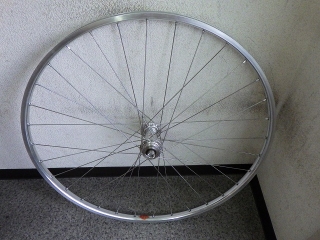
I built a rear wheel using a Passenti Brevet rim and
a Filwood single-threaded fixed gear hub.
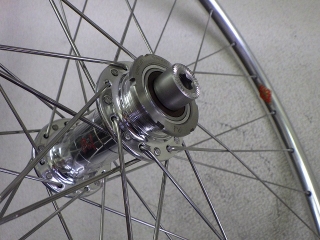
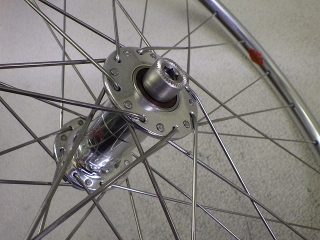
32H, all-competition lacing, Italian pattern, no cross-lacing.
With Shimano hubs — rear hubs, disc front hubs, or
dynamo front hubs that have flange offset —
a number called "offset amount" is clearly listed in the catalog.
This is calculated as "(total flange width ÷ 2) plus/minus (offset amount)"
to determine left and right flange widths, but
as I've written about before,
I think they should just write out the actual flange width numbers themselves.
In fact, long ago there was no "offset amount" notation —
the actual right flange width and left flange width numbers were written out directly.
To give a calculation example of this "offset amount":
for the FH-RS400 rear hub for rim brakes,
the flange width is 56.9mm and the offset amount is 9.75mm, so
adding and subtracting 9.75 from 28.45 (which is 56.9÷2)
gives 38.2mm (left side) and 18.7mm (right side) as
the left and right flange widths respectively.
Naturally, 38.2 plus 18.7 equals 56.9, but
the point is they should just write out 38.2 and 18.7 from the start.
However, this offset amount might actually be
useful as an evaluation standard when doing
different-diameter, different-count, different-number lacing and such.
Though I doubt many people ever think along those lines.
The FH-RS400 rear hub for rim brakes I mentioned earlier
has an offset amount of 9.75mm, but
the HB-RS770 disc road front hub
has an offset amount of 6mm, and
its matching rear hub, the FH-RS770,
has an offset amount of 7.5mm.
With the M9000 series XTR rear hub,
both the FH-M9000 with OLD 135mm quick release
and the FH-M9010 with OLD 142mm through-axle
have the same 57.4mm flange width and
the same 6.6mm offset amount.
But with the BOOST-spec FH-M9010-B,
it's OLD 148mm with 63.4mm flange width, and
all the 6mm OLD increase from BOOSTification
gets put into the flange width calculation, yet
the offset amount is still 6.6mm
(the important point being that the ratio of offset amount
to total left-right flange width is different).
With the Dura-Ace track large-flange rear hub
HB-7600-R in single-threaded-side specification,
the offset amount is 5.25mm.
As for the Filwood rear hub this time, calculating from
the actual flange width measurements with calipers,
the offset amount came out to 7.35mm.
Compared to the Dura-Ace single-threaded hub,
the dimension on the right side where the fixed gear mounts is roughly the same,
so it works out to having a wider left flange with a larger offset.
Also, while the flange width differs,
the offset amount is comparable to
Shimano's disc road rear hub.
However, between the FH-RS770's offset amount of 7.5mm and
this Filwood rear hub's offset amount of 7.35mm,
the ratio to the total left-right flange width differs, so
even though the dimensions are roughly similar,
the evaluation won't necessarily be almost the same.
Normally with the HB-7600-R-S,
which has an offset amount of 5.25mm,
I don't do different-diameter, different-count lacing, but
with the FH-RS770 with offset amount 7.5mm,
I do different-diameter, different-count lacing.
So with this Filwood hub at 7.35mm offset amount,
shouldn't I be putting in at least different-count lacing with smaller effect range
on top of different-diameter? Specifically, I thought
something like all-competition 26-spoke lacing
might be good, but
this time I went with 6x6 lacing with the same diameter and count on both sides.
I'm not looking for objective evaluation, which is why
I'm writing this here — for that reason,
I've deliberately not written out the specific number needed for that evaluation,
which is the Filwood hub's total flange width.
Also, the fact that spoke count is 32 is relevant too.
If it were 24, I probably wouldn't be doing same-diameter same-count lacing either.

I built a rear wheel using a Passenti Brevet rim and
a Filwood single-threaded fixed gear hub.


32H, all-competition lacing, Italian pattern, no cross-lacing.
With Shimano hubs — rear hubs, disc front hubs, or
dynamo front hubs that have flange offset —
a number called "offset amount" is clearly listed in the catalog.
This is calculated as "(total flange width ÷ 2) plus/minus (offset amount)"
to determine left and right flange widths, but
as I've written about before,
I think they should just write out the actual flange width numbers themselves.
In fact, long ago there was no "offset amount" notation —
the actual right flange width and left flange width numbers were written out directly.
To give a calculation example of this "offset amount":
for the FH-RS400 rear hub for rim brakes,
the flange width is 56.9mm and the offset amount is 9.75mm, so
adding and subtracting 9.75 from 28.45 (which is 56.9÷2)
gives 38.2mm (left side) and 18.7mm (right side) as
the left and right flange widths respectively.
Naturally, 38.2 plus 18.7 equals 56.9, but
the point is they should just write out 38.2 and 18.7 from the start.
However, this offset amount might actually be
useful as an evaluation standard when doing
different-diameter, different-count, different-number lacing and such.
Though I doubt many people ever think along those lines.
The FH-RS400 rear hub for rim brakes I mentioned earlier
has an offset amount of 9.75mm, but
the HB-RS770 disc road front hub
has an offset amount of 6mm, and
its matching rear hub, the FH-RS770,
has an offset amount of 7.5mm.
With the M9000 series XTR rear hub,
both the FH-M9000 with OLD 135mm quick release
and the FH-M9010 with OLD 142mm through-axle
have the same 57.4mm flange width and
the same 6.6mm offset amount.
But with the BOOST-spec FH-M9010-B,
it's OLD 148mm with 63.4mm flange width, and
all the 6mm OLD increase from BOOSTification
gets put into the flange width calculation, yet
the offset amount is still 6.6mm
(the important point being that the ratio of offset amount
to total left-right flange width is different).
With the Dura-Ace track large-flange rear hub
HB-7600-R in single-threaded-side specification,
the offset amount is 5.25mm.
As for the Filwood rear hub this time, calculating from
the actual flange width measurements with calipers,
the offset amount came out to 7.35mm.
Compared to the Dura-Ace single-threaded hub,
the dimension on the right side where the fixed gear mounts is roughly the same,
so it works out to having a wider left flange with a larger offset.
Also, while the flange width differs,
the offset amount is comparable to
Shimano's disc road rear hub.
However, between the FH-RS770's offset amount of 7.5mm and
this Filwood rear hub's offset amount of 7.35mm,
the ratio to the total left-right flange width differs, so
even though the dimensions are roughly similar,
the evaluation won't necessarily be almost the same.
Normally with the HB-7600-R-S,
which has an offset amount of 5.25mm,
I don't do different-diameter, different-count lacing, but
with the FH-RS770 with offset amount 7.5mm,
I do different-diameter, different-count lacing.
So with this Filwood hub at 7.35mm offset amount,
shouldn't I be putting in at least different-count lacing with smaller effect range
on top of different-diameter? Specifically, I thought
something like all-competition 26-spoke lacing
might be good, but
this time I went with 6x6 lacing with the same diameter and count on both sides.
I'm not looking for objective evaluation, which is why
I'm writing this here — for that reason,
I've deliberately not written out the specific number needed for that evaluation,
which is the Filwood hub's total flange width.
Also, the fact that spoke count is 32 is relevant too.
If it were 24, I probably wouldn't be doing same-diameter same-count lacing either.