High-low flanges and asymmetrical spoke lacing (building the non-drive side with tangential lacing while the drive side uses radial) both
are effective at correcting left-right spoke tension differences,
but the actual degree of correction is not the same.
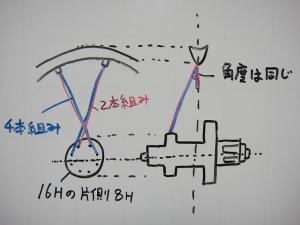
Let me think about a wheel built with a 16H high-low flange rear hub.
Since 16H tangential lacing is 4-cross,
if doing asymmetrical lacing, the non-drive side becomes 4-cross.
When the non-drive side is built 2-cross versus 4-cross,
the angle of the spokes when viewed from the side of the wheel
(how far the angle deviates from radial lacing) differs.
However, the spoke angle when viewed from front to back of the wheel is the same.
Addendum: The "angles are the same" statement is incorrect! That was my mistake!
For the correction, please see (→here)
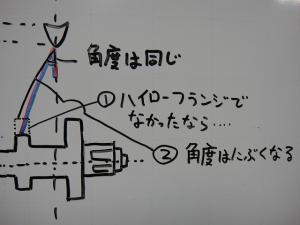
If this hub weren't a high-low flange,
the angle between the spoke and the wheel's centerline would become more obtuse,
and the left-right spoke tension difference would increase.
This angle difference is quite a significant factor in spoke tension imbalance.
Another method to correct the angle (sharpening the non-drive side angle) is using an offset rim.
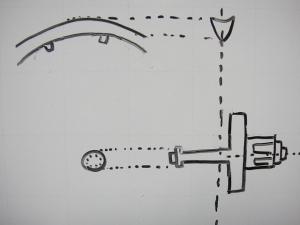
Next, let me consider a case where the non-drive side flange is extremely small.
As a thought experiment taken to an extreme, you could think of the left flange as a "point."
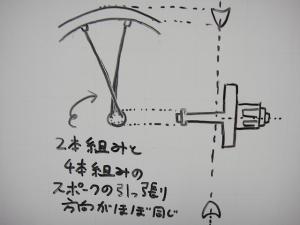
↑The smaller the left flange becomes, the smaller the difference in spoke extension direction
between 4-cross and 2-cross lacing.
What I'm trying to say is: as the left flange diameter gets smaller,
the correction degree achieved by asymmetrical lacing decreases.
So does asymmetrical lacing on a high-low flange hub become pointless? Not at all—
with the flange diameters of actual hubs I use regularly (like the Tuni Evo),
it does make a difference (the tension meter shows clear numerical differences).
However, regarding the magnitude of correction, the high-low flange characteristic of the hub has a
much greater influence.
With a decent high-low flange hub, even when using symmetrical lacing,
you'll notice less left-right spoke tension difference compared to
a left-right equal diameter flange hub with similar flange width.
With a left-right equal diameter flange hub, asymmetrical lacing (like 4-6 lacing on 24H or 4-8 on 32H)
also shows less left-right spoke tension difference.
Now, with a high-low flange hub using asymmetrical lacing,
the correction degree is reduced, but it's not completely pointless—
naturally it shows less left-right tension difference compared to
building the same hub with symmetrical lacing.
To conclude the title question: basically "High-Low Flange > Asymmetrical Lacing."
Dura-Ace rear hubs have a 45mm right flange and 44mm left flange,
so technically they are high-low by 0.5mm in radius.
If you built this with free-side radial lacing like a Ksyrium pattern,
then the asymmetrical lacing effect would probably be larger,
but then the question becomes whether 45mm right/44mm left should really be called a high-low flange.
Many recent hubs have right flange widths under 20mm due to multi-speed cassettes,
but the priorities are:
First: flange width of 55mm or more,
Second: preferably a high-low flange design.
There's a huge gap in importance between first and second,
and it definitely doesn't reverse.
Hub dimensions are a factor the builder cannot control,
while lacing methods and spoke selection are just the builder's workarounds.
I build wheels with what I consider my "Best Workaround,"
but hub selection beforehand is equally important.
I don't list every wheel I've built here,
but I'm amazed at how many hubs are brought to me lately that show
what looks like asketchy understanding of these rules.
Hand-built wheels are getting interesting, aren't they! Quack quack quack (laughing)
are effective at correcting left-right spoke tension differences,
but the actual degree of correction is not the same.
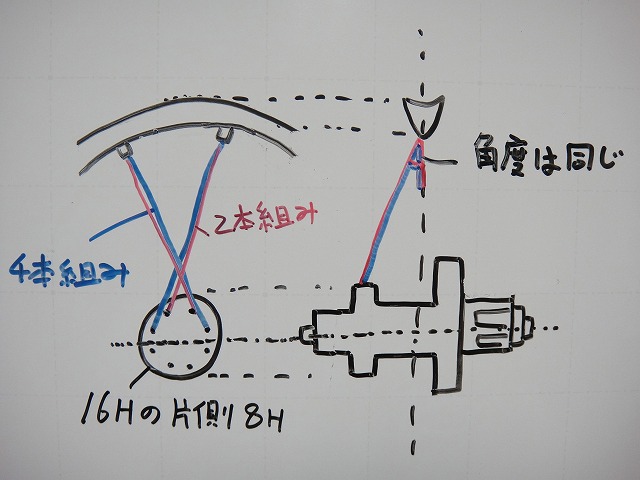
Let me think about a wheel built with a 16H high-low flange rear hub.
Since 16H tangential lacing is 4-cross,
if doing asymmetrical lacing, the non-drive side becomes 4-cross.
When the non-drive side is built 2-cross versus 4-cross,
the angle of the spokes when viewed from the side of the wheel
(how far the angle deviates from radial lacing) differs.
However, the spoke angle when viewed from front to back of the wheel is the same.
Addendum: The "angles are the same" statement is incorrect! That was my mistake!
For the correction, please see (→here)
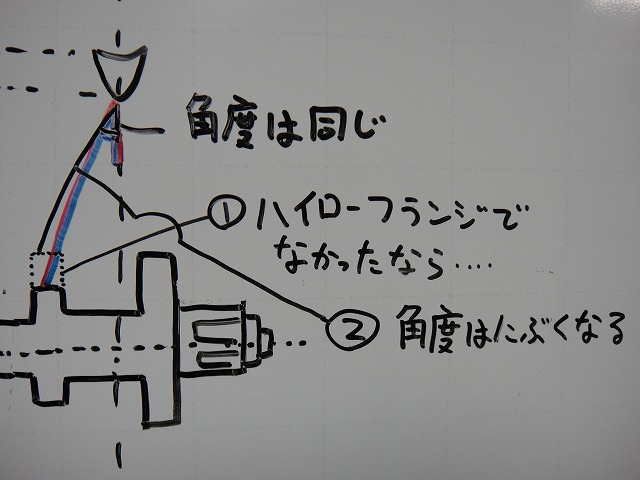
If this hub weren't a high-low flange,
the angle between the spoke and the wheel's centerline would become more obtuse,
and the left-right spoke tension difference would increase.
This angle difference is quite a significant factor in spoke tension imbalance.
Another method to correct the angle (sharpening the non-drive side angle) is using an offset rim.

Next, let me consider a case where the non-drive side flange is extremely small.
As a thought experiment taken to an extreme, you could think of the left flange as a "point."
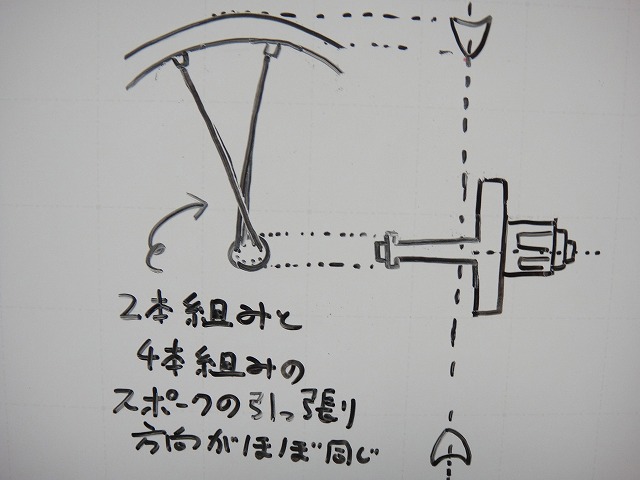
↑The smaller the left flange becomes, the smaller the difference in spoke extension direction
between 4-cross and 2-cross lacing.
What I'm trying to say is: as the left flange diameter gets smaller,
the correction degree achieved by asymmetrical lacing decreases.
So does asymmetrical lacing on a high-low flange hub become pointless? Not at all—
with the flange diameters of actual hubs I use regularly (like the Tuni Evo),
it does make a difference (the tension meter shows clear numerical differences).
However, regarding the magnitude of correction, the high-low flange characteristic of the hub has a
much greater influence.
With a decent high-low flange hub, even when using symmetrical lacing,
you'll notice less left-right spoke tension difference compared to
a left-right equal diameter flange hub with similar flange width.
With a left-right equal diameter flange hub, asymmetrical lacing (like 4-6 lacing on 24H or 4-8 on 32H)
also shows less left-right spoke tension difference.
Now, with a high-low flange hub using asymmetrical lacing,
the correction degree is reduced, but it's not completely pointless—
naturally it shows less left-right tension difference compared to
building the same hub with symmetrical lacing.
To conclude the title question: basically "High-Low Flange > Asymmetrical Lacing."
Dura-Ace rear hubs have a 45mm right flange and 44mm left flange,
so technically they are high-low by 0.5mm in radius.
If you built this with free-side radial lacing like a Ksyrium pattern,
then the asymmetrical lacing effect would probably be larger,
but then the question becomes whether 45mm right/44mm left should really be called a high-low flange.
Many recent hubs have right flange widths under 20mm due to multi-speed cassettes,
but the priorities are:
First: flange width of 55mm or more,
Second: preferably a high-low flange design.
There's a huge gap in importance between first and second,
and it definitely doesn't reverse.
Hub dimensions are a factor the builder cannot control,
while lacing methods and spoke selection are just the builder's workarounds.
I build wheels with what I consider my "Best Workaround,"
but hub selection beforehand is equally important.
I don't list every wheel I've built here,
but I'm amazed at how many hubs are brought to me lately that show
what looks like a
Hand-built wheels are getting interesting, aren't they! Quack quack quack (laughing)