I have something I want to write about regarding wheel left-right balance.
This is also the story of a man who, from constantly hallucinating blue dashed lines, has finally gone mad. Hehehehe.
Before that. In this article, I'll need to frequently write the words "freewheel side" and "non-freewheel side,"
so I'm going to express the freewheel side as "right side" and the non-freewheel side as "left side."
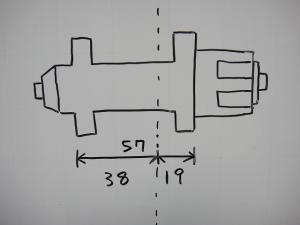
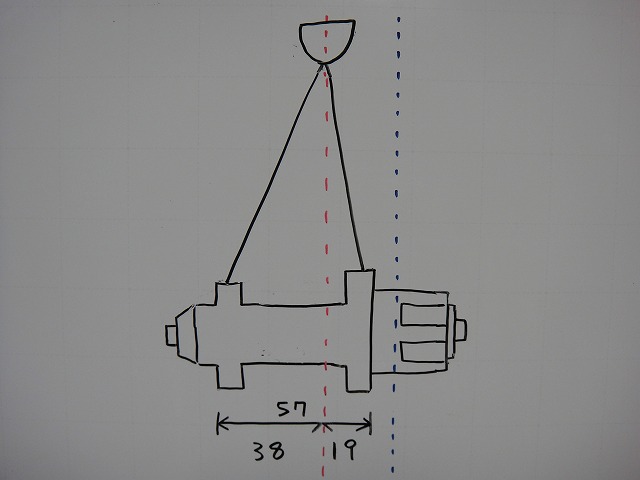
I've drawn a rear hub.
The flange width (end to end) is 57mm,
19mm from the hub center to the right flange edge, and 38mm on the left side.
The hub center is drawn with a black dashed line.
These flange widths are typical of standard hubs.
This is not some arbitrary condition designed to be advantageous for what I'm about to write.
The flange diameter is the same on both left and right.
With this rear hub, it's possible to build a wheel so that
spoke tension is equal on both sides.
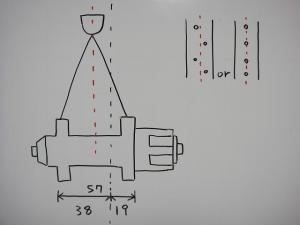
This happens when you build the wheel so the rim center comes at the center of the flange width,
rather than at the center of the hub's full width.
As a prerequisite, you need to have the same number of spokes on both sides.
The rim center is drawn with a red dashed line.
This "rim center" refers to the midpoint between the left and right spoke holes on non-offset rims,
or the center of rims without spoke offset.
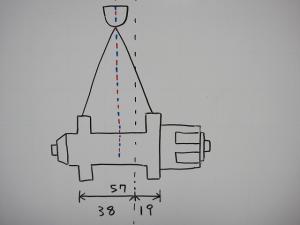
Let me think about the "wheel left-right balance" in this state.
Setting aside the left-right deviation of rim position relative to the entire hub,
from the perspective of the relationship between flange width and rim it's the same as a front wheel,
so there's no deviation in wheel left-right balance.
I'll express the magnitude of spoke tension deviation using the left-right position of the blue dashed line.
In this case, since there's no left-right deviation, the blue dashed line overlaps with the red dashed line.
I made them dashed lines so they can be drawn even when overlapping.
The red dashed line is visible to the eye (since it's the rim position),
but to know the left-right offset precisely, you need a rim center gauge.
The blue dashed line isn't visible to the eye, but by measuring spoke tension with a spoke tension gauge,
you can calculate from the left-right difference where it theoretically is.
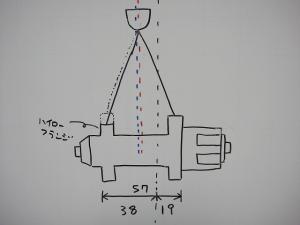
From the previous state, I've made it a high-low flange.
I haven't changed the rim's left-right position.
Since the left flange became smaller, the left side spoke tension increases.
The left-right balance has become skewed.
Regarding the blue dashed line,
I'm defining it as: "shifts sideways toward the side with higher spoke tension, with the magnitude of shift proportional to the amount of deviation."
Going forward, I'll refer to the blue dashed line's deviation as being shifted toward the "higher spoke tension side,"
calling it "right-biased" or "left-biased."
Of course, this has nothing whatsoever to do with political ideology.
In this case the left spoke tension is higher,
so the wheel balance has become left-biased.
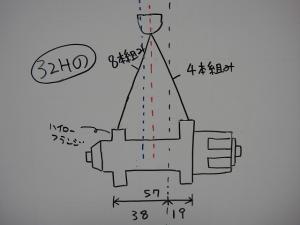
From the previous state, I've further changed it to unequal spoke count left and right.
(Let's say it was a 32H forty-eight cross pattern.)
The blue dashed line shifts further left-biased.
This rear wheel has the red dashed line at the center of the flange width, which
is something that would never happen in reality.
In an actual rear wheel, where is the red dashed line?
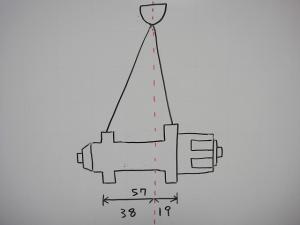
↑Naturally, it becomes the center of the entire hub.
The red dashed line is at the same position as the black dashed line from before.
(Rim center = hub center)
If I were to add the blue dashed line to this typical rear wheel,
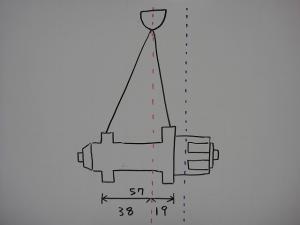
it would be around here.
That said, it's a matter of perception, and exactly where it is may vary depending on how you define it.
What I'm getting at is that it's hopelessly right-biased.
The right bias is of course a side effect of multi-speed cassettes, and the major theme of both factory-built and hand-built wheels is to shift this leftward using various methods.
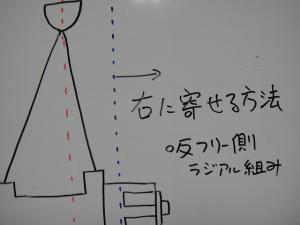
I thought no one would further shift this to the right, but
that's not the case.
If you use tangential spoking on the right side and radial spoking on the left side,
the blue dashed line shifts even further right. Probably because of the idea that
"all-radial spoking on all four directions is the lightest and most aerodynamic,
but we'll use tangential spoking on the rear right side to resist pedaling torque twisting,"
but it seems unlikely that slight spoke weight savings or streamlining benefits
would outweigh the reduction in lateral stiffness enough to make the left hub prone to shutting.
With exceptions to be discussed later, I believe that basically radial spoking on the non-freewheel side is an outdated building method.
Even Shimano wheels, which have three convictions for wide-flange fraud with constantly changing specifications,
have never done unmotivated non-freewheel side radial spoking.
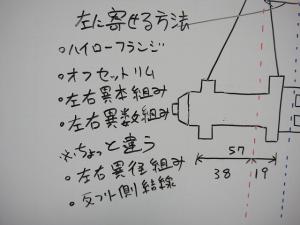
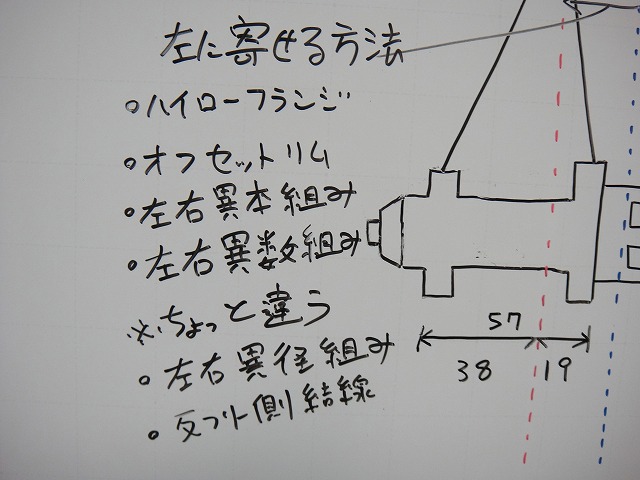
There are many ways to shift it left.
In order as I'm writing them:
High-low flanges shift the wheel center and the included angle between wheel and spokes (hereafter "included angle").
The degree of left-right correction isn't huge, but doing it versus not doing it makes a difference, so it has merit.
Offset rims are a great idea that shift the theoretical red dashed line
by changing the included angle.
What's amazing about this is that it simultaneously makes the right side obtuse and the left side acute,
but the unfortunate part is that (in the case of road bikes) rim width is around 20mm,
so there isn't as much freedom in the amount you can offset as on the hub side.
The left-right correction degree is somewhat large.
Unequal spoke counts involve the ultimate form seen on Kyserium wheels:
"right side radial spoking, left side tangential spoking."
If you go that far the left-right correction degree is large, but
with traditional spooked rims (hand-built) "right side four-cross plus left side six-cross or more"
seems to be the limit when considering spoke breakage and pedaling torque losses.
Tangential spoking on the left side (preferably close-parallel if possible)
drops the left-right correction degree when combined with high-low flanges.
But doing it is much better than not doing it.
Unequal spoke count spoking usually refers to
building a wheel with right 2 : left 1 spoke count ratio.
The left-right correction degree of this is tremendous.
With 2:1 spoking and unequal spoke counts, spoke tension may not equalize left to right.
Equalizing means the blue dashed line overlaps on the red dashed line.
Concretely speaking, when building a rear wheel with 32H hub at right 16H : left 8H
if you do tangential spoking on the left 8H, depending on hub dimensions
spoke tension can actually reverse.
I myself consider 2:1 spoking inherently risky to build with traditional spokes,
and adding tangential spoking on the left side creates even more problems, so
even though I understand it's theoretically best at a certain point, I don't build it.
The "exception to non-freewheel side radial spoking" I mentioned earlier refers to this.
With 2:1 spoking, non-freewheel side radial spoking has fewer drawbacks
(I avoid saying "more benefits" because there are meal tickets in the code)
so in this case only it's OK.
"Slightly different" are unequal flange diameter spoking and
wire connection on the lower spoke tension side (usually the left),
but even though these show differences in spoke tension meter readings
I consider them slightly different from fundamental left-right difference correction.
I can't write about this either because of meal ticket codes.
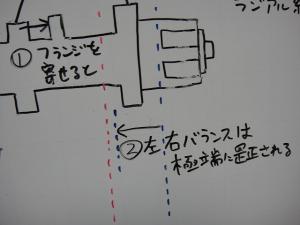
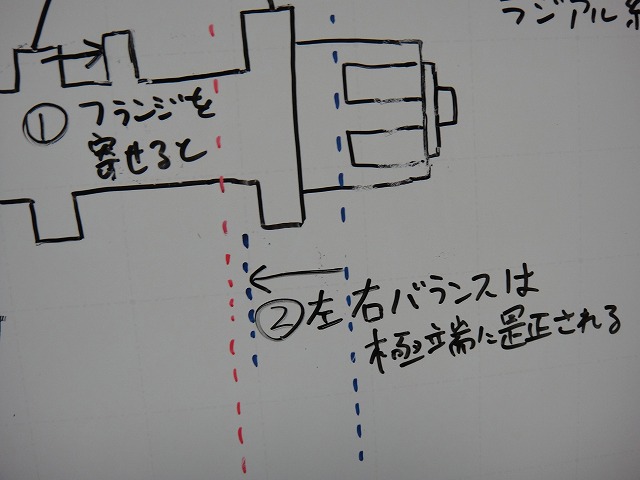
Based on everything I've written so far, right-biased balance seems absolutely bad, but
it would be short-sighted to fixate only on correcting left-right spoke tension difference.
Just as offset rims shift on the rim side, if you move the left hub flange toward center
the left-right balance corrects dramatically.
But narrowing flange width also drops lateral stiffness dramatically.
The lateral stiffness lost this way cannot be recovered through means like increasing spoke tension.
Even increasing flange diameter does almost nothing.
If this were effective, since the front wheel is more aerodynamically important than the rear,
narrow, large-diameter front hubs should exist in the world.
When I write about American Classic hub dimensional shortcomings
I often receive comment pushback, but this is a fact I won't yield on.
Making left-right spoke tension equal has no relation to lateral stiffness improvement.
My W-freehub has flanges about 42mm wide and equal left-right width, so
left-right spoke tension also equalizes, but no matter how I build it I can't gain lateral stiffness.
American Classic hubs have flange width around 50mm
(some models are around 53mm)
which is somewhere between normal hubs and W-freehubs.
I received a comment long ago that I still haven't answered:
"What do you think about Gokiso hubs?" so I'll answer here while I have the chance.
First, regarding Gokiso hubs—I've built with them too—
they have incredibly low-resistance bearing rotation.
In this respect, no one else comes close. It's a different dimension entirely.
True, they're heavy (the standard model rear hub is slightly heavier than a PowerTap PRO),
but since the weight stems from the structure for low-resistance rotation
and it's at the hub's inner section,
I think it's acceptable to sacrifice weight for that rotation performance.
The problem is the narrowness of the rear hub flange width.
Even the one touted as "wide flange" is only about 44mm, so it doesn't gain lateral stiffness.
Update: I received a correction about Gokiso hub flange width.
"It's not 44mm, it's wider" they said, and
for the Shimano 8/9-speed and Shimano 10-speed only hubs it's about 48mm,
but the Shimano 11-speed compatible hubs are about 44mm.
These are both wide-flange road versions, and
for small-wheel narrow-flange that's also Shimano 11-speed compatible, it's about 42mm.
When you grab a stationary rear wheel near the top and shake it left-right,
wheels with hubs that squish more than standard ones (especially on the left side)
—even if dynamically evaluated while riding—rotation performance's goodness cannot help lateral stiffness.
Gokiso claims to be a "engineering group unconstrained by precedent,"
but there's also the saying "learning from the past to understand the present," and
the accumulated precedents resulting in various current hubs arriving at a certain width range
(in other words, conventional dimensions) shouldn't be taken lightly.
Writing "technical directional tone-deafness" would cause a flare-up so I'll refrain.
At this font size it should be ignored
Heavy hubs (= unnoticeable on flat ground) with
narrow flanges (= unnoticeable if you don't stand and pedal) would be
interesting used in the rear hub portion of disc wheels, I think.
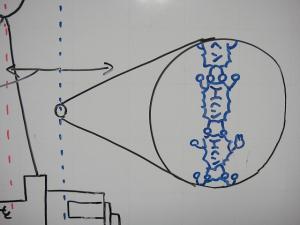
Recently, whether hand-built or factory-built, when I look at wheels
I've started hallucinating the "balance line" blue dashed line specific to each wheel.
With rebuild-capable wheels, I especially pay attention to whether the balance line
is more centered than before the rebuild.
Regarding spoke tension, "just pull tight" isn't the approach, so
I don't fixate on "making it tighter than before the rebuild,"
though it often works out that way from customer requests.
Regarding the hallucination of balance lines, among those who started
"reading wheels" having been influenced by this blog, similar symptoms may appear,
but in my case I see it as shown in the diagram above,
so those who can see the balance line probably shouldn't tell people about it.
When I started writing I didn't expect it to get this long,
but it's become like a general theory of my thoughts on wheels.
This is also the story of a man who, from constantly hallucinating blue dashed lines, has finally gone mad. Hehehehe.
Before that. In this article, I'll need to frequently write the words "freewheel side" and "non-freewheel side,"
so I'm going to express the freewheel side as "right side" and the non-freewheel side as "left side."

I've drawn a rear hub.
The flange width (end to end) is 57mm,
19mm from the hub center to the right flange edge, and 38mm on the left side.
The hub center is drawn with a black dashed line.
These flange widths are typical of standard hubs.
This is not some arbitrary condition designed to be advantageous for what I'm about to write.
The flange diameter is the same on both left and right.
With this rear hub, it's possible to build a wheel so that
spoke tension is equal on both sides.
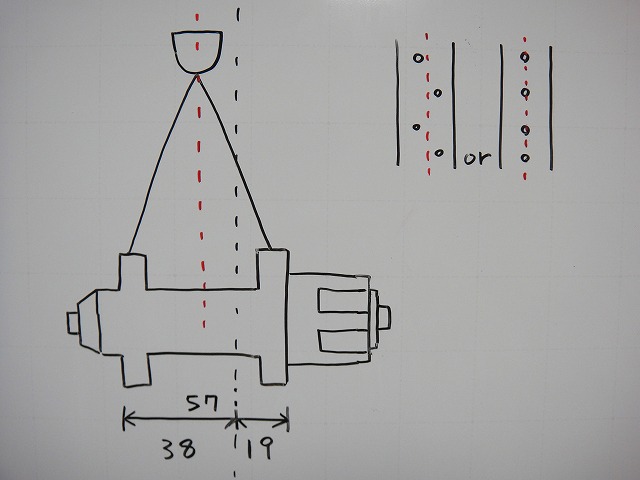
This happens when you build the wheel so the rim center comes at the center of the flange width,
rather than at the center of the hub's full width.
As a prerequisite, you need to have the same number of spokes on both sides.
The rim center is drawn with a red dashed line.
This "rim center" refers to the midpoint between the left and right spoke holes on non-offset rims,
or the center of rims without spoke offset.
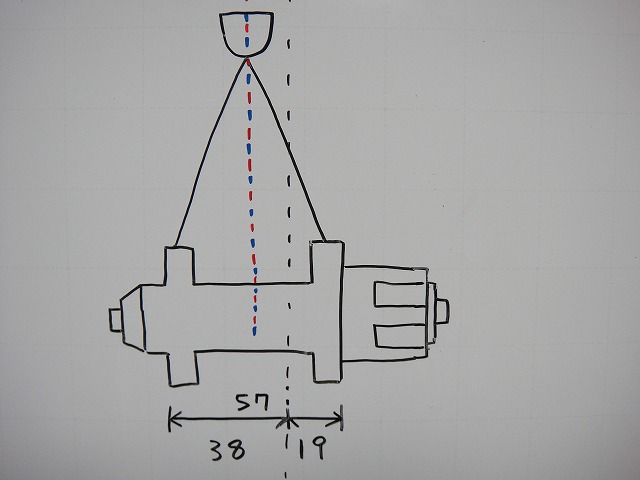
Let me think about the "wheel left-right balance" in this state.
Setting aside the left-right deviation of rim position relative to the entire hub,
from the perspective of the relationship between flange width and rim it's the same as a front wheel,
so there's no deviation in wheel left-right balance.
I'll express the magnitude of spoke tension deviation using the left-right position of the blue dashed line.
In this case, since there's no left-right deviation, the blue dashed line overlaps with the red dashed line.
I made them dashed lines so they can be drawn even when overlapping.
The red dashed line is visible to the eye (since it's the rim position),
but to know the left-right offset precisely, you need a rim center gauge.
The blue dashed line isn't visible to the eye, but by measuring spoke tension with a spoke tension gauge,
you can calculate from the left-right difference where it theoretically is.
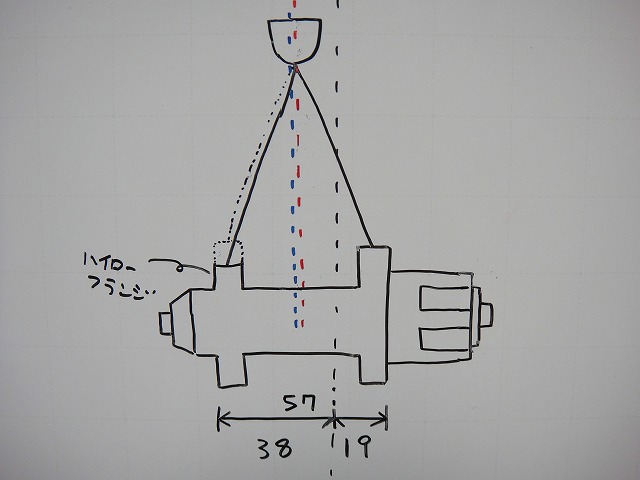
From the previous state, I've made it a high-low flange.
I haven't changed the rim's left-right position.
Since the left flange became smaller, the left side spoke tension increases.
The left-right balance has become skewed.
Regarding the blue dashed line,
I'm defining it as: "shifts sideways toward the side with higher spoke tension, with the magnitude of shift proportional to the amount of deviation."
Going forward, I'll refer to the blue dashed line's deviation as being shifted toward the "higher spoke tension side,"
calling it "right-biased" or "left-biased."
In this case the left spoke tension is higher,
so the wheel balance has become left-biased.
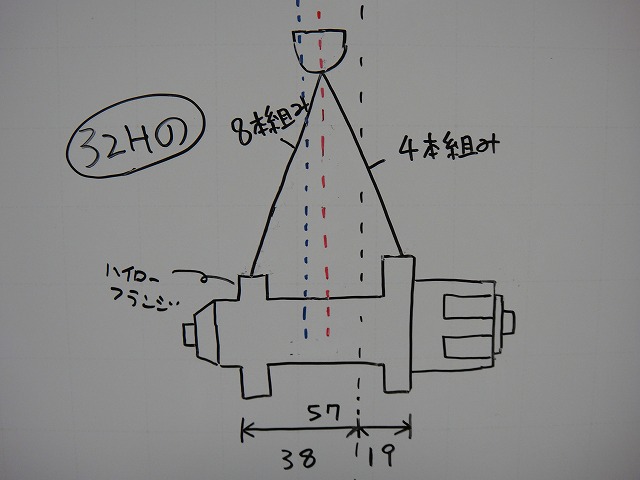
From the previous state, I've further changed it to unequal spoke count left and right.
(Let's say it was a 32H forty-eight cross pattern.)
The blue dashed line shifts further left-biased.
This rear wheel has the red dashed line at the center of the flange width, which
is something that would never happen in reality.
In an actual rear wheel, where is the red dashed line?
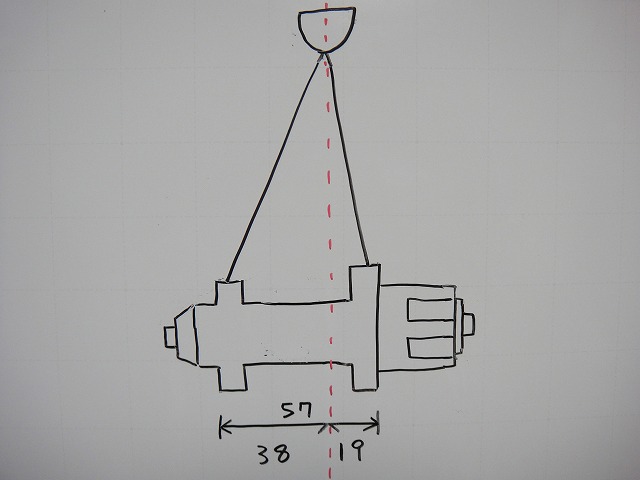
↑Naturally, it becomes the center of the entire hub.
The red dashed line is at the same position as the black dashed line from before.
(Rim center = hub center)
If I were to add the blue dashed line to this typical rear wheel,
it would be around here.
That said, it's a matter of perception, and exactly where it is may vary depending on how you define it.
What I'm getting at is that it's hopelessly right-biased.
The right bias is of course a side effect of multi-speed cassettes, and the major theme of both factory-built and hand-built wheels is to shift this leftward using various methods.

I thought no one would further shift this to the right, but
that's not the case.
If you use tangential spoking on the right side and radial spoking on the left side,
the blue dashed line shifts even further right. Probably because of the idea that
"all-radial spoking on all four directions is the lightest and most aerodynamic,
but we'll use tangential spoking on the rear right side to resist pedaling torque twisting,"
but it seems unlikely that slight spoke weight savings or streamlining benefits
would outweigh the reduction in lateral stiffness enough to make the left hub prone to shutting.
With exceptions to be discussed later, I believe that basically radial spoking on the non-freewheel side is an outdated building method.
Even Shimano wheels, which have three convictions for wide-flange fraud with constantly changing specifications,
have never done unmotivated non-freewheel side radial spoking.
There are many ways to shift it left.
In order as I'm writing them:
High-low flanges shift the wheel center and the included angle between wheel and spokes (hereafter "included angle").
The degree of left-right correction isn't huge, but doing it versus not doing it makes a difference, so it has merit.
Offset rims are a great idea that shift the theoretical red dashed line
by changing the included angle.
What's amazing about this is that it simultaneously makes the right side obtuse and the left side acute,
but the unfortunate part is that (in the case of road bikes) rim width is around 20mm,
so there isn't as much freedom in the amount you can offset as on the hub side.
The left-right correction degree is somewhat large.
Unequal spoke counts involve the ultimate form seen on Kyserium wheels:
"right side radial spoking, left side tangential spoking."
If you go that far the left-right correction degree is large, but
with traditional spooked rims (hand-built) "right side four-cross plus left side six-cross or more"
seems to be the limit when considering spoke breakage and pedaling torque losses.
Tangential spoking on the left side (preferably close-parallel if possible)
drops the left-right correction degree when combined with high-low flanges.
But doing it is much better than not doing it.
Unequal spoke count spoking usually refers to
building a wheel with right 2 : left 1 spoke count ratio.
The left-right correction degree of this is tremendous.
With 2:1 spoking and unequal spoke counts, spoke tension may not equalize left to right.
Equalizing means the blue dashed line overlaps on the red dashed line.
Concretely speaking, when building a rear wheel with 32H hub at right 16H : left 8H
if you do tangential spoking on the left 8H, depending on hub dimensions
spoke tension can actually reverse.
I myself consider 2:1 spoking inherently risky to build with traditional spokes,
and adding tangential spoking on the left side creates even more problems, so
even though I understand it's theoretically best at a certain point, I don't build it.
The "exception to non-freewheel side radial spoking" I mentioned earlier refers to this.
With 2:1 spoking, non-freewheel side radial spoking has fewer drawbacks
(I avoid saying "more benefits" because there are meal tickets in the code)
so in this case only it's OK.
"Slightly different" are unequal flange diameter spoking and
wire connection on the lower spoke tension side (usually the left),
but even though these show differences in spoke tension meter readings
I consider them slightly different from fundamental left-right difference correction.
I can't write about this either because of meal ticket codes.
Based on everything I've written so far, right-biased balance seems absolutely bad, but
it would be short-sighted to fixate only on correcting left-right spoke tension difference.
Just as offset rims shift on the rim side, if you move the left hub flange toward center
the left-right balance corrects dramatically.
But narrowing flange width also drops lateral stiffness dramatically.
The lateral stiffness lost this way cannot be recovered through means like increasing spoke tension.
Even increasing flange diameter does almost nothing.
If this were effective, since the front wheel is more aerodynamically important than the rear,
narrow, large-diameter front hubs should exist in the world.
When I write about American Classic hub dimensional shortcomings
I often receive comment pushback, but this is a fact I won't yield on.
Making left-right spoke tension equal has no relation to lateral stiffness improvement.
My W-freehub has flanges about 42mm wide and equal left-right width, so
left-right spoke tension also equalizes, but no matter how I build it I can't gain lateral stiffness.
American Classic hubs have flange width around 50mm
(some models are around 53mm)
which is somewhere between normal hubs and W-freehubs.
I received a comment long ago that I still haven't answered:
"What do you think about Gokiso hubs?" so I'll answer here while I have the chance.
First, regarding Gokiso hubs—I've built with them too—
they have incredibly low-resistance bearing rotation.
In this respect, no one else comes close. It's a different dimension entirely.
True, they're heavy (the standard model rear hub is slightly heavier than a PowerTap PRO),
but since the weight stems from the structure for low-resistance rotation
and it's at the hub's inner section,
I think it's acceptable to sacrifice weight for that rotation performance.
The problem is the narrowness of the rear hub flange width.
Even the one touted as "wide flange" is only about 44mm, so it doesn't gain lateral stiffness.
Update: I received a correction about Gokiso hub flange width.
"It's not 44mm, it's wider" they said, and
for the Shimano 8/9-speed and Shimano 10-speed only hubs it's about 48mm,
but the Shimano 11-speed compatible hubs are about 44mm.
These are both wide-flange road versions, and
for small-wheel narrow-flange that's also Shimano 11-speed compatible, it's about 42mm.
When you grab a stationary rear wheel near the top and shake it left-right,
wheels with hubs that squish more than standard ones (especially on the left side)
—even if dynamically evaluated while riding—rotation performance's goodness cannot help lateral stiffness.
Gokiso claims to be a "engineering group unconstrained by precedent,"
but there's also the saying "learning from the past to understand the present," and
the accumulated precedents resulting in various current hubs arriving at a certain width range
(in other words, conventional dimensions) shouldn't be taken lightly.
Writing "technical directional tone-deafness" would cause a flare-up so I'll refrain.
At this font size it should be ignored
Heavy hubs (= unnoticeable on flat ground) with
narrow flanges (= unnoticeable if you don't stand and pedal) would be
interesting used in the rear hub portion of disc wheels, I think.

Recently, whether hand-built or factory-built, when I look at wheels
I've started hallucinating the "balance line" blue dashed line specific to each wheel.
With rebuild-capable wheels, I especially pay attention to whether the balance line
is more centered than before the rebuild.
Regarding spoke tension, "just pull tight" isn't the approach, so
I don't fixate on "making it tighter than before the rebuild,"
though it often works out that way from customer requests.
Regarding the hallucination of balance lines, among those who started
"reading wheels" having been influenced by this blog, similar symptoms may appear,
but in my case I see it as shown in the diagram above,
so those who can see the balance line probably shouldn't tell people about it.
When I started writing I didn't expect it to get this long,
but it's become like a general theory of my thoughts on wheels.