I kind of expected to get a comment like this, but
regarding the Gokiso hub that I mentioned in a recent post,
I received this comment:
"If the rim itself has extremely high rigidity like an ENVE deep rim,
the bracing angle is easy to secure, spoke tension can be raised sufficiently,
and the spokes are something like CX-RAY that can withstand high tension,
then even with a narrow flange width Gokiso hub,
I think you could build a wheel with sufficient lateral rigidity. What do you think?"
As I've mentioned many times on this blog,
the "lateral rigidity loss due to narrow flange width"
cannot be resolved by simply cranking up spoke tension or
using a stiff rim. Those kinds of conditions aren't nearly enough.
Even with ENVE rims, the maximum spoke tension is around 130-140 kgf at best,
which is high for carbon rims but not much different from aluminum rim limits.
If you were to build a wheel with a Dura-Ace hub using an ENVE rim and CX-RAY spokes, tightened properly,
it would definitely have higher lateral rigidity than a Gokiso hub wheel.
In that case, the only way the Dura-Ace hub would be inferior to the Gokiso is in hub rotational performance,
and all other wheel elements would be superior with Dura-Ace.
But no matter how much you tune a Dura-Ace hub, you won't match the smooth rotation of a Gokiso hub. That's a fact.
When you weigh that "rotational performance" against the structurally-coupled heavy hub weight,
and the lateral rigidity loss that likely isn't structurally necessary for rotational performance due to the narrow flanges,
if you think "I don't care if the hub is heavy or lacks lateral rigidity for this rotational performance,"
and you're willing to pay over 200,000 yen for it, then yes, it's a good hub.
Another painful point with Gokiso hubs is the "terrible asymmetry."
The right flange width on Shimano 9-speed OEM hubs varies by model,
but is generally around 21.1mm to 20.8mm.
The 9000 Dura-Ace is 18.7mm for multi-speed compatibility.
From my wheel-building experience, when the right flange width drops below 20mm,
I strongly feel that "the asymmetry is terrible and the left side spoke tension becomes slack."
The current Campagnolo Record hub (right flange width just under 19mm)
hasn't changed dimensionally since 2002, but
when it first came out I thought "man, the asymmetry is bad. The left spokes are slack,"
but ultimately that freebody went on to support 11-speed,
and now basically every manufacturer's 11-speed hub has a right flange width under 20mm,
so the times have caught up with Campa (though they shouldn't have),
and now I don't feel that "only the Record hub has terrible asymmetry."
That 1mm or 2mm difference in flange width is an absolutely massive number.
For example, with a 24H rear hub (depending on left flange width too),
the difference between "4x4 lacing with 21mm right flange width"
and "4x6 lacing with 19mm right flange width"
shows almost no difference in left spoke tension.
The asymmetric lacing method I call "mixed spoke count" for building also
corrects wheel balance to about the same degree as recovering 2mm of right flange offset.
(Though doing it versus not doing it makes a huge difference.)
As for the Gokiso hub's asymmetry—with a flange width of approximately 44mm,
it has an abnormal right flange width of just 16.5mm.
If you build this with symmetric lacing, the left spoke tension won't rise much compared to the right,
making it a wheel prone to brake rub on the left side.
If you use anti-freewheel side radial lacing, it would be even worse.
I've never seen a 16.5mm number elsewhere,
so combined with the approximately 44mm flange width, it might be
"the world's easiest rear hub to cause brake rub on the left side."
I repeat: this is a problem that cannot be solved by
"raising spoke tension!" or "using a stiff rim!"
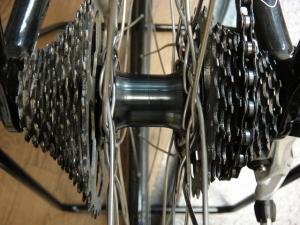
My W-freehub has a flange width of about 42mm,
and it's 21mm right and 21mm left, so there's no asymmetry.
So even though it's 2mm narrower in flange width than Gokiso,
I think it's actually better in terms of brake rub resistance.

The rim is an XR300 aluminum rim, and I think its resistance to twisting
is actually better than ENVE's 1-45.
When building wheels, we do a "breaking-in" process where we lay the wheel on its side and press down on the rim section toward the floor.
At the same spoke tension, from my experience,
the XR300 shows less deflection.
ENVE rims are very stiff for carbon, but
compared to aluminum rims like this, they fall short.
The spokes are 2.0mm plain gauge, which are
far more resistant to lateral deformation than CX-RAY.
I've built them as stiff as I possibly can with desperate measures,
but I just can't generate lateral rigidity.
On my own bike, I set the brake lever throw on the larger side,
so the gap between brake shoe and rim is wide,
which is why I don't get brake rub,
but if I tighten that gap (within normal range of adjustment),
I've confirmed that brake rub would occur.
In addition to "raised spoke tension!" and
"used a stiff rim!",
I also added "used thicker spokes!" and
"used a ridiculous lacing method!" but it still didn't work.
Looking purely at the structure without bias,
"the Gokiso hub is this W-freehub design with added asymmetry
and further worsened dimensional conditions as a rear hub."
Rotational performance is probably the best in the world though.
Also, in the comments I received this point:
"However, even if the actual finished wheel lacks lateral rigidity,
if the rim itself has more than sufficient lateral rigidity,
the demerits might be hard to perceive, don't you think?"
But that's just not true.
If the finished wheel's lateral rigidity is low,
it will feel laterally stiff when actually riding.
The rim's stiffness is irrelevant.
The reason is what I wrote earlier.
I'm saying the same thing again, but
I don't think the narrow flange width is a structurally necessary condition for the Gokiso hub's smooth rotation,
so if you could just fix the flange width, it could become a completely different hub.
(If it were structurally necessary, then it can't be helped.)
There's a limit, but hub weight doesn't affect ride feel that much.
This "limit" becomes immediately critical when hillclimbing is the goal,
completely separate from ride feel.
Regardless of whether you have engineering knowledge and skills or not,
if you have practical experience with bicycle components,
I don't think you'd ever make a hub with these dimensions.
They talk about "manufacturing free from precedent," but
it seems like narrow-minded fixation on rotational performance alone.
regarding the Gokiso hub that I mentioned in a recent post,
I received this comment:
"If the rim itself has extremely high rigidity like an ENVE deep rim,
the bracing angle is easy to secure, spoke tension can be raised sufficiently,
and the spokes are something like CX-RAY that can withstand high tension,
then even with a narrow flange width Gokiso hub,
I think you could build a wheel with sufficient lateral rigidity. What do you think?"
As I've mentioned many times on this blog,
the "lateral rigidity loss due to narrow flange width"
cannot be resolved by simply cranking up spoke tension or
using a stiff rim. Those kinds of conditions aren't nearly enough.
Even with ENVE rims, the maximum spoke tension is around 130-140 kgf at best,
which is high for carbon rims but not much different from aluminum rim limits.
If you were to build a wheel with a Dura-Ace hub using an ENVE rim and CX-RAY spokes, tightened properly,
it would definitely have higher lateral rigidity than a Gokiso hub wheel.
In that case, the only way the Dura-Ace hub would be inferior to the Gokiso is in hub rotational performance,
and all other wheel elements would be superior with Dura-Ace.
But no matter how much you tune a Dura-Ace hub, you won't match the smooth rotation of a Gokiso hub. That's a fact.
When you weigh that "rotational performance" against the structurally-coupled heavy hub weight,
and the lateral rigidity loss that likely isn't structurally necessary for rotational performance due to the narrow flanges,
if you think "I don't care if the hub is heavy or lacks lateral rigidity for this rotational performance,"
and you're willing to pay over 200,000 yen for it, then yes, it's a good hub.
Another painful point with Gokiso hubs is the "terrible asymmetry."
The right flange width on Shimano 9-speed OEM hubs varies by model,
but is generally around 21.1mm to 20.8mm.
The 9000 Dura-Ace is 18.7mm for multi-speed compatibility.
From my wheel-building experience, when the right flange width drops below 20mm,
I strongly feel that "the asymmetry is terrible and the left side spoke tension becomes slack."
The current Campagnolo Record hub (right flange width just under 19mm)
hasn't changed dimensionally since 2002, but
when it first came out I thought "man, the asymmetry is bad. The left spokes are slack,"
but ultimately that freebody went on to support 11-speed,
and now basically every manufacturer's 11-speed hub has a right flange width under 20mm,
so the times have caught up with Campa (though they shouldn't have),
and now I don't feel that "only the Record hub has terrible asymmetry."
That 1mm or 2mm difference in flange width is an absolutely massive number.
For example, with a 24H rear hub (depending on left flange width too),
the difference between "4x4 lacing with 21mm right flange width"
and "4x6 lacing with 19mm right flange width"
shows almost no difference in left spoke tension.
The asymmetric lacing method I call "mixed spoke count" for building also
corrects wheel balance to about the same degree as recovering 2mm of right flange offset.
(Though doing it versus not doing it makes a huge difference.)
As for the Gokiso hub's asymmetry—with a flange width of approximately 44mm,
it has an abnormal right flange width of just 16.5mm.
If you build this with symmetric lacing, the left spoke tension won't rise much compared to the right,
making it a wheel prone to brake rub on the left side.
If you use anti-freewheel side radial lacing, it would be even worse.
I've never seen a 16.5mm number elsewhere,
so combined with the approximately 44mm flange width, it might be
"the world's easiest rear hub to cause brake rub on the left side."
I repeat: this is a problem that cannot be solved by
"raising spoke tension!" or "using a stiff rim!"

My W-freehub has a flange width of about 42mm,
and it's 21mm right and 21mm left, so there's no asymmetry.
So even though it's 2mm narrower in flange width than Gokiso,
I think it's actually better in terms of brake rub resistance.
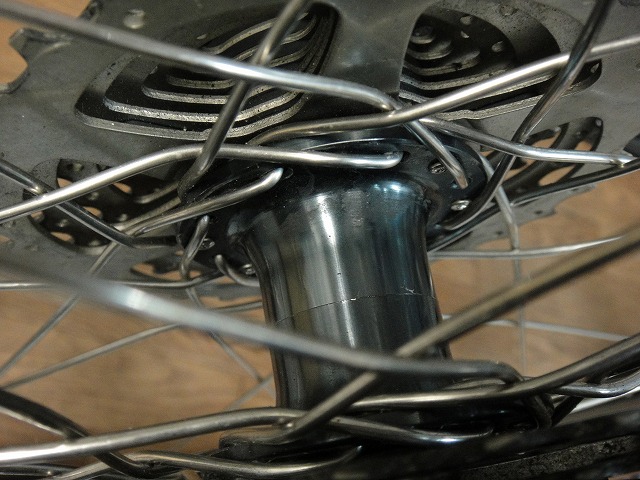
The rim is an XR300 aluminum rim, and I think its resistance to twisting
is actually better than ENVE's 1-45.
When building wheels, we do a "breaking-in" process where we lay the wheel on its side and press down on the rim section toward the floor.
At the same spoke tension, from my experience,
the XR300 shows less deflection.
ENVE rims are very stiff for carbon, but
compared to aluminum rims like this, they fall short.
The spokes are 2.0mm plain gauge, which are
far more resistant to lateral deformation than CX-RAY.
I've built them as stiff as I possibly can with desperate measures,
but I just can't generate lateral rigidity.
On my own bike, I set the brake lever throw on the larger side,
so the gap between brake shoe and rim is wide,
which is why I don't get brake rub,
but if I tighten that gap (within normal range of adjustment),
I've confirmed that brake rub would occur.
In addition to "raised spoke tension!" and
"used a stiff rim!",
I also added "used thicker spokes!" and
"used a ridiculous lacing method!" but it still didn't work.
Looking purely at the structure without bias,
"the Gokiso hub is this W-freehub design with added asymmetry
and further worsened dimensional conditions as a rear hub."
Rotational performance is probably the best in the world though.
Also, in the comments I received this point:
"However, even if the actual finished wheel lacks lateral rigidity,
if the rim itself has more than sufficient lateral rigidity,
the demerits might be hard to perceive, don't you think?"
But that's just not true.
If the finished wheel's lateral rigidity is low,
it will feel laterally stiff when actually riding.
The rim's stiffness is irrelevant.
The reason is what I wrote earlier.
I'm saying the same thing again, but
I don't think the narrow flange width is a structurally necessary condition for the Gokiso hub's smooth rotation,
so if you could just fix the flange width, it could become a completely different hub.
(If it were structurally necessary, then it can't be helped.)
There's a limit, but hub weight doesn't affect ride feel that much.
This "limit" becomes immediately critical when hillclimbing is the goal,
completely separate from ride feel.
Regardless of whether you have engineering knowledge and skills or not,
if you have practical experience with bicycle components,
I don't think you'd ever make a hub with these dimensions.
They talk about "manufacturing free from precedent," but
it seems like narrow-minded fixation on rotational performance alone.