For more than a month now, I haven't been able to give proper replies to comments, emails, inquiries, or orders.
I've been sending back responses little by little every Wednesday (my regular day off)
but I'm nowhere near caught up.
For comments that are quick to answer,
I sometimes reply right away,
but I have quite a backlog of questions and other comments too.
I will get back to everyone eventually, so please bear with me for a while.
"I understand the logic that the GOKISO hub's right flange is too narrow and no good.
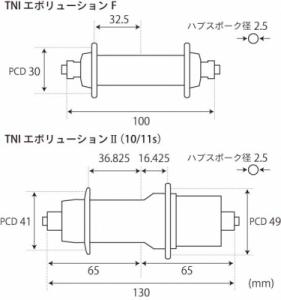
But looking at the Tni Evo Hub II on the Tri-Sports website,
the right flange width appears to be similarly narrow—is that okay?
Or am I reading the diagram wrong?"
That's the comment I received.
You're reading it correctly.
The issue is that the definition of "flange width" in the diagram above is non-standard.
For most manufacturers that publish hub dimensions,
"flange width" means
"from the outside of one flange to the outside of the other flange."
Shimano, for example, also uses outside-to-outside.
The spoke length derived from outside-to-outside measurement is actually "inpoke length."
With tangent lacing, you alternate inpokes and outpokes through the flange holes,
and the typical radial lacing method for conventional bent-head spokes is all outpokes—
but all of these are actually built using inpoke length.
At this scale, the spoke thread length absorbs the difference,
so there's no practical problem.
In the diagram above, "the left-right flange width as stated in this diagram"
is 16.425mm + 36.825mm = 53.25mm,
but this uses a very unusual measurement method: "from the center of one flange to the center of the other."
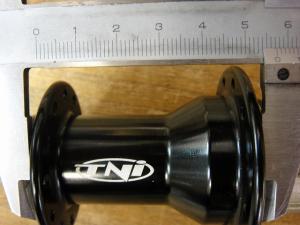
Measuring outside-to-outside, it's about 57.7mm.
When I say "flange width" on this blog, that's what I mean—this width.

Just to verify, I held calipers set to 53.25mm against it.
That's the flange center-to-center length.
If you calculate spoke length trusting manufacturer specs for both hubs and rims,
sometimes you end up in real trouble.
Looking at the Evo Hub II in the diagram above, the over-locknut dimension is listed as
65mm + 65mm = 130mm,
but in reality it's all about 130.5mm.
At Tni, there's also the AERO80 rim (the rim for Nomu Lab Wheel #3)—
its ERD (effective rim diameter/spoke support length) is listed as 506mm,
but that's wrong too. It's completely different from the actual measured value.
I tried calculating it as a correction factor accounting for internal nipples, but that doesn't match either.
In the end, you have to measure it yourself.
For the ROAD38 (rim for Nomu Lab Wheel #2) and ROAD50 (rim for Wheel #2.5),
the spoke length correction value from the internal nipples is the same,
but it's different from the AERO80 correction value.
Anyway, getting back to the point: the Tni Evo Hub II's right flange width
(from the hub's center to the outside of the right flange) is in the high 18mm range.
That's standard for an 11-speed hub.
If the outside measurement came out in the 16mm range, the drive-side spoke tension would max out immediately
while the non-drive side stays slack—an unbalanced wheel.
With some careful thought about the lacing method, you can improve it somewhat, but that's it.
I've been sending back responses little by little every Wednesday (my regular day off)
but I'm nowhere near caught up.
For comments that are quick to answer,
I sometimes reply right away,
but I have quite a backlog of questions and other comments too.
I will get back to everyone eventually, so please bear with me for a while.
"I understand the logic that the GOKISO hub's right flange is too narrow and no good.
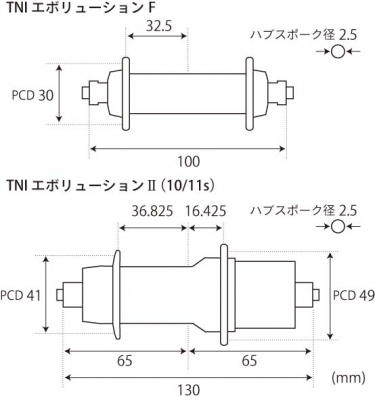
But looking at the Tni Evo Hub II on the Tri-Sports website,
the right flange width appears to be similarly narrow—is that okay?
Or am I reading the diagram wrong?"
That's the comment I received.
You're reading it correctly.
The issue is that the definition of "flange width" in the diagram above is non-standard.
For most manufacturers that publish hub dimensions,
"flange width" means
"from the outside of one flange to the outside of the other flange."
Shimano, for example, also uses outside-to-outside.
The spoke length derived from outside-to-outside measurement is actually "inpoke length."
With tangent lacing, you alternate inpokes and outpokes through the flange holes,
and the typical radial lacing method for conventional bent-head spokes is all outpokes—
but all of these are actually built using inpoke length.
At this scale, the spoke thread length absorbs the difference,
so there's no practical problem.
In the diagram above, "the left-right flange width as stated in this diagram"
is 16.425mm + 36.825mm = 53.25mm,
but this uses a very unusual measurement method: "from the center of one flange to the center of the other."
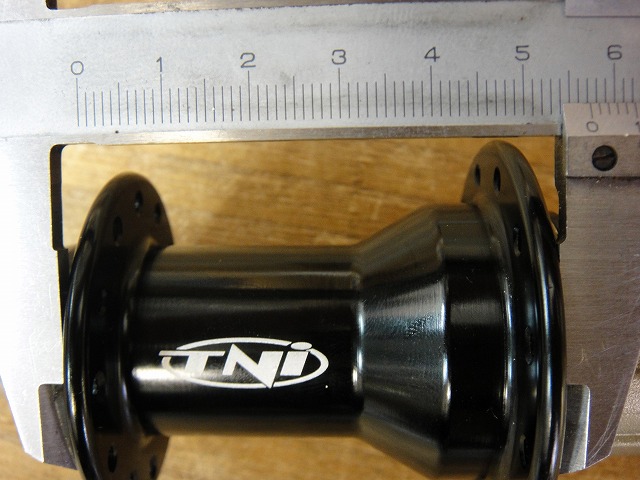
Measuring outside-to-outside, it's about 57.7mm.
When I say "flange width" on this blog, that's what I mean—this width.
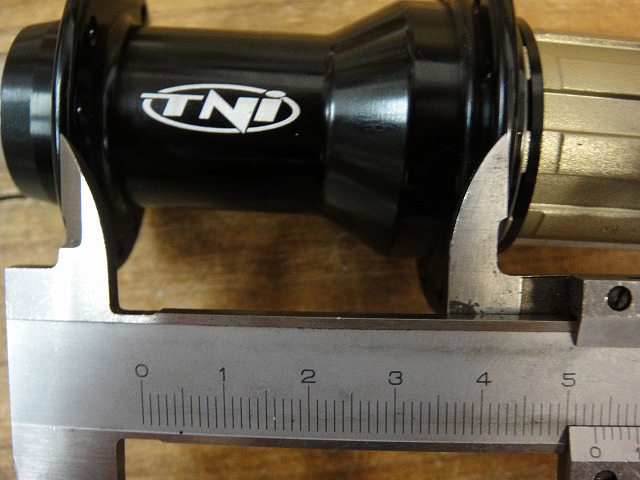
Just to verify, I held calipers set to 53.25mm against it.
That's the flange center-to-center length.
If you calculate spoke length trusting manufacturer specs for both hubs and rims,
sometimes you end up in real trouble.
Looking at the Evo Hub II in the diagram above, the over-locknut dimension is listed as
65mm + 65mm = 130mm,
but in reality it's all about 130.5mm.
At Tni, there's also the AERO80 rim (the rim for Nomu Lab Wheel #3)—
its ERD (effective rim diameter/spoke support length) is listed as 506mm,
but that's wrong too. It's completely different from the actual measured value.
I tried calculating it as a correction factor accounting for internal nipples, but that doesn't match either.
In the end, you have to measure it yourself.
For the ROAD38 (rim for Nomu Lab Wheel #2) and ROAD50 (rim for Wheel #2.5),
the spoke length correction value from the internal nipples is the same,
but it's different from the AERO80 correction value.
Anyway, getting back to the point: the Tni Evo Hub II's right flange width
(from the hub's center to the outside of the right flange) is in the high 18mm range.
That's standard for an 11-speed hub.
If the outside measurement came out in the 16mm range, the drive-side spoke tension would max out immediately
while the non-drive side stays slack—an unbalanced wheel.
With some careful thought about the lacing method, you can improve it somewhat, but that's it.