This is a supplement to my previous post.
I'm going to write about why the SLR1 from the previous article
couldn't be tensioned excessively
and why the additional tensioning for true adjustment
didn't translate well into rim inboard movement.
But first.
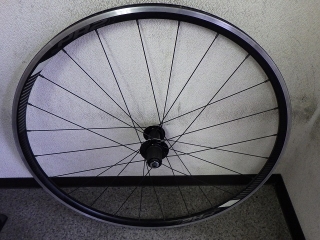
↑This is a budget complete wheelset from GIANT
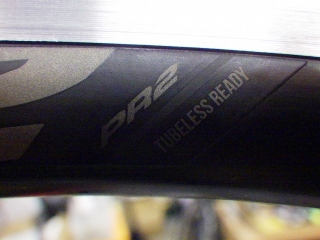
the PR2 model.
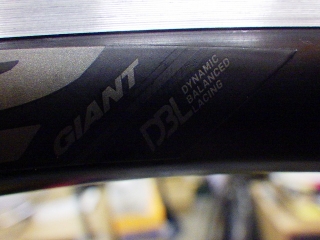
This also adopts GIANT's proprietary Dynamic Balanced Lacing,
or DBL.
Regarding DBL, the manufacturer's site quotes verbatim:
"DBL optimizes spoke tension during pedaling,
improving durability and pedaling efficiency."
Essentially, the idea is that when the wheel deforms during pedal input,
only spokes in the pulling direction transmit drive force to the rim,
so on one side of the hub flange—especially the freewheel side—
you introduce high-low flanges or different-diameter lacing.
There's DBL from hub construction and DBL from spoke gauge,
but this PR2 uses only hub DBL.
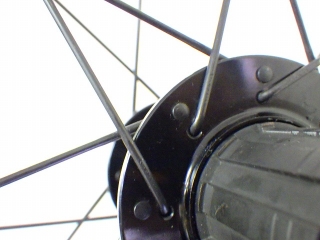
Reverse Italian lacing aside
Two flange holes for J-bend spokes are arranged radially in line,
and pulling-direction spokes are threaded through the holes on the large flange side.
According to GIANT's thinking, this supposedly improves engagement compared to
a standard hub with only large flange holes under the same conditions.
By the way, this is a rim brake model,
2:1 laced, but the non-freewheel side uses
tangent rather than radial lacing.
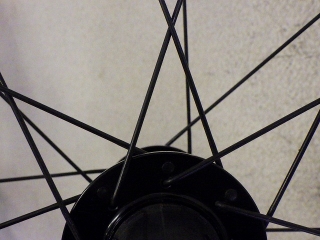
When the bisector of the final crossing angle is extended inward,
it doesn't pass through the hub center.
This wheel doesn't vary spoke gauge on one side flange,
but when you mix large and small flanges on one side like this,
spoke deformation rather than tension becomes different
depending on the spoke from each flange diameter.
When this becomes extreme, spoke loosening can occur on the side with larger deformation.
But as long as one flange side is laced with uniform-gauge spokes,
even if that flange side is high-low, you won't notice it in practice
and problems rarely arise.
When building a wheel with very low initial tension,
the difference in deformation between large and small flange spokes is pronounced,
but once it's tensioned appropriately, you stop noticing it.
A single-flange high-low example that's radially laced:
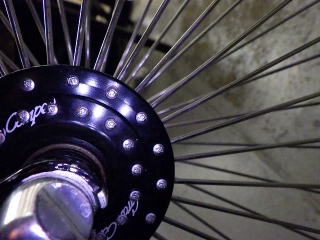
would be my lab wheel 1, the 3-3-7—essentially a personal one-off.
3-3-7 comes from factoring 63; a 32H rim's inner holes doubled would be 64H,
but rim holes can't align with the valve hole phase from 32H,
so it's 64-1 = 63H.
Strictly measured, the small flange side spokes have lower tension,
but not so much that only the small flange side loosens.

↑This is the front wheel of a Shimano WH-7701:

"Looking at the flange nearest me, it's a 4-repeat final crossing
where pulling-direction spokes emerge from the large flange side
in a single-flange high-low."
The position relationship in parentheses doesn't change even when the wheel is flipped,
unlike JIS lacing.
When a single-flange high-low has two final crossing spokes
emerging from large and small flanges respectively,
pulling-direction spokes emerging from the large flange side
is consistent across all manufacturers.
Quoting from an older post:
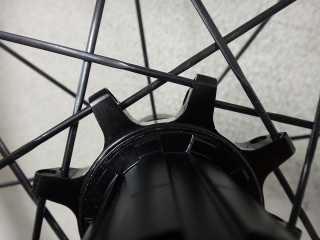
This is the rear wheel of a Deda complete wheelset.
The two final crossing spokes emerge from large and small flanges respectively,
and pulling-direction spokes emerge from the large flange side.
This is 2:1 laced, 24H, so freewheel side 16H,
8 flange holes, but this spoke pattern would work even on a 2:1 21H
with an odd number of 7 flange holes.
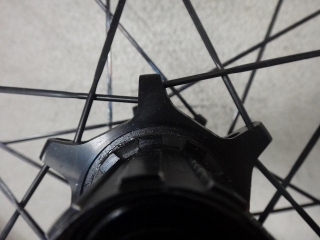
This is the rear wheel of a Zipp complete wheelset.
The flanges from which the two final crossing spokes emerge
alternate between large-large and small-small pairs.
This is 24H equal-sided, 12H per side,
6 flange holes, and this spoke pattern requires an even number of flanges.
This rear wheel alternates between low and high spoke tension
at final crossings, but it rides normally without feeling
rough or loose.
So what's the takeaway here?
A hub-side high-low flange creates spoke tension differences
in theory or under strict measurement,
but not perceptibly—so it's not a real problem.
Therefore, hub DBL is just cosmetic with no practical downside.
I used the term "practical downside" because
spoke DBL actually has real downsides.
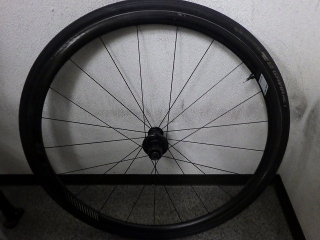
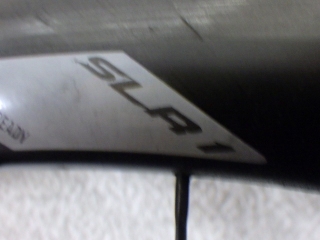
↑Here's the SLR1 from the previous article.
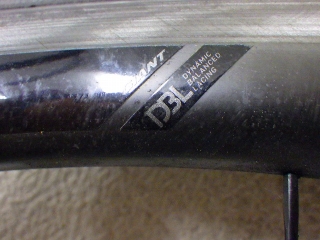
"D[where] B[some] L[idiot thought up this] Lacing"
—that's DBL on the rim.
As I mentioned, GIANT claims better pedaling efficiency and sprint response,
but without overgeneralizing, at least this owner finds it underwhelming.
Though comparing it to real stuff like Bora is probably unfair.
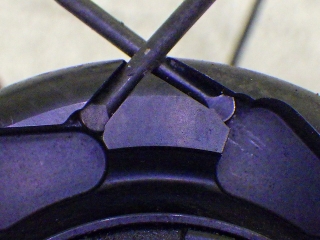
The hub side has a very slight DBL-style
single-side high-low flange.
Compared to Deda and Zipp, which probably have single-side high-low
without consciously thinking of it as DBL,
this level of high-low is practically indistinguishable from a standard hub.

At the root of the final crossing, it looks like this.

Now, the problem with this wheel:
spoke DBL—using different-diameter lacing on one flange side.
The images clearly show the final crossing spokes have different diameters.
I've built extreme single-side different-diameter rear wheels with Champion/Revolution,
but with Italian lacing's outpoke on both sides pulling-direction—
Revolution showed much greater deformation than Champion,
true adjustment became impossible, and Revolution loosened.
I wrote earlier that DBL was thought up by an idiot,
and that's it—coming up with ideas is fine, prototyping is fine,
but calling it a sellable product? That's questionable.
Different-diameter single-side lacing—I thought of it before GIANT,
but I'm not claiming credit; anyone would think of it.
If this spoke pattern truly had no problems and mostly benefits,
every wheelset in the world would be built this way by now.
The real issue with this wheel isn't just different-diameter single-side lacing
but the spoke gauge itself.
This SLR1 uses 2:1 lacing, non-freewheel radial:
freewheel pulling-direction spokes and non-freewheel spokes are black Campagnolo straight butted
2.0-1.8-2.0mm,
freewheel non-pulling spokes are black Revolution straight butted
2.0-1.5-2.0mm—both round butted.
The freewheel Revolution might be 2.0-1.6-2.0mm Campagnolo Race,
but my caliper measurement showed 1.5mm in the butted section.
On GIANT Japan's site, the past product overview page exists,
but clicking thumbnails for specific models like wheels gives 404s,
making past model specs hard to research.
Whether that's intentional, I won't speculate.
I recall a DBL wheel using round spokes where the freewheel side matches this SLR1
and the non-freewheel is black Champion 14 plain,
with all three spoke directions different,
but I couldn't verify it.
The problem is that ~65% round spokes are mixed in at this spoke weight ratio.
What I prioritize most about CX-RAY isn't aero but work hardening—
at ~65% spoke weight it won't yield or uniplex at ~100kgf,
something I've written many times.
So when I said it couldn't be tensioned excessively and was hard to true—
Revolution, being round butted at ~65% spoke weight, causes uniplex,
especially the two Revolution spokes near the true problem area
were already showing uniplex behavior.
Nipple rotation genuinely wasn't translating to rim movement.
If spoke DBL must use round spokes, using stiff Champion for the thick freewheel side
and Campagnolo Race for the non-freewheel side would've allowed more tension.
Fortunately(?), the rim shifted right, and stiff Campagnolo on the non-freewheel side
avoided uniplex—a saving grace.
If the owner really wants improvement despite cost and lead time,
freewheel both spokes CX-RAY, drop spoke DBL,
and non-freewheel left-right reverse different-diameter with CX Sprint—
you'd get a stiffer rear wheel.
You could even lace and tension the final crossing.
The wide crossing angle Ж lacing means more upside than similarly-spec'd
Lovéal rim brake wheels using Х lacing.
I didn't do that this time though.
In summary: hub DBL (single-side high-low flange) is a minor factor irrelevant to overall wheel character;
spoke DBL (single-side different-diameter lacing) is a major negative element with no benefits exceeding demerits.
I'm going to write about why the SLR1 from the previous article
couldn't be tensioned excessively
and why the additional tensioning for true adjustment
didn't translate well into rim inboard movement.
But first.

↑This is a budget complete wheelset from GIANT

the PR2 model.

This also adopts GIANT's proprietary Dynamic Balanced Lacing,
or DBL.
Regarding DBL, the manufacturer's site quotes verbatim:
"DBL optimizes spoke tension during pedaling,
improving durability and pedaling efficiency."
Essentially, the idea is that when the wheel deforms during pedal input,
only spokes in the pulling direction transmit drive force to the rim,
so on one side of the hub flange—especially the freewheel side—
you introduce high-low flanges or different-diameter lacing.
There's DBL from hub construction and DBL from spoke gauge,
but this PR2 uses only hub DBL.

Two flange holes for J-bend spokes are arranged radially in line,
and pulling-direction spokes are threaded through the holes on the large flange side.
According to GIANT's thinking, this supposedly improves engagement compared to
a standard hub with only large flange holes under the same conditions.
By the way, this is a rim brake model,
2:1 laced, but the non-freewheel side uses
tangent rather than radial lacing.

When the bisector of the final crossing angle is extended inward,
it doesn't pass through the hub center.
This wheel doesn't vary spoke gauge on one side flange,
but when you mix large and small flanges on one side like this,
spoke deformation rather than tension becomes different
depending on the spoke from each flange diameter.
When this becomes extreme, spoke loosening can occur on the side with larger deformation.
But as long as one flange side is laced with uniform-gauge spokes,
even if that flange side is high-low, you won't notice it in practice
and problems rarely arise.
When building a wheel with very low initial tension,
the difference in deformation between large and small flange spokes is pronounced,
but once it's tensioned appropriately, you stop noticing it.
A single-flange high-low example that's radially laced:

would be my lab wheel 1, the 3-3-7—essentially a personal one-off.
3-3-7 comes from factoring 63; a 32H rim's inner holes doubled would be 64H,
but rim holes can't align with the valve hole phase from 32H,
so it's 64-1 = 63H.
Strictly measured, the small flange side spokes have lower tension,
but not so much that only the small flange side loosens.

↑This is the front wheel of a Shimano WH-7701:

"Looking at the flange nearest me, it's a 4-repeat final crossing
where pulling-direction spokes emerge from the large flange side
in a single-flange high-low."
The position relationship in parentheses doesn't change even when the wheel is flipped,
unlike JIS lacing.
When a single-flange high-low has two final crossing spokes
emerging from large and small flanges respectively,
pulling-direction spokes emerging from the large flange side
is consistent across all manufacturers.
Quoting from an older post:
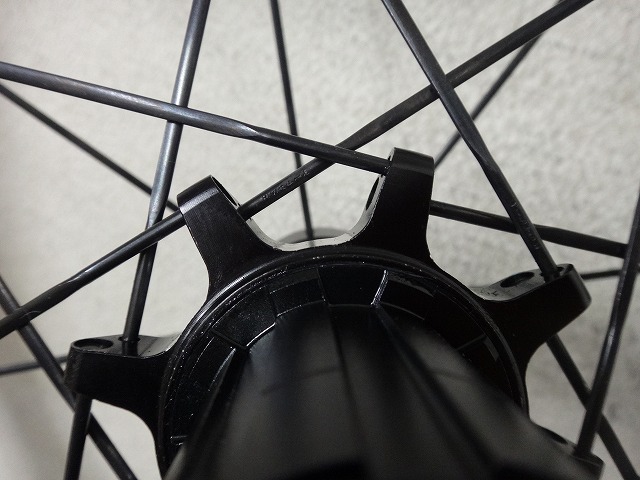
This is the rear wheel of a Deda complete wheelset.
The two final crossing spokes emerge from large and small flanges respectively,
and pulling-direction spokes emerge from the large flange side.
This is 2:1 laced, 24H, so freewheel side 16H,
8 flange holes, but this spoke pattern would work even on a 2:1 21H
with an odd number of 7 flange holes.
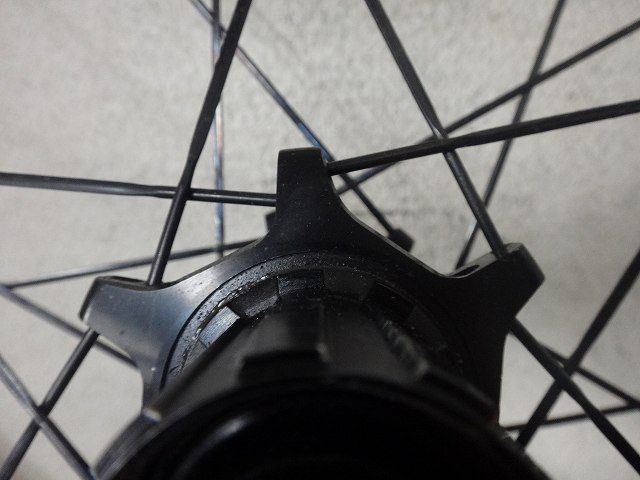
This is the rear wheel of a Zipp complete wheelset.
The flanges from which the two final crossing spokes emerge
alternate between large-large and small-small pairs.
This is 24H equal-sided, 12H per side,
6 flange holes, and this spoke pattern requires an even number of flanges.
This rear wheel alternates between low and high spoke tension
at final crossings, but it rides normally without feeling
rough or loose.
So what's the takeaway here?
A hub-side high-low flange creates spoke tension differences
in theory or under strict measurement,
but not perceptibly—so it's not a real problem.
Therefore, hub DBL is just cosmetic with no practical downside.
I used the term "practical downside" because
spoke DBL actually has real downsides.


↑Here's the SLR1 from the previous article.

"D[where] B[some] L[idiot thought up this] Lacing"
—that's DBL on the rim.
As I mentioned, GIANT claims better pedaling efficiency and sprint response,
but without overgeneralizing, at least this owner finds it underwhelming.
Though comparing it to real stuff like Bora is probably unfair.

The hub side has a very slight DBL-style
single-side high-low flange.
Compared to Deda and Zipp, which probably have single-side high-low
without consciously thinking of it as DBL,
this level of high-low is practically indistinguishable from a standard hub.

At the root of the final crossing, it looks like this.

Now, the problem with this wheel:
spoke DBL—using different-diameter lacing on one flange side.
The images clearly show the final crossing spokes have different diameters.
I've built extreme single-side different-diameter rear wheels with Champion/Revolution,
but with Italian lacing's outpoke on both sides pulling-direction—
Revolution showed much greater deformation than Champion,
true adjustment became impossible, and Revolution loosened.
I wrote earlier that DBL was thought up by an idiot,
and that's it—coming up with ideas is fine, prototyping is fine,
but calling it a sellable product? That's questionable.
Different-diameter single-side lacing—I thought of it before GIANT,
but I'm not claiming credit; anyone would think of it.
If this spoke pattern truly had no problems and mostly benefits,
every wheelset in the world would be built this way by now.
The real issue with this wheel isn't just different-diameter single-side lacing
but the spoke gauge itself.
This SLR1 uses 2:1 lacing, non-freewheel radial:
freewheel pulling-direction spokes and non-freewheel spokes are black Campagnolo straight butted
2.0-1.8-2.0mm,
freewheel non-pulling spokes are black Revolution straight butted
2.0-1.5-2.0mm—both round butted.
The freewheel Revolution might be 2.0-1.6-2.0mm Campagnolo Race,
but my caliper measurement showed 1.5mm in the butted section.
On GIANT Japan's site, the past product overview page exists,
but clicking thumbnails for specific models like wheels gives 404s,
making past model specs hard to research.
Whether that's intentional, I won't speculate.
I recall a DBL wheel using round spokes where the freewheel side matches this SLR1
and the non-freewheel is black Champion 14 plain,
with all three spoke directions different,
but I couldn't verify it.
The problem is that ~65% round spokes are mixed in at this spoke weight ratio.
What I prioritize most about CX-RAY isn't aero but work hardening—
at ~65% spoke weight it won't yield or uniplex at ~100kgf,
something I've written many times.
So when I said it couldn't be tensioned excessively and was hard to true—
Revolution, being round butted at ~65% spoke weight, causes uniplex,
especially the two Revolution spokes near the true problem area
were already showing uniplex behavior.
Nipple rotation genuinely wasn't translating to rim movement.
If spoke DBL must use round spokes, using stiff Champion for the thick freewheel side
and Campagnolo Race for the non-freewheel side would've allowed more tension.
Fortunately(?), the rim shifted right, and stiff Campagnolo on the non-freewheel side
avoided uniplex—a saving grace.
If the owner really wants improvement despite cost and lead time,
freewheel both spokes CX-RAY, drop spoke DBL,
and non-freewheel left-right reverse different-diameter with CX Sprint—
you'd get a stiffer rear wheel.
You could even lace and tension the final crossing.
The wide crossing angle Ж lacing means more upside than similarly-spec'd
Lovéal rim brake wheels using Х lacing.
I didn't do that this time though.
In summary: hub DBL (single-side high-low flange) is a minor factor irrelevant to overall wheel character;
spoke DBL (single-side different-diameter lacing) is a major negative element with no benefits exceeding demerits.