DT's venture into the hub market under the spoke brand isn't that ancient history.
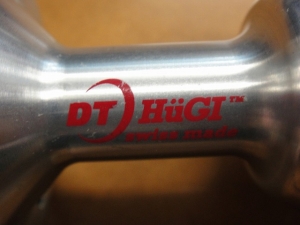
Before the current model, they operated under the brand name "Hugi (フギ)".
(I typed "u" because entering the umlaut is annoying)
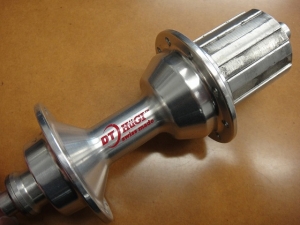
Now, this Hugi hub doesn't have anything particularly special about it as a hub.
But there is one extraordinarily rare feature—
this is an 18H rear hub.

18H means 9H on each side.
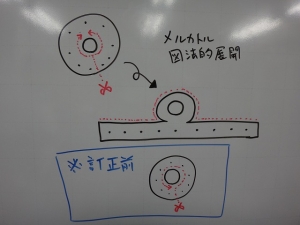
↑I often think about hub flanges by laying them out like this.
I call it a Mercator projection-style layout,
but Admiral-style or Mizkan-style layout works too.
Edit: I corrected the cut line placement because I had it wrong initially.
Thank you for pointing that out in the comments.
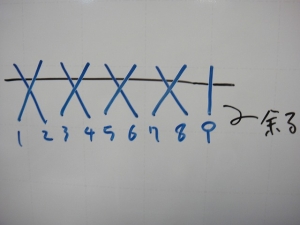
Now, if you take a 2-cross lacing on a 9-hole side,
you're left with one hole since it's odd. This would obviously create poor wheel balance,
so I think about lacing methods that minimize balance issues.
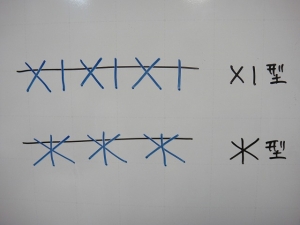
↑That leaves only these two options.
Either alternate 2-cross and radial lacing, or nest radial lacing within 2-cross lacing.
The former produces less radial runout variation across the entire rim,
so if I ever need to build an 18H rear wheel, I use XI lacing.
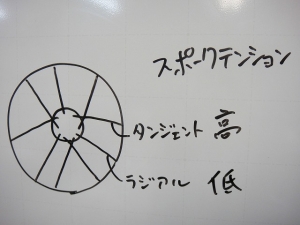
One flange side has both tangent and radial lacing mixed together,
so naturally the spoke tension differs for each lacing method.
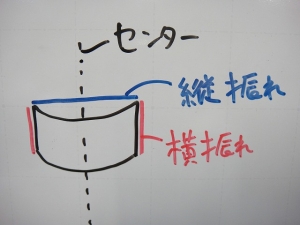
Wheel building is the work of positioning the rim at the center of the entire hub width
while reducing radial and lateral runout at the highest reasonable compromise.
This radial runout shown in blue—
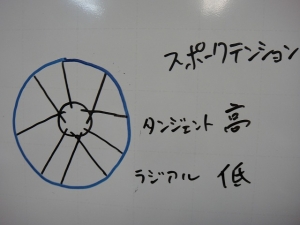
↑you want to make it as circular as possible,
but at that point the spoke tension between tangent and radial lacing differs.
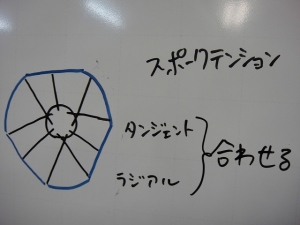
↑If you match spoke tension instead, it looks something like this taken to extremes.
Reduce runout and tension varies; match tension and runout appears.
When actually using the wheel, the former is still better.
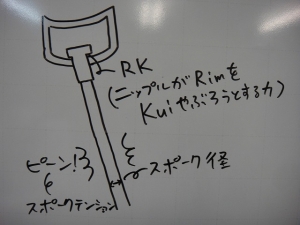
Spoke tension is the tension acting on the spoke itself.
It's different from what I call RK in the diagram above.
Spoke tension ≠ RK.
What relates to rim damage from nipples is RK.
With the same RK, thicker spokes produce lower spoke tension.
Since RK can't realistically be measured,
rim makers define spoke tension as the threshold for damage resistance,
but RK varies by thickness even at the same spoke tension.
Since thicker spokes at the same tension produce higher RK,
for example, if you tension a rim with a 120 kgf upper limit
using 2.0mm plain spokes at 120 kgf,
the rim's fracture risk at that point (=RK) might be
similar to a CX-RAY at 140 kgf.
However, since the rim says "120 kgf max!",
you have to follow that spoke tension limit.
Since spoke tension can be estimated quite accurately unlike RK,
manufacturers have no choice but to specify the threshold by spoke tension.
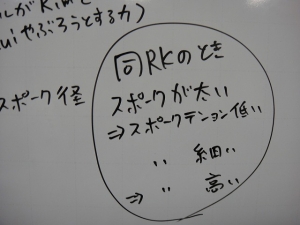
To get back on track: the relationship between spoke diameter and spoke tension is
"thicker = lower, thinner = higher".
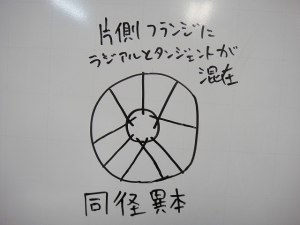
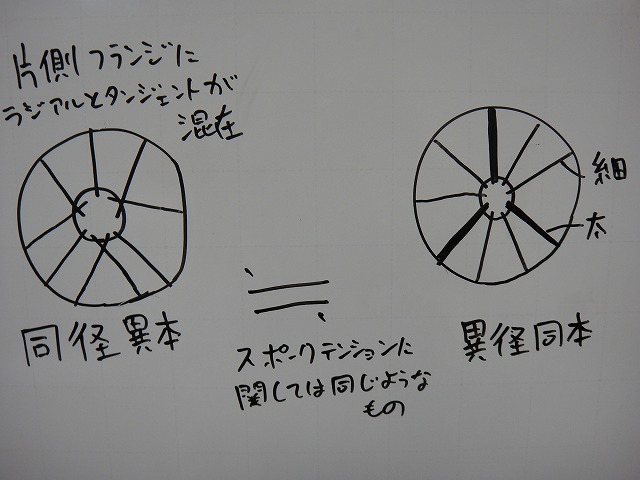
Now, let's say you build the XI lacing pattern with all the same spoke model.
This is same-diameter mixed-count lacing on one flange.
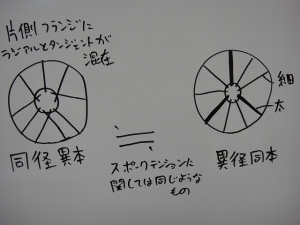
It's actually possible to express same-diameter mixed-count lacing in terms of spoke tension
using different-diameter same-count lacing.
If you could arbitrarily and infinitely adjust the weight ratio of the two spoke types in different-diameter same-count lacing—
(say, choosing the plain spoke diameter including nipple hole size yourself)—
Then you could potentially make the spoke tension ratio of
"tangent : radial" in 18H same-diameter mixed-count lacing
equal to the ratio of
"thin : thick" spokes in 18H different-diameter same-count lacing.
In reality, tangent and radial lacing behave differently under torsional input, so
if that were the case, the same-diameter mixed-count lacing keeping two-thirds tangent
would probably be stronger against torsion.
With the DT Hugi 18H rear hub, you're forced
to use mixed-count lacing on one flange.
Also, for rear wheels, both sides radial is absolutely no good,
so at minimum one side must use tangent lacing.
But what if this were an 18H front wheel instead?
In that case, it's normally radial lacing only.
From a spoke tension standpoint, one-flange different-diameter lacing
is equivalent to doing radial lacing with haphazardly different-thickness spokes.
If I could justify the merits of radial lacing with mismatched spoke thicknesses,
I could also justify mixing tangent and radial on one flange.
But I can't—neither theoretically nor from experience.
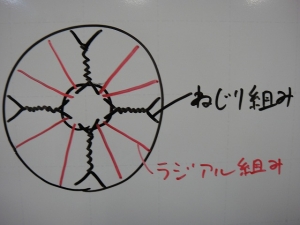
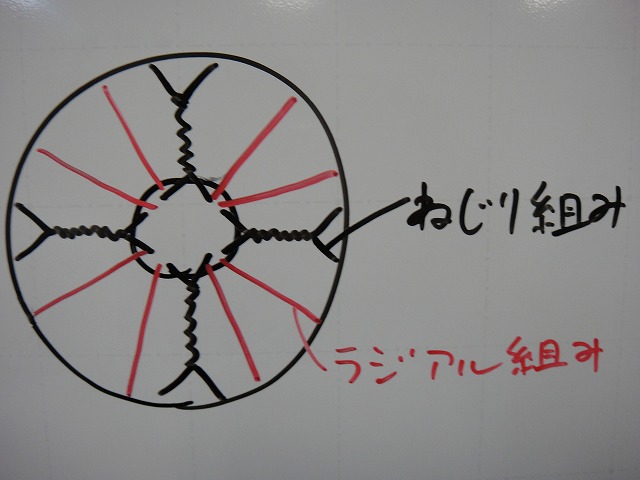
In my personal "ahowheel" (※stupid wheel)—
a 32H hub with 16H per side, with 1-cross twist lacing and 2 radial spokes grouped together—
I couldn't get clean radial runout.
The radial spokes I drew in red had lower tension,
and lower tension means closer to zero.
In actual use, the radial side didn't feel like it was doing the work
of torque transmission and rigidity support.
Exaggerating, it felt barely different from a wheel with just the twist-laced spokes.
Plus, those radial spokes loosened up constantly.
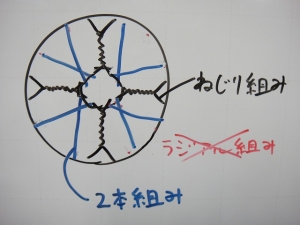
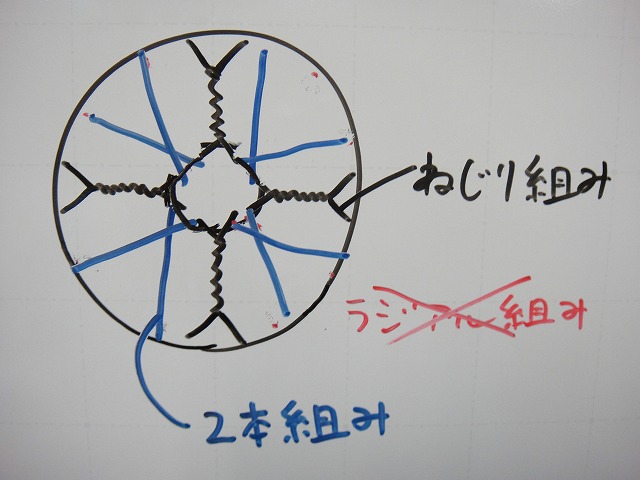
So I modified it slightly, changing the radial to 1-cross.
The only difference then is whether it's twisted or not,
but the spoke heads broke in about two months, so I took it apart.
I wasn't planning to sell it, but it confirmed what I already suspected—
it's not sellable.
One-flange different-diameter lacing is basically no good.
DT has a Triacon concept wheel, but
they've changed the flange height for spoke offset on the hub side and
carefully engineered the direction of the two non-radial spokes,
so while there is spoke tension variation,
they probably avoid frequent spoke head failures.
And before that, they use straight spokes. That's also significant.
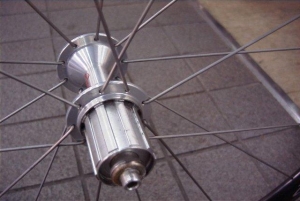
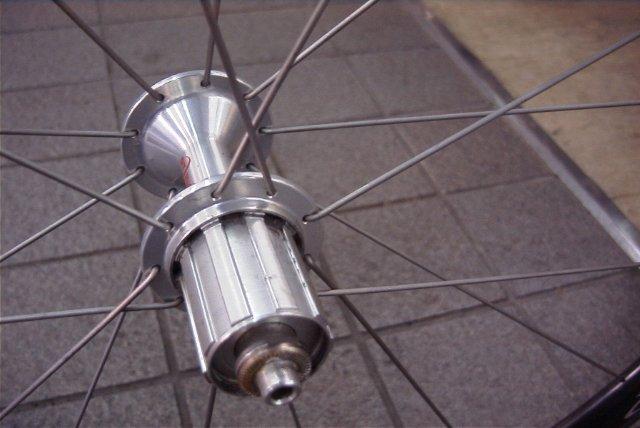
↑Found it while searching.
A photo from when I was building these back then.
This is "freewheel-side inpoke XI lacing / non-freewheel-side outpoke radial lacing".
After that I changed the non-freewheel side to all-inpoke XI lacing too, but
I don't have photos from that.
I use neologisms like XI lacing, but I'm not trying to claim authorship.
Anyone handed an 18H rear hub would essentially have to lace it this way.
The front wheel counterpart was a Tni carbon hub 18H XI lacing,
but back then I didn't have the idea of different-diameter spokes and
was nervous about thin spokes on a prototype, so I built it all with 2.0mm plain.
If you establish terms like inpoke, 46-lacing, XI lacing, etc.,
you can slot almost any lacing pattern into a category, which is convenient.
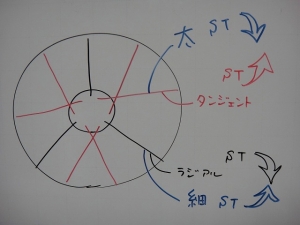
↑If you obsess only about spoke tension,
making 3 radial spokes thinner would
(though I don't know what the exact ratio should be)
probably get close to 6 tangent spokes.
The idea is mixed-count mixed-diameter lacing to get as close to net zero as possible.
But this only matches spoke tension—it doesn't match spoke deformation amount or
RK on the nipple side.
However, there is a revolutionary lacing method that matches all three (tension, deformation, RK).
You're welcome to copy it!
It's same-count same-diameter lacing! With 18H using tangent lacing,
you can't make all spokes the same count, so switch to radial!
Use all the same spoke model with radial lacing and
on a front wheel you'll match spoke tension, deformation, and RK perfectly!
18H XI lacing is a method you resort to only "when you happen to get stuck building a rear wheel with an 18H rear hub"—
it has virtually no merit!
The biggest drawback is spoke tension variation.
Though without a tension meter you won't notice this clearly.
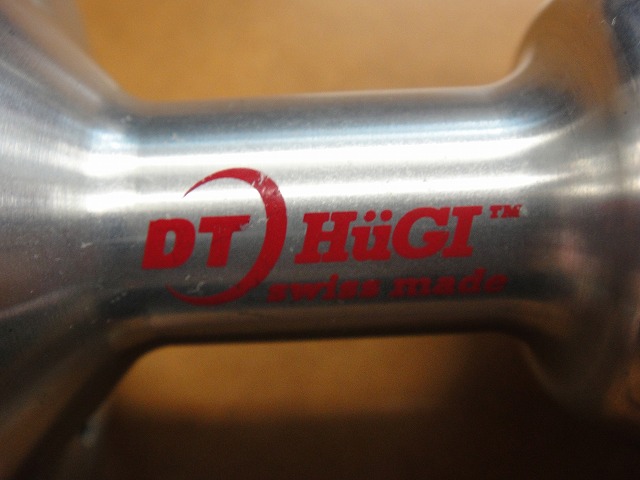
Before the current model, they operated under the brand name "Hugi (フギ)".
(I typed "u" because entering the umlaut is annoying)
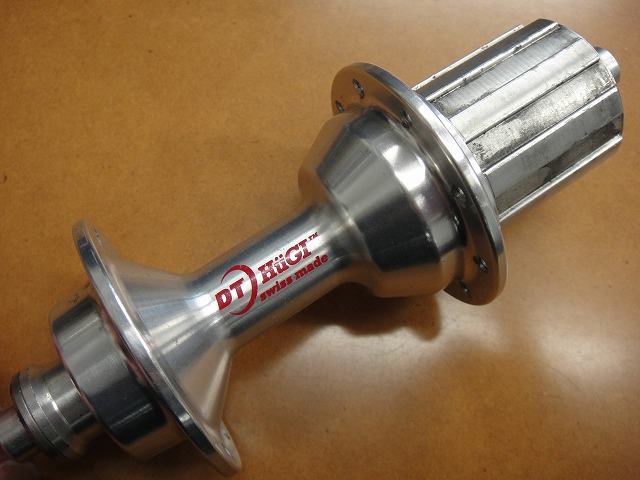
Now, this Hugi hub doesn't have anything particularly special about it as a hub.
But there is one extraordinarily rare feature—
this is an 18H rear hub.
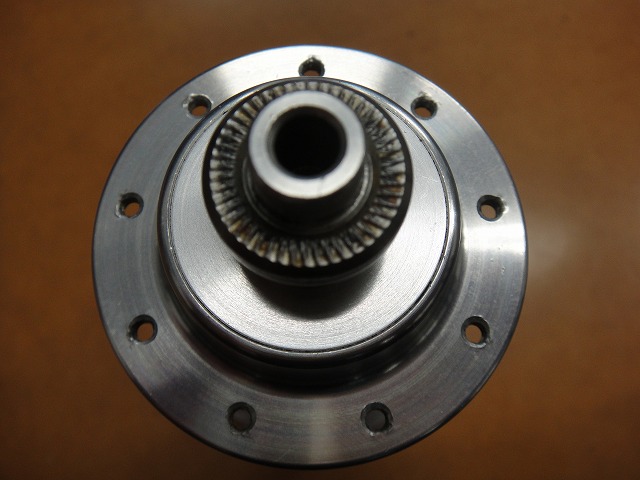
18H means 9H on each side.

↑I often think about hub flanges by laying them out like this.
I call it a Mercator projection-style layout,
but Admiral-style or Mizkan-style layout works too.
Edit: I corrected the cut line placement because I had it wrong initially.
Thank you for pointing that out in the comments.
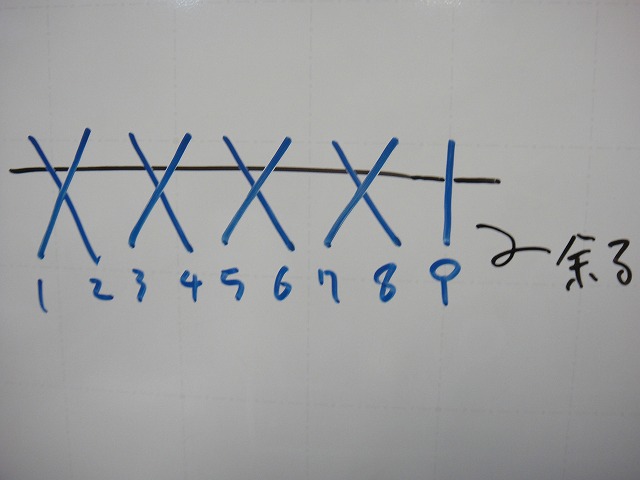
Now, if you take a 2-cross lacing on a 9-hole side,
you're left with one hole since it's odd. This would obviously create poor wheel balance,
so I think about lacing methods that minimize balance issues.
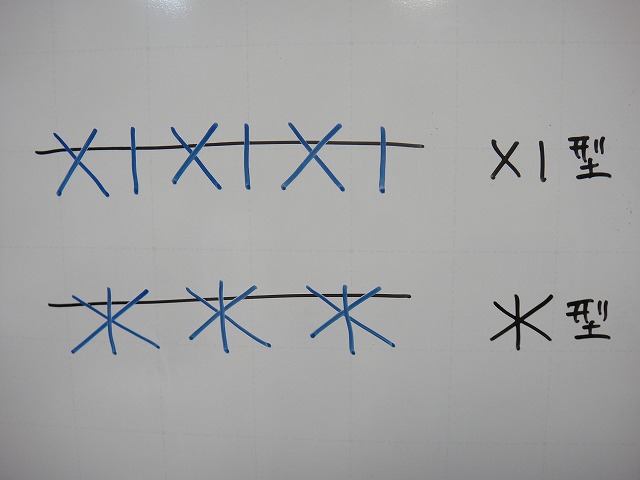
↑That leaves only these two options.
Either alternate 2-cross and radial lacing, or nest radial lacing within 2-cross lacing.
The former produces less radial runout variation across the entire rim,
so if I ever need to build an 18H rear wheel, I use XI lacing.

One flange side has both tangent and radial lacing mixed together,
so naturally the spoke tension differs for each lacing method.
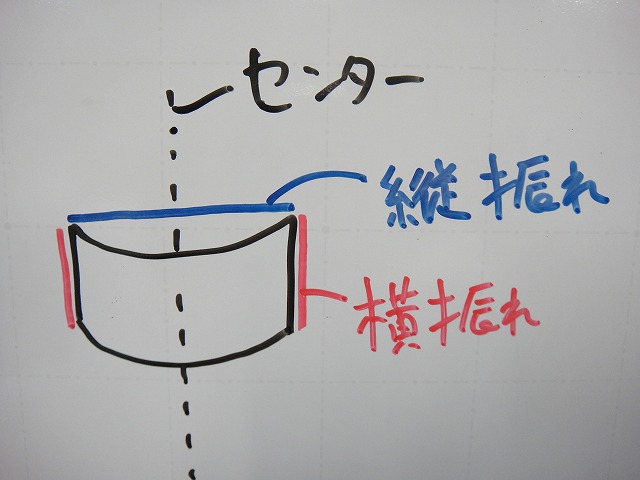
Wheel building is the work of positioning the rim at the center of the entire hub width
while reducing radial and lateral runout at the highest reasonable compromise.
This radial runout shown in blue—
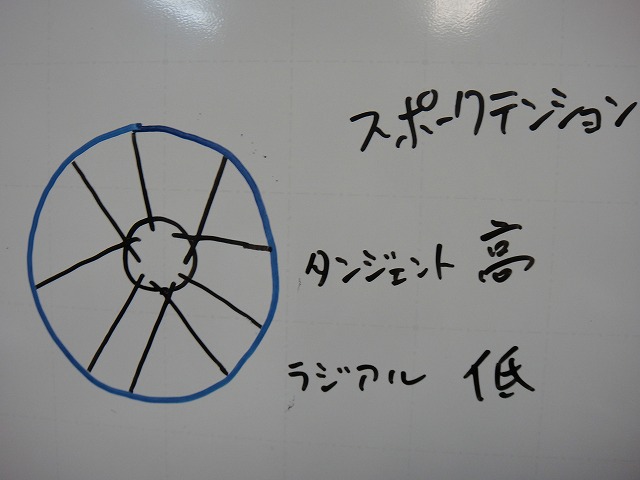
↑you want to make it as circular as possible,
but at that point the spoke tension between tangent and radial lacing differs.
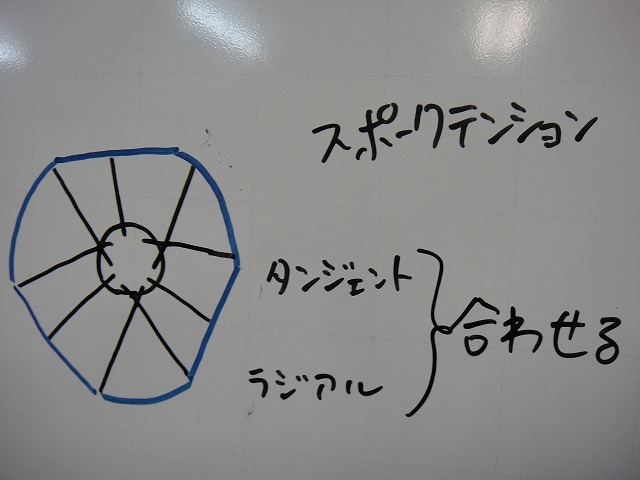
↑If you match spoke tension instead, it looks something like this taken to extremes.
Reduce runout and tension varies; match tension and runout appears.
When actually using the wheel, the former is still better.
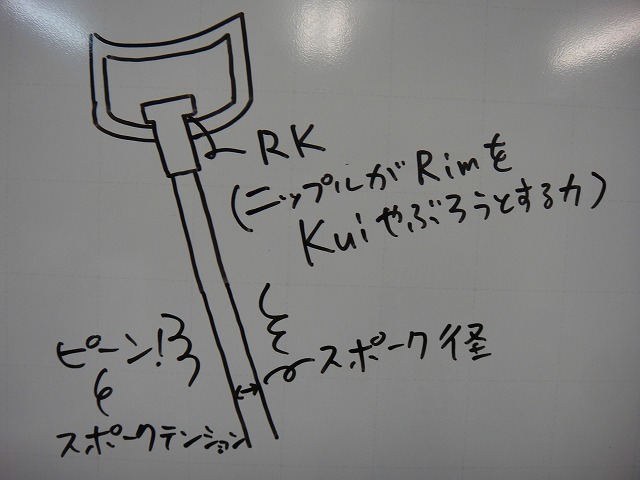
Spoke tension is the tension acting on the spoke itself.
It's different from what I call RK in the diagram above.
Spoke tension ≠ RK.
What relates to rim damage from nipples is RK.
With the same RK, thicker spokes produce lower spoke tension.
Since RK can't realistically be measured,
rim makers define spoke tension as the threshold for damage resistance,
but RK varies by thickness even at the same spoke tension.
Since thicker spokes at the same tension produce higher RK,
for example, if you tension a rim with a 120 kgf upper limit
using 2.0mm plain spokes at 120 kgf,
the rim's fracture risk at that point (=RK) might be
similar to a CX-RAY at 140 kgf.
However, since the rim says "120 kgf max!",
you have to follow that spoke tension limit.
Since spoke tension can be estimated quite accurately unlike RK,
manufacturers have no choice but to specify the threshold by spoke tension.
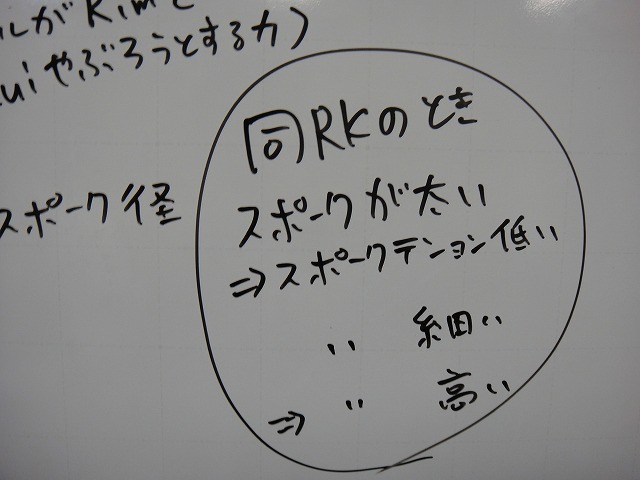
To get back on track: the relationship between spoke diameter and spoke tension is
"thicker = lower, thinner = higher".
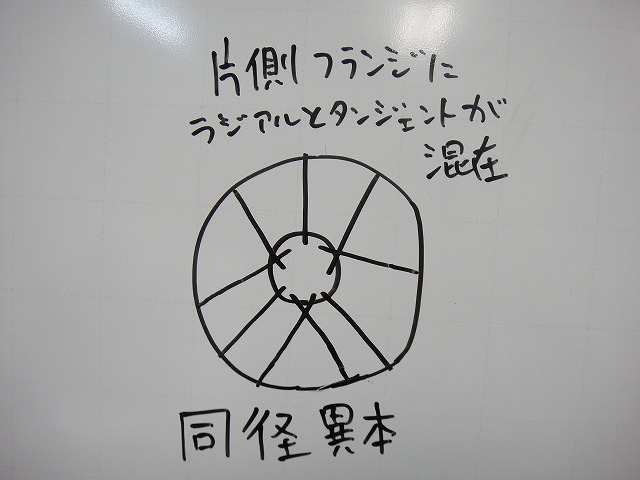
Now, let's say you build the XI lacing pattern with all the same spoke model.
This is same-diameter mixed-count lacing on one flange.
It's actually possible to express same-diameter mixed-count lacing in terms of spoke tension
using different-diameter same-count lacing.
If you could arbitrarily and infinitely adjust the weight ratio of the two spoke types in different-diameter same-count lacing—
(say, choosing the plain spoke diameter including nipple hole size yourself)—
Then you could potentially make the spoke tension ratio of
"tangent : radial" in 18H same-diameter mixed-count lacing
equal to the ratio of
"thin : thick" spokes in 18H different-diameter same-count lacing.
In reality, tangent and radial lacing behave differently under torsional input, so
if that were the case, the same-diameter mixed-count lacing keeping two-thirds tangent
would probably be stronger against torsion.
With the DT Hugi 18H rear hub, you're forced
to use mixed-count lacing on one flange.
Also, for rear wheels, both sides radial is absolutely no good,
so at minimum one side must use tangent lacing.
But what if this were an 18H front wheel instead?
In that case, it's normally radial lacing only.
From a spoke tension standpoint, one-flange different-diameter lacing
is equivalent to doing radial lacing with haphazardly different-thickness spokes.
If I could justify the merits of radial lacing with mismatched spoke thicknesses,
I could also justify mixing tangent and radial on one flange.
But I can't—neither theoretically nor from experience.
In my personal "ahowheel" (※stupid wheel)—
a 32H hub with 16H per side, with 1-cross twist lacing and 2 radial spokes grouped together—
I couldn't get clean radial runout.
The radial spokes I drew in red had lower tension,
and lower tension means closer to zero.
In actual use, the radial side didn't feel like it was doing the work
of torque transmission and rigidity support.
Exaggerating, it felt barely different from a wheel with just the twist-laced spokes.
Plus, those radial spokes loosened up constantly.
So I modified it slightly, changing the radial to 1-cross.
The only difference then is whether it's twisted or not,
but the spoke heads broke in about two months, so I took it apart.
I wasn't planning to sell it, but it confirmed what I already suspected—
it's not sellable.
One-flange different-diameter lacing is basically no good.
DT has a Triacon concept wheel, but
they've changed the flange height for spoke offset on the hub side and
carefully engineered the direction of the two non-radial spokes,
so while there is spoke tension variation,
they probably avoid frequent spoke head failures.
And before that, they use straight spokes. That's also significant.
↑Found it while searching.
A photo from when I was building these back then.
This is "freewheel-side inpoke XI lacing / non-freewheel-side outpoke radial lacing".
After that I changed the non-freewheel side to all-inpoke XI lacing too, but
I don't have photos from that.
I use neologisms like XI lacing, but I'm not trying to claim authorship.
Anyone handed an 18H rear hub would essentially have to lace it this way.
The front wheel counterpart was a Tni carbon hub 18H XI lacing,
but back then I didn't have the idea of different-diameter spokes and
was nervous about thin spokes on a prototype, so I built it all with 2.0mm plain.
If you establish terms like inpoke, 46-lacing, XI lacing, etc.,
you can slot almost any lacing pattern into a category, which is convenient.

↑If you obsess only about spoke tension,
making 3 radial spokes thinner would
(though I don't know what the exact ratio should be)
probably get close to 6 tangent spokes.
The idea is mixed-count mixed-diameter lacing to get as close to net zero as possible.
But this only matches spoke tension—it doesn't match spoke deformation amount or
RK on the nipple side.
However, there is a revolutionary lacing method that matches all three (tension, deformation, RK).
You're welcome to copy it!
It's same-count same-diameter lacing! With 18H using tangent lacing,
you can't make all spokes the same count, so switch to radial!
Use all the same spoke model with radial lacing and
on a front wheel you'll match spoke tension, deformation, and RK perfectly!
18H XI lacing is a method you resort to only "when you happen to get stuck building a rear wheel with an 18H rear hub"—
it has virtually no merit!
The biggest drawback is spoke tension variation.
Though without a tension meter you won't notice this clearly.
Products Mentioned in This Article
* Amazon affiliate links — prices may vary
Original Japanese post: のむラボ日記 #822