Another wheel day (and so on).

A customer left me front and rear wheels that are on a 2002 model Cannondale Jekyll.
Today I'm only doing the rear wheel though.
It's a 700C rim, but they want to run 38–40C tires on it
and when you fit tires that size,
the vertical clearance gets tight with the frame and fork,
so they're asking me to use this wheel's hub
and rebuild it as a 650B rim instead.

The hub is a DT Onyx brand hub.
Separately from this, there's another manufacturer called ONYX Racing that makes hubs,
but in Japanese distributorship it's called OH-EN-YEX Racing
because there's a trademark issue within Japan.
I heard from someone inside a distributor that there definitely is a "trademark issue,"
but it's unclear whether the issue is with DT's Onyx or something else.
Regarding the DT Onyx (→here)
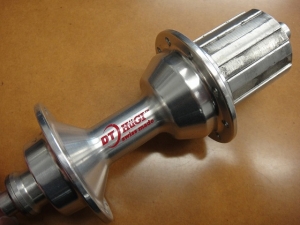
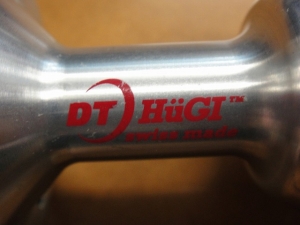
↑The road hub brand "Fuji" from the linked article. It's an older model than the 240.

The 6-bolt mount isn't independent from the hub flange
but extends down to the hub body like a Pudding Cup container—
a design very similar to Shimano's early disc brake hub,
the Deore FH-M525 hub.
The difference is that while the FH-M525 has flanges of equal diameter on both sides,
this one has reverse high-low flanges.

↑This is a Tnito Evo disc hub (not Levo disc hub) rear hub body, and since the 6-bolt mount is constrained by the minimum dimensions of the flange holes,
the flange diameter is designed so that spokes don't interfere during wheel building.
This hub also has the same flange diameter on the freewheel side as the Evolite hub,
so it too has reverse high-low flanges.

On a wheel I built a while back with a Powerway hub,
some had staggered-phase flange holes to avoid the 6-bolt mount.
What I'm doing today isn't building a wheel on the DT Onyx hub... but rather

after that, they want me to find some hub to build a rim brake wheel with this CXP23 rim,
so I decided to do that first.
Since it's 32H, I'm building it with an R7000-series 105 hub.

The rim tape width looked mismatched, but

it was a Schwalbe 16mm width one.
And currently it's not even 16mm wide anymore.
The cause is unknown, but the width has shrunk.
When I tried to remove it, it became brittle
and tore at the valve hole, snapping cleanly off.

↑Freewheel side

↑Non-freewheel side

↑Freewheel side

↑Non-freewheel side
The spoke length on the freewheel side is about flush with the slot,
while the non-freewheel side is about two threads shorter—
notably different lengths.
The slot on the 2nd and 4th nipples shows damage marks from an electric screwdriver with a minus bit used during initial building.
Also, there's a round mark stamped on the outer edge of the nipple rim,
which indicates this is a #15 nipple, not #14.
Most of the nipples with round marks were on the non-freewheel side,
so I thought they were doing a left-right different-diameter build with #14 on the freewheel side and #15 on the non-freewheel side,
but there are places where round-marked nipples are used on the freewheel side too
(like in the third photo above), and for some reason
they're mixing the two types of nipples indiscriminately.
With current DT nipples,
the brass #14, 12mm long, silver one is part number 30-001,
and the most commonly used aluminum #14, 12mm long, silver one is 30-008.

↑This is the 30-033 nipple—brass, #15, 12mm long, silver color—

and it has a round mark on the outer edge.

↑This is from the era when parts were managed with 5-digit part numbers—
the 65167 nipple, the same as the 30-033: brass, #15, 12mm long, silver—

and it has a tripod-shaped marking on the outer edge, like a trident or the feet you see on the back of a watch face.
When this overlaps with the slot phase,
the marking appears as two feet instead of three.
On this wheel, I think one set of nipples is DT,
but I couldn't figure out what the other set is from.
They're not Sapim.
The outer edge of Sapim brass nipples is flared out flat like a screw head.
According to the customer's information, this wheel was on a Cannondale Jekyll,
but that doesn't mean it came as a stock wheel with the complete bike—
it means they previously had a 26-inch HE-rim wheel on the Jekyll
and this is a separately built 700C WO-rim wheel.
It's built with disc brake hubs, yet
(as you can see from the images if you scroll back)
it's built in Italian style, which is also unusual.
Whether there's a firm philosophy behind doing such unusual things or not


—looking at the wheel center is one of my bad habits for judging.
The fact that it's shifted in the opposite direction to wear shift and hugely shifted,
plus the spoke lengths differ noticeably between sides,
plus two types of nipples used haphazardly—
I really can't imagine the person who built this wheel had any clever reasoning behind what they were doing.

I pressed brass nipples in hard, and I wondered if the burred edge would form a countersink that reduces friction with the nipple on future builds,
but it had an unpleasant burr that didn't look like it would help at all,
so I did some Midril treatment.
The image above is before processing, just so you know.

I also have the front wheel built with the same rim and a Lefty front hub on deposit,
but since both rims were light enough that I'd need to weight-distribute based on rim weight,
I just disassembled the old rear wheel and built the rear wheel.

All built.

FH-R7000 silver hub shell (there's also a black hub shell version, by the way)
32H, all #14 Compé 246 Italian style with silver aluminum nipples.
The original spokes were #15-based Compé, but if they'd been #14-based I might've reused them.

If this grade of rim were current production,
it would certainly be made in Romania,
but all of Mavic's aluminum rims from this era are made in France.
And the limit to which it lets you chase down vertical runout outside of the seam—
that is, the rim's roundness—was as high as an Open Pro.


↑Wheel center

↑Freewheel side

↑Non-freewheel side

↑Freewheel side

↑Non-freewheel side


Unrelated to wheels, but
the box the wheel came in
had rice shochu included, which I gratefully received.

A customer left me front and rear wheels that are on a 2002 model Cannondale Jekyll.
Today I'm only doing the rear wheel though.
It's a 700C rim, but they want to run 38–40C tires on it
and when you fit tires that size,
the vertical clearance gets tight with the frame and fork,
so they're asking me to use this wheel's hub
and rebuild it as a 650B rim instead.

The hub is a DT Onyx brand hub.
Separately from this, there's another manufacturer called ONYX Racing that makes hubs,
but in Japanese distributorship it's called OH-EN-YEX Racing
because there's a trademark issue within Japan.
I heard from someone inside a distributor that there definitely is a "trademark issue,"
but it's unclear whether the issue is with DT's Onyx or something else.
Regarding the DT Onyx (→here)
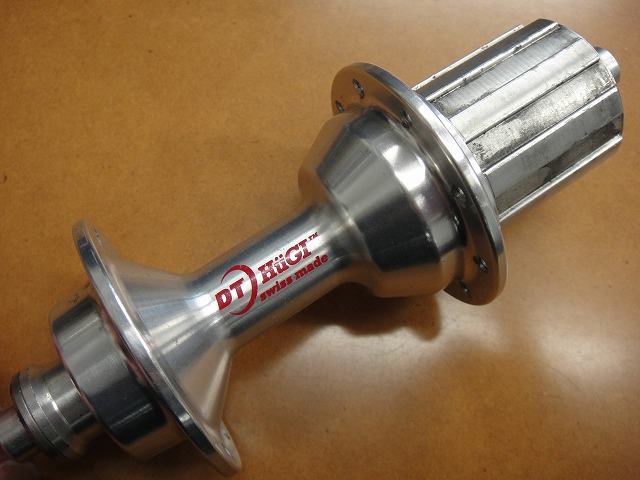
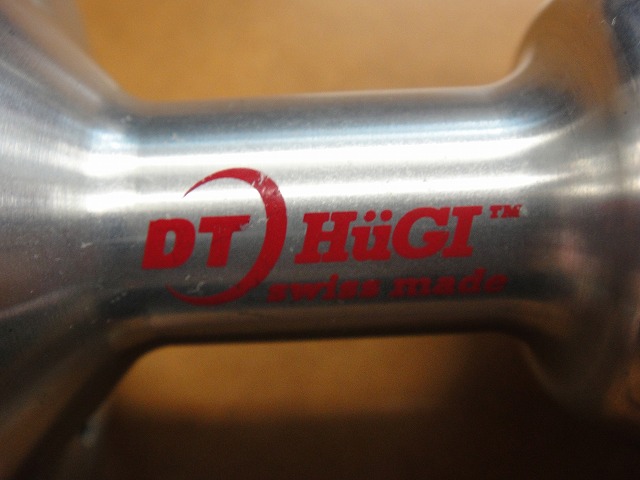
↑The road hub brand "Fuji" from the linked article. It's an older model than the 240.

The 6-bolt mount isn't independent from the hub flange
but extends down to the hub body like a Pudding Cup container—
a design very similar to Shimano's early disc brake hub,
the Deore FH-M525 hub.
The difference is that while the FH-M525 has flanges of equal diameter on both sides,
this one has reverse high-low flanges.

↑This is a Tnito Evo disc hub (not Levo disc hub) rear hub body, and since the 6-bolt mount is constrained by the minimum dimensions of the flange holes,
the flange diameter is designed so that spokes don't interfere during wheel building.
This hub also has the same flange diameter on the freewheel side as the Evolite hub,
so it too has reverse high-low flanges.

On a wheel I built a while back with a Powerway hub,
some had staggered-phase flange holes to avoid the 6-bolt mount.
What I'm doing today isn't building a wheel on the DT Onyx hub... but rather

after that, they want me to find some hub to build a rim brake wheel with this CXP23 rim,
so I decided to do that first.
Since it's 32H, I'm building it with an R7000-series 105 hub.

The rim tape width looked mismatched, but

it was a Schwalbe 16mm width one.
And currently it's not even 16mm wide anymore.
The cause is unknown, but the width has shrunk.
When I tried to remove it, it became brittle
and tore at the valve hole, snapping cleanly off.

↑Freewheel side

↑Non-freewheel side

↑Freewheel side

↑Non-freewheel side
The spoke length on the freewheel side is about flush with the slot,
while the non-freewheel side is about two threads shorter—
notably different lengths.
The slot on the 2nd and 4th nipples shows damage marks from an electric screwdriver with a minus bit used during initial building.
Also, there's a round mark stamped on the outer edge of the nipple rim,
which indicates this is a #15 nipple, not #14.
Most of the nipples with round marks were on the non-freewheel side,
so I thought they were doing a left-right different-diameter build with #14 on the freewheel side and #15 on the non-freewheel side,
but there are places where round-marked nipples are used on the freewheel side too
(like in the third photo above), and for some reason
they're mixing the two types of nipples indiscriminately.
With current DT nipples,
the brass #14, 12mm long, silver one is part number 30-001,
and the most commonly used aluminum #14, 12mm long, silver one is 30-008.

↑This is the 30-033 nipple—brass, #15, 12mm long, silver color—

and it has a round mark on the outer edge.

↑This is from the era when parts were managed with 5-digit part numbers—
the 65167 nipple, the same as the 30-033: brass, #15, 12mm long, silver—

and it has a tripod-shaped marking on the outer edge, like a trident or the feet you see on the back of a watch face.
When this overlaps with the slot phase,
the marking appears as two feet instead of three.
On this wheel, I think one set of nipples is DT,
but I couldn't figure out what the other set is from.
They're not Sapim.
The outer edge of Sapim brass nipples is flared out flat like a screw head.
According to the customer's information, this wheel was on a Cannondale Jekyll,
but that doesn't mean it came as a stock wheel with the complete bike—
it means they previously had a 26-inch HE-rim wheel on the Jekyll
and this is a separately built 700C WO-rim wheel.
It's built with disc brake hubs, yet
(as you can see from the images if you scroll back)
it's built in Italian style, which is also unusual.
Whether there's a firm philosophy behind doing such unusual things or not


—looking at the wheel center is one of my bad habits for judging.
The fact that it's shifted in the opposite direction to wear shift and hugely shifted,
plus the spoke lengths differ noticeably between sides,
plus two types of nipples used haphazardly—
I really can't imagine the person who built this wheel had any clever reasoning behind what they were doing.

I pressed brass nipples in hard, and I wondered if the burred edge would form a countersink that reduces friction with the nipple on future builds,
but it had an unpleasant burr that didn't look like it would help at all,
so I did some Midril treatment.
The image above is before processing, just so you know.

I also have the front wheel built with the same rim and a Lefty front hub on deposit,
but since both rims were light enough that I'd need to weight-distribute based on rim weight,
I just disassembled the old rear wheel and built the rear wheel.

All built.

FH-R7000 silver hub shell (there's also a black hub shell version, by the way)
32H, all #14 Compé 246 Italian style with silver aluminum nipples.
The original spokes were #15-based Compé, but if they'd been #14-based I might've reused them.

If this grade of rim were current production,
it would certainly be made in Romania,
but all of Mavic's aluminum rims from this era are made in France.
And the limit to which it lets you chase down vertical runout outside of the seam—
that is, the rim's roundness—was as high as an Open Pro.


↑Wheel center

↑Freewheel side

↑Non-freewheel side

↑Freewheel side

↑Non-freewheel side


Unrelated to wheels, but
the box the wheel came in
had rice shochu included, which I gratefully received.