SRAM disc brake pads come in 4 types depending on differences in backplate and pad material, and since the names alone don't make it clear what's different, I decided to investigate.
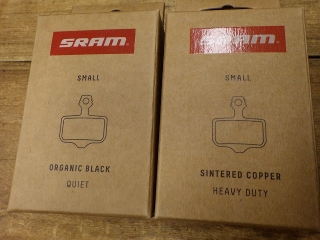
↑These are 2 of the 4 types:
Organic Black and Sintered Copper.
Looking at the text on the box, first from the top,
"Small" refers to the pad shape.
Next, "Organic Black" and "Sintered Copper" aren't single continuous terms like
"organically black" or "sintered copper"—
rather, they each indicate the pad material and backplate color separately.
So I wish they'd use a slash like Organic/Black.
Sintered means "sintered," but
in this case it refers to a pad containing sintered metal particles.
Organic pads don't contain any metal.
Finally, "Quiet" and "Heavy Duty" are
names that indicate characteristics.
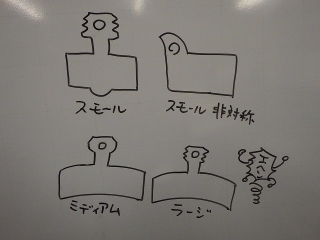
Regarding pad size:
Small is for current road and high-end XC,
Small Asymmetric is
for road and high-end XC from the early one-piece molded monoblock era,
Medium and Large are
for MTB other than high-end XC.
Medium and Large have larger plates and pads than the two Small types,
but the diagram above is rough so it doesn't show that.
However, it's true that there isn't much size difference between Medium and Large,
and perhaps because of this distinction, the Large has
the same serrated edge next to the hole that Small also has.
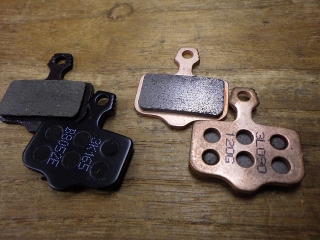
↑Black/Organic/Quiet and
Sintered/Copper/Heavy Duty.
Copper is a color name; the material is steel.
The other two pads are also organic,
but organic pads are flush with the backplate,
while sintered pads have a recess relative to the backplate.
This is the same regardless of pad size.
The remaining two are
Grey/Organic/Powerful and
Aluminum/Organic/Quiet+Lightweight.
Grey has a grey steel backplate,
and Aluminum has a lightweight aluminum backplate.
Except for sintered, the three organic pads have
nearly identical manufacturer descriptions of their characteristics.
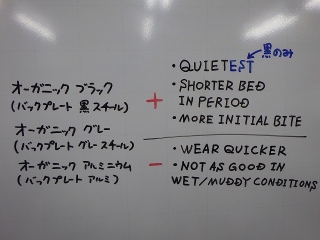
Positive points are marked with plus, negative points with minus.
First, starting from the top of the positives,
the brake noise is quiet—
but only Black is described as top-tier for quietness.
Next, it says bedding-in time is short,
which means the time until the pad material transfers to
a new disc rotor and brake bite improves—
this refers to the bedding-in process.
Next, it says initial bite is even more excellent.
Initial (early) bite (grip) refers to
the braking force near the brake lever's initial engagement,
meaning the brake grips suddenly and firmly right from the start
without needing to squeeze the lever much.
Then, the negative points:
First, wear is fast,
and second, it's unsuitable for wet surfaces and mud.
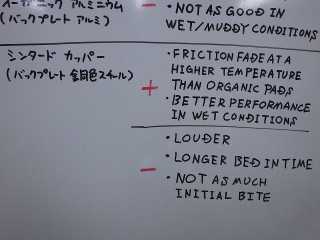
This is the description for sintered pads.
The positives are that fade due to high-temperature friction is
less than with organic pads,
and suitability for wet surfaces—two points total.
The negatives are
noise, longer bedding-in time, and
initial bite isn't as strong—three points.
If I think of Shimano's resin brake pads as equivalent to SRAM's organic
and metal pads as equivalent to sintered,
initial bite seems like it should be better on sintered,
but perhaps SRAM's sintered pads
bite softly at first (weak initial bite),
and as you squeeze the lever more, the bite increases,
eventually exceeding organic's upper limit—
that kind of characteristic.

I've listed the
• backplate color
• pad material
• backplate material
• name
for the 4 pad types.
I arranged them in the order Grey, Black, Aluminum, Copper
because that's the order SRAM uses in the table that follows.

I arranged the same pads on the vertical axis in the same order as the horizontal axis to create a compatibility table.
Regarding why brake pads improve braking when the rotor is bedded in,
it's not just the initial wear where the brake pad contacts the rotor fully across its surface—
SRAM explicitly states that
"a thin layer of brake pad material transfers onto the rotor surface,
and the friction between these two surfaces enables powerful braking."
So when replacing pads, there are certain combinations where you can't reuse the old rotor (it needs replacement)
depending on what type of pad material was on it before.
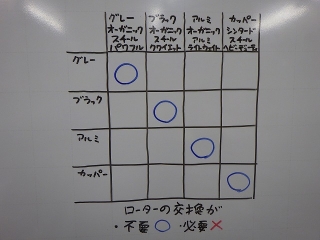
First, when old and new pads are the same type:
Naturally, rotor replacement isn't needed.
As for whether the horizontal or vertical axis represents old or new pads,
they're symmetrical around the diagonal circles from top-left to bottom-right,
so either works.
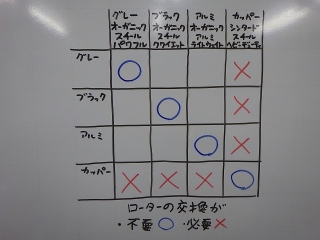
Next, since sintered and organic aren't compatible,
the space between these two gets an X.
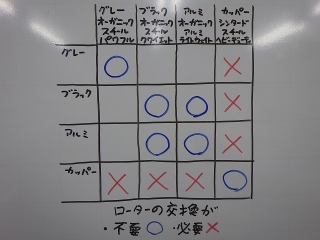
Next, black steel plate and aluminum plate are
likely different only in backplate material
(though quietness differed between Quietest and Quiet),
so they're compatible.
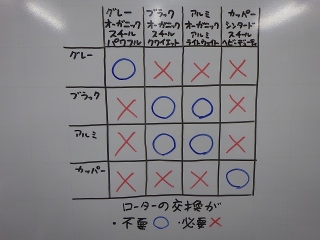
Finally—and this was surprising—
Powerful (Grey) maintains organic-leaning material
while increasing brake power,
but it's not compatible with organic pads other than Powerful.
So you can't arrive at a race venue on a rainy day,
swap pads from Black or Aluminum to Grey,
and use them as-is—that's not allowed.
Well, since that's what the manufacturer says,
people might suggest cleaning the rotor would work,
or that it probably won't be a problem as long as you don't cross between organic and sintered,
and honestly, I think so too.
By the way, the pads that come standard on brake calipers are
Black/Organic/Quiet for road,
and Grey/Organic/Powerful for MTB.
Since Powerful is sometimes just listed as "New Compound" in distributor specifications,
someone might not know the difference and think it's an upgraded version of the standard,
leading them to switch from Black to Grey.
The suggested retail price (tax included) for "Small" size pads at the time of writing is
Black and Copper at ¥3,840,
Grey at ¥4,020, and Aluminum at ¥4,610.
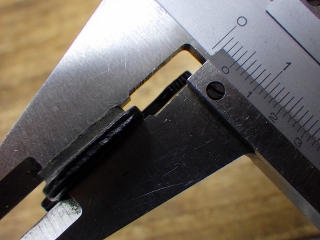
SRAM brake pad thickness, backplate and pad combined, is about 4mm,
and replacement is required when this drops below 3mm.
Since the limit includes the backplate,
measuring with calipers is easier and more reliable
than if the pad thickness alone were specified.
I wrote "about 4mm" because the breakdown differs:
Black Organic is 1.8mm pad + 2.2mm plate = 4mm,
while sintered is 1.8mm pad + 2mm plate = 3.8mm.
I assume the Grey plate thickness is the same as Black,
but Aluminum might be different.
Either way, the pad thickness is 1.8mm,
but since the manufacturer's limit includes the plate,
at 4mm total, the pad has 0.8mm remaining,
and at 3.8mm total, the pad has 1mm remaining—
but replacement is due at that point, with some margin.
Even if you notice at 3mm combined on Odaigahara or at the Norikura summit,
you can manage to get back alive.
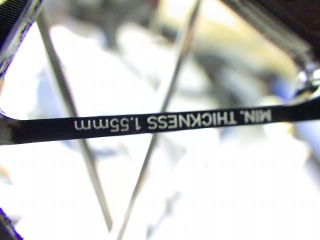
↑This is the aluminum section at the center of a SRAM disc rotor.
SRAM rotors come in 2mm and 1.85mm thicknesses,
and the replacement limit for each is 0.3mm less than new.
Road disc rotors are 1.85mm thick, so
as shown in the image above, 1.55mm is marked as the replacement limit.
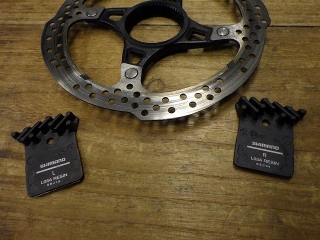
↑This is a Shimano disc rotor that was replaced because
the brake noise and feel were off, and
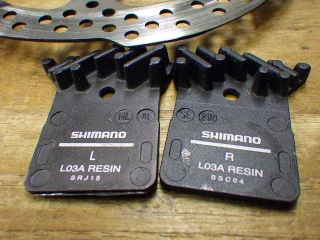
the brake pads.
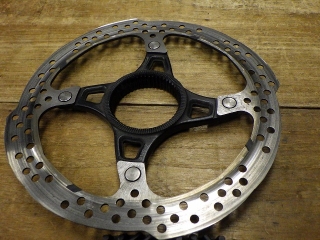
First, the rotor.
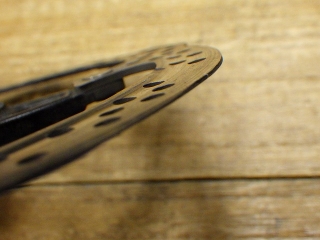
Shimano specifies replacement when rotor thickness reaches 1.5mm,
but this rotor is 0.95mm thick.
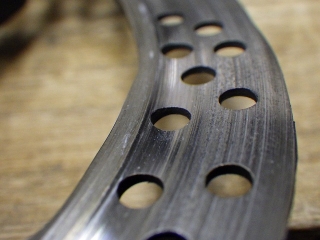
The section where the pad contacted has worn with a step.
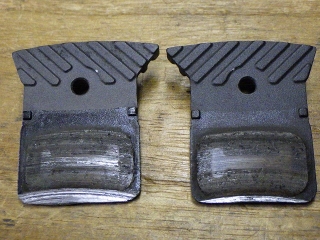
The brake pads are also worn to death (not an exaggeration).
In the image above, left is left side (outer side), and it's more worn than the right side.
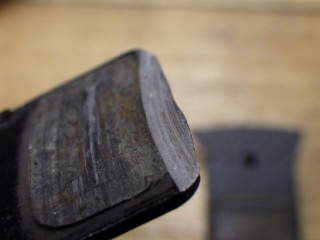
Both have mainly vertical uneven wear,
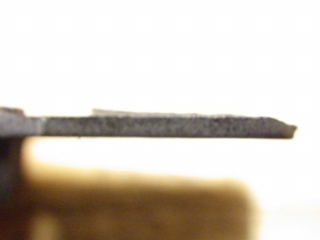
↑Left pad (left side of image is upward direction)
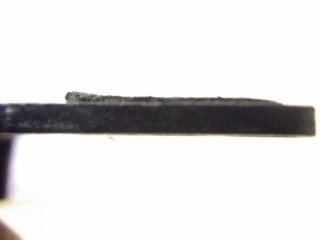
↑Right pad (left side of image is upward direction)
The upper edge barely retains some pad material,
but measuring the upper edge thickness of the right pad where more remains,
it's actually still 0.4mm.
Shimano specifies brake pad replacement when
the pad material thickness is 0.5mm,
but since brake caliper position adjustment can cause
front-to-back uneven wear (even 0.1mm is significant for pads),
the point where the thinnest part of a diagonally-worn pad reaches 0.5mm
is rather tight—basically critical.
So with Shimano brake pads,
it's best to err toward early replacement.
Shimano has two types of pads: resin and metal,
and while there are disc rotors that don't support metal pads,
there's no instruction to replace the rotor when switching pads
from resin to metal or vice versa.
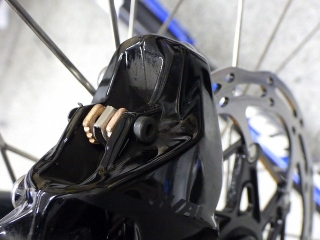
While replacing the disc rotor,
I also swapped the brake pads to
Sintered/Copper/Heavy Duty.
Let's test them out right away.

↑These are 2 of the 4 types:
Organic Black and Sintered Copper.
Looking at the text on the box, first from the top,
"Small" refers to the pad shape.
Next, "Organic Black" and "Sintered Copper" aren't single continuous terms like
"organically black" or "sintered copper"—
rather, they each indicate the pad material and backplate color separately.
So I wish they'd use a slash like Organic/Black.
Sintered means "sintered," but
in this case it refers to a pad containing sintered metal particles.
Organic pads don't contain any metal.
Finally, "Quiet" and "Heavy Duty" are
names that indicate characteristics.

Regarding pad size:
Small is for current road and high-end XC,
Small Asymmetric is
for road and high-end XC from the early one-piece molded monoblock era,
Medium and Large are
for MTB other than high-end XC.
Medium and Large have larger plates and pads than the two Small types,
but the diagram above is rough so it doesn't show that.
However, it's true that there isn't much size difference between Medium and Large,
and perhaps because of this distinction, the Large has
the same serrated edge next to the hole that Small also has.

↑Black/Organic/Quiet and
Sintered/Copper/Heavy Duty.
Copper is a color name; the material is steel.
The other two pads are also organic,
but organic pads are flush with the backplate,
while sintered pads have a recess relative to the backplate.
This is the same regardless of pad size.
The remaining two are
Grey/Organic/Powerful and
Aluminum/Organic/Quiet+Lightweight.
Grey has a grey steel backplate,
and Aluminum has a lightweight aluminum backplate.
Except for sintered, the three organic pads have
nearly identical manufacturer descriptions of their characteristics.

Positive points are marked with plus, negative points with minus.
First, starting from the top of the positives,
the brake noise is quiet—
but only Black is described as top-tier for quietness.
Next, it says bedding-in time is short,
which means the time until the pad material transfers to
a new disc rotor and brake bite improves—
this refers to the bedding-in process.
Next, it says initial bite is even more excellent.
Initial (early) bite (grip) refers to
the braking force near the brake lever's initial engagement,
meaning the brake grips suddenly and firmly right from the start
without needing to squeeze the lever much.
Then, the negative points:
First, wear is fast,
and second, it's unsuitable for wet surfaces and mud.

This is the description for sintered pads.
The positives are that fade due to high-temperature friction is
less than with organic pads,
and suitability for wet surfaces—two points total.
The negatives are
noise, longer bedding-in time, and
initial bite isn't as strong—three points.
If I think of Shimano's resin brake pads as equivalent to SRAM's organic
and metal pads as equivalent to sintered,
initial bite seems like it should be better on sintered,
but perhaps SRAM's sintered pads
bite softly at first (weak initial bite),
and as you squeeze the lever more, the bite increases,
eventually exceeding organic's upper limit—
that kind of characteristic.

I've listed the
• backplate color
• pad material
• backplate material
• name
for the 4 pad types.
I arranged them in the order Grey, Black, Aluminum, Copper
because that's the order SRAM uses in the table that follows.

I arranged the same pads on the vertical axis in the same order as the horizontal axis to create a compatibility table.
Regarding why brake pads improve braking when the rotor is bedded in,
it's not just the initial wear where the brake pad contacts the rotor fully across its surface—
SRAM explicitly states that
"a thin layer of brake pad material transfers onto the rotor surface,
and the friction between these two surfaces enables powerful braking."
So when replacing pads, there are certain combinations where you can't reuse the old rotor (it needs replacement)
depending on what type of pad material was on it before.

First, when old and new pads are the same type:
Naturally, rotor replacement isn't needed.
As for whether the horizontal or vertical axis represents old or new pads,
they're symmetrical around the diagonal circles from top-left to bottom-right,
so either works.

Next, since sintered and organic aren't compatible,
the space between these two gets an X.

Next, black steel plate and aluminum plate are
likely different only in backplate material
(though quietness differed between Quietest and Quiet),
so they're compatible.

Finally—and this was surprising—
Powerful (Grey) maintains organic-leaning material
while increasing brake power,
but it's not compatible with organic pads other than Powerful.
So you can't arrive at a race venue on a rainy day,
swap pads from Black or Aluminum to Grey,
and use them as-is—that's not allowed.
Well, since that's what the manufacturer says,
people might suggest cleaning the rotor would work,
or that it probably won't be a problem as long as you don't cross between organic and sintered,
and honestly, I think so too.
By the way, the pads that come standard on brake calipers are
Black/Organic/Quiet for road,
and Grey/Organic/Powerful for MTB.
Since Powerful is sometimes just listed as "New Compound" in distributor specifications,
someone might not know the difference and think it's an upgraded version of the standard,
leading them to switch from Black to Grey.
The suggested retail price (tax included) for "Small" size pads at the time of writing is
Black and Copper at ¥3,840,
Grey at ¥4,020, and Aluminum at ¥4,610.

SRAM brake pad thickness, backplate and pad combined, is about 4mm,
and replacement is required when this drops below 3mm.
Since the limit includes the backplate,
measuring with calipers is easier and more reliable
than if the pad thickness alone were specified.
I wrote "about 4mm" because the breakdown differs:
Black Organic is 1.8mm pad + 2.2mm plate = 4mm,
while sintered is 1.8mm pad + 2mm plate = 3.8mm.
I assume the Grey plate thickness is the same as Black,
but Aluminum might be different.
Either way, the pad thickness is 1.8mm,
but since the manufacturer's limit includes the plate,
at 4mm total, the pad has 0.8mm remaining,
and at 3.8mm total, the pad has 1mm remaining—
but replacement is due at that point, with some margin.
Even if you notice at 3mm combined on Odaigahara or at the Norikura summit,
you can manage to get back alive.

↑This is the aluminum section at the center of a SRAM disc rotor.
SRAM rotors come in 2mm and 1.85mm thicknesses,
and the replacement limit for each is 0.3mm less than new.
Road disc rotors are 1.85mm thick, so
as shown in the image above, 1.55mm is marked as the replacement limit.

↑This is a Shimano disc rotor that was replaced because
the brake noise and feel were off, and

the brake pads.

First, the rotor.

Shimano specifies replacement when rotor thickness reaches 1.5mm,
but this rotor is 0.95mm thick.

The section where the pad contacted has worn with a step.

The brake pads are also worn to death (not an exaggeration).
In the image above, left is left side (outer side), and it's more worn than the right side.

Both have mainly vertical uneven wear,

↑Left pad (left side of image is upward direction)

↑Right pad (left side of image is upward direction)
The upper edge barely retains some pad material,
but measuring the upper edge thickness of the right pad where more remains,
it's actually still 0.4mm.
Shimano specifies brake pad replacement when
the pad material thickness is 0.5mm,
but since brake caliper position adjustment can cause
front-to-back uneven wear (even 0.1mm is significant for pads),
the point where the thinnest part of a diagonally-worn pad reaches 0.5mm
is rather tight—basically critical.
So with Shimano brake pads,
it's best to err toward early replacement.
Shimano has two types of pads: resin and metal,
and while there are disc rotors that don't support metal pads,
there's no instruction to replace the rotor when switching pads
from resin to metal or vice versa.

While replacing the disc rotor,
I also swapped the brake pads to
Sintered/Copper/Heavy Duty.
Let's test them out right away.