I'm sure many of you already know this, but
yesterday (September 21st) Shimano released
a statement acknowledging instances of crank adhesive separation.
This rigidity issue has actually
been well-known for a long time,
but due to Shimano's massive size and the reality that you have no choice but to use their products,
people have had to stay silent until now.
I'm sure many have just accepted their losses in silence.
Oh, just to be clear, this whole discussion so far has been about Hollowtech II cranks.
The affected models are
FC-9000, FC-R9100, FC-R9100P,
FC-6800, FC-R8000, and
basically the "11-speed Dura-Ace and Ultegra cranks,"
but while Shimano hasn't spelled it out explicitly,
the issue really only occurs with what I call the "mochi" structure cranks.
Before I get into that,
the affected manufacturing stamps are
KF~KL, LA~LL, MA~ML, NA~NL,
OA~OL, PA~PL, QA~QL, RA~RF.
When the first character continues to the next,
the second character always ends in L (the 12th letter of the alphabet),
so my blog readers will have no trouble recognizing
the manufacturing date code system for stamps (→here).
Shimano's statement says "up until June 30th, 2019,"
telling us the end date but keeping the start date hidden—
though KF is June 2012.
For the record, RF is June 2019.
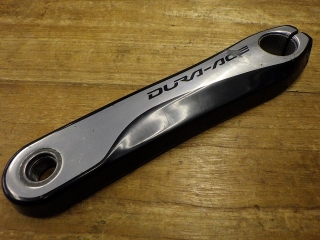
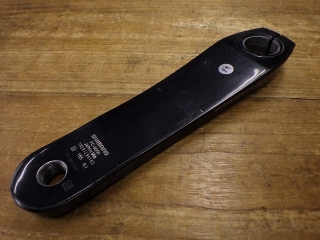
↑This is the left crank of an FC-9000.
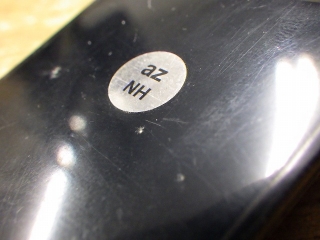
The manufacturing stamp is NH, so that's August 2015.
What I call "mochi structure" refers to
a structure where the crank is like a box lid glued shut—similar to a portable chopstick case lid.
You can tell if it's mochi or not by checking whether there's a thin seam line
on the back of the crank.

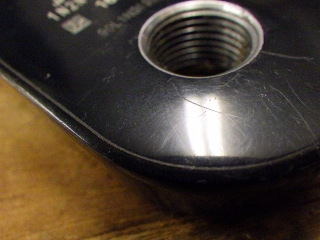
↑This is the part in the image, where
the aluminum is corroding and the adhesive is starting to separate.
With a normal mochi seam, you won't feel a step even if you scrape it with your fingernail,
but this part has enough of a step that your nail catches on it.
At this level, there probably wouldn't be any odd pedaling feel,
so detection while riding would be difficult... or so you'd think.
"Mochi structure started" with the FC-9000.
The FC-7700, 7800, 7900 were forged hollow cranks, but
starting around the FC-9000, the adoption of power meters
became common, and when
mochi separation happens on a crank with a power meter,
the crank deformation increases →
the power meter thinks "whoa, this much flex?
This guy must be putting down serious power!" and misreads it →
the power meter displays abnormally high wattage—
which is how mochi cracks started getting caught more often.
Sometimes, for whatever reason, the readings come out abnormally low instead.

There's a mark where something was attached,
and this is the mounting mark from a Pioneer Pedaling Monitor.
According to Pioneer, if the crank is the same length,
you don't need to recalibrate (← this is my speculation),
so if you source the same crank in the same length separately,
they'll replace the sensor for under 40,000 yen or so.
That's genuinely excellent service.And then the gods died.
According to Shimano, all power meters including Pioneer
apply heat during the attachment process, which adversely affects the mochi,
so as for mochi separation on power meter-equipped cranks
(which are secondary modifications of their cranks),
their basic policy is "not our problem,"
and even at our shop, we once repaired a Racing Zero front wheel
from a customer whose non-shop-purchase power meter-equipped crank
separated spectacularly mid-pedal and he stuffed his shoe into the front wheel
and broke the spokes.
According to that customer, the moment Shimano heard the crank was power meter-equipped,
they acted delighted, insisted it was the power meter's fault, and
"as a special exception" agreed to replace it.
To my knowledge, mochi separation happens even on cranks without power meters,
and I don't think there's any meaningful difference based on whether a power meter is present or not.
For information on "soft crank guy" who had separation independent of a power meter
(→here),
check that link.
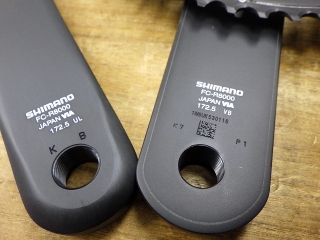
↑This is an FC-R8000 that our shop recently received,
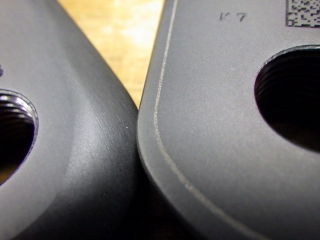
and only the right crank has mochi structure.
As I mentioned earlier,
it's useful to remember that
"11-speed cranks have mochi on both sides of Dura-Ace and the right side of Ultegra."
This crank is newer than the recall period,
and there's no plan to retrofit a power meter anyway.
Many people with experience of a mochi crank separating
have also had their power meter die with it,
and quite a few use only the left crank—
a non-mochi crank plus power meter combination.
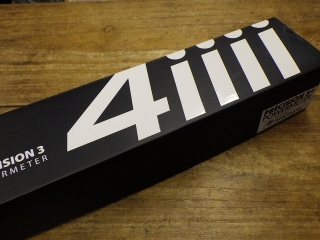
↑This is also a 4iiii (Four Eyes) power meter-equipped crank
that our shop recently received—
a Precision 3+ (Three Plus), which is their latest product—
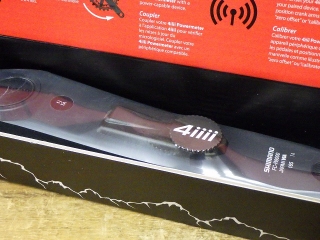
and the customer confirmed
"it's not mochi" before choosing
only the left crank from the R8000.
If they hadn't known, I would have explained it,
but it seems this is already fairly common knowledge in some circles.
Just to be thorough, I'm not saying that a non-mochi crank means
the power meter won't have issues.
It's just that it won't die due to a crank-side problem in the first place,
and since there's no other manufacturer (at least none that I know of) offering replacement service like Pioneer does,
if you're running a power meter on Shimano cranks,
the safest bet is to use only Ultegra or 105 left cranks.
The latest Dura-Ace FC-R9200,
the left crank has reverted to a forged hollow crank design.I wonder what happened there (deadpan).
Actually, mochi structure cranks do have a better weight-to-stiffness ratio than
conventional hollow cranks, and
if you tried to make the R9200 crankset the same weight as the R9100
while keeping the same stiffness, it wouldn't work,
so instead they matched the stiffness,
and as a result
the R9200 crankset is about 70g heavier than the R9100
when comparing the same chainring configurations.
This is something I wrote about when the R9200 Dura-Ace came out,
but comparing the FC-R7000 (the smallest 11-speed 105 crank at the time)
with a 170-50-34 configuration
to the R9200 (the largest R9200 crank at 170-54-40)
the weight difference is only about 15g.
The cranks subject to this recall are said to number
2.8 million units worldwide, or about
700,000 in North America alone,
(Edit: apparently 680,000 in the US plus 80,000 in Canada = 760,000 total)
but how this will be handled in Japan is still undetermined—
more details to come later.
North America has clearly stated "recall,"
though.
Edit: North American announcement and my thoughts
For third-party power meter-equipped cranks
(which Shimano considers "modifications"—
though before FC-R9100P there were no OEM options anyway),
they're apparently "specially" making them eligible for exchange too,
but it's unclear who pays for the power meter transfer
(or new installation if there isn't one).
Also, the replacement cranks might have different cosmetics
than the originals, but since 9000-series and R9100-series are both 11-speed,
you could probably create separate recall-exchange-only models
like FC-R9101 and FC-R8001 for Dura-Ace and Ultegra respectively
to make inventory management easier.
I can already see the future flooded with listings on Yahoo Auctions and Mercari...
Also, this exchange will almost certainly
mess up the delivery schedule for other products...
yesterday (September 21st) Shimano released
a statement acknowledging instances of crank adhesive separation.
This rigidity issue has actually
been well-known for a long time,
but due to Shimano's massive size and the reality that you have no choice but to use their products,
people have had to stay silent until now.
I'm sure many have just accepted their losses in silence.
Oh, just to be clear, this whole discussion so far has been about Hollowtech II cranks.
The affected models are
FC-9000, FC-R9100, FC-R9100P,
FC-6800, FC-R8000, and
basically the "11-speed Dura-Ace and Ultegra cranks,"
but while Shimano hasn't spelled it out explicitly,
the issue really only occurs with what I call the "mochi" structure cranks.
Before I get into that,
the affected manufacturing stamps are
KF~KL, LA~LL, MA~ML, NA~NL,
OA~OL, PA~PL, QA~QL, RA~RF.
When the first character continues to the next,
the second character always ends in L (the 12th letter of the alphabet),
so my blog readers will have no trouble recognizing
the manufacturing date code system for stamps (→here).
Shimano's statement says "up until June 30th, 2019,"
telling us the end date but keeping the start date hidden—
though KF is June 2012.
For the record, RF is June 2019.


↑This is the left crank of an FC-9000.

The manufacturing stamp is NH, so that's August 2015.

What I call "mochi structure" refers to
a structure where the crank is like a box lid glued shut—similar to a portable chopstick case lid.
You can tell if it's mochi or not by checking whether there's a thin seam line
on the back of the crank.

↑This is the part in the image, where
the aluminum is corroding and the adhesive is starting to separate.
With a normal mochi seam, you won't feel a step even if you scrape it with your fingernail,
but this part has enough of a step that your nail catches on it.
At this level, there probably wouldn't be any odd pedaling feel,
so detection while riding would be difficult... or so you'd think.
"Mochi structure started" with the FC-9000.
The FC-7700, 7800, 7900 were forged hollow cranks, but
starting around the FC-9000, the adoption of power meters
became common, and when
mochi separation happens on a crank with a power meter,
the crank deformation increases →
the power meter thinks "whoa, this much flex?
This guy must be putting down serious power!" and misreads it →
the power meter displays abnormally high wattage—
which is how mochi cracks started getting caught more often.
Sometimes, for whatever reason, the readings come out abnormally low instead.

There's a mark where something was attached,
and this is the mounting mark from a Pioneer Pedaling Monitor.
According to Pioneer, if the crank is the same length,
you don't need to recalibrate (← this is my speculation),
so if you source the same crank in the same length separately,
they'll replace the sensor for under 40,000 yen or so.
That's genuinely excellent service.
According to Shimano, all power meters including Pioneer
apply heat during the attachment process, which adversely affects the mochi,
so as for mochi separation on power meter-equipped cranks
(which are secondary modifications of their cranks),
their basic policy is "not our problem,"
and even at our shop, we once repaired a Racing Zero front wheel
from a customer whose non-shop-purchase power meter-equipped crank
separated spectacularly mid-pedal and he stuffed his shoe into the front wheel
and broke the spokes.
According to that customer, the moment Shimano heard the crank was power meter-equipped,
they acted delighted, insisted it was the power meter's fault, and
"as a special exception" agreed to replace it.
To my knowledge, mochi separation happens even on cranks without power meters,
and I don't think there's any meaningful difference based on whether a power meter is present or not.
For information on "soft crank guy" who had separation independent of a power meter
(→here),
check that link.

↑This is an FC-R8000 that our shop recently received,

and only the right crank has mochi structure.
As I mentioned earlier,
it's useful to remember that
"11-speed cranks have mochi on both sides of Dura-Ace and the right side of Ultegra."
This crank is newer than the recall period,
and there's no plan to retrofit a power meter anyway.
Many people with experience of a mochi crank separating
have also had their power meter die with it,
and quite a few use only the left crank—
a non-mochi crank plus power meter combination.

↑This is also a 4iiii (Four Eyes) power meter-equipped crank
that our shop recently received—
a Precision 3+ (Three Plus), which is their latest product—

and the customer confirmed
"it's not mochi" before choosing
only the left crank from the R8000.
If they hadn't known, I would have explained it,
but it seems this is already fairly common knowledge in some circles.
Just to be thorough, I'm not saying that a non-mochi crank means
the power meter won't have issues.
It's just that it won't die due to a crank-side problem in the first place,
and since there's no other manufacturer (at least none that I know of) offering replacement service like Pioneer does,
if you're running a power meter on Shimano cranks,
the safest bet is to use only Ultegra or 105 left cranks.
The latest Dura-Ace FC-R9200,
the left crank has reverted to a forged hollow crank design.
Actually, mochi structure cranks do have a better weight-to-stiffness ratio than
conventional hollow cranks, and
if you tried to make the R9200 crankset the same weight as the R9100
while keeping the same stiffness, it wouldn't work,
so instead they matched the stiffness,
and as a result
the R9200 crankset is about 70g heavier than the R9100
when comparing the same chainring configurations.
This is something I wrote about when the R9200 Dura-Ace came out,
but comparing the FC-R7000 (the smallest 11-speed 105 crank at the time)
with a 170-50-34 configuration
to the R9200 (the largest R9200 crank at 170-54-40)
the weight difference is only about 15g.
The cranks subject to this recall are said to number
2.8 million units worldwide, or about
700,000 in North America alone,
(Edit: apparently 680,000 in the US plus 80,000 in Canada = 760,000 total)
but how this will be handled in Japan is still undetermined—
more details to come later.
North America has clearly stated "recall,"
though.
Edit: North American announcement and my thoughts
For third-party power meter-equipped cranks
(which Shimano considers "modifications"—
though before FC-R9100P there were no OEM options anyway),
they're apparently "specially" making them eligible for exchange too,
but it's unclear who pays for the power meter transfer
(or new installation if there isn't one).
Also, the replacement cranks might have different cosmetics
than the originals, but since 9000-series and R9100-series are both 11-speed,
you could probably create separate recall-exchange-only models
like FC-R9101 and FC-R8001 for Dura-Ace and Ultegra respectively
to make inventory management easier.
Also, this exchange will almost certainly
mess up the delivery schedule for other products...
Products Mentioned in This Article
- 🛒 Shimano FC-9000 Hollowtech II crank
- 🛒 Shimano FC-R9100 Dura-Ace crank
- 🛒 Pioneer Pedaling Monitor power meter
- 🛒 4iiii Precision 3+ power meter
* Amazon affiliate links — prices may vary
Original Japanese post: のむラボ日記 #6852