I bought a USE Exposure light called the Axis
at the end of 2022
and wrote about it in January 2023 (→here),
but that was warehouse stock.
USE lights follow a model naming convention of "pet name + MK (number)"
with minor revisions repeated,
and what I bought was the Axis MK8.
I really like this light a lot.
The mode settings vary widely depending on runtime,
and it doesn't have that annoying
"flashing while illuminated mode" that I hate.
So at that time I ordered
the latest Axis model, the Axis MK9, from my distributor.
Since this was a verbal phone order
and the distributor handles Tni,
but the capital and management changed and
the company relocated from Kobe to Tokyo,
I thought the order might not have gone through.
But then, after a year and a half, it arrived properly.
Though it was the MK10, the latest model at the time of shipment.
I could have obtained it through overseas retailers,
but since I have a relationship with an authorized distributor,
I felt it would be disloyal to do that.
So I'm glad it arrived.
Below, there's considerable overlap
with the past article at the link,
but I'll start by writing about the Axis MK8.


The Axis MK8.

USE Exposure lights publish only the maximum lumens,
and for the Axis MK8,
the box says 1300 lumens,
while the marking on the unit itself says 1250 lumens.
With the shortest runtime being 1.5 hours,
the high setting when modes (PGM = program)
1, 4, or 8 are selected corresponds to 1250 lumens.
I normally use mode 5 with high 2 hours / low 6 hours,
and the high appears to be over 1000 lumens.
The low is noticeably different when I press the button to switch,
of course, but it doesn't look as dim
as you'd expect from the runtime being tripled,
so my operating method is
"always go to high when the light turns on →
immediately switch to low, high only for downhill sections on dark roads without street lights."

This is a bracket where the light fits into a plastic holder,
which is then secured to the handlebar with a rubber band.
In the article at the link I wrote that
it wouldn't sag,

but with time and vibration during riding,
the tip started to droop.
The manufacturer specifies that the part of the bracket
that the rubber catches should be long and hanging downward on the rear side,
but when I mount it front-to-back reversed,
the tip doesn't point
upward during riding vibration.
The light's weight distribution isn't
extremely biased toward either the front or rear.

So I discovered that keeping the bracket in the manufacturer's specified orientation
but positioning the light all the way toward the rear
relative to the bracket
keeps it from moving much.

I use the Axis MK8 with its marking facing straight up,

but the light's position relative to the bracket
started rotating and sliding forward,

so I've applied anti-slip
plastic tape on the inside of the bracket.
If you don't mind the ugly appearance,
wrapping thin cable ties around the body
prevents the light from sliding forward.

As I wrote in a recent article, the
RockMount cylindrical light or mobile battery holder
that secures with rubber bands or cable ties
can be mounted on a CatEye H-34 bracket, making attachment secure.
But I like the lightness of the USE bracket,
so I don't use this on the road bike.
I do plan to use it on the gravel bike Niner
to mount the Axis under the SRAM Cura crankset,
and I'll use this then.

The box for the Axis MK10.

Both the MK8 and MK10 have
stickers on the box stating 1300 lumens.


All current models now come in gunmetal color.

The marking on the unit has been changed
to 1300 lumens for the MK10.
Actually, according to the manufacturer's classification,
the Axis is not a road-use light.

The 2024 catalog came with the light.
USE lights,
because the price per lumen is high →
"For that claimed brightness, other companies have cheaper options!"
or the absolute price is high →
"I can't spend that much on a light!"
I think they don't sell well in Japan for these reasons.
The Axis MK10 I ordered was set at
a pre-tax suggested retail price of 26,000 yen
based on the distributor's pricing at the time,
but if ordering now the pre-tax suggested retail price is 37,000 yen,
with a tax-included price of 40,700 yen.

First, the MTB models.

Six Pack, Max-D,

Toro, and Race—four models that
are operated with what the company calls a QR bracket,
an aluminum handlebar-mount bracket.
Listing the model number, claimed lumens, and claimed weight:
Six Pack MK13 3900 lumens 386g
Max-D MK15 2900 lumens 310g
Toro MK14 2250 lumens 236g
Race MK17 1700 lumens 186g
These models are not listed on the Japanese distributor's website,
but they feature "SYNC," a Bluetooth function that connects with an app,
so the distributor lists
Six Pack SYNC MK5 at 104,500 yen tax-included and
Max-D SYNC MK5 at 91,300 yen tax-included.
The SYNC models and
the latest Six Pack and Max-D
have the same claimed lumens and weight.
The Max-D MK8 and MK6 from before the SYNC era
remain at the distributor with prices of 53,350 yen and 46,200 yen tax-included respectively,
so please buy them.
The MK6 should be a model from about 10 years ago.

These four models feature
Reflex+ Technology
(the icon shows overlapping plus signs),

where the light detects vibrations like riding on rough terrain
and becomes even brighter.
For the Six Pack this goes up to
a claimed 5450 lumens maximum.
In other words, if you ride mostly on unpaved roads,
runtime gets shorter.
The last of the above four models, Race
(no SYNC version available), is also listed on the Japanese distributor's site.
It says "Race is an ultra-lightweight light with 2600 lumens, but..." but
this is with Reflex+ active;
the normal maximum is 1700 lumens.
The tax-included price is 52,800 yen.

Next, the four MTB models not using the QR bracket system.
Zenith, Diablo,

Axis, and Joystick,

but in this manufacturer's intended use chart,
they're not classified as road-suitable.
There's a reason for this, but first here are
the model numbers, claimed lumens, claimed weight, and
Japanese distributor tax-included prices:
Zenith MK3 2200 lumens 150g
Diablo MK14 2000 lumens 120g 45,100 yen
Axis MK10 1300 lumens 186g 40,700 yen
Joystick MK17 1150 lumens 93g 35,200 yen
Zenith is not listed on the Japanese distributor's site.
The weight listed for Axis MK10 seems off, but that's what the source says.
My actual measurement was 102g.
Of these four models, only Diablo has a SYNC version:
Diablo SYNC MK5 at 55,000 yen tax-included.

SYNC models allow one switch to control
two lights' on/off simultaneously, so
the manufacturer's catalog suggests
bundled set proposals like this.
Now, why these four non-QR bracket models
aren't considered road-suitable is

because they're primarily intended for helmet-mount use.
The plastic M6 bolts of different lengths are included
to accommodate different helmet shell thicknesses.
For this use, the helmet must have
a hole on the crown (this is essential),
and ideally an odd number of holes (3, 5, etc.)
so it can be centered.

↑This part is a ball joint
allowing you to change the angle.
USE positions the Axis as a top-beam light,
but since the company's road models seemed a bit bulky to me,
I went with the Axis.
I originally planned to buy the Diablo,
but since there was no stock available for immediate delivery, I chose the Axis instead.

About the models USE recommends for roads.


"QR bracket models without Reflex+ function, smaller than the MTB versions"
—in that vein,
there are four Strada models.
Regarding brightness,
there's Strada SB (Super Bright) at 1700 lumens 230g and
Strada RS (Road Sport) at 1450 lumens 183g,
and each has a version with "AKTiv,"
which detects oncoming vehicles and automatically switches to low beam,
then returns to high beam when the vehicle passes—so four versions total.
All are listed on the Japanese distributor's site, with tax-included prices of
Strada SB AKTiv 74,000 yen
Strada SB 63,800 yen
Strada RS AKTiv 60,500 yen
Strada RS 55,000 yen

Honestly, I don't understand why
the Strada's radar chart
differs so much from the MTB models.

In the catalog there's a rubber-band bracket road model
called Sirius MK10
950 lumens 84g, but
it's not listed on the Japanese distributor's site.

About light accessories.
When I bought the Axis MK8,
a USB charging cable was included.
Besides normal charging, this can also be used
to power the light from a commercial mobile battery.

↑On the left is the AC charger that came with the Axis MK8,
on the right is a separately sold AC charger.
The left one used to be called "Smart Charger"
and the right one "Fast Charger"
when the Japanese distributor sold them.
With the separately sold charger, the Fast Charger
came with a warning not to use it on models from before a certain year (←I forgot which),
and the Axis MK8 was compatible with Fast Chargers, so I bought it.
But both chargers in the image above have 4.2V output marked on them
and are identical in all other specs.
Looking at the USE manufacturer website,
in the accessories section
there are lower-output chargers for older lights,
with 2.8V and 1.5V options in addition to 4.2V.
But those pages don't list compatible models.
My guess is that the left-style charger
with 2.8V output was called "Smart Charger"
and sold by the Japanese distributor,
while the Axis MK8 bundled charger
has the "Smart Charger" appearance
but with 4.2V output.
If someone buys the Max-D MK6 that still sits at the distributor,
it probably comes with
a 2.8V "Smart Charger."
Someone please buy it.
I bought an extra AC charger
because I wanted to charge the light at both home and the shop.

The charger came with
an adapter compatible with Japanese outlets.
With overseas retailers, you might get stuck here.

Piggyback is a USE light-specific external battery.
I added the blue connector cover
for waterproofing.

This is a single-cell with just one battery inside,
but there's also a triple-cell with three bunched together.
Even then, the cross-section isn't clover-shaped
but cylindrical.
Piggyback has been updated to "Support Cell,"
which has a coiled cord between the cylinder and connector.
Capacities come in 8.7A, 3.4A, and 1.7A,
but strictly speaking it's not an external battery—
it extends runtime of a lit light,
with the specs such that it won't provide power if the light's battery is nearly dead.
Well, I'm writing all this explanation at length,
but it's not listed on the Japanese distributor's site.

Both Piggyback and chargers
have male connectors, so

charging the Piggyback requires
the bundled dual-female adapter.
Lose this and the Piggyback becomes
garbage (and awkward garbage to dispose of).
Support Cell charging also requires something similar,
sold as Support Cell Connector
(labeled Exposure, not Piggyback).

I've decided not to use images except selfies,
but here's a Support Cell 3.4A image from the manufacturer's site.
The part that plugs into the light's storm cap
looks to have high waterproof capability—nice.

Axis MK10 accessories.
They're hard to see in the case, so

I dumped them on the desk.
Helmet bracket, handlebar bracket,
strap (this also came with the Axis MK8),
and a charger,

but this AC charger
has its cord replaced with a
USB cable,

and apart from that it's identical
to the Fast Charger in specs like 4.2V output.
USE lights have a transparent rear that shows
battery status by the light's color and behavior during use.
When fully charged it glows green steady,
then progresses through green flashing → amber steady → amber flashing → red steady → red flashing.
If you keep using it on red flashing,
the front light starts twinkling roughly once every 70 seconds.
This happens about 20 times (dependent on runtime),
a final warning that the battery is critically low.
The danger is that it could suddenly go out on a dark downhill,
but it warns repeatedly before that happens.
For a given runtime, the rear display timing is roughly equal for each state,
with only red flashing slightly longer (perhaps dimmer).
For instance, if green steady lasts about
30 minutes on a certain runtime,
then green flashing through red steady each last about 30 minutes,
red flashing about 40 minutes, and red flashing with twinkling about 40 minutes.
I wrote "orange" to mean amber (amber = amber color),
which is the original term, and the Japanese distributor's manual
also says amber, but since I wanted a single character I used "orange."
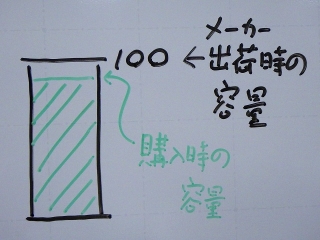
However, as the internal battery ages,
these times don't shrink equally.
Only the initial green steady time gets shorter.
In my Axis MK8 this was evident
from early on (the distributor presumably had it in stock for years),br/>so I investigated
how the Axis MK10 behaves.
As I mentioned earlier,
I use mode 5 with high 2 hours / low 6 hours,
turning on high briefly then switching to low immediately,
but "fully charged" has some range—
right after the charger's light turns green (charge complete)
versus after sitting for half a day shows
different initial green steady times of about 15 minutes and 40 minutes respectively.
From what I call the true full charge
(half a day sitting after charge complete)
I set both the Axis MK8 and MK10
to 1.5-hour runtime
(↑to shorten experiment time)
and turned them on simultaneously, marking
with cycle computers (Polar and Karoo)
when I noticed the rear light color change.
There may be minor error, but during
the experiment I didn't look away
for more than a minute.
I've even caught the color change at traffic lights.

Starting with Axis MK8.
Green steady is only about 1 minute.
If the battery ages further,
the brightest 1.5-hour runtime might show
no green steady at all.
The normal duration for green steady through red steady
seems to be about 13 minutes each.
Shutdown came at 1 hour 33 minutes.
Honestly, I thought this would fall short of the claimed
1.5-hour runtime, so I'm surprised.

Next, Axis MK10.
Wow, green steady is obviously much shorter!
And there are sections where it's slightly behind Axis MK8.
By red steady shutdown,
it's only kept the 2-minute gap from green steady.
My guess is that by the MK8 or even before,
USE sourced the same-era cells
for both units.
The MK8 has undergone at least 150 charge cycles,
and I consider the degradation light for that.
Also, according to the unit markings,
Axis MK8's max lumens are 1250
and Axis MK10's are 1300,
but the stickers on the boxes originally said both were 1300,
so I don't think the 50-lumen difference disadvantages
MK10.
Actually, I suspect both are the same and the difference is fake.
I ran the same experiment at 3-hour runtime
shortly after purchase (→here),
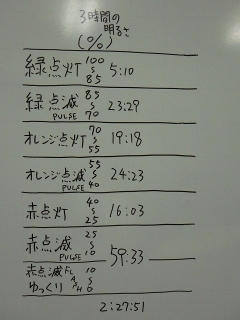
and I'll post the image from that article.
The trend of shorter green steady time is the same,
and I couldn't distinguish the border between red flashing and red warning,
so I combined them.
This didn't reach the claimed runtime,
possibly because true full charge wasn't achieved.
USE Exposure lights
have sat in the distributor's inventory for years since I phoned in
"I'll wait forever—give me Axis MK9" without negotiating,
and the current model is MK10.
If the price were lower I'd recommend them more,
but since it's British-made by a British manufacturer
priced in pounds, the price hikes these past years have been brutal.
But because I made that stubborn phone call,
the distributor must resume dealing with USE,
and they're now calling shops to take orders for USE lights.
Excluding the leftover Max-D,
every model on the distributor's site—
Six Pack SYNC, Max-D SYNC,
Diablo SYNC, Race, four Strada variants,
Diablo, Axis, Joystick—all
are out of stock.
Will the new order bring inventory?
They do cost tens of thousands to over 100,000 yen,
but I like them.
If you're interested, please order
a USE light at your local shop.
at the end of 2022
and wrote about it in January 2023 (→here),
but that was warehouse stock.
USE lights follow a model naming convention of "pet name + MK (number)"
with minor revisions repeated,
and what I bought was the Axis MK8.
I really like this light a lot.
The mode settings vary widely depending on runtime,
and it doesn't have that annoying
"flashing while illuminated mode" that I hate.
So at that time I ordered
the latest Axis model, the Axis MK9, from my distributor.
Since this was a verbal phone order
and the distributor handles Tni,
but the capital and management changed and
the company relocated from Kobe to Tokyo,
I thought the order might not have gone through.
But then, after a year and a half, it arrived properly.
Though it was the MK10, the latest model at the time of shipment.
I could have obtained it through overseas retailers,
but since I have a relationship with an authorized distributor,
I felt it would be disloyal to do that.
So I'm glad it arrived.
Below, there's considerable overlap
with the past article at the link,
but I'll start by writing about the Axis MK8.


The Axis MK8.

USE Exposure lights publish only the maximum lumens,
and for the Axis MK8,
the box says 1300 lumens,
while the marking on the unit itself says 1250 lumens.
With the shortest runtime being 1.5 hours,
the high setting when modes (PGM = program)
1, 4, or 8 are selected corresponds to 1250 lumens.
I normally use mode 5 with high 2 hours / low 6 hours,
and the high appears to be over 1000 lumens.
The low is noticeably different when I press the button to switch,
of course, but it doesn't look as dim
as you'd expect from the runtime being tripled,
so my operating method is
"always go to high when the light turns on →
immediately switch to low, high only for downhill sections on dark roads without street lights."

This is a bracket where the light fits into a plastic holder,
which is then secured to the handlebar with a rubber band.
In the article at the link I wrote that
it wouldn't sag,

but with time and vibration during riding,
the tip started to droop.
The manufacturer specifies that the part of the bracket
that the rubber catches should be long and hanging downward on the rear side,
but when I mount it front-to-back reversed,
the tip doesn't point
upward during riding vibration.
The light's weight distribution isn't
extremely biased toward either the front or rear.

So I discovered that keeping the bracket in the manufacturer's specified orientation
but positioning the light all the way toward the rear
relative to the bracket
keeps it from moving much.

I use the Axis MK8 with its marking facing straight up,

but the light's position relative to the bracket
started rotating and sliding forward,

so I've applied anti-slip
plastic tape on the inside of the bracket.
If you don't mind the ugly appearance,
wrapping thin cable ties around the body
prevents the light from sliding forward.

As I wrote in a recent article, the
RockMount cylindrical light or mobile battery holder
that secures with rubber bands or cable ties
can be mounted on a CatEye H-34 bracket, making attachment secure.
But I like the lightness of the USE bracket,
so I don't use this on the road bike.
I do plan to use it on the gravel bike Niner
to mount the Axis under the SRAM Cura crankset,
and I'll use this then.

The box for the Axis MK10.

Both the MK8 and MK10 have
stickers on the box stating 1300 lumens.


All current models now come in gunmetal color.

The marking on the unit has been changed
to 1300 lumens for the MK10.
Actually, according to the manufacturer's classification,
the Axis is not a road-use light.

The 2024 catalog came with the light.
USE lights,
because the price per lumen is high →
"For that claimed brightness, other companies have cheaper options!"
or the absolute price is high →
"I can't spend that much on a light!"
I think they don't sell well in Japan for these reasons.
The Axis MK10 I ordered was set at
a pre-tax suggested retail price of 26,000 yen
based on the distributor's pricing at the time,
but if ordering now the pre-tax suggested retail price is 37,000 yen,
with a tax-included price of 40,700 yen.

First, the MTB models.

Six Pack, Max-D,

Toro, and Race—four models that
are operated with what the company calls a QR bracket,
an aluminum handlebar-mount bracket.
Listing the model number, claimed lumens, and claimed weight:
Six Pack MK13 3900 lumens 386g
Max-D MK15 2900 lumens 310g
Toro MK14 2250 lumens 236g
Race MK17 1700 lumens 186g
These models are not listed on the Japanese distributor's website,
but they feature "SYNC," a Bluetooth function that connects with an app,
so the distributor lists
Six Pack SYNC MK5 at 104,500 yen tax-included and
Max-D SYNC MK5 at 91,300 yen tax-included.
The SYNC models and
the latest Six Pack and Max-D
have the same claimed lumens and weight.
The Max-D MK8 and MK6 from before the SYNC era
remain at the distributor with prices of 53,350 yen and 46,200 yen tax-included respectively,
so please buy them.
The MK6 should be a model from about 10 years ago.

These four models feature
Reflex+ Technology
(the icon shows overlapping plus signs),

where the light detects vibrations like riding on rough terrain
and becomes even brighter.
For the Six Pack this goes up to
a claimed 5450 lumens maximum.
In other words, if you ride mostly on unpaved roads,
runtime gets shorter.
The last of the above four models, Race
(no SYNC version available), is also listed on the Japanese distributor's site.
It says "Race is an ultra-lightweight light with 2600 lumens, but..." but
this is with Reflex+ active;
the normal maximum is 1700 lumens.
The tax-included price is 52,800 yen.

Next, the four MTB models not using the QR bracket system.
Zenith, Diablo,

Axis, and Joystick,

but in this manufacturer's intended use chart,
they're not classified as road-suitable.
There's a reason for this, but first here are
the model numbers, claimed lumens, claimed weight, and
Japanese distributor tax-included prices:
Zenith MK3 2200 lumens 150g
Diablo MK14 2000 lumens 120g 45,100 yen
Axis MK10 1300 lumens 186g 40,700 yen
Joystick MK17 1150 lumens 93g 35,200 yen
Zenith is not listed on the Japanese distributor's site.
The weight listed for Axis MK10 seems off, but that's what the source says.
My actual measurement was 102g.
Of these four models, only Diablo has a SYNC version:
Diablo SYNC MK5 at 55,000 yen tax-included.

SYNC models allow one switch to control
two lights' on/off simultaneously, so
the manufacturer's catalog suggests
bundled set proposals like this.
Now, why these four non-QR bracket models
aren't considered road-suitable is

because they're primarily intended for helmet-mount use.
The plastic M6 bolts of different lengths are included
to accommodate different helmet shell thicknesses.
For this use, the helmet must have
a hole on the crown (this is essential),
and ideally an odd number of holes (3, 5, etc.)
so it can be centered.

↑This part is a ball joint
allowing you to change the angle.
USE positions the Axis as a top-beam light,
but since the company's road models seemed a bit bulky to me,
I went with the Axis.
I originally planned to buy the Diablo,
but since there was no stock available for immediate delivery, I chose the Axis instead.

About the models USE recommends for roads.


"QR bracket models without Reflex+ function, smaller than the MTB versions"
—in that vein,
there are four Strada models.
Regarding brightness,
there's Strada SB (Super Bright) at 1700 lumens 230g and
Strada RS (Road Sport) at 1450 lumens 183g,
and each has a version with "AKTiv,"
which detects oncoming vehicles and automatically switches to low beam,
then returns to high beam when the vehicle passes—so four versions total.
All are listed on the Japanese distributor's site, with tax-included prices of
Strada SB AKTiv 74,000 yen
Strada SB 63,800 yen
Strada RS AKTiv 60,500 yen
Strada RS 55,000 yen

Honestly, I don't understand why
the Strada's radar chart
differs so much from the MTB models.

In the catalog there's a rubber-band bracket road model
called Sirius MK10
950 lumens 84g, but
it's not listed on the Japanese distributor's site.

About light accessories.
When I bought the Axis MK8,
a USB charging cable was included.
Besides normal charging, this can also be used
to power the light from a commercial mobile battery.

↑On the left is the AC charger that came with the Axis MK8,
on the right is a separately sold AC charger.
The left one used to be called "Smart Charger"
and the right one "Fast Charger"
when the Japanese distributor sold them.
With the separately sold charger, the Fast Charger
came with a warning not to use it on models from before a certain year (←I forgot which),
and the Axis MK8 was compatible with Fast Chargers, so I bought it.
But both chargers in the image above have 4.2V output marked on them
and are identical in all other specs.
Looking at the USE manufacturer website,
in the accessories section
there are lower-output chargers for older lights,
with 2.8V and 1.5V options in addition to 4.2V.
But those pages don't list compatible models.
My guess is that the left-style charger
with 2.8V output was called "Smart Charger"
and sold by the Japanese distributor,
while the Axis MK8 bundled charger
has the "Smart Charger" appearance
but with 4.2V output.
If someone buys the Max-D MK6 that still sits at the distributor,
it probably comes with
a 2.8V "Smart Charger."
Someone please buy it.
I bought an extra AC charger
because I wanted to charge the light at both home and the shop.

The charger came with
an adapter compatible with Japanese outlets.
With overseas retailers, you might get stuck here.

Piggyback is a USE light-specific external battery.
I added the blue connector cover
for waterproofing.

This is a single-cell with just one battery inside,
but there's also a triple-cell with three bunched together.
Even then, the cross-section isn't clover-shaped
but cylindrical.
Piggyback has been updated to "Support Cell,"
which has a coiled cord between the cylinder and connector.
Capacities come in 8.7A, 3.4A, and 1.7A,
but strictly speaking it's not an external battery—
it extends runtime of a lit light,
with the specs such that it won't provide power if the light's battery is nearly dead.
Well, I'm writing all this explanation at length,
but it's not listed on the Japanese distributor's site.

Both Piggyback and chargers
have male connectors, so

charging the Piggyback requires
the bundled dual-female adapter.
Lose this and the Piggyback becomes
garbage (and awkward garbage to dispose of).
Support Cell charging also requires something similar,
sold as Support Cell Connector
(labeled Exposure, not Piggyback).

I've decided not to use images except selfies,
but here's a Support Cell 3.4A image from the manufacturer's site.
The part that plugs into the light's storm cap
looks to have high waterproof capability—nice.

Axis MK10 accessories.
They're hard to see in the case, so

I dumped them on the desk.
Helmet bracket, handlebar bracket,
strap (this also came with the Axis MK8),
and a charger,

but this AC charger
has its cord replaced with a
USB cable,

and apart from that it's identical
to the Fast Charger in specs like 4.2V output.
USE lights have a transparent rear that shows
battery status by the light's color and behavior during use.
When fully charged it glows green steady,
then progresses through green flashing → amber steady → amber flashing → red steady → red flashing.
If you keep using it on red flashing,
the front light starts twinkling roughly once every 70 seconds.
This happens about 20 times (dependent on runtime),
a final warning that the battery is critically low.
The danger is that it could suddenly go out on a dark downhill,
but it warns repeatedly before that happens.
For a given runtime, the rear display timing is roughly equal for each state,
with only red flashing slightly longer (perhaps dimmer).
For instance, if green steady lasts about
30 minutes on a certain runtime,
then green flashing through red steady each last about 30 minutes,
red flashing about 40 minutes, and red flashing with twinkling about 40 minutes.
I wrote "orange" to mean amber (amber = amber color),
which is the original term, and the Japanese distributor's manual
also says amber, but since I wanted a single character I used "orange."
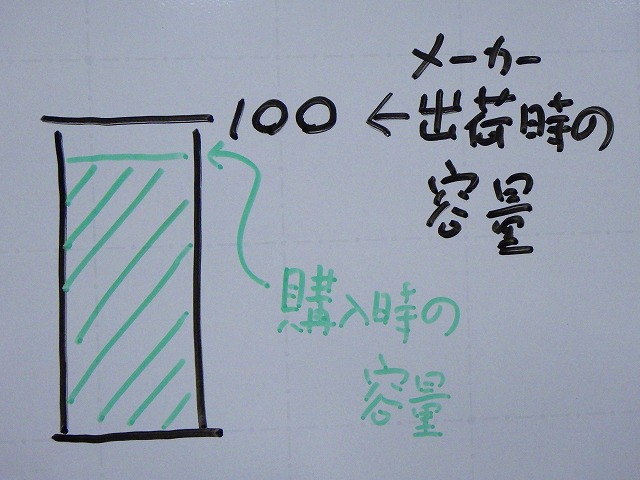
However, as the internal battery ages,
these times don't shrink equally.
Only the initial green steady time gets shorter.
In my Axis MK8 this was evident
from early on (the distributor presumably had it in stock for years),br/>so I investigated
how the Axis MK10 behaves.
As I mentioned earlier,
I use mode 5 with high 2 hours / low 6 hours,
turning on high briefly then switching to low immediately,
but "fully charged" has some range—
right after the charger's light turns green (charge complete)
versus after sitting for half a day shows
different initial green steady times of about 15 minutes and 40 minutes respectively.
From what I call the true full charge
(half a day sitting after charge complete)
I set both the Axis MK8 and MK10
to 1.5-hour runtime
(↑to shorten experiment time)
and turned them on simultaneously, marking
with cycle computers (Polar and Karoo)
when I noticed the rear light color change.
There may be minor error, but during
the experiment I didn't look away
for more than a minute.
I've even caught the color change at traffic lights.

Starting with Axis MK8.
Green steady is only about 1 minute.
If the battery ages further,
the brightest 1.5-hour runtime might show
no green steady at all.
The normal duration for green steady through red steady
seems to be about 13 minutes each.
Shutdown came at 1 hour 33 minutes.
Honestly, I thought this would fall short of the claimed
1.5-hour runtime, so I'm surprised.

Next, Axis MK10.
Wow, green steady is obviously much shorter!
And there are sections where it's slightly behind Axis MK8.
By red steady shutdown,
it's only kept the 2-minute gap from green steady.
My guess is that by the MK8 or even before,
USE sourced the same-era cells
for both units.
The MK8 has undergone at least 150 charge cycles,
and I consider the degradation light for that.
Also, according to the unit markings,
Axis MK8's max lumens are 1250
and Axis MK10's are 1300,
but the stickers on the boxes originally said both were 1300,
so I don't think the 50-lumen difference disadvantages
MK10.
Actually, I suspect both are the same and the difference is fake.
I ran the same experiment at 3-hour runtime
shortly after purchase (→here),
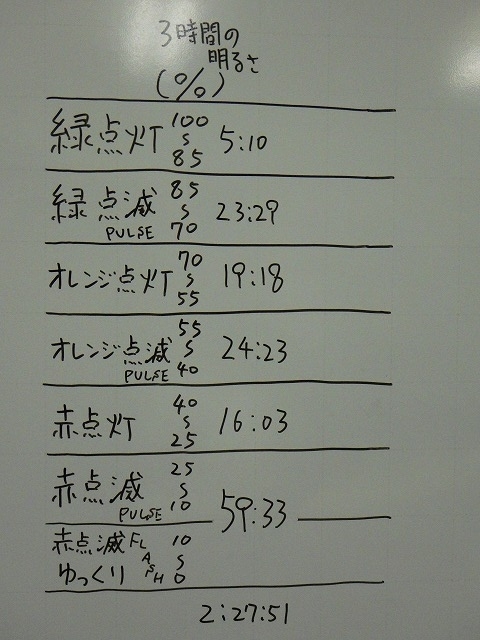
and I'll post the image from that article.
The trend of shorter green steady time is the same,
and I couldn't distinguish the border between red flashing and red warning,
so I combined them.
This didn't reach the claimed runtime,
possibly because true full charge wasn't achieved.
USE Exposure lights
have sat in the distributor's inventory for years since I phoned in
"I'll wait forever—give me Axis MK9" without negotiating,
and the current model is MK10.
If the price were lower I'd recommend them more,
but since it's British-made by a British manufacturer
priced in pounds, the price hikes these past years have been brutal.
But because I made that stubborn phone call,
the distributor must resume dealing with USE,
and they're now calling shops to take orders for USE lights.
Excluding the leftover Max-D,
every model on the distributor's site—
Six Pack SYNC, Max-D SYNC,
Diablo SYNC, Race, four Strada variants,
Diablo, Axis, Joystick—all
are out of stock.
Will the new order bring inventory?
They do cost tens of thousands to over 100,000 yen,
but I like them.
If you're interested, please order
a USE light at your local shop.