A customer's FC-6750 crankset had abnormally worn tooth tips on the
50T outer chainring, so

I replaced it with a Stronglight 49T.
The FC-6750 is from the era of the 7900-series Dura-Ace,
but it's the 6700-series Ultegra crankset version with
a 110mm PCD compact chainring, not the 130mm PCD FC-6700.
Shimano has no intention of stocking spare parts from this era,
and if you just install a regular flat chainring,
a step appears between it and the crank arm,
which looks bad. The claw-like nuts that fill that gap
are extremely difficult to obtain, so
I sourced an outer chainring from Stronglight
that has a shape continuous with the crank arm.
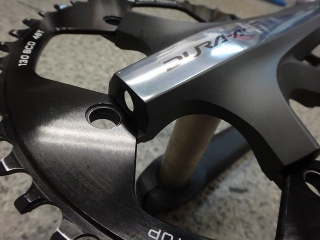
↑This is quoted from a past post—
my personal FC-7900—
and the part that fills this gap
was available from Praxis Works (now Praxis).
You can find it by searching "praxis works 7900 bolt kit."
By the way, the 7900 and 7950 versions
have different shapes and aren't compatible.

Stronglight offers this chainring in 1T increments from 48T to 53T
(plus a 46T option), but
for replacement purposes, the only one that makes sense to sell is
the 50T, which of course was sold out.
I asked the customer whether a 51T or 49T
would work better than the original 50T,
and they chose 49T, so that's what I sourced.
I wasn't trying to hoard them, by the way—
it was literally the last one.
If they'd chosen 51T, the front capacity would exceed 16T
with the 34T inner, so
49T is the safer choice.

The original 50T never had tooth clearance correction done,
and with the 49T the clearance became slightly more noticeable, so
I decided to correct it.
"Tooth clearance" is a term I coined for this blog—
it refers to the increasing gap between the front derailleur cage
and the chainring teeth as you move toward the rear.
Most modern frames and
standard cranksets for general use have
"a seat angle close to 75° (steep) and
a 50T outer chainring," both of which are poor conditions for tooth clearance.
But if you design the cage shape to prevent clearance with those conditions,
then on a road racer (not a road bike) with
"a seat angle close to 72° (slack) and
a 53T outer chainring,"
you risk causing "reverse clearance."
So with the "modern frame + 50T outer chainring"
combination, some tooth clearance is inevitable with the cage shape.
Or you could offer two front derailleur types in the same groupset.
With electronic groupsets, it might not matter—
you don't need precise adjustment of where on the inner cage
the motor scoops up the chain, and even if the rider has zero skill
(like unweighting and then powering up when shifting to the outer on a climb),
the motor just forces it through with brute power,
so it's probably irrelevant.
In the image above, the front derailleur is mounted on a rivet-brazed boss,
but doing tooth clearance correction there could damage the boss, so

I move it to a dedicated correction jig first.
The correction method itself isn't my invention—
I learned it at a Shimano technical seminar back in the day,
but it's not in Shimano's manuals.

Before
(note that the front derailleur height is still set for the 50T)

After
With SRAM road groupsets,
starting from 11-speed and assuming a minimum sprocket of 10T,
their front double cranksets with the largest tooth count come in 50–37T,
and then both sizes decrease by 2T in each subsequent step:
48–35T, 46–33T, etc.
All of these have a 13T difference.
So SRAM front derailleurs have the connecting section
between the outer and inner cage higher up than
Shimano front derailleurs, which are designed for a 16T difference.
So if you run a fully SRAM groupset but swap just the crankset
for a Shimano with 16T difference like 50–34T or 52–36T,
when you shift to inner-small (inner×top),
the chain tends to ride up on the left-right connector of the front derailleur
(how much depends on frame hanger drop and other factors).
Shimano claims their front derailleur has a 16T capacity,
and in most of their installation examples
tooth clearance does occur, yet
the chain never rides up on the derailleur connector with inner×top
(except in some extreme cases like small-wheeled bikes with unusual BB positioning).
There's some design margin built in.
Tooth clearance correction doesn't increase the front derailleur's capacity,
but if the customer's choice had been 51T,
and if correcting the clearance allowed me to position the
left-right connector lower than it would be uncorrected at 50×34T,
then with the correction at 51×34T, I could have achieved
"with a 17T difference, inner×top no longer risks
derailleur-chain contact—effectively gaining pseudo-capacity,"
which would have made swapping to 51T
rather than 49T more valuable as a blog post.
50T outer chainring, so

I replaced it with a Stronglight 49T.
The FC-6750 is from the era of the 7900-series Dura-Ace,
but it's the 6700-series Ultegra crankset version with
a 110mm PCD compact chainring, not the 130mm PCD FC-6700.
Shimano has no intention of stocking spare parts from this era,
and if you just install a regular flat chainring,
a step appears between it and the crank arm,
which looks bad. The claw-like nuts that fill that gap
are extremely difficult to obtain, so
I sourced an outer chainring from Stronglight
that has a shape continuous with the crank arm.
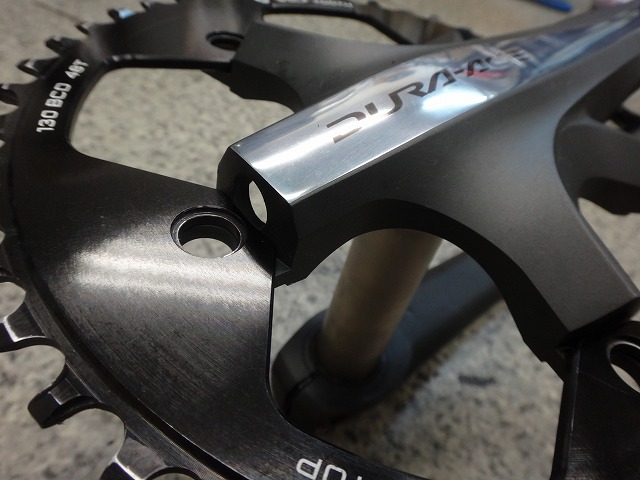
↑This is quoted from a past post—
my personal FC-7900—
and the part that fills this gap
was available from Praxis Works (now Praxis).
You can find it by searching "praxis works 7900 bolt kit."
By the way, the 7900 and 7950 versions
have different shapes and aren't compatible.

Stronglight offers this chainring in 1T increments from 48T to 53T
(plus a 46T option), but
for replacement purposes, the only one that makes sense to sell is
the 50T, which of course was sold out.
I asked the customer whether a 51T or 49T
would work better than the original 50T,
and they chose 49T, so that's what I sourced.
I wasn't trying to hoard them, by the way—
it was literally the last one.
If they'd chosen 51T, the front capacity would exceed 16T
with the 34T inner, so
49T is the safer choice.

The original 50T never had tooth clearance correction done,
and with the 49T the clearance became slightly more noticeable, so
I decided to correct it.
"Tooth clearance" is a term I coined for this blog—
it refers to the increasing gap between the front derailleur cage
and the chainring teeth as you move toward the rear.
Most modern frames and
standard cranksets for general use have
"a seat angle close to 75° (steep) and
a 50T outer chainring," both of which are poor conditions for tooth clearance.
But if you design the cage shape to prevent clearance with those conditions,
then on a road racer (not a road bike) with
"a seat angle close to 72° (slack) and
a 53T outer chainring,"
you risk causing "reverse clearance."
So with the "modern frame + 50T outer chainring"
combination, some tooth clearance is inevitable with the cage shape.
Or you could offer two front derailleur types in the same groupset.
With electronic groupsets, it might not matter—
you don't need precise adjustment of where on the inner cage
the motor scoops up the chain, and even if the rider has zero skill
(like unweighting and then powering up when shifting to the outer on a climb),
the motor just forces it through with brute power,
so it's probably irrelevant.
In the image above, the front derailleur is mounted on a rivet-brazed boss,
but doing tooth clearance correction there could damage the boss, so

I move it to a dedicated correction jig first.
The correction method itself isn't my invention—
I learned it at a Shimano technical seminar back in the day,
but it's not in Shimano's manuals.

Before
(note that the front derailleur height is still set for the 50T)

After
With SRAM road groupsets,
starting from 11-speed and assuming a minimum sprocket of 10T,
their front double cranksets with the largest tooth count come in 50–37T,
and then both sizes decrease by 2T in each subsequent step:
48–35T, 46–33T, etc.
All of these have a 13T difference.
So SRAM front derailleurs have the connecting section
between the outer and inner cage higher up than
Shimano front derailleurs, which are designed for a 16T difference.
So if you run a fully SRAM groupset but swap just the crankset
for a Shimano with 16T difference like 50–34T or 52–36T,
when you shift to inner-small (inner×top),
the chain tends to ride up on the left-right connector of the front derailleur
(how much depends on frame hanger drop and other factors).
Shimano claims their front derailleur has a 16T capacity,
and in most of their installation examples
tooth clearance does occur, yet
the chain never rides up on the derailleur connector with inner×top
(except in some extreme cases like small-wheeled bikes with unusual BB positioning).
There's some design margin built in.
Tooth clearance correction doesn't increase the front derailleur's capacity,
but if the customer's choice had been 51T,
and if correcting the clearance allowed me to position the
left-right connector lower than it would be uncorrected at 50×34T,
then with the correction at 51×34T, I could have achieved
"with a 17T difference, inner×top no longer risks
derailleur-chain contact—effectively gaining pseudo-capacity,"
which would have made swapping to 51T
rather than 49T more valuable as a blog post.