The whiteboard is getting a lot of use. Really glad I bought it.
Today I'm thinking about the weight per millimeter of spoke.
Though to be precise, that's not quite the right way to express it—
strictly speaking, it's "the weight when an X mm spoke is divided into X segments from the center of the spoke."
I'm just calling that the weight per mm.
I know this sounds confusing, but I'll take my time explaining below.
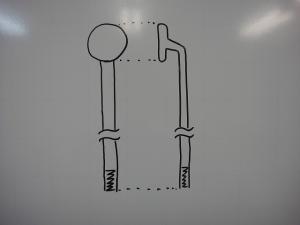
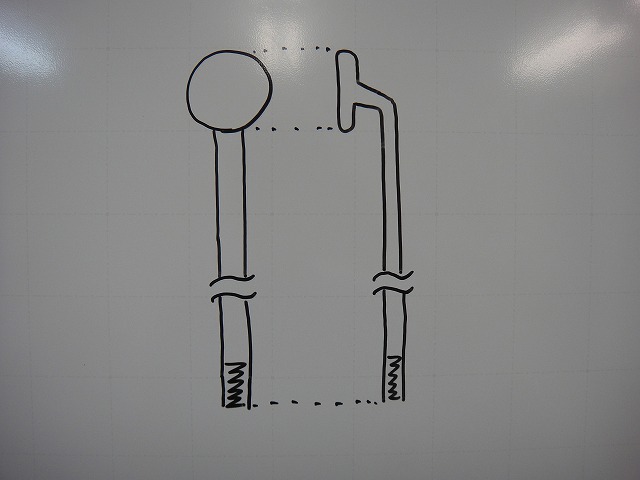
↑This is a spoke. Please bear with my childish drawings (laugh).
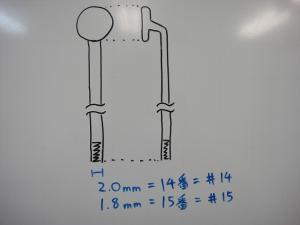
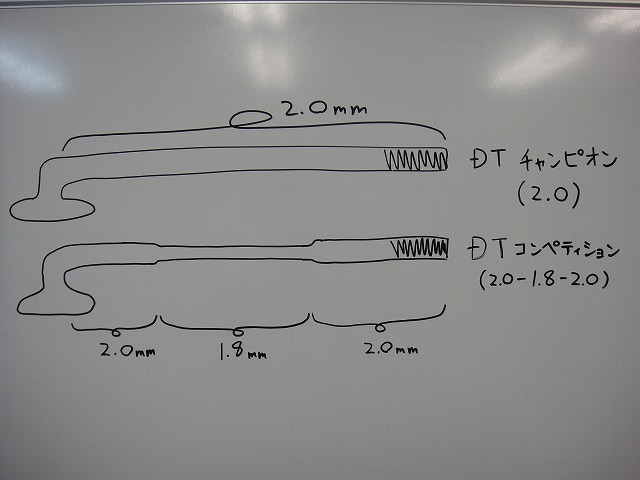
Spoke thickness on sport bikes is basically limited to two types shown above.
2.0 mm diameter and 1.8 mm diameter.
The thickness of a spoke is called the gauge, and
2.0 mm is also called 14-gauge, 1.8 mm is called 15-gauge.
There are exceptions, like Cosmic Carbone (Cosmic Carbone—exclusive carbon wheelset spokes) adopting 2.34 mm (13-gauge),
but basically it's one of these two: 2.0 or 1.8.
Since 1.8 is thinner, it's naturally lighter than 1.8.
When standard spokes like those above are used in complete wheels,
it's almost 100% 2.0 mm spokes.
Even in complete wheels with LEW VT-1 rims that are under 1000g for a front-and-rear pair,
they use 2.0 mm spokes.
I mostly use 2.0 mm for hand-built wheels as well.
There's a reason for this (more on that later).
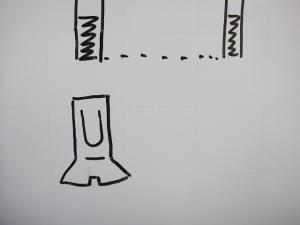
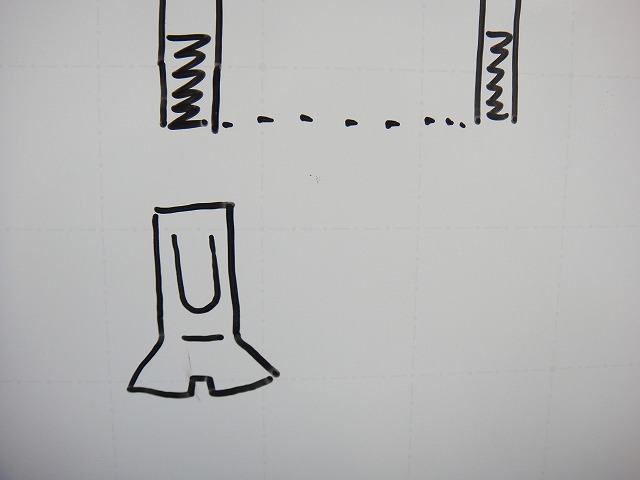
Nipples also come in 2.0 and 1.8 versions, and they're not compatible.
The material is either brass or aluminum. Aluminum is lighter, but
when standard nipples are used in complete wheels, they're almost 100% brass.
FFW wheels use standard nipples, so they're brass.
(When complete wheels use proprietary nipples designed in-house, they're often aluminum)
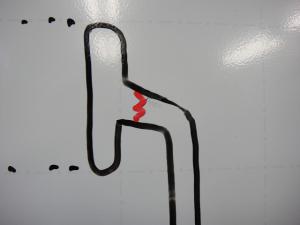
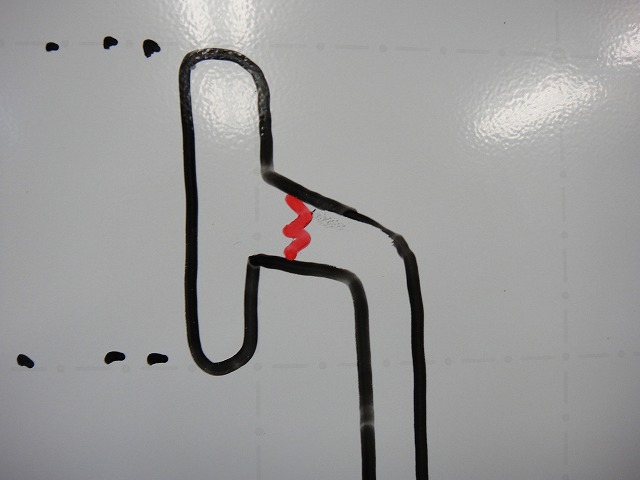
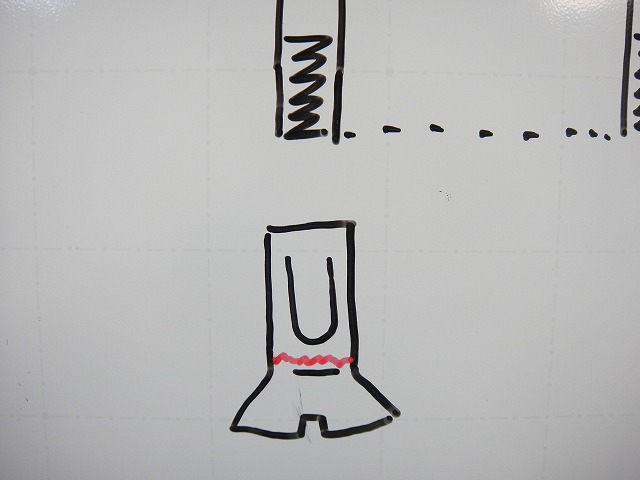
When "a spoke breaks," it's almost always a fracture at the neck (the red line in the diagram above).
With 1.8 spokes, the neck is also 1.8 mm, so compared to 2.0 spokes
the risk of breaking at this point is higher.
This is why 1.8 isn't used in complete wheels, and
it's also why I don't use it much.
If you build a rear wheel with 1.8, you really notice it—clearly the neck breaks more easily than with 2.0.
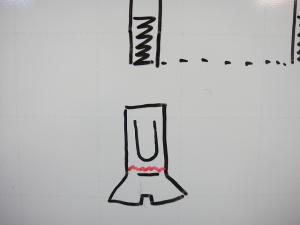
When the nipple is the cause, fractures can rarely occur at the point shown by the red line in the diagram above.
It can happen not just with aluminum but with brass as well.
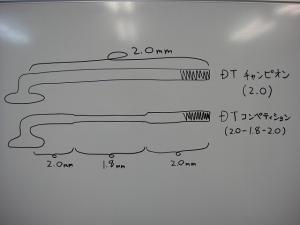
Spokes break almost 100% of the time at the neck. They don't break in the middle.
When the chain falls to the inside of the low gear and jams between chain and spoke,
the spoke might get worn away and eventually break in the middle from that external damage, but
aside from such external factors, you can say "spoke break = neck break."
So to achieve weight reduction, the idea was to create spokes where the neck and threaded parts stay at 2.0 mm
but the middle is made thinner. Since breaks almost never happen in the middle,
you can reduce weight without increasing the risk of spoke neck breaks.
Spokes that are the same diameter from end to end are called "plain spokes,"
and spokes with a thinner middle section are called "butted spokes."
The Swiss spoke maker DT calls their plain spokes Champion
and their butted spokes Competition.
For Competition 2.0, the butted section is 1.8 mm.
It's not shown in the diagram above, but for Competition 1.8,
the butted section is 1.6 mm.
I'll denote Champion 2.0 as 2.0.
I'll denote Competition 2.0 as 2.0-1.8-2.0.
Just listing the neck diameter, butted section diameter, and threaded section diameter.
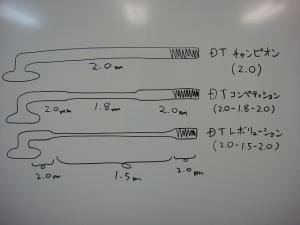
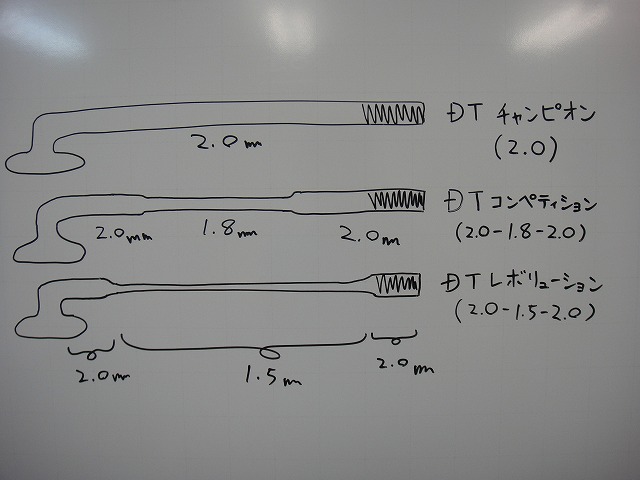
DT also has an even lighter butted spoke model called Revolution.
There's 2.0 and 1.8, but both have a butted section of 1.5 mm.
Since the butted section takes up a proportionally longer stretch compared to Competition,
it ends up even lighter.
I'll denote Revolution 2.0 as 2.0-1.5-2.0.
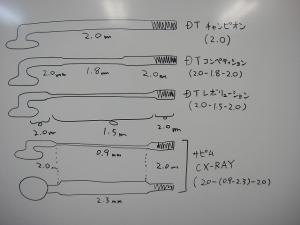
The spokes I use often are DT Champion and Competition, but
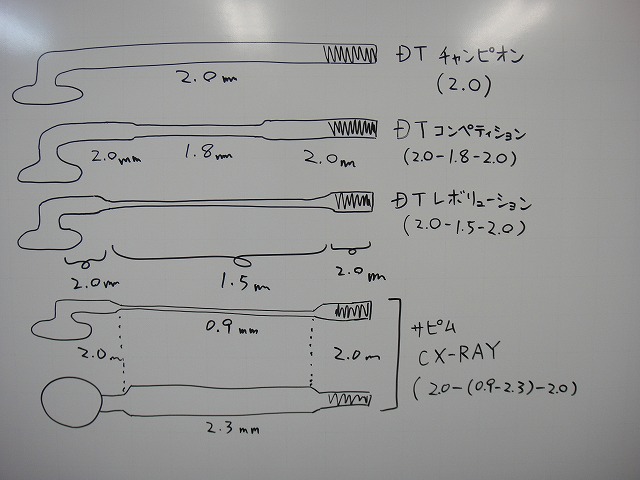
there's another spoke I frequently use: Sapim CX-RAY from Belgium.
This is a spoke with a flattened butted section,
what's called an aero spoke.
The aero section's cross-section is 0.9 mm at its most flat point
and 2.3 mm at its widest point.
This shape is primarily aimed at aerodynamic characteristics, but CX-RAY
is designed with weight reduction in mind as well.
I'll denote this as 2.0-(0.9-2.3)-2.0.
Sapim does have 1.8 mm plain spokes in their lineup, but
their other butted or aero spoke models don't come in 1.8 mm diameter.
So CX-RAY doesn't exist in 1.8.
(Custom orders might exist, but...)
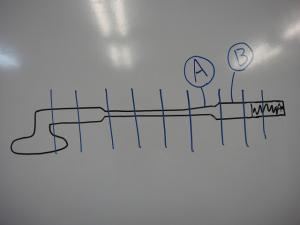
Now we get to the main topic.
I want to find the weight per millimeter of spoke, but
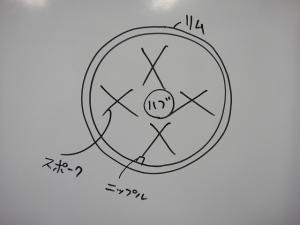
for example, if I divide it into 10 equal parts as shown above, A and B will have different weights.
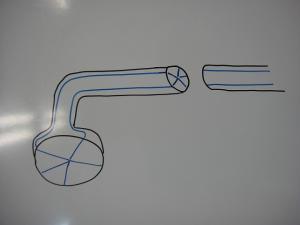
So, as a thought experiment, let's divide the spoke radially from its center.
In the diagram above it's 5 equal parts, but it doesn't look at all like 5 equal parts because my drawing skills
are terrible, but anyway think of it divided this way.
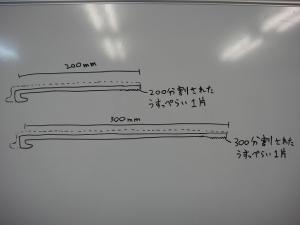
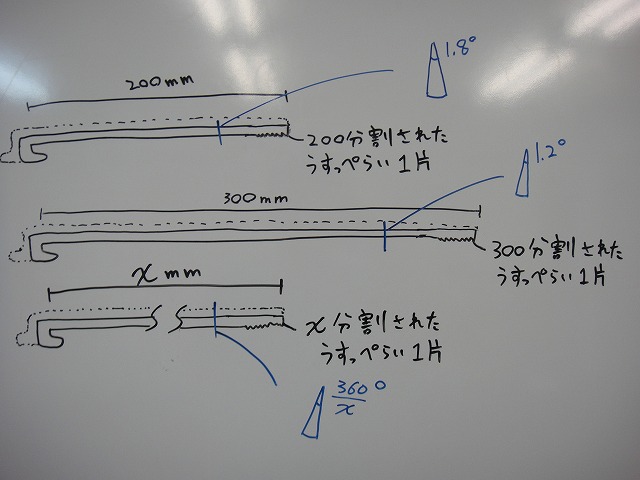
So, consider a 200 mm spoke divided into 200 segments,
and a 300 mm spoke divided into 300 segments, and think about one piece each.
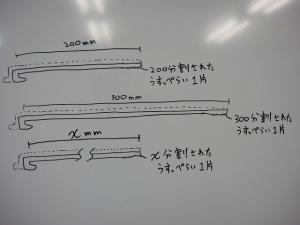
And while we're at it, about the case of dividing an X mm spoke into X segments.
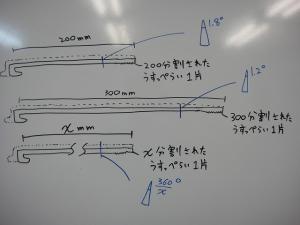
The central angle per piece is as shown in the diagram above.
What I'm getting at is this:
"The weight of each piece should be roughly the same."
That said, with plain spokes I could see it, but with butted spokes
the ratio of butted section to total spoke length changes with spoke length, so
I really can't imagine them being the same.
A 50 mm Revolution versus a 100,000,000 mm Revolution—
if you divide weight by length, the longer one is obviously lighter.
But this is a tangent: over the years I've built many "unauthorized modifications" of complete wheels.
There's a lot I can't openly write about, but
I'll dribble those out little by little on this blog (laugh). One of them is
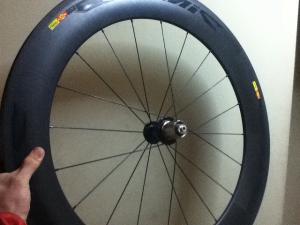
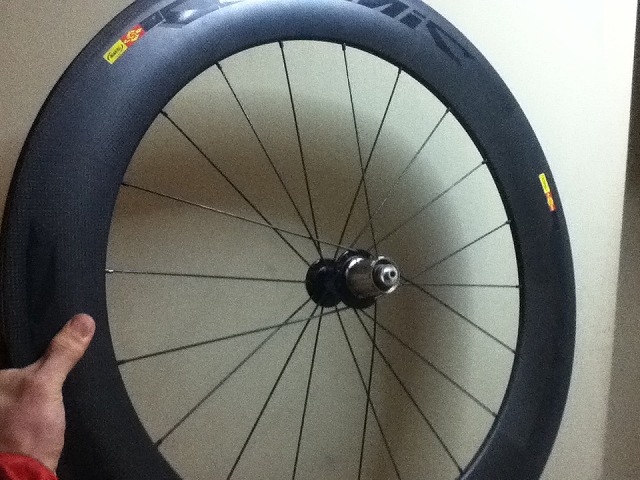
"Cosmic Carbone 80 built by hand with a standard hub,"
and the spoke length for this is, without getting into details, about 230 mm.
Except in cases where you want to ××(self-censored) a Campagnolo Bullet 105,
there are probably no shorter spokes than this for 700C wheels.

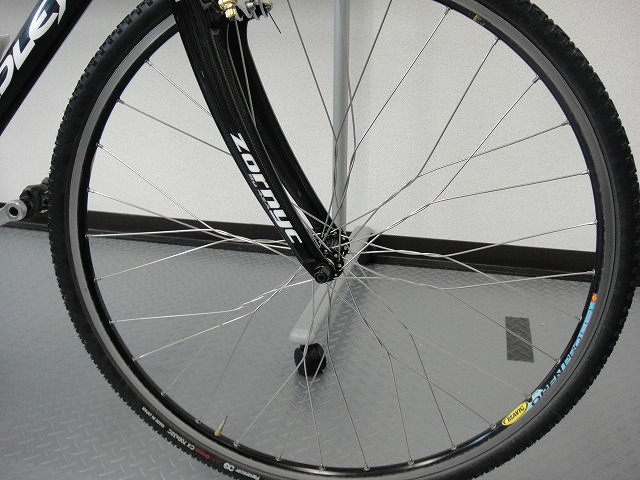
↑This is my cyclocross front wheel, built with Open Pro 32H in radial lacing.
The build that would have the longest spokes in 700C is probably
"36H from an old low-profile tubular rim, built with 8-spoke radial," and for that
it would be about 310 mm (well, I do know the exact number).
So spoke lengths that could exist on a road bike
are almost entirely within the 230-310 mm range.
The variation in weight caused by butting should be quite limited.
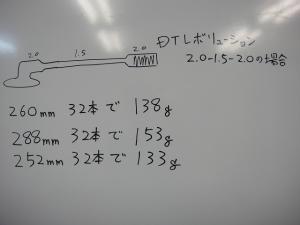
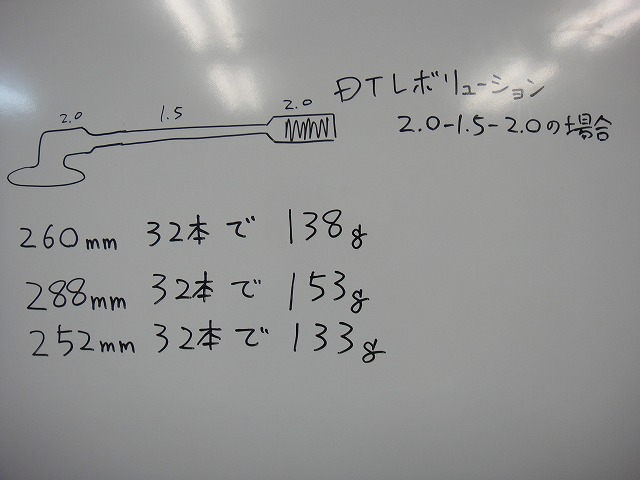
So I actually checked. I'm showing 3 types, but I have many more samples.
Weighing just a single spoke on a scale that only measures in 1 g increments or 0.1 g increments
is way too rough. In the case above, they all happen to be 32 spokes, but
weighing a bunch of spokes of the same length together and dividing by the number gives quite accurate
weight per spoke.
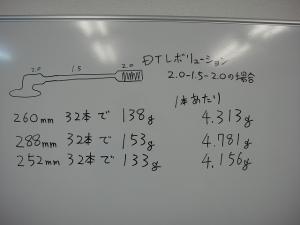
And here's what I got.

Then I divided that by length.
I call it weight per mm, but as mentioned at the start,
strictly speaking it's the weight of one piece divided radially from the center.
I use the term "per mm" because I'm dividing by length.
I'd say that's basically the same thing.
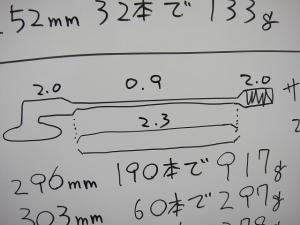
I did the same for Sapim CX-RAY.
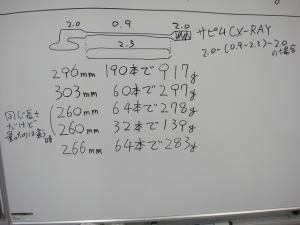
Total weight looks like this,
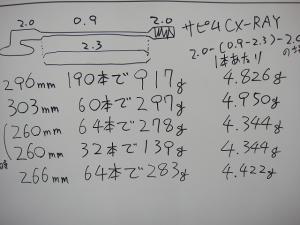
and weight per spoke looks like this.
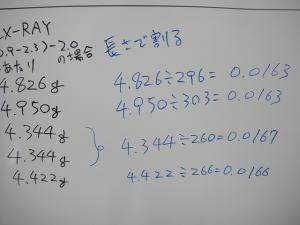
Then I divided by length. There is some variation.
The maximum variation is 0.004 g per mm.
I have more samples, but that's the biggest variation I found.
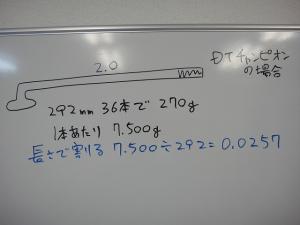
I also tried it with 2.0 plain DT Champion.
Sapim also has 2.0 plain spokes called Leader.
Star Industries has 2.0 plain called Starbright.
These are technically not stainless spokes in the usual sense.
They are stainless, but a bit different from what people usually think of as stainless steel.
Writing about that would make this even longer, so I'll save it for another day.
Since DT, Sapim, Star, and other makers don't have identical compositions and ratios,
I'd expect that even with 2.0 mm plain spokes, if you test a large batch,
differences in specific gravity should appear.

Anyway, I'm going to use the DT Champion 2.0 weight per mm of 0.0257 g
as 100%, and calculate the weight ratio for each spoke type.
The reason this diagram is still around is because my whiteboard is double-sided.
I really am glad I bought it.
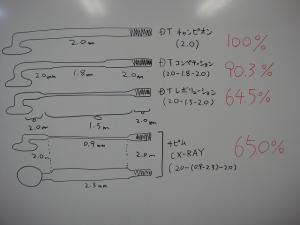
↑This is what I get. Variations use the median value.
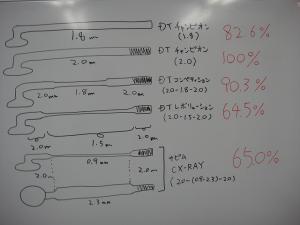
↑I added Champion 1.8 as well.
The lack of threading is just something I forgot to note (laugh).
Naturally it's lighter than Competition 2.0-1.8-2.0.
Revolution 2.0 and CX-RAY have material shaved down to about two-thirds compared to plain 2.0.
Pretty impressive.

Now I can calculate spoke weight accounting for length as well.
Since I'm multiplying three times, there might be some error, but
as a Fermi estimation method, I think it's quite accurate.
Substitute the percentage in red from before into the final coefficient.
Using this, you can estimate the weight before ordering spokes or before building a wheel
(as long as you know the coefficient).
Also, while I didn't write it here, there are two spokes in existence with coefficients under 60%.
If you want to build a really light spoke wheel, using those is a must.
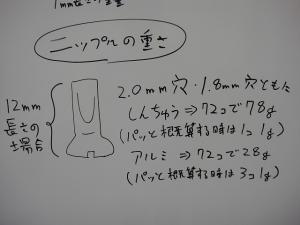
I'll note nipple weight too.
Now I can estimate the weight of spokes and nipples, the main components of a wheel.
For hubs and rims, weighing the actual part is best, but if you don't have one, use catalog weight.
In most cases they'll be heavier than catalog weight, so the estimate you get from desk calculation
serves as a useful benchmark: "it should be about this, but it'll probably end up heavier."
If you weigh the spoke bundle every time you build a wheel,
you get data for calculating a more accurate coefficient.
That kind of accumulation matters.
Today I'm thinking about the weight per millimeter of spoke.
Though to be precise, that's not quite the right way to express it—
strictly speaking, it's "the weight when an X mm spoke is divided into X segments from the center of the spoke."
I'm just calling that the weight per mm.
I know this sounds confusing, but I'll take my time explaining below.
↑This is a spoke. Please bear with my childish drawings (laugh).

Spoke thickness on sport bikes is basically limited to two types shown above.
2.0 mm diameter and 1.8 mm diameter.
The thickness of a spoke is called the gauge, and
2.0 mm is also called 14-gauge, 1.8 mm is called 15-gauge.
There are exceptions, like Cosmic Carbone (Cosmic Carbone—exclusive carbon wheelset spokes) adopting 2.34 mm (13-gauge),
but basically it's one of these two: 2.0 or 1.8.
Since 1.8 is thinner, it's naturally lighter than 1.8.
When standard spokes like those above are used in complete wheels,
it's almost 100% 2.0 mm spokes.
Even in complete wheels with LEW VT-1 rims that are under 1000g for a front-and-rear pair,
they use 2.0 mm spokes.
I mostly use 2.0 mm for hand-built wheels as well.
There's a reason for this (more on that later).
Nipples also come in 2.0 and 1.8 versions, and they're not compatible.
The material is either brass or aluminum. Aluminum is lighter, but
when standard nipples are used in complete wheels, they're almost 100% brass.
FFW wheels use standard nipples, so they're brass.
(When complete wheels use proprietary nipples designed in-house, they're often aluminum)
When "a spoke breaks," it's almost always a fracture at the neck (the red line in the diagram above).
With 1.8 spokes, the neck is also 1.8 mm, so compared to 2.0 spokes
the risk of breaking at this point is higher.
This is why 1.8 isn't used in complete wheels, and
it's also why I don't use it much.
If you build a rear wheel with 1.8, you really notice it—clearly the neck breaks more easily than with 2.0.
When the nipple is the cause, fractures can rarely occur at the point shown by the red line in the diagram above.
It can happen not just with aluminum but with brass as well.
Spokes break almost 100% of the time at the neck. They don't break in the middle.
When the chain falls to the inside of the low gear and jams between chain and spoke,
the spoke might get worn away and eventually break in the middle from that external damage, but
aside from such external factors, you can say "spoke break = neck break."
So to achieve weight reduction, the idea was to create spokes where the neck and threaded parts stay at 2.0 mm
but the middle is made thinner. Since breaks almost never happen in the middle,
you can reduce weight without increasing the risk of spoke neck breaks.
Spokes that are the same diameter from end to end are called "plain spokes,"
and spokes with a thinner middle section are called "butted spokes."
The Swiss spoke maker DT calls their plain spokes Champion
and their butted spokes Competition.
For Competition 2.0, the butted section is 1.8 mm.
It's not shown in the diagram above, but for Competition 1.8,
the butted section is 1.6 mm.
I'll denote Champion 2.0 as 2.0.
I'll denote Competition 2.0 as 2.0-1.8-2.0.
Just listing the neck diameter, butted section diameter, and threaded section diameter.
DT also has an even lighter butted spoke model called Revolution.
There's 2.0 and 1.8, but both have a butted section of 1.5 mm.
Since the butted section takes up a proportionally longer stretch compared to Competition,
it ends up even lighter.
I'll denote Revolution 2.0 as 2.0-1.5-2.0.
The spokes I use often are DT Champion and Competition, but
there's another spoke I frequently use: Sapim CX-RAY from Belgium.
This is a spoke with a flattened butted section,
what's called an aero spoke.
The aero section's cross-section is 0.9 mm at its most flat point
and 2.3 mm at its widest point.
This shape is primarily aimed at aerodynamic characteristics, but CX-RAY
is designed with weight reduction in mind as well.
I'll denote this as 2.0-(0.9-2.3)-2.0.
Sapim does have 1.8 mm plain spokes in their lineup, but
their other butted or aero spoke models don't come in 1.8 mm diameter.
So CX-RAY doesn't exist in 1.8.
(Custom orders might exist, but...)
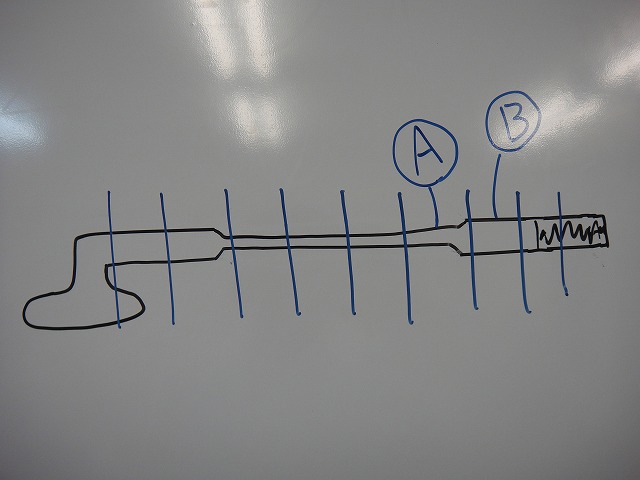
Now we get to the main topic.
I want to find the weight per millimeter of spoke, but
for example, if I divide it into 10 equal parts as shown above, A and B will have different weights.
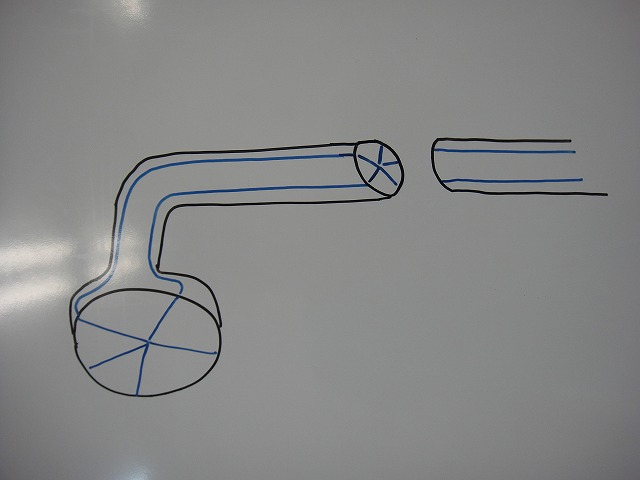
So, as a thought experiment, let's divide the spoke radially from its center.
In the diagram above it's 5 equal parts, but it doesn't look at all like 5 equal parts because my drawing skills
are terrible, but anyway think of it divided this way.
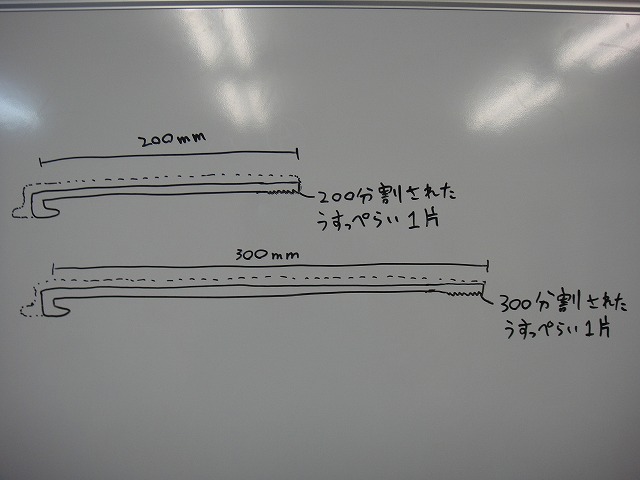
So, consider a 200 mm spoke divided into 200 segments,
and a 300 mm spoke divided into 300 segments, and think about one piece each.
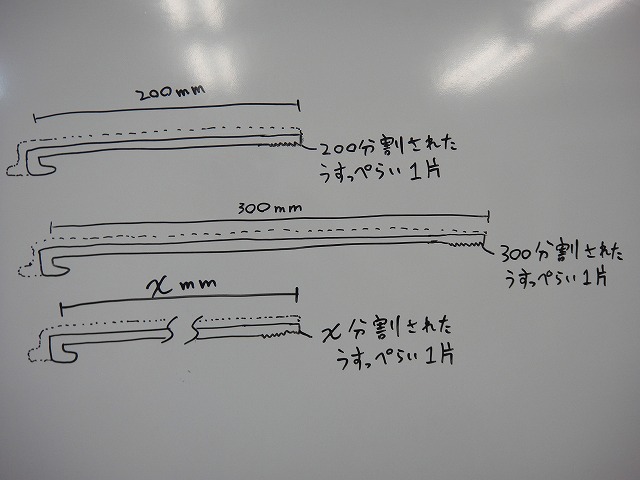
And while we're at it, about the case of dividing an X mm spoke into X segments.
The central angle per piece is as shown in the diagram above.
What I'm getting at is this:
"The weight of each piece should be roughly the same."
That said, with plain spokes I could see it, but with butted spokes
the ratio of butted section to total spoke length changes with spoke length, so
I really can't imagine them being the same.
A 50 mm Revolution versus a 100,000,000 mm Revolution—
if you divide weight by length, the longer one is obviously lighter.
But this is a tangent: over the years I've built many "unauthorized modifications" of complete wheels.
There's a lot I can't openly write about, but
I'll dribble those out little by little on this blog (laugh). One of them is
"Cosmic Carbone 80 built by hand with a standard hub,"
and the spoke length for this is, without getting into details, about 230 mm.
Except in cases where you want to ××(self-censored) a Campagnolo Bullet 105,
there are probably no shorter spokes than this for 700C wheels.
↑This is my cyclocross front wheel, built with Open Pro 32H in radial lacing.
The build that would have the longest spokes in 700C is probably
"36H from an old low-profile tubular rim, built with 8-spoke radial," and for that
it would be about 310 mm (well, I do know the exact number).
So spoke lengths that could exist on a road bike
are almost entirely within the 230-310 mm range.
The variation in weight caused by butting should be quite limited.
So I actually checked. I'm showing 3 types, but I have many more samples.
Weighing just a single spoke on a scale that only measures in 1 g increments or 0.1 g increments
is way too rough. In the case above, they all happen to be 32 spokes, but
weighing a bunch of spokes of the same length together and dividing by the number gives quite accurate
weight per spoke.
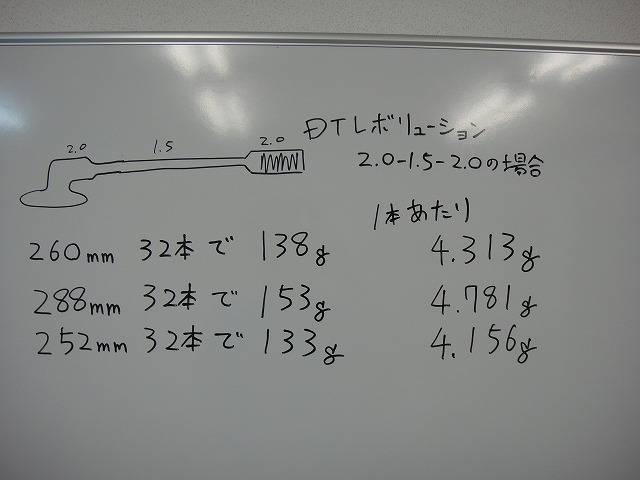
And here's what I got.
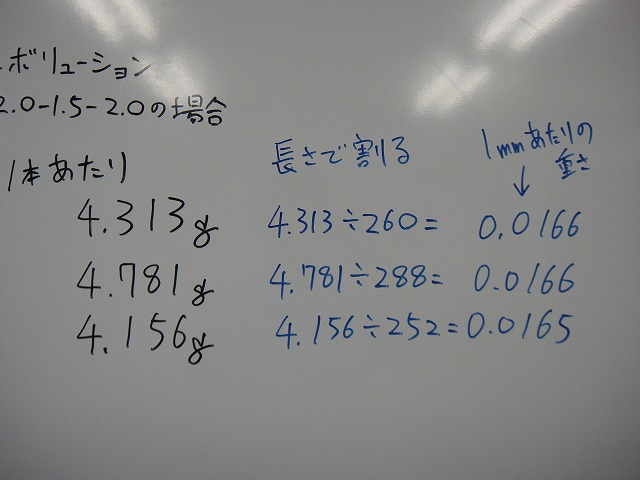
Then I divided that by length.
I call it weight per mm, but as mentioned at the start,
strictly speaking it's the weight of one piece divided radially from the center.
I use the term "per mm" because I'm dividing by length.
I'd say that's basically the same thing.
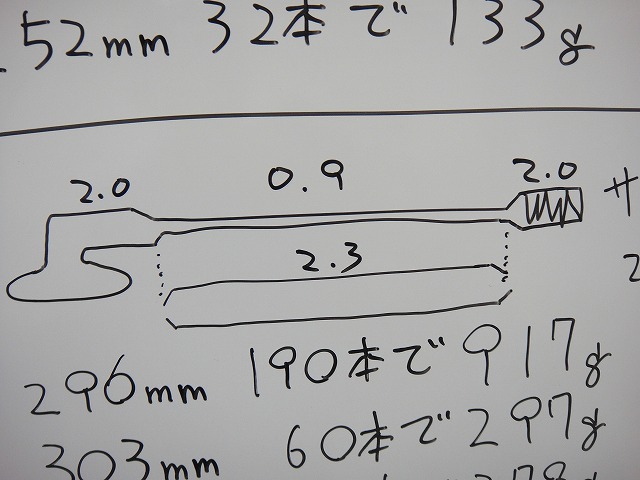
I did the same for Sapim CX-RAY.
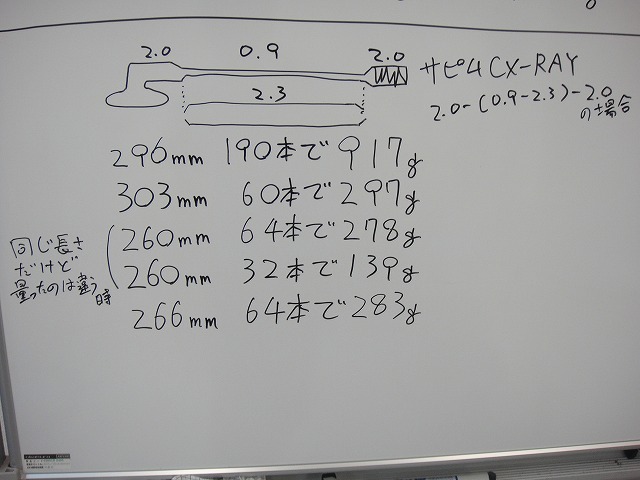
Total weight looks like this,
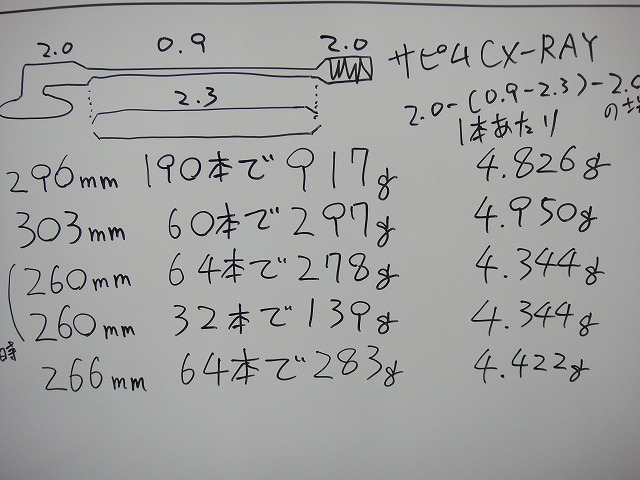
and weight per spoke looks like this.
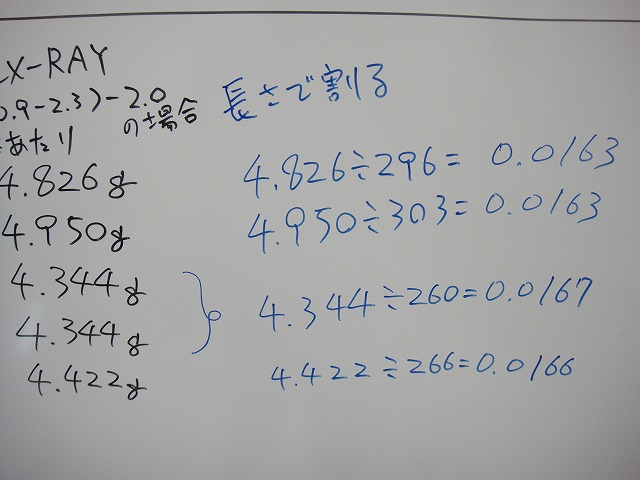
Then I divided by length. There is some variation.
The maximum variation is 0.004 g per mm.
I have more samples, but that's the biggest variation I found.
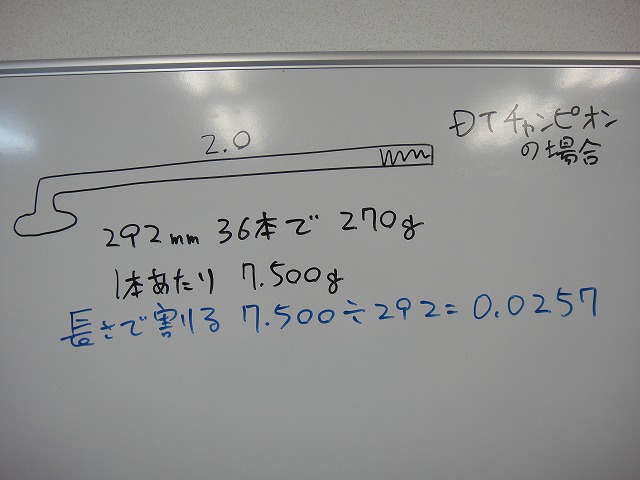
I also tried it with 2.0 plain DT Champion.
Sapim also has 2.0 plain spokes called Leader.
Star Industries has 2.0 plain called Starbright.
These are technically not stainless spokes in the usual sense.
They are stainless, but a bit different from what people usually think of as stainless steel.
Writing about that would make this even longer, so I'll save it for another day.
Since DT, Sapim, Star, and other makers don't have identical compositions and ratios,
I'd expect that even with 2.0 mm plain spokes, if you test a large batch,
differences in specific gravity should appear.
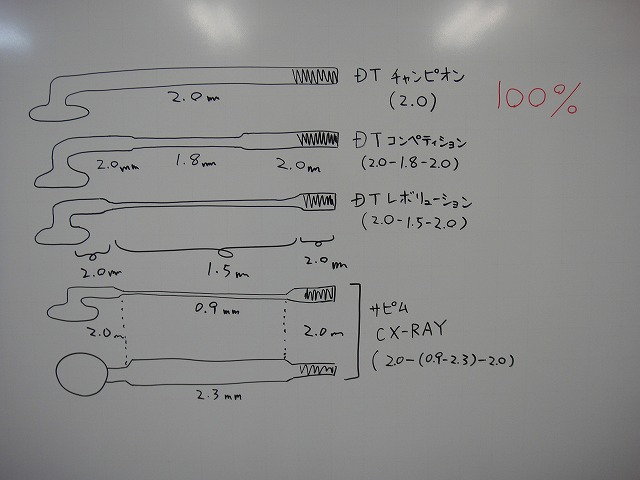
Anyway, I'm going to use the DT Champion 2.0 weight per mm of 0.0257 g
as 100%, and calculate the weight ratio for each spoke type.
The reason this diagram is still around is because my whiteboard is double-sided.
I really am glad I bought it.

↑This is what I get. Variations use the median value.
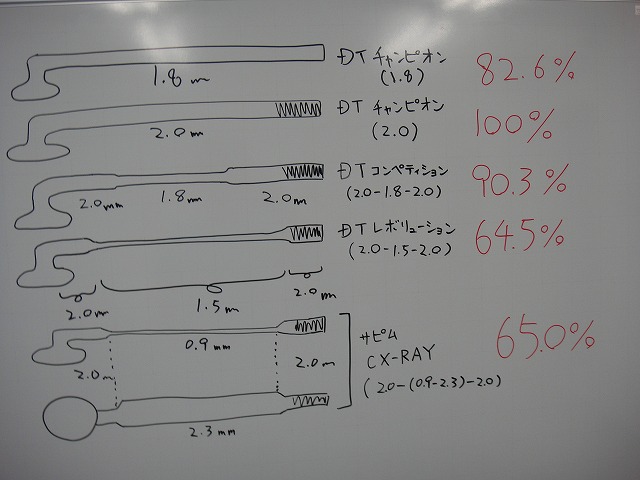
↑I added Champion 1.8 as well.
The lack of threading is just something I forgot to note (laugh).
Naturally it's lighter than Competition 2.0-1.8-2.0.
Revolution 2.0 and CX-RAY have material shaved down to about two-thirds compared to plain 2.0.
Pretty impressive.
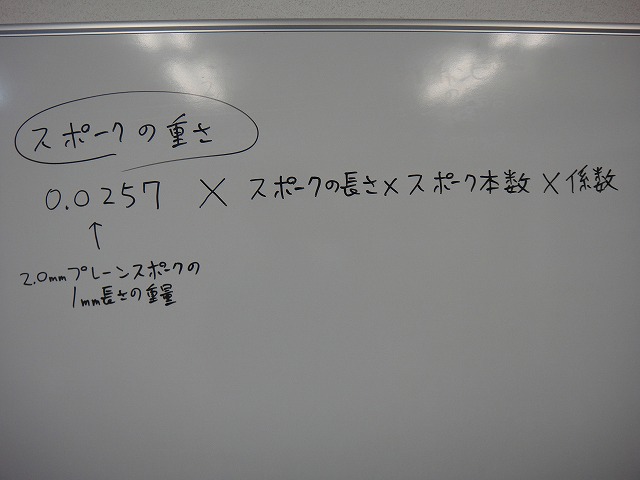
Now I can calculate spoke weight accounting for length as well.
Since I'm multiplying three times, there might be some error, but
as a Fermi estimation method, I think it's quite accurate.
Substitute the percentage in red from before into the final coefficient.
Using this, you can estimate the weight before ordering spokes or before building a wheel
(as long as you know the coefficient).
Also, while I didn't write it here, there are two spokes in existence with coefficients under 60%.
If you want to build a really light spoke wheel, using those is a must.
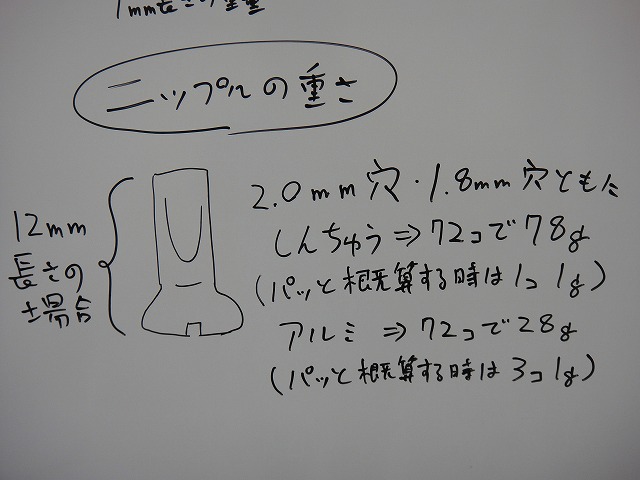
I'll note nipple weight too.
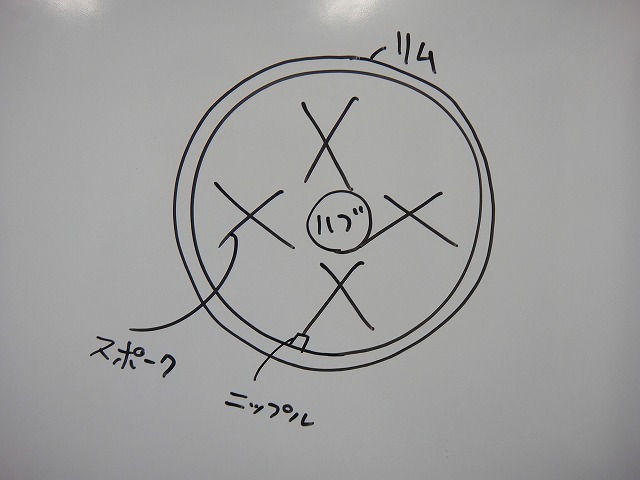
Now I can estimate the weight of spokes and nipples, the main components of a wheel.
For hubs and rims, weighing the actual part is best, but if you don't have one, use catalog weight.
In most cases they'll be heavier than catalog weight, so the estimate you get from desk calculation
serves as a useful benchmark: "it should be about this, but it'll probably end up heavier."
If you weigh the spoke bundle every time you build a wheel,
you get data for calculating a more accurate coefficient.
That kind of accumulation matters.
Products Mentioned in This Article
- 🛒 Cosmic Carbon bicycle wheel
- 🛒 LEW VT-1 rim wheelset
- 🛒 FFWD bicycle wheels
- 🛒 DT Champion bicycle spoke
* Amazon affiliate links — prices may vary
Original Japanese post: のむラボ日記 #8