I took in a wheel I built about eight years ago.
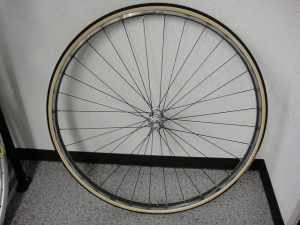

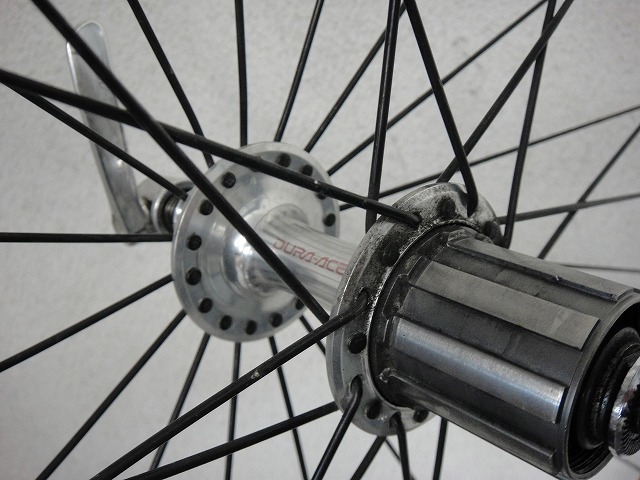
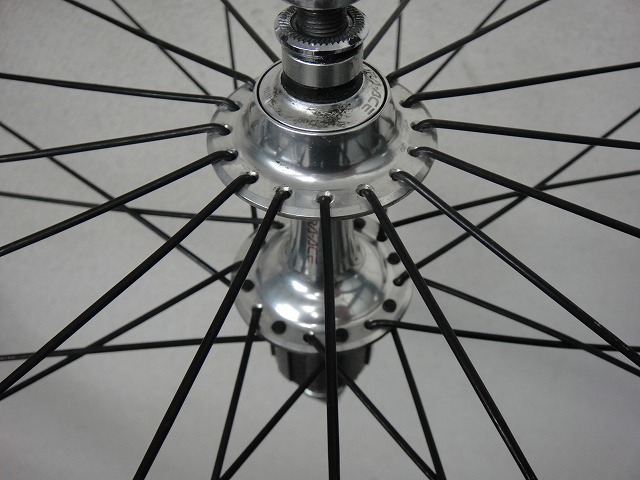
Both front and rear hubs are 7700 Dura-Ace, rims are Mavic GP4 final version,
and spokes are DT Black Competition.
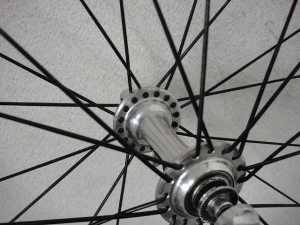
The front wheel is laced inpoke in a two-cross pattern.
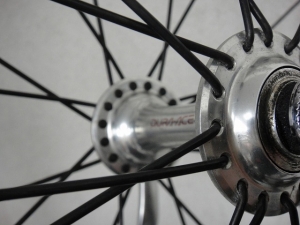
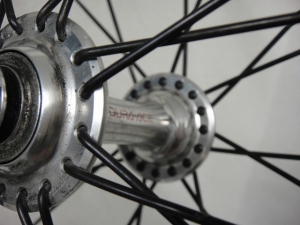
I think what I'd call the "Italian-style appearance" of inpoke two-cross lacing
is where the spokes on the Yamaarashi side are positioned more inward.
Where the spokes cross, with CX-RAY rims it would
hit the aero-butted section, so ideally you'd want to build it
with CX-RAY or similar instead.
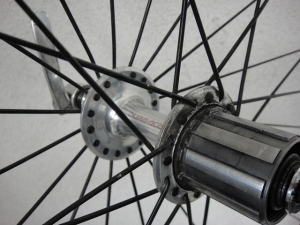
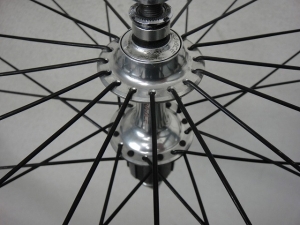
The rear wheel is a four-cross with outpoke on the non-drive side and inpoke through-lace.
The 7700 is a hub from an era when radial lacing still wasn't permitted.
Even so, the HB-7700 came in round-hole flanges in 36, 32, 28, and 24 spoke counts, and
slit-hole versions in 32, 28, 24, 20, 18, 16, and 12 spoke counts,
while the FH-7700 had round holes in 36, 32, 28, 24, and 20 spoke counts
and slit holes in 32, 28, 24, 20, 16, and 12 spoke counts—basically
pretty much everything was available. So insisting that you can only do
tangent lacing with these lower spoke count hubs doesn't really make sense.
With something like a front 18-hole hub, doing radial lacing would actually
create worse spoke balance.
The 5500 hub from 7700-era 105, and later the 5501 hub—the "A" version 5501-A with aero—
was Shimano's first radial-lacing-approved hub,
but there are countless examples of radial lacing before that, both amateur and professional.
Not that I'm saying "if everyone runs a red light, it's okay"...
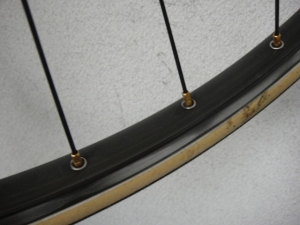

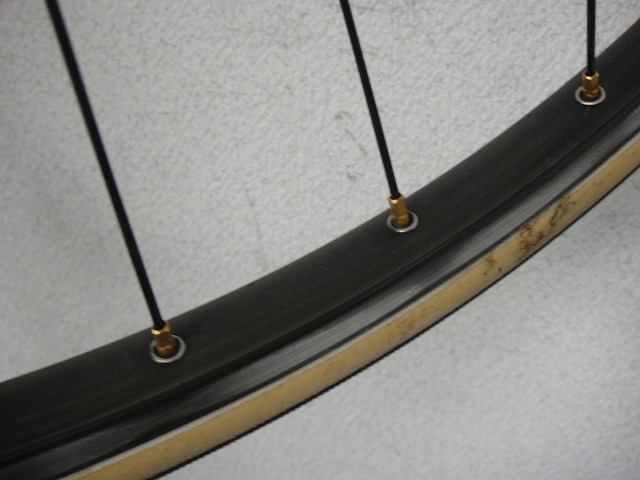
Half the wheel uses red nipples and half uses gold nipples.
Not alternating, but half at 180-degree phase in the same color.
This makes the rim sparkle and shimmer when it rotates.
Red and blue actually look better color-wise than red and gold.
It's hard to see under fluorescent lights, but in sunlight it really sparkles.
I forgot what I was supposed to do with it.
"True the wheel and install a tire" is what the customer said.
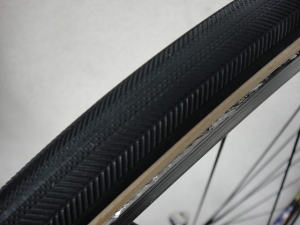
This tire, it's made by Lion Tires, right?
The glossy black tread, the stitching below the bead—
everything about it, the caramel color of the sidewalls—I'm almost certain.
It says Made in Thailand,
and with inexpensive tubulars especially, regardless of the brand name on the label,
Lion Tire is almost certainly the actual manufacturer.
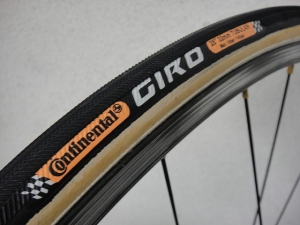
Oh, sorry, this tire
is a Continental Giro.
Forget everything I just wrote.
(Not saying I was wrong or anything)

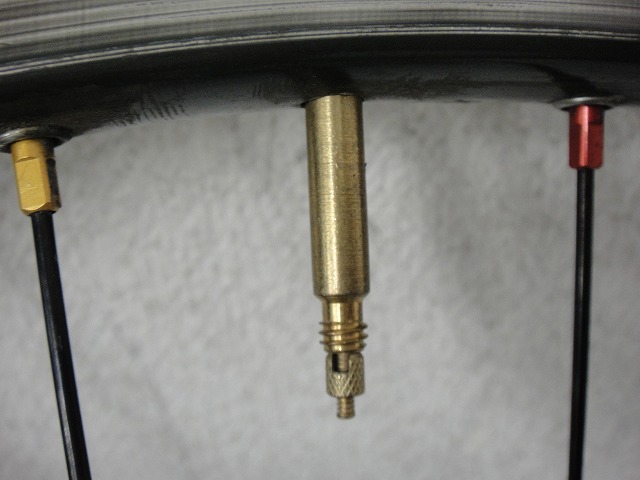
The drawback is that the valve core can't be removed—you can't extend it with an adapter valve.
Some capcap-style extenders won't even fit through the rim valve holes
(like Campagnolo and Fulcrum ones),
so if the valve core can't be removed, it's effectively limited to low-profile rims only.
Such a shame.
Ugh, this valve too, there's no way it's not from Lion T—
wait, who's that knocking at this hour, a customer maybe?
whoa what in tarnation is going on qwerty asdf ghjkl;'
Edit: Apparently there are Giro tires where the valve core CAN be removed.
Just checked and all the Giro tires we have in stock can't be removed.
It seems unlikely that different versions would be mixed in the same shipment,
so either the non-removable version or removable version was recently
changed, or one of the two happened.
(Our Giro stock was recently purchased from our distributor)
Or, the Giro might have had two different valve core specifications from the start,
and the version that our Japanese distributor stocks
happens to be the non-removable type.


Both front and rear hubs are 7700 Dura-Ace, rims are Mavic GP4 final version,
and spokes are DT Black Competition.
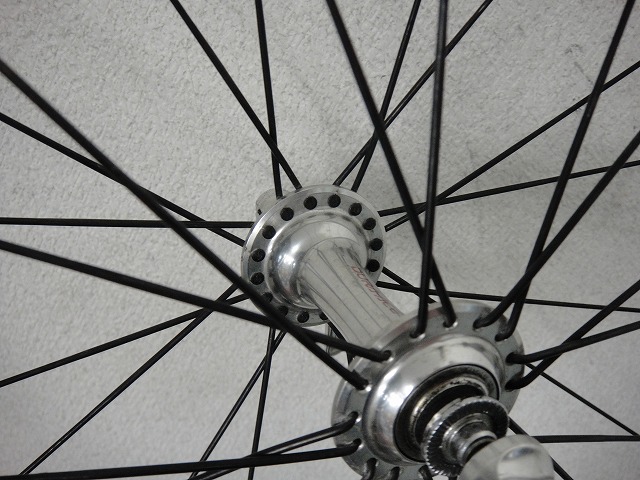
The front wheel is laced inpoke in a two-cross pattern.
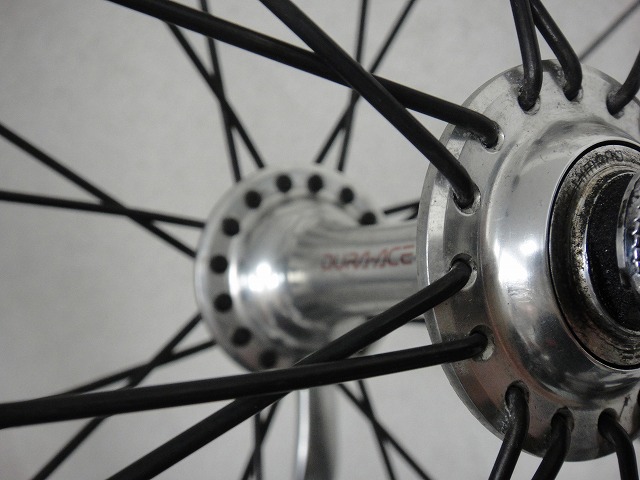
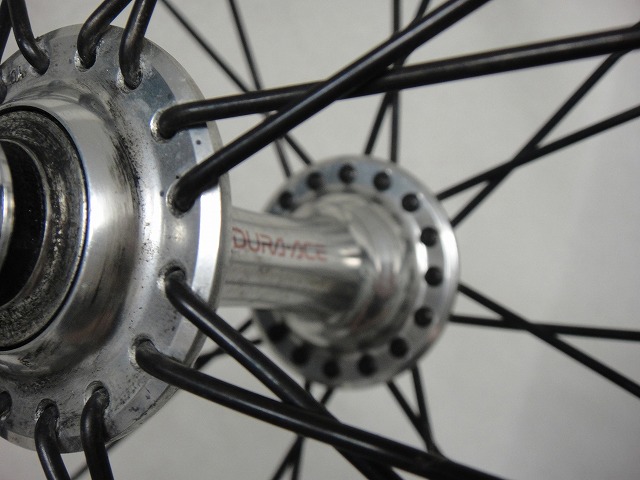
I think what I'd call the "Italian-style appearance" of inpoke two-cross lacing
is where the spokes on the Yamaarashi side are positioned more inward.
Where the spokes cross, with CX-RAY rims it would
hit the aero-butted section, so ideally you'd want to build it
with CX-RAY or similar instead.
The rear wheel is a four-cross with outpoke on the non-drive side and inpoke through-lace.
The 7700 is a hub from an era when radial lacing still wasn't permitted.
Even so, the HB-7700 came in round-hole flanges in 36, 32, 28, and 24 spoke counts, and
slit-hole versions in 32, 28, 24, 20, 18, 16, and 12 spoke counts,
while the FH-7700 had round holes in 36, 32, 28, 24, and 20 spoke counts
and slit holes in 32, 28, 24, 20, 16, and 12 spoke counts—basically
pretty much everything was available. So insisting that you can only do
tangent lacing with these lower spoke count hubs doesn't really make sense.
With something like a front 18-hole hub, doing radial lacing would actually
create worse spoke balance.
The 5500 hub from 7700-era 105, and later the 5501 hub—the "A" version 5501-A with aero—
was Shimano's first radial-lacing-approved hub,
but there are countless examples of radial lacing before that, both amateur and professional.
Not that I'm saying "if everyone runs a red light, it's okay"...

Half the wheel uses red nipples and half uses gold nipples.
Not alternating, but half at 180-degree phase in the same color.
This makes the rim sparkle and shimmer when it rotates.
Red and blue actually look better color-wise than red and gold.
It's hard to see under fluorescent lights, but in sunlight it really sparkles.

I forgot what I was supposed to do with it.
"True the wheel and install a tire" is what the customer said.
This tire, it's made by Lion Tires, right?
The glossy black tread, the stitching below the bead—
everything about it, the caramel color of the sidewalls—I'm almost certain.
It says Made in Thailand,
and with inexpensive tubulars especially, regardless of the brand name on the label,
Lion Tire is almost certainly the actual manufacturer.

Oh, sorry, this tire
is a Continental Giro.
Forget everything I just wrote.
The drawback is that the valve core can't be removed—you can't extend it with an adapter valve.
Some capcap-style extenders won't even fit through the rim valve holes
(like Campagnolo and Fulcrum ones),
so if the valve core can't be removed, it's effectively limited to low-profile rims only.
Such a shame.
Ugh, this valve too, there's no way it's not from Lion T—
wait, who's that knocking at this hour, a customer maybe?
whoa what in tarnation is going on qwerty asdf ghjkl;'
Edit: Apparently there are Giro tires where the valve core CAN be removed.
Just checked and all the Giro tires we have in stock can't be removed.
It seems unlikely that different versions would be mixed in the same shipment,
so either the non-removable version or removable version was recently
changed, or one of the two happened.
(Our Giro stock was recently purchased from our distributor)
Or, the Giro might have had two different valve core specifications from the start,
and the version that our Japanese distributor stocks
happens to be the non-removable type.