I'm going to write about spoke tension and tension meters.
Without writing this, I can't cover topics like "hand-built freewheel-side radial lacing," "single-flange asymmetric lacing," or "zero-cross but not radial lacing."
I was supposed to have written this around December last year, but things dragged on.
First, let me start with the principle and how to use tension meters.

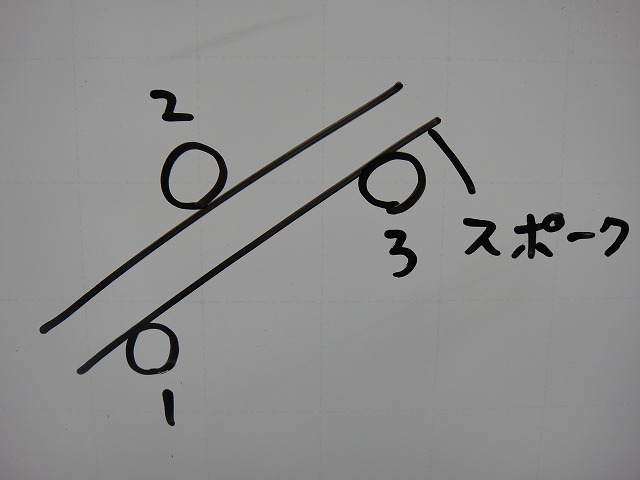
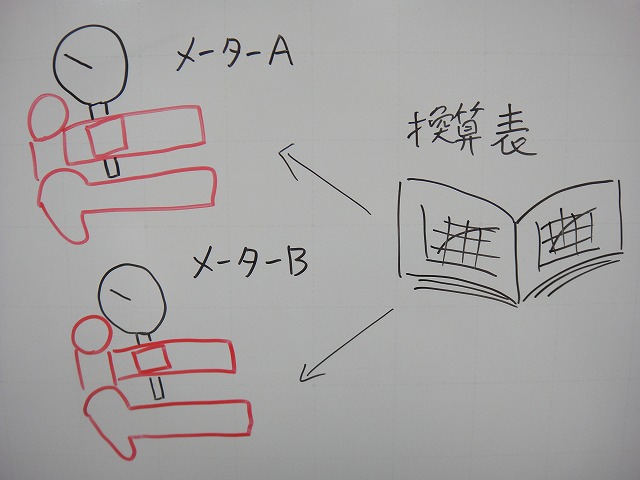
To measure spoke deflection, the meter holds the spoke at three points like a lever.
Two of these are fixed, one is movable, and it measures spoke deflection by the resistance to compression.

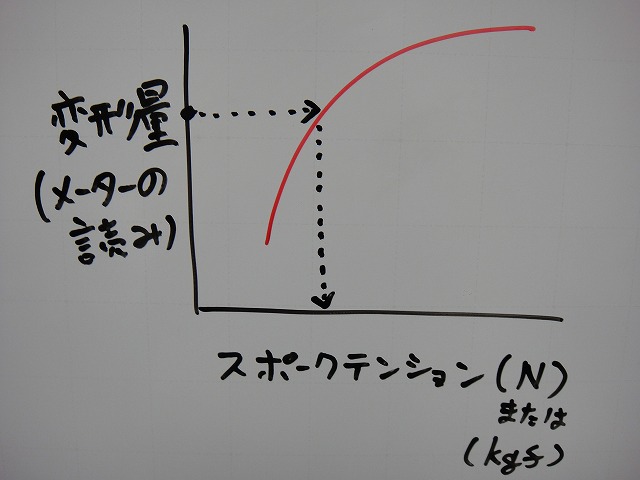
↑You then apply that deflection measurement to the conversion table that comes with the meter to determine the spoke tension.
The relationship between deflection and spoke tension at this point forms a curved line like the one shown above, but

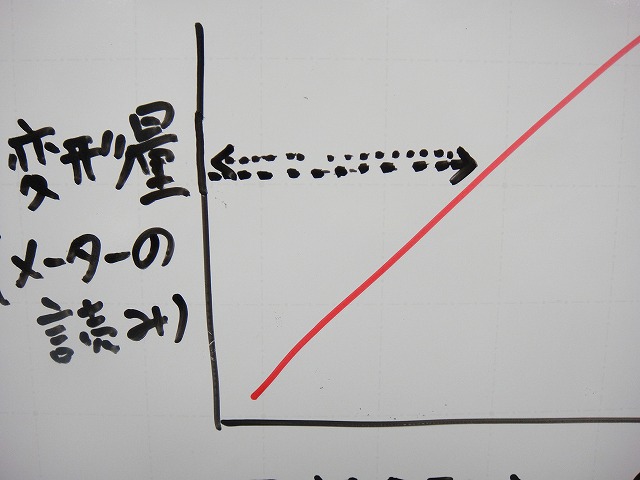
if this were to become a straight line instead,
and if you then stipulated that you'd use only 2.0mm plain spokes, with no other spoke types,

you could theoretically make a tension meter where the meter reading itself displays the spoke tension.
(The dashed line in the diagram above is drawn offset, but it's on the same line.)
In reality, because of the curved line and the wide variety of spoke types, you cannot use a tension meter without a conversion table.

This is an extremely important point: When I simply write "spoke tension" in this blog, it refers to one of at least three different meanings, but I've consistently made a policy of not writing the details about which one.
I basically plan to continue that approach.
In my own personal terminology,
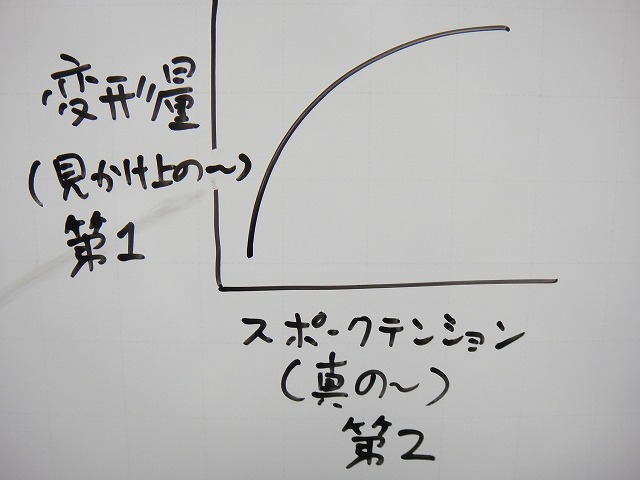
"the amount of spoke deflection when measured with a tension meter" is called the "first type of spoke tension."
When I call it "apparent spoke tension," that's usually what I mean, though rereading my posts sometimes it's not.
Regarding calling spoke deflection "spoke tension"—because there's a causal relationship between small deflection and high spoke tension,
I call this the "first type of spoke tension" somewhat arbitrarily as "spoke-tension-like."
Next, the approximate value of spoke tension after conversion using the conversion table is called the "second type of spoke tension."
Looking back at my past posts, I often call this the "true spoke tension," but there are many exceptions, so "second = true" isn't always the case.
This is what's generally meant by spoke tension in the ordinary sense—what people normally mean when they say "spoke tension."
Next, regarding the third type of spoke tension.
This is not spoke tension itself.
It's a value obtained by applying the first and second types of spoke tension, spoke thickness (strictly speaking, specific gravity), and the roughly radial angle between spoke and hub to a certain constant.
I can't write what the constant is—it's my own arbitrary definition.
However, I have an unshakeable conviction from experience that the presence or absence of third-type spoke tension expresses wheel performance more accurately than second-type spoke tension.
Third-type spoke tension is roughly "the amount of spoke deflection," but the difference from the first type is that spoke specific gravity and the angle at which it's tensioned are factored into the calculation.
Even with the same spoke tension (←now which type of spoke tension is this, I wonder?), drive transmission efficiency differs between radial and tangential lacing,
so the angle at which spokes are tensioned is important for wheel performance.
Think of third-type spoke tension as "the quantification of wheel performance."
It's not quite that, but roughly.
There's also a "fourth type of spoke tension," but in the actual task of building wheels, it's basically an unnecessary concept, so I've never mentioned it in this blog.
As I'll explain later, currently I can't research the fourth type. Give it back.

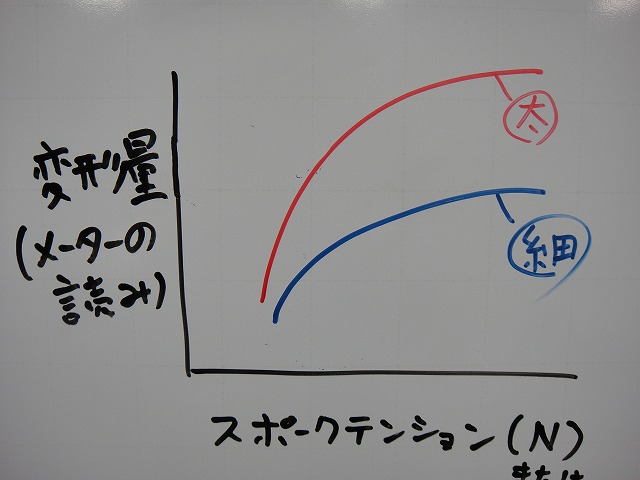
With some exceptions for round and flattened spokes, when you put thick and thin spokes on the same conversion table, you get the relationship shown above.
Because both are curves, the relationship between meter reading and the approximate spoke tension—that is, between the first and second types—won't be in the same proportion for thick and thin spokes.
When building a rear wheel with all-Campagnolo versus all-CX-RAY, though both are symmetrical lacing,
the CX-RAY will have less left-right spoke tension difference than the Campagnolo.
Say both have the freewheel side tensioned at 1000N second-type tension.
Naturally the lacing method, rim, and hub are all the same.
In that case, the tactile feel of the non-freewheel side spoke deflection will feel more tensioned with the CX-RAY.
If I calculate this using third-type spoke tension, the CX-RAY also comes out with a higher value. That's because the specific gravity of the spoke is included in the third-type calculation formula.
Even though I said "first, let me start with the principle and how to use tension meters," I've digressed quite a bit.

Back to spoke tension meters.
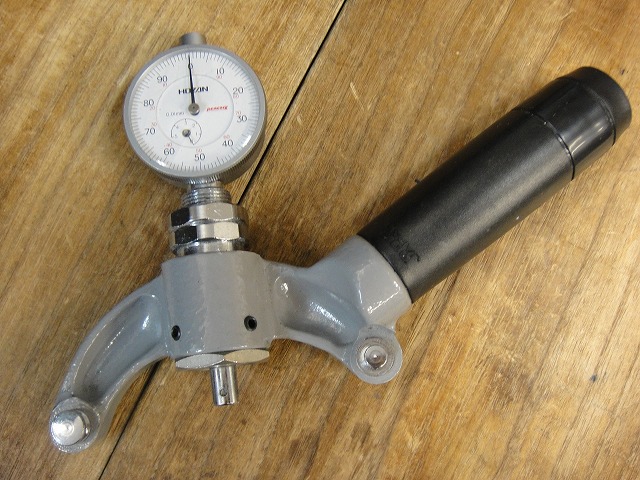
First, the Hozan tension meter.
This is what I normally use.
The list price before tax is 44,000 yen. For reference.

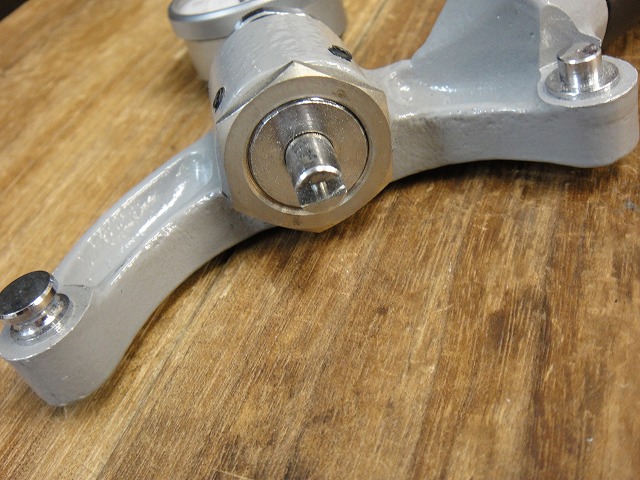
You press the measurement probe in the middle against the spoke to measure deflection.

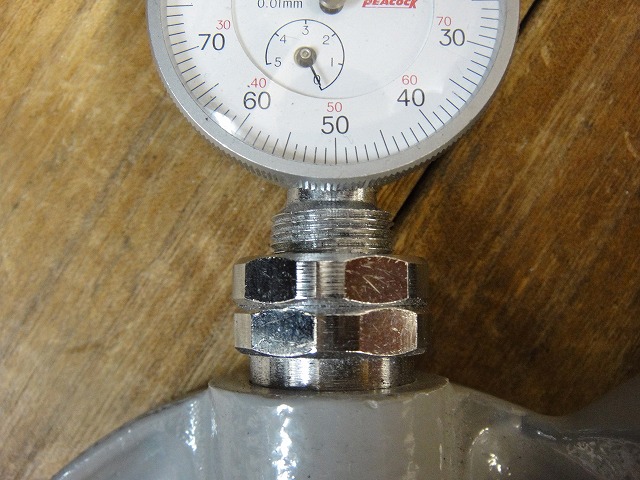
↑Calibration is done by adjusting the double nut here, but you absolutely must never touch this. It will throw off the calibration.
Like with torque wrenches, instruments can drift over years of use, and measurement values gradually change.
With Hozan tension meters, you can send them back to the manufacturer for recalibration.
Whether measuring instruments can be recalibrated is extremely important.
From the instruction manual, it says:
"Conversion values differ for each unit, so each meter individually receives official inspection and a conversion table is created.
Please keep the conversion table safe.
If you unfortunately lose the conversion table, the device will need to be re-inspected."
The "individually" part is what differs from other manufacturers.

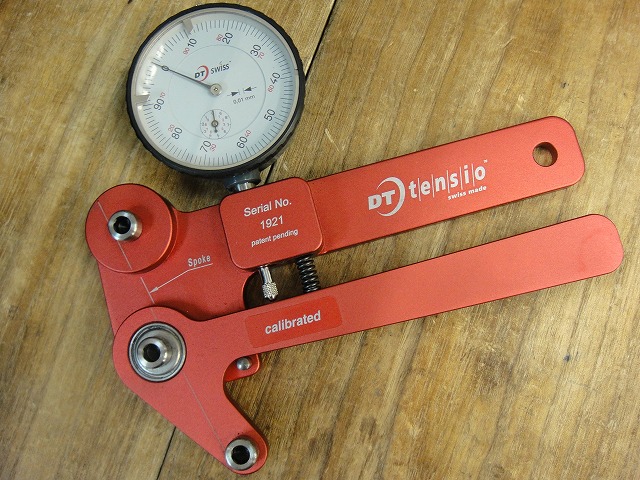
Next, the DT tension meter.
Without this, you can't use the Hozan meter (I'll explain why later).
The list price before tax is 72,380 yen. For reference.

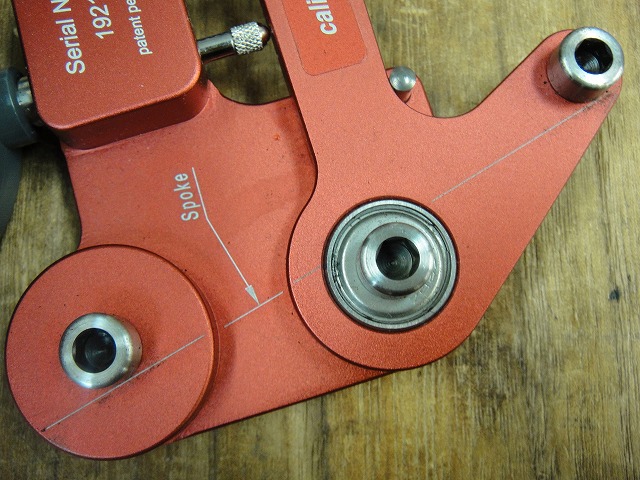
↑You clamp the spoke here.

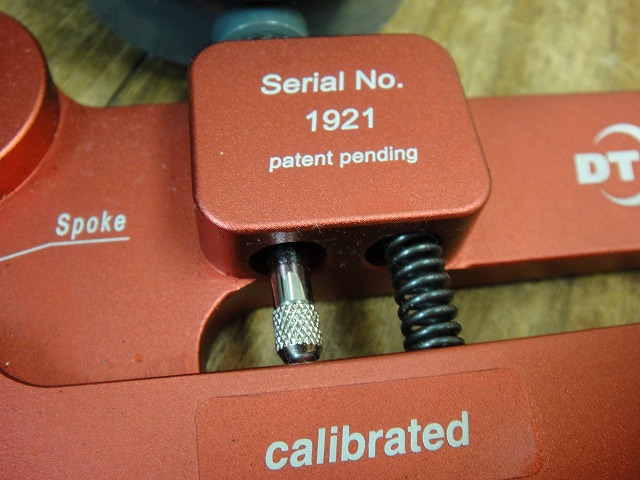
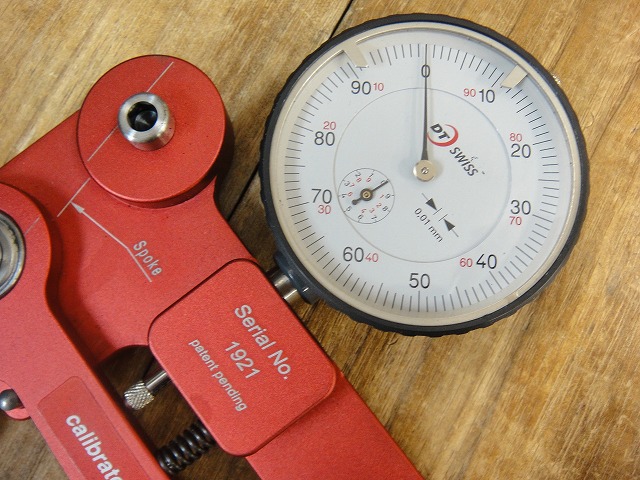
When you clamp the spoke, you grip it like a grip strengthener, the probe is pressed, and you can measure the deflection, but


↑The probe is held in place on the grip strengthener with just a set screw.
You can calibrate by adjusting here.
With Hozan they say absolutely never touch the calibration, but with DT you can do it yourself.
That's because DT's conversion table is not specific to each meter—there's only one that applies to all of them.
The idea is that the meter itself should be adjusted so it produces the values that match the conversion table.

↑This is the conversion table.

For reference, 2.0mm Champion.

Next, 2.0-1.5mm Revolution.
Earlier I drew a diagram showing the curved line for thin spokes below the curved line for thick spokes, but looking at these two, they look the same.
Don't be fooled. The maximum values and ranges of the graphs are completely different.
For example, Champion reaches 1000N at 2.2mm deflection, but Revolution reaches 1000N at just under 1.3mm deflection.

Hozan comes with individual conversion tables for each meter, and conversion tables from another Hozan meter (←awkward phrasing) have no compatibility.
Also, the conversion table is updated with each calibration.
Perhaps because this conversion table is made for standard bikes, you can only determine spoke tension for 13-, 14-, and 15-gauge plain spokes.
For any other sizes or special spokes like aero spokes, it clearly states "impossible."

DT, on the other hand, considers a meter to be "correct" if it faithfully matches the single, universal conversion table.
If you have multiple DT tension meters and apply them to the same 2.0mm Champion spoke, they'll all point to the same 2.2mm deflection.
However, if you keep using just one of them, it will drift over time.
If you have another DT meter (whose accuracy is reliable) to use as a reference, you can calibrate it yourself as a user.
So ideally, you'd want at least two DT meters.
There's a wheel-building method I personally call "zero-in lacing," which uses two or more DT meters, but since I only have one now, I can't do it.
For my current wheel-building method, whether zero-in lacing directly leads to better wheel building is debatable, so it's fine.
The DT conversion table has the curved lines for all of DT's spoke models. Strictly speaking, they're not identical because the butted lengths differ, but if you consider Sapim CX-RAY to be the same as DT Aero Light, Race as Competition, and Laser as Revolution, you can measure Sapim spokes with a DT meter too.
The error should be minimal, so that's what I do.
Leader and Champion are both plain spokes, so there's essentially no difference.
So what if you only have one DT meter?
Even if it's established that "1000N for 2.0mm Champion plain equals 2.2mm deflection," there's a question: is that deflection reading truly 1000N?
If you had a metronome-like standard that says "this is definitely 1000N," you could dial it in, but...
"Having two DT meters" is like tuning musical instruments against each other.
But as long as they're new, DT meters have very little drift or individual variation, so even if you buy just one, there's no problem if you don't calibrate.
Calibration is necessary only if you're building wheels daily, but in this age of pre-built wheel dominance, nobody does that.

So how am I measuring butted and aero spokes with a Hozan meter? I'm comparing 100N-interval deflections between DT and Hozan and using my own homemade conversion table.
This lets me convert things like "○.○mm deflection on Hozan equals ○○○○N for CX-RAY (actually Aero Light)."
This is equivalent to "zero-in lacing between DT and Hozan," and as long as I keep using this Hozan meter through calibration, I can keep using it.

↑Three sets of conversion tables and such.


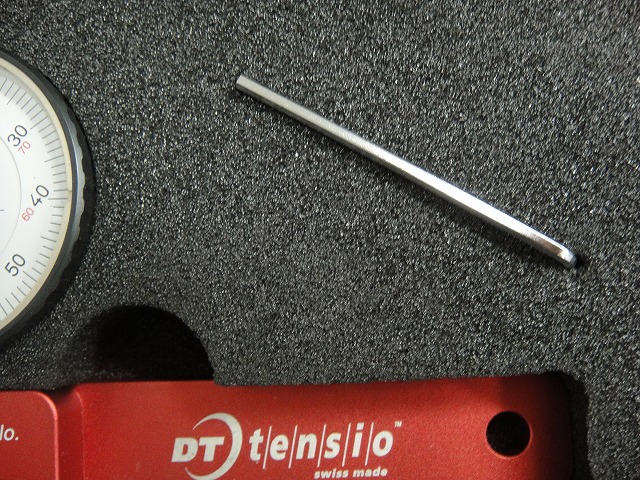
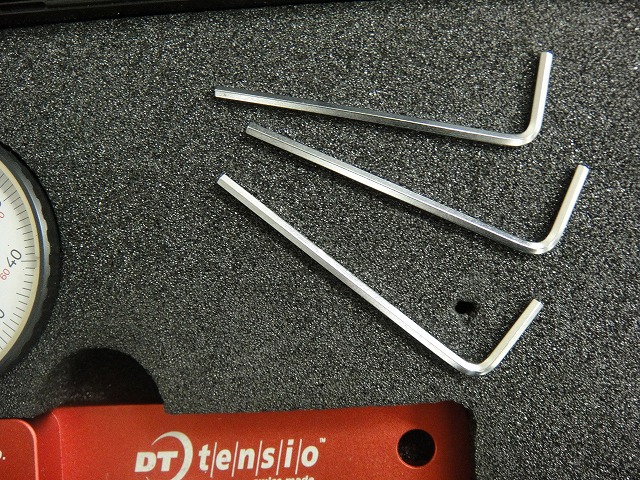
Three PB 2.5mm Allen keys for adjusting the probe set screw come with it.

Anyway, when others took responsibility for managing the tools, they were careless and things went missing—I had a painful experience with that. So now I only have one DT meter.
Without a conversion table, it's useless (though I could probably get a DT one), and it's too good a tool for you, so if you haven't lost it, return it.
Never mind that zero-in lacing isn't possible—verifying the fourth type of spoke tension requires at least two DT meters! Argh!
Thanks to the DT meter and its conversion table, I can now use the Hozan meter with Competition and CX-RAY spokes.
Do I constantly reference the conversion table when using it? Actually, no—I've memorized things like "for CX-RAY at 1100N the needle should be around here," so for the frequently-used DT Competition and CX-RAY, I don't check the table.
I just build using the meter reading—the first type of spoke tension.
Actually, some complete wheel manufacturers do this too—they specify spoke tension by saying "the freewheel side of this wheel shows X mm deflection on a DT meter."
This approach is clever, maybe.
The spokes don't necessarily have to be DT brand.
It's fine to just say "we build our wheels using a DT meter."
That's one reason DT meters are essential for shops. They're sometimes necessary for repairs on overseas-brand wheels.
So even if you use them without the conversion table for that reason, you should return them.

Finally, I'll write this preemptively:
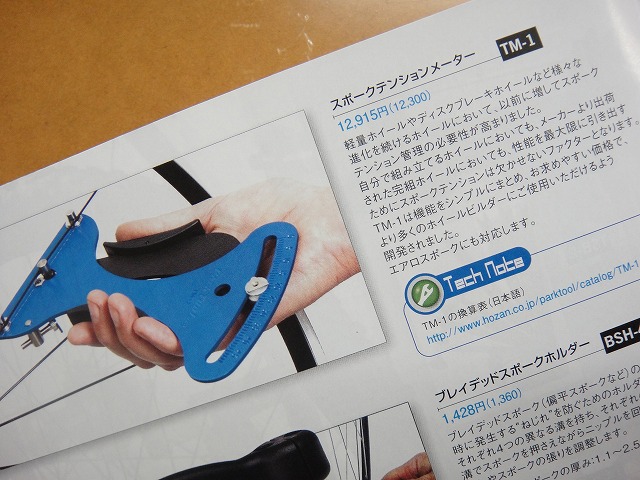
I'll probably be asked "What about the Park Tool TM-1?"
At 12,300 yen before tax, it's affordable and I'd recommend it for home mechanics.
However, the precision and repeatability are somewhat questionable, so be aware of that.
The individual variation in crimp hardness is very large, and the sliding resistance feels different from unit to unit.
Furthermore, adjusting or lubricating the crimp can significantly change how easily the needle moves on the same individual meter.
Hozan and DT don't have these issues thanks to their robustness, but that's reflected in the price too (though I still think DT is expensive).
Structurally, it's a super-simplified DT.
I don't think it's a professional shop tool, but for general use I think it's adequate.
However, as I mentioned before, maintaining the same condition is important, so please be careful about that.
There's a certain risk—it's like a "ruler whose scale width can vary depending on how you treat it."

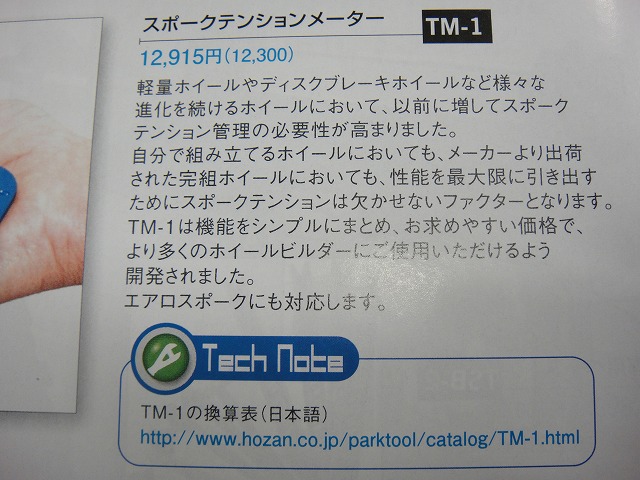
Park Tool names their tools either "acronym + size number" or "acronym + version number."
For hub wrenches (what Park Tool calls Shop Cone Wrench), it's the ShopCornWrench acronym SCW plus the size—SCW-13 for 13mm, SCW-17 for 17mm—so this is a size number.
For floor pumps, it's ProfessionalFloorPump, acronym PFP, followed by a number. Currently existing are PFP-5, PFP-7, and PFP-8.
These are version numbers, so there used to be 1, 2, 3, 4, and 6 as well.
What I'm getting at is that TM-1 is the first TensionMeter—version 1.
Park Tool only recently realized the necessity of spoke tension management, it seems.
Or maybe, with reliable meters from other companies already establishing themselves as standards, they found it hard to enter the market.
If you think about it that way, the TM-1—aiming deliberately for "something much cheaper than what others make," simple but not cheap-looking, squeezed to keep the retail price down—looks like a masterpiece at that limit.
If the TM-1 were the only spoke tension meter in existence, I'd obviously use it. I wouldn't rely on just my fingers.
But the point is that if price is no object, I have other options.
If TM-2 or something comes out later and it's solid and trustworthy, 50,000 yen wouldn't seem expensive. I'm actually hoping for it.
Even that gimmick tool, the pizza cutter, is now PZT-2 after all.
Without writing this, I can't cover topics like "hand-built freewheel-side radial lacing," "single-flange asymmetric lacing," or "zero-cross but not radial lacing."
I was supposed to have written this around December last year, but things dragged on.
First, let me start with the principle and how to use tension meters.
To measure spoke deflection, the meter holds the spoke at three points like a lever.
Two of these are fixed, one is movable, and it measures spoke deflection by the resistance to compression.
↑You then apply that deflection measurement to the conversion table that comes with the meter to determine the spoke tension.
The relationship between deflection and spoke tension at this point forms a curved line like the one shown above, but

if this were to become a straight line instead,
and if you then stipulated that you'd use only 2.0mm plain spokes, with no other spoke types,
you could theoretically make a tension meter where the meter reading itself displays the spoke tension.
(The dashed line in the diagram above is drawn offset, but it's on the same line.)
In reality, because of the curved line and the wide variety of spoke types, you cannot use a tension meter without a conversion table.
This is an extremely important point: When I simply write "spoke tension" in this blog, it refers to one of at least three different meanings, but I've consistently made a policy of not writing the details about which one.
I basically plan to continue that approach.
In my own personal terminology,
"the amount of spoke deflection when measured with a tension meter" is called the "first type of spoke tension."
When I call it "apparent spoke tension," that's usually what I mean, though rereading my posts sometimes it's not.
Regarding calling spoke deflection "spoke tension"—because there's a causal relationship between small deflection and high spoke tension,
I call this the "first type of spoke tension" somewhat arbitrarily as "spoke-tension-like."
Next, the approximate value of spoke tension after conversion using the conversion table is called the "second type of spoke tension."
Looking back at my past posts, I often call this the "true spoke tension," but there are many exceptions, so "second = true" isn't always the case.
This is what's generally meant by spoke tension in the ordinary sense—what people normally mean when they say "spoke tension."
Next, regarding the third type of spoke tension.
This is not spoke tension itself.
It's a value obtained by applying the first and second types of spoke tension, spoke thickness (strictly speaking, specific gravity), and the roughly radial angle between spoke and hub to a certain constant.
I can't write what the constant is—it's my own arbitrary definition.
However, I have an unshakeable conviction from experience that the presence or absence of third-type spoke tension expresses wheel performance more accurately than second-type spoke tension.
Third-type spoke tension is roughly "the amount of spoke deflection," but the difference from the first type is that spoke specific gravity and the angle at which it's tensioned are factored into the calculation.
Even with the same spoke tension (←now which type of spoke tension is this, I wonder?), drive transmission efficiency differs between radial and tangential lacing,
so the angle at which spokes are tensioned is important for wheel performance.
Think of third-type spoke tension as "the quantification of wheel performance."
It's not quite that, but roughly.
There's also a "fourth type of spoke tension," but in the actual task of building wheels, it's basically an unnecessary concept, so I've never mentioned it in this blog.
As I'll explain later, currently I can't research the fourth type. Give it back.
With some exceptions for round and flattened spokes, when you put thick and thin spokes on the same conversion table, you get the relationship shown above.
Because both are curves, the relationship between meter reading and the approximate spoke tension—that is, between the first and second types—won't be in the same proportion for thick and thin spokes.
When building a rear wheel with all-Campagnolo versus all-CX-RAY, though both are symmetrical lacing,
the CX-RAY will have less left-right spoke tension difference than the Campagnolo.
Say both have the freewheel side tensioned at 1000N second-type tension.
Naturally the lacing method, rim, and hub are all the same.
In that case, the tactile feel of the non-freewheel side spoke deflection will feel more tensioned with the CX-RAY.
If I calculate this using third-type spoke tension, the CX-RAY also comes out with a higher value. That's because the specific gravity of the spoke is included in the third-type calculation formula.
Even though I said "first, let me start with the principle and how to use tension meters," I've digressed quite a bit.
Back to spoke tension meters.
First, the Hozan tension meter.
This is what I normally use.
The list price before tax is 44,000 yen. For reference.
You press the measurement probe in the middle against the spoke to measure deflection.
↑Calibration is done by adjusting the double nut here, but you absolutely must never touch this. It will throw off the calibration.
Like with torque wrenches, instruments can drift over years of use, and measurement values gradually change.
With Hozan tension meters, you can send them back to the manufacturer for recalibration.
Whether measuring instruments can be recalibrated is extremely important.
From the instruction manual, it says:
"Conversion values differ for each unit, so each meter individually receives official inspection and a conversion table is created.
Please keep the conversion table safe.
If you unfortunately lose the conversion table, the device will need to be re-inspected."
The "individually" part is what differs from other manufacturers.
Next, the DT tension meter.
Without this, you can't use the Hozan meter (I'll explain why later).
The list price before tax is 72,380 yen. For reference.
↑You clamp the spoke here.
When you clamp the spoke, you grip it like a grip strengthener, the probe is pressed, and you can measure the deflection, but
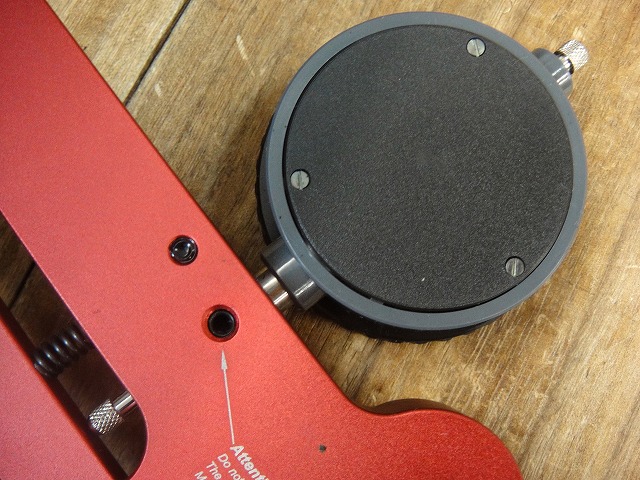
↑The probe is held in place on the grip strengthener with just a set screw.
You can calibrate by adjusting here.
With Hozan they say absolutely never touch the calibration, but with DT you can do it yourself.
That's because DT's conversion table is not specific to each meter—there's only one that applies to all of them.
The idea is that the meter itself should be adjusted so it produces the values that match the conversion table.
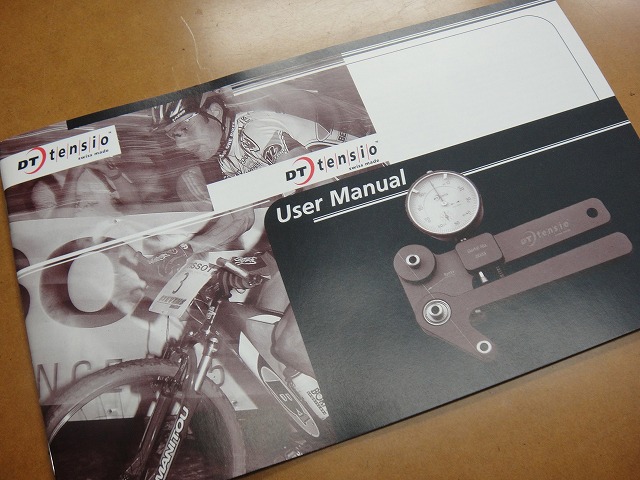
↑This is the conversion table.
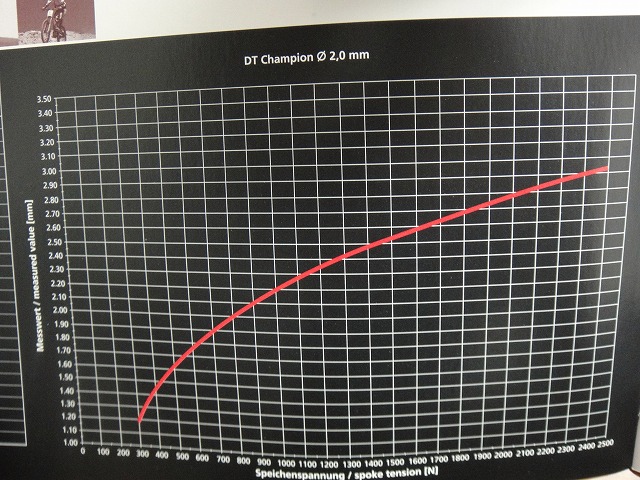
For reference, 2.0mm Champion.
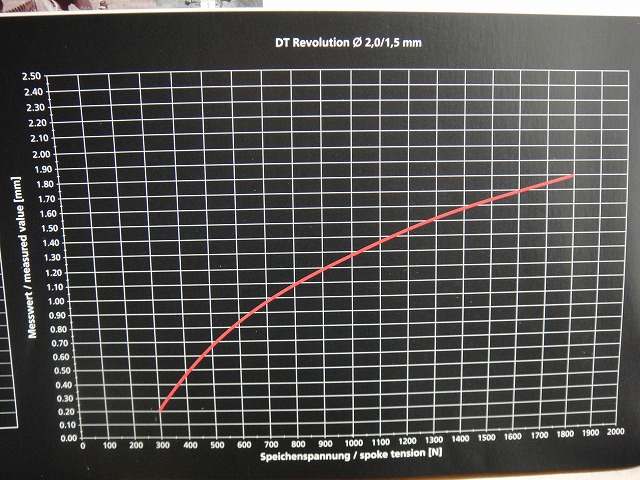
Next, 2.0-1.5mm Revolution.
Earlier I drew a diagram showing the curved line for thin spokes below the curved line for thick spokes, but looking at these two, they look the same.
Don't be fooled. The maximum values and ranges of the graphs are completely different.
For example, Champion reaches 1000N at 2.2mm deflection, but Revolution reaches 1000N at just under 1.3mm deflection.

Hozan comes with individual conversion tables for each meter, and conversion tables from another Hozan meter (←awkward phrasing) have no compatibility.
Also, the conversion table is updated with each calibration.
Perhaps because this conversion table is made for standard bikes, you can only determine spoke tension for 13-, 14-, and 15-gauge plain spokes.
For any other sizes or special spokes like aero spokes, it clearly states "impossible."
DT, on the other hand, considers a meter to be "correct" if it faithfully matches the single, universal conversion table.
If you have multiple DT tension meters and apply them to the same 2.0mm Champion spoke, they'll all point to the same 2.2mm deflection.
However, if you keep using just one of them, it will drift over time.
If you have another DT meter (whose accuracy is reliable) to use as a reference, you can calibrate it yourself as a user.
So ideally, you'd want at least two DT meters.
There's a wheel-building method I personally call "zero-in lacing," which uses two or more DT meters, but since I only have one now, I can't do it.
For my current wheel-building method, whether zero-in lacing directly leads to better wheel building is debatable, so it's fine.
The DT conversion table has the curved lines for all of DT's spoke models. Strictly speaking, they're not identical because the butted lengths differ, but if you consider Sapim CX-RAY to be the same as DT Aero Light, Race as Competition, and Laser as Revolution, you can measure Sapim spokes with a DT meter too.
The error should be minimal, so that's what I do.
Leader and Champion are both plain spokes, so there's essentially no difference.
So what if you only have one DT meter?
Even if it's established that "1000N for 2.0mm Champion plain equals 2.2mm deflection," there's a question: is that deflection reading truly 1000N?
If you had a metronome-like standard that says "this is definitely 1000N," you could dial it in, but...
"Having two DT meters" is like tuning musical instruments against each other.
But as long as they're new, DT meters have very little drift or individual variation, so even if you buy just one, there's no problem if you don't calibrate.
Calibration is necessary only if you're building wheels daily, but in this age of pre-built wheel dominance, nobody does that.
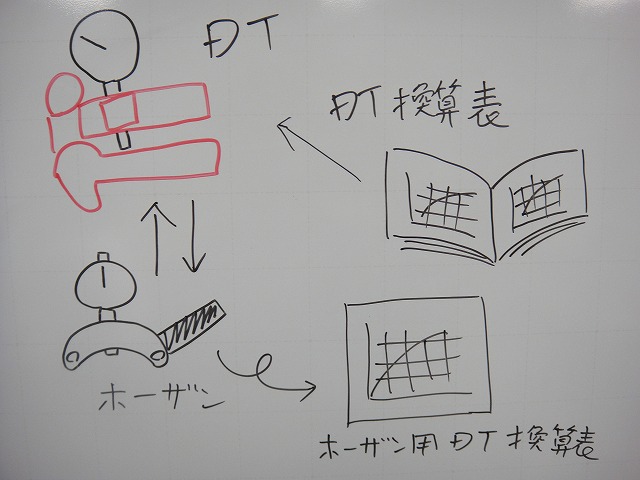
So how am I measuring butted and aero spokes with a Hozan meter? I'm comparing 100N-interval deflections between DT and Hozan and using my own homemade conversion table.
This lets me convert things like "○.○mm deflection on Hozan equals ○○○○N for CX-RAY (actually Aero Light)."
This is equivalent to "zero-in lacing between DT and Hozan," and as long as I keep using this Hozan meter through calibration, I can keep using it.
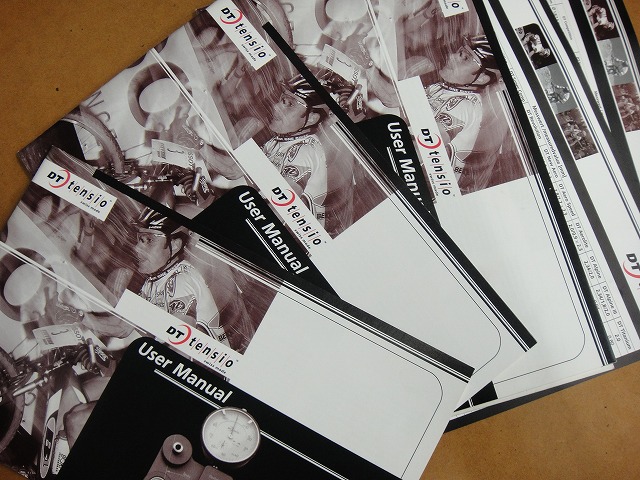
↑Three sets of conversion tables and such.
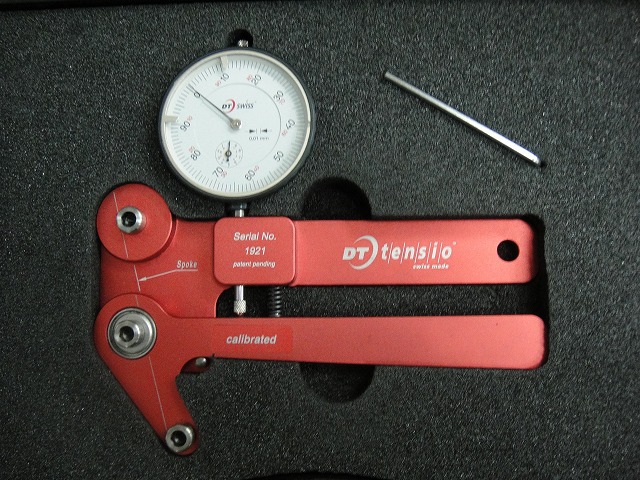
Three PB 2.5mm Allen keys for adjusting the probe set screw come with it.
Anyway, when others took responsibility for managing the tools, they were careless and things went missing—I had a painful experience with that. So now I only have one DT meter.
Without a conversion table, it's useless (though I could probably get a DT one), and it's too good a tool for you, so if you haven't lost it, return it.
Never mind that zero-in lacing isn't possible—verifying the fourth type of spoke tension requires at least two DT meters! Argh!
Thanks to the DT meter and its conversion table, I can now use the Hozan meter with Competition and CX-RAY spokes.
Do I constantly reference the conversion table when using it? Actually, no—I've memorized things like "for CX-RAY at 1100N the needle should be around here," so for the frequently-used DT Competition and CX-RAY, I don't check the table.
I just build using the meter reading—the first type of spoke tension.
Actually, some complete wheel manufacturers do this too—they specify spoke tension by saying "the freewheel side of this wheel shows X mm deflection on a DT meter."
This approach is clever, maybe.
The spokes don't necessarily have to be DT brand.
It's fine to just say "we build our wheels using a DT meter."
That's one reason DT meters are essential for shops. They're sometimes necessary for repairs on overseas-brand wheels.
So even if you use them without the conversion table for that reason, you should return them.
Finally, I'll write this preemptively:
I'll probably be asked "What about the Park Tool TM-1?"
At 12,300 yen before tax, it's affordable and I'd recommend it for home mechanics.
However, the precision and repeatability are somewhat questionable, so be aware of that.
The individual variation in crimp hardness is very large, and the sliding resistance feels different from unit to unit.
Furthermore, adjusting or lubricating the crimp can significantly change how easily the needle moves on the same individual meter.
Hozan and DT don't have these issues thanks to their robustness, but that's reflected in the price too (though I still think DT is expensive).
Structurally, it's a super-simplified DT.
I don't think it's a professional shop tool, but for general use I think it's adequate.
However, as I mentioned before, maintaining the same condition is important, so please be careful about that.
There's a certain risk—it's like a "ruler whose scale width can vary depending on how you treat it."
Park Tool names their tools either "acronym + size number" or "acronym + version number."
For hub wrenches (what Park Tool calls Shop Cone Wrench), it's the ShopCornWrench acronym SCW plus the size—SCW-13 for 13mm, SCW-17 for 17mm—so this is a size number.
For floor pumps, it's ProfessionalFloorPump, acronym PFP, followed by a number. Currently existing are PFP-5, PFP-7, and PFP-8.
These are version numbers, so there used to be 1, 2, 3, 4, and 6 as well.
What I'm getting at is that TM-1 is the first TensionMeter—version 1.
Park Tool only recently realized the necessity of spoke tension management, it seems.
Or maybe, with reliable meters from other companies already establishing themselves as standards, they found it hard to enter the market.
If you think about it that way, the TM-1—aiming deliberately for "something much cheaper than what others make," simple but not cheap-looking, squeezed to keep the retail price down—looks like a masterpiece at that limit.
If the TM-1 were the only spoke tension meter in existence, I'd obviously use it. I wouldn't rely on just my fingers.
But the point is that if price is no object, I have other options.
If TM-2 or something comes out later and it's solid and trustworthy, 50,000 yen wouldn't seem expensive. I'm actually hoping for it.
Even that gimmick tool, the pizza cutter, is now PZT-2 after all.