I received comments about spoke tension and meters.
I could add a follow-up to the previous article, but
since the article itself is already long
(because I covered meter talk and a third type of spoke tension all at once)
I'll make this a separate post.
So, first off,
I got a comment saying:
"Why not just prepare some double-threaded spokes, hang a weight, and calibrate it yourself?"
Ah, I see! So you'd reverse-transfer the tool reference point from a trustworthy spoke.
The problem is, I don't have the confidence to build such a trustworthy device myself...

↑What about something like this? A "1000N standard gauge."
It's a standard with a thick platinum and iridium alloy frame
that has a spoke tensioned at 1000N inside it, like a harp string.
Some might point out that compared to the comment's suggestion, this is far more elaborate
and practically impossible to manufacture,
but before that even comes into play, the spoke part seems like it would drift quickly due to aging.
By "quickly," I mean relative to how stable the frame part is.
Next up,
"I've never touched a DT meter, but if you prepare two or more TM-1s
that you've carefully calibrated using that as a standard..."
Oh, I can't quote any further than that. That was close.
As for what the fourth type of spoke tension is,
I can't go into details, but having two or more meters that are "the same in accuracy"
is a means, not an end.
There are things you can only do and understand once you have two.
It's extremely difficult to prepare two TM-1s that are truly "identical."
With DT and Hozan, the only adjustment point is the spring compression of the probe,
but Park Tool has multiple adjustment points—the play in the rivet and the sliding parts when gripping—
so it's questionable whether you can achieve the same condition through adjustment alone.
It seems impossible to bring into the same state something like
"the rivet is tight but the needle slides" versus
"the rivet is loose but the needle doesn't slide."
If only the probe adjustment mattered, two Hozans would work,
but since we need to correlate with the DT conversion table, two DTs would be more convenient.
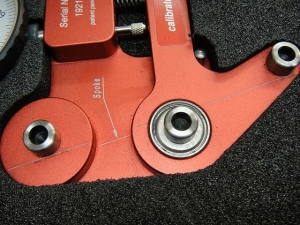
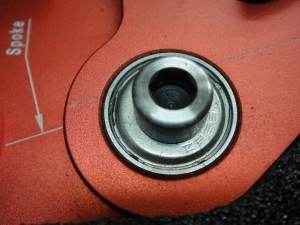
↑The rivet section on the DT has bearings built in.
The spring return is extremely smooth, so individual variation is unlikely.
From here on is bonus material.
Not responding to comments.
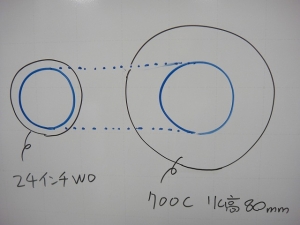
The inner diameter of a 700C 80mm-deep rim
and a 24-inch low-profile rim are roughly the same.
When I build the Nomunolab Wheel No. 3, I often say stuff like
"the deformation when squeezing the spokes is basically zero, hehehehe"
but on a 24-inch wheel with the same spoke length,
you don't see that phenomenon as much.
I bet the inner circumference of the rim (the blue circle in the diagram above) deforms inward
by an amount that varies depending on rim stiffness under spoke tension.
But it's definitely true that as spokes get shorter, the deformation for a given tension decreases.
With smaller-diameter wheels like 16-inch, you have to be aware of that kind of thing.
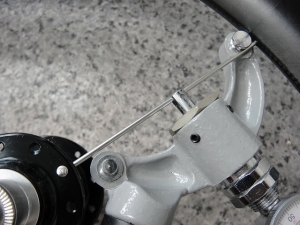
What I'm getting at is that as spokes get shorter,
the first-type tension becomes higher relative to the second-type tension.
But in the conversion from first-type to second-type,
the information "a 2.0mm Champion is 1000N at 2.2mm" doesn't include
spoke length.
Strictly speaking, the shape and position of the conversion table's curved line
should change between extremely long and short spokes.
Since the tension meter existed before deep rims,
let's say the reference length is 300mm as a baseline.
This is roughly what an old-school low-profile tubular rim 32H six-spoke build comes to.
The spoke length when building an 80mm-deep rim is 250mm.
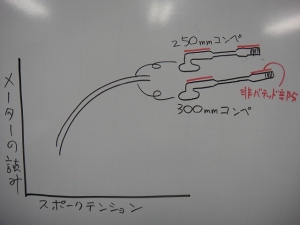
With DT Competition, the non-butted section length is the same
regardless of overall spoke length.
This means as spokes get shorter, the thin butted section proportionally decreases,
and the spoke's specific gravity increases.
Increased specific gravity means it deforms less,
so the curved line for short spokes sits higher than for long spokes.
Just because spoke length gets shorter, deformation decreases anyway,
so even non-butted spokes will shift the curve position if length differs.
In reality it's probably a negligible difference where the lines nearly overlap,
but I've drawn them separated in the diagram above.
So why did I draw it with butted spokes?
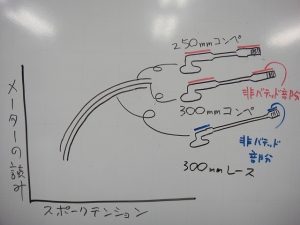
Because I wanted to throw Sapim Race, which has the same butted dimensions as DT Competition
but a shorter non-butted section,
into this table.
The 300mm Race is lighter in specific gravity than the 300mm Competition,
so its curved line would sit lower.
This is also a negligible difference—in practice, the lines would overlap.
In short, that was sophistry along the lines of:
"If we're allowed to overlook the crudeness of not including length information in the curved line,
shouldn't we also be allowed to treat DT Competition and Sapim Race as equivalent?"
One more thing. About Revolution.
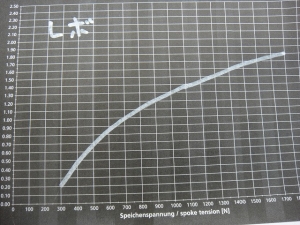
This is a copy of the conversion table for 2.0–1.5–2.0mm Revolution.
It's really just the result of a tensile test on 2mm-diameter wire, but
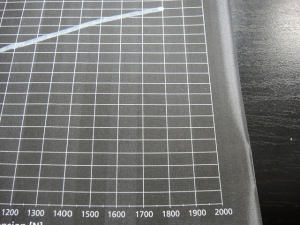
↑they've drawn it out to 1800N.
I don't know if that's the breaking point.
But setting that aside... no, that can't be right.
Revolution shows "unyoon" probabilistically from around 1000N and onward,
and definitely from around 1300N and above.
This is the phenomenon where nipple tightening converts to spoke elongation
rather than spoke tension.
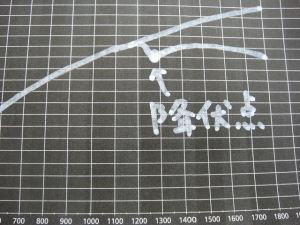
↑So the yield point should really be somewhere around here.
Whoever draws this kind of graph while hiding the yield point is a coward!
Is there something shady going on?! I don't have the standing to accuse them of that.
Basically, I avoid drawing it too.
There's no way Revolution can be tensioned nicely all the way to 1800N.
This must be the curved line for a different spoke—Revolution (perfectly rigid).
Probably.
(If it were perfectly rigid, the curve shape itself would change! —no, that objection is not allowed)
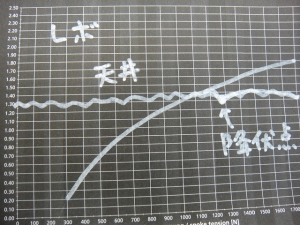
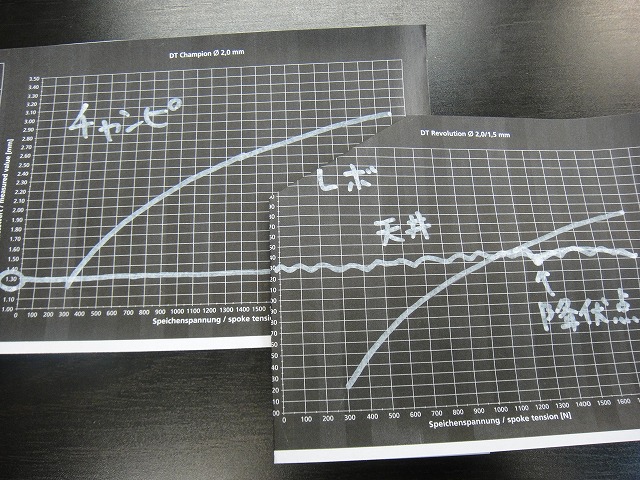
Anyway, the "ceiling" for Revolution spoke tension
is probably around here, if we're being generous.
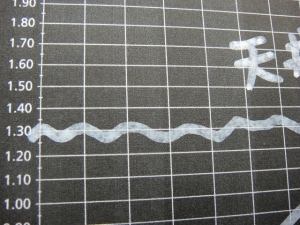
The first-type tension—the meter reading—at that point is around 1.3mm.
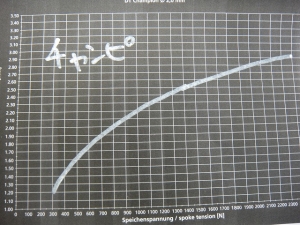
Next, here's the conversion table for 2.0mm plain Champion.
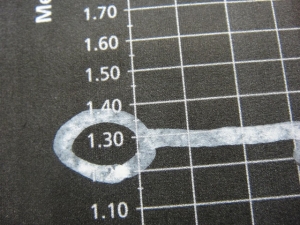
I draw a horizontal line from the 1.3mm mark.
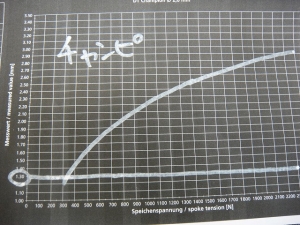
It comes out like this.
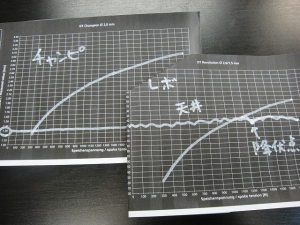
So when I line up the Revolution conversion table with the Champion curve
so the 1.3mm line matches, what I see is that Revolution's ceiling and
the lower limit of Champion's curve are at roughly the same height.
What the heck is this soft spoke?
Earlier I wrote "Revolution, the perfectly rigid spoke," but
there is something close to that.
Sapim CX-RAY.
Both Revolution and CX-RAY are about 65% the weight of a 2.0mm plain spoke,
but CX-RAY, through work-hardening from aero machining,
almost never experiences "unyoon."
Its yield point is much higher than Revolution's.
On the other hand, I suspect the yield point and breaking point are very close,
but with welded spokes, you basically never tension to that point, so it's fine.
This might look like trash-talking Revolution and shill-posting for CX-RAY,
and you know what, it is. Got a problem with that? (Shameless admission)
If spokes with the same specific gravity differ this much in "unyoon" resistance,
then all I can say is: "CX-RAY has replaced it" and "There's no reason to choose Revolution."
Unfortunately.
I could add a follow-up to the previous article, but
since the article itself is already long
(because I covered meter talk and a third type of spoke tension all at once)
I'll make this a separate post.
So, first off,
I got a comment saying:
"Why not just prepare some double-threaded spokes, hang a weight, and calibrate it yourself?"
Ah, I see! So you'd reverse-transfer the tool reference point from a trustworthy spoke.
The problem is, I don't have the confidence to build such a trustworthy device myself...
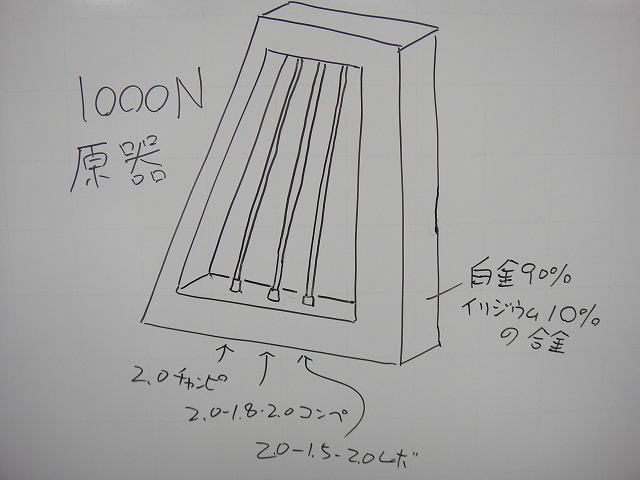
↑What about something like this? A "1000N standard gauge."
It's a standard with a thick platinum and iridium alloy frame
that has a spoke tensioned at 1000N inside it, like a harp string.
Some might point out that compared to the comment's suggestion, this is far more elaborate
and practically impossible to manufacture,
but before that even comes into play, the spoke part seems like it would drift quickly due to aging.
By "quickly," I mean relative to how stable the frame part is.
Next up,
"I've never touched a DT meter, but if you prepare two or more TM-1s
that you've carefully calibrated using that as a standard..."
Oh, I can't quote any further than that. That was close.
As for what the fourth type of spoke tension is,
I can't go into details, but having two or more meters that are "the same in accuracy"
is a means, not an end.
There are things you can only do and understand once you have two.
It's extremely difficult to prepare two TM-1s that are truly "identical."
With DT and Hozan, the only adjustment point is the spring compression of the probe,
but Park Tool has multiple adjustment points—the play in the rivet and the sliding parts when gripping—
so it's questionable whether you can achieve the same condition through adjustment alone.
It seems impossible to bring into the same state something like
"the rivet is tight but the needle slides" versus
"the rivet is loose but the needle doesn't slide."
If only the probe adjustment mattered, two Hozans would work,
but since we need to correlate with the DT conversion table, two DTs would be more convenient.
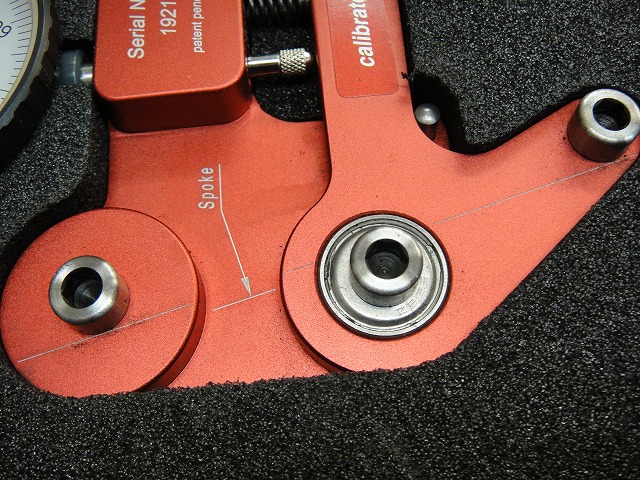
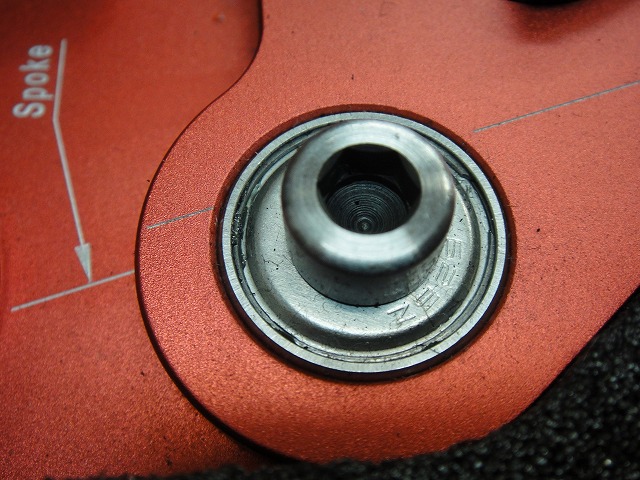
↑The rivet section on the DT has bearings built in.
The spring return is extremely smooth, so individual variation is unlikely.
From here on is bonus material.
Not responding to comments.
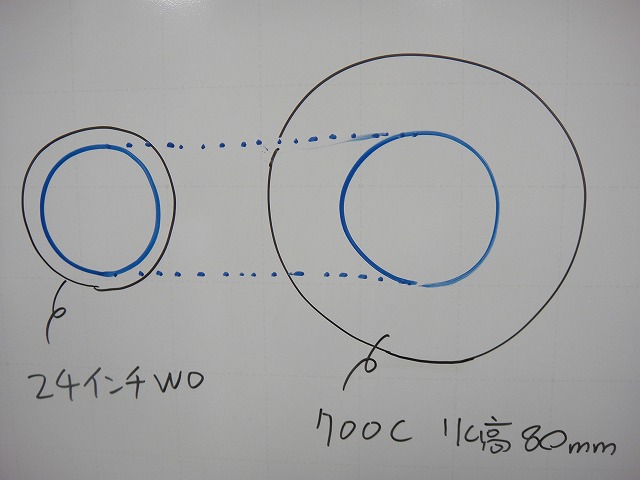
The inner diameter of a 700C 80mm-deep rim
and a 24-inch low-profile rim are roughly the same.
When I build the Nomunolab Wheel No. 3, I often say stuff like
"the deformation when squeezing the spokes is basically zero, hehehehe"
but on a 24-inch wheel with the same spoke length,
you don't see that phenomenon as much.
I bet the inner circumference of the rim (the blue circle in the diagram above) deforms inward
by an amount that varies depending on rim stiffness under spoke tension.
But it's definitely true that as spokes get shorter, the deformation for a given tension decreases.
With smaller-diameter wheels like 16-inch, you have to be aware of that kind of thing.
What I'm getting at is that as spokes get shorter,
the first-type tension becomes higher relative to the second-type tension.
But in the conversion from first-type to second-type,
the information "a 2.0mm Champion is 1000N at 2.2mm" doesn't include
spoke length.
Strictly speaking, the shape and position of the conversion table's curved line
should change between extremely long and short spokes.
Since the tension meter existed before deep rims,
let's say the reference length is 300mm as a baseline.
This is roughly what an old-school low-profile tubular rim 32H six-spoke build comes to.
The spoke length when building an 80mm-deep rim is 250mm.
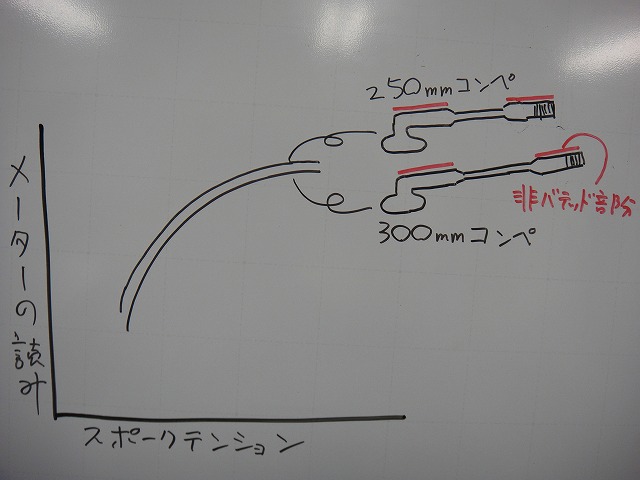
With DT Competition, the non-butted section length is the same
regardless of overall spoke length.
This means as spokes get shorter, the thin butted section proportionally decreases,
and the spoke's specific gravity increases.
Increased specific gravity means it deforms less,
so the curved line for short spokes sits higher than for long spokes.
Just because spoke length gets shorter, deformation decreases anyway,
so even non-butted spokes will shift the curve position if length differs.
In reality it's probably a negligible difference where the lines nearly overlap,
but I've drawn them separated in the diagram above.
So why did I draw it with butted spokes?
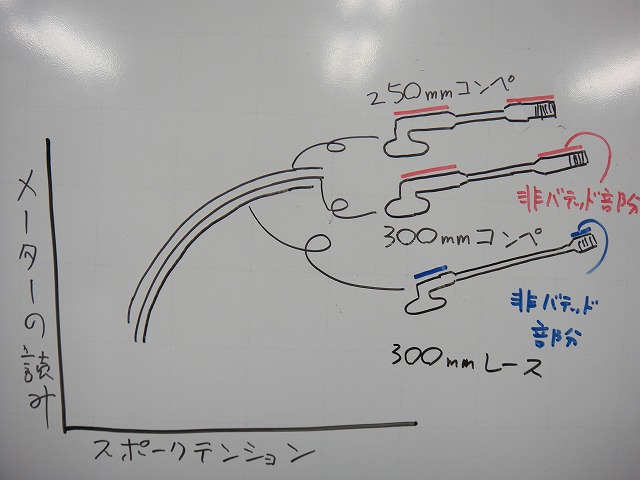
Because I wanted to throw Sapim Race, which has the same butted dimensions as DT Competition
but a shorter non-butted section,
into this table.
The 300mm Race is lighter in specific gravity than the 300mm Competition,
so its curved line would sit lower.
This is also a negligible difference—in practice, the lines would overlap.
In short, that was sophistry along the lines of:
"If we're allowed to overlook the crudeness of not including length information in the curved line,
shouldn't we also be allowed to treat DT Competition and Sapim Race as equivalent?"
One more thing. About Revolution.
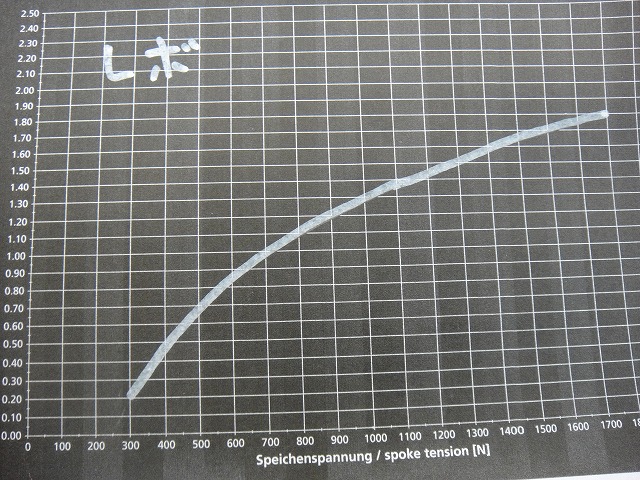
This is a copy of the conversion table for 2.0–1.5–2.0mm Revolution.
It's really just the result of a tensile test on 2mm-diameter wire, but
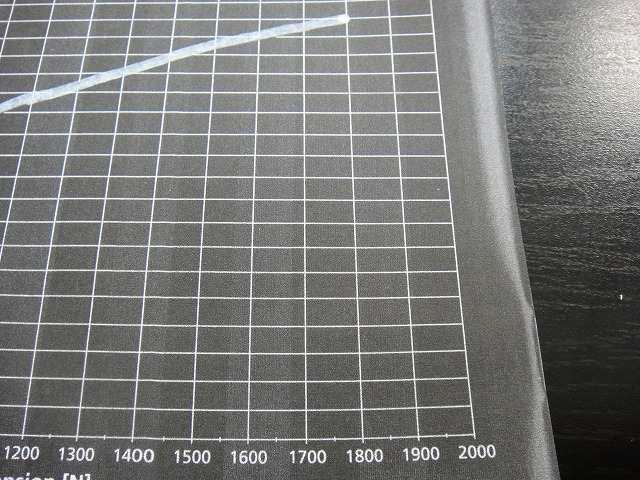
↑they've drawn it out to 1800N.
I don't know if that's the breaking point.
But setting that aside... no, that can't be right.
Revolution shows "unyoon" probabilistically from around 1000N and onward,
and definitely from around 1300N and above.
This is the phenomenon where nipple tightening converts to spoke elongation
rather than spoke tension.
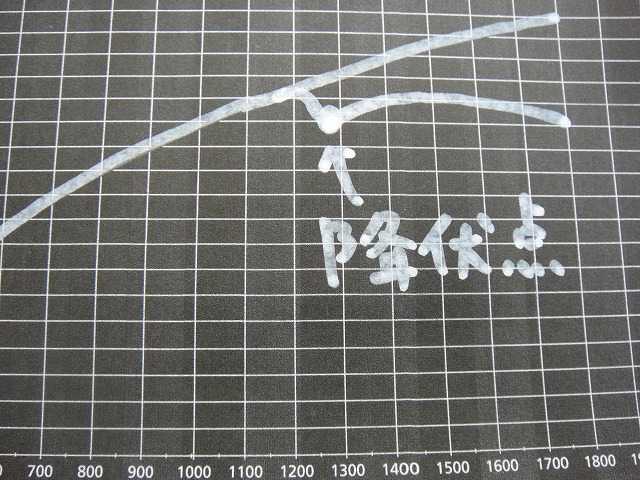
↑So the yield point should really be somewhere around here.
Whoever draws this kind of graph while hiding the yield point is a coward!
Is there something shady going on?! I don't have the standing to accuse them of that.
Basically, I avoid drawing it too.
There's no way Revolution can be tensioned nicely all the way to 1800N.
This must be the curved line for a different spoke—Revolution (perfectly rigid).
Probably.
(If it were perfectly rigid, the curve shape itself would change! —no, that objection is not allowed)
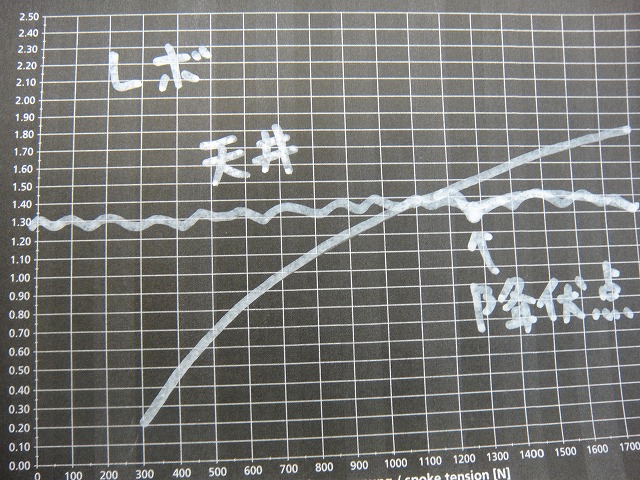
Anyway, the "ceiling" for Revolution spoke tension
is probably around here, if we're being generous.

The first-type tension—the meter reading—at that point is around 1.3mm.

Next, here's the conversion table for 2.0mm plain Champion.
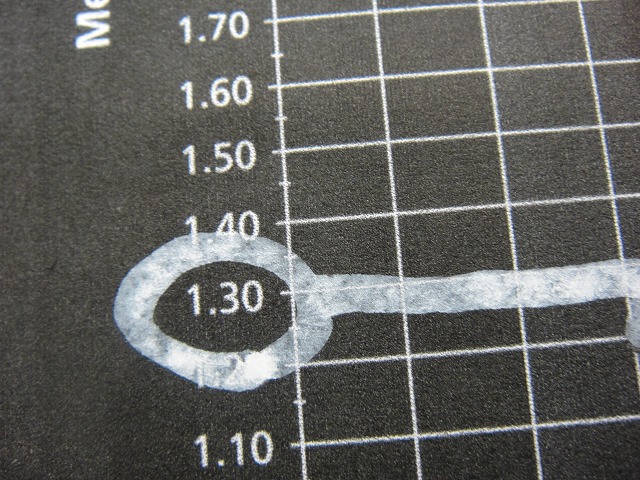
I draw a horizontal line from the 1.3mm mark.
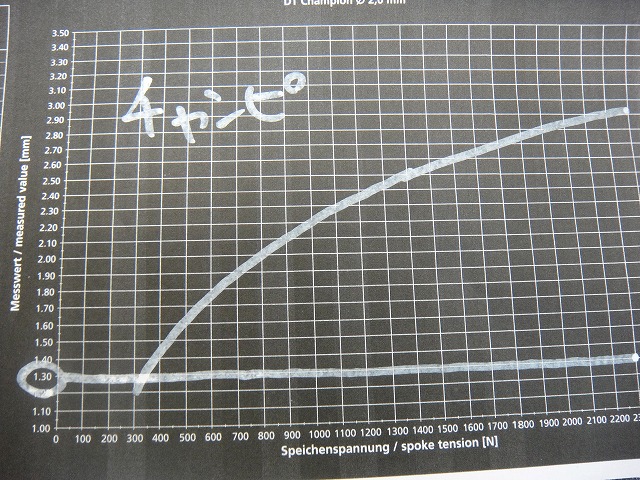
It comes out like this.
So when I line up the Revolution conversion table with the Champion curve
so the 1.3mm line matches, what I see is that Revolution's ceiling and
the lower limit of Champion's curve are at roughly the same height.
What the heck is this soft spoke?
Earlier I wrote "Revolution, the perfectly rigid spoke," but
there is something close to that.
Sapim CX-RAY.
Both Revolution and CX-RAY are about 65% the weight of a 2.0mm plain spoke,
but CX-RAY, through work-hardening from aero machining,
almost never experiences "unyoon."
Its yield point is much higher than Revolution's.
On the other hand, I suspect the yield point and breaking point are very close,
but with welded spokes, you basically never tension to that point, so it's fine.
This might look like trash-talking Revolution and shill-posting for CX-RAY,
and you know what, it is. Got a problem with that? (Shameless admission)
If spokes with the same specific gravity differ this much in "unyoon" resistance,
then all I can say is: "CX-RAY has replaced it" and "There's no reason to choose Revolution."
Unfortunately.