The other day, I built a wheel using DT Revolution spokes, and I received a comment asking something like "didn't you get any twanging?"
The front wheel is all Revolution, but I built it right at the threshold where twanging could theoretically occur with probability.
The rear wheel is Competition/Revolution, but if the freewheel side had been Revolution,
twanging would definitely occur (but it doesn't because it's Competition) — I built it at that tension level.
If you look at left-right different-diameter builds regardless of spoke shape (round or flattened),
considering only spoke weight-ratio differences, Competition/Revolution is
equivalent to Competition/CX-RAY (← semi-Competition).
That concludes my reply to the comment.
Next, I'll write down what I'm empirically certain about regarding twanging occurrence.
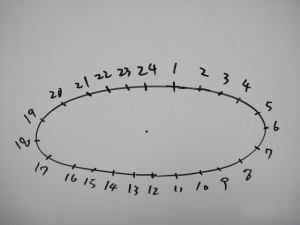
Let me think about this using a hypothetical 24-hole front wheel.
A rear wheel would work too, but with a rear wheel, spoke tension
alternates up and down at each rim hole.
Since I want to think simply, let's go with a front wheel.
I'm using 24 holes because I want to draw a six-pointed star for the punchline,
and there's no deeper meaning than that.
With 20 holes you'd get a five-pointed star instead.
Anyway, I numbered the 24 rim holes.
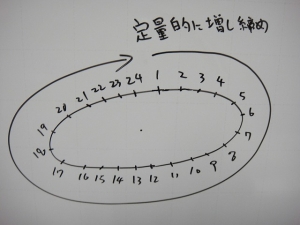
In the stage well before the final true-up of wheel building,
not for trueing but purely for spoke tension,
I tighten the nipples by the same amount in sequence (in number order from the diagram above),
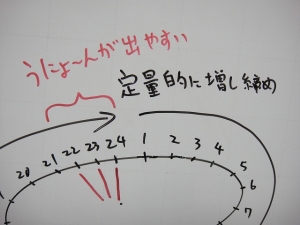
and twanging is most likely to occur near the end of this tightening process.
This is definitely true from experience.
For example, if a spoke starts twanging above 1000N,
and before tightening it's 950N and after tightening it becomes 1020N,
then toward the end all spokes exceed 1000N,
but twanging usually won't happen unless the spoke is
"exceeding 1000N while its nipple is being turned."
The stress from the stretch when you tighten one particular nipple
is not the same as the stress from the tension increase of the other 23 nipples happening at that moment.
With a front wheel, you can aim for nearly the final tension during rough assembly,
but if you try to reduce steps — for example, "turn each nipple five full turns at once" —
twanging becomes more likely. Especially near the end of each rim lap.
So in those cases, if you do "tighten 3 turns, then tighten 2 turns," it becomes
less likely to twang.
Going further, with five turns, "one turn at a time × 5" or "half turn at a time × 10" might be
kinder to the spokes,
but when I can see exactly how many tightening steps it'll take to finish building,
I just try to build it in as few steps as possible.
That said, within the range of wheel building I do,
twanging normally only happens with DT Revolution and
Sapim Laser spokes,
so I don't worry that much unless it's one of these spokes.
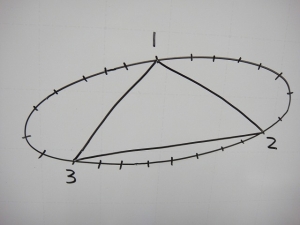
I thought about a tightening sequence that might make
twanging less likely to occur.
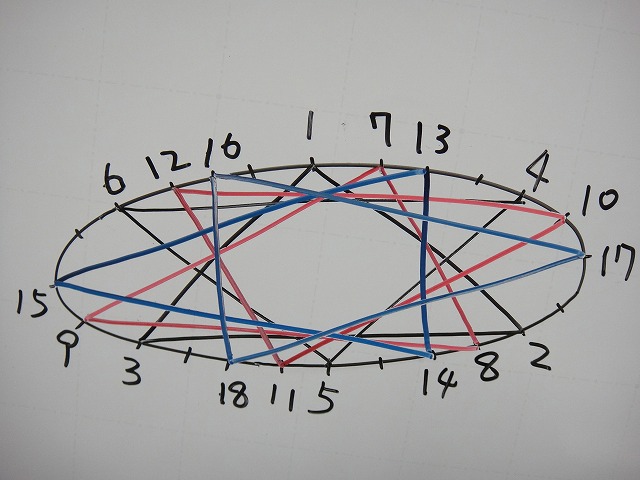
First, I draw a triangle like in the diagram above
and number them clockwise.
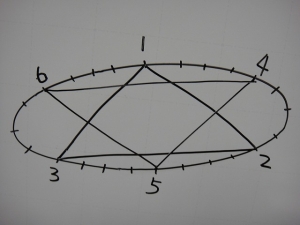
Next, I number them like this.
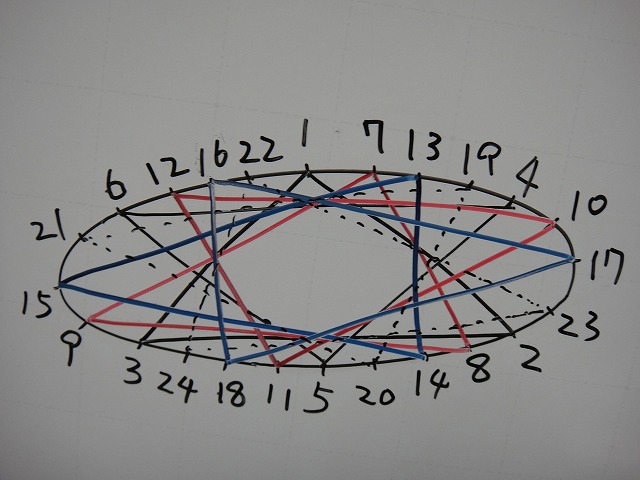
In the six-pointed star, clockwise gives 1・4・2・5・3・6.

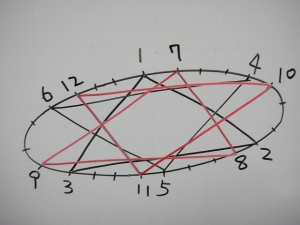
Then I shift the phase and do the same thing.
I've determined positions 7–9.
Then positions 10–12.
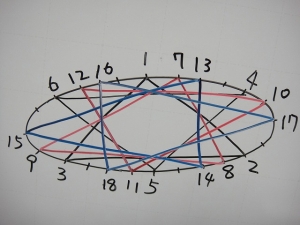
From here I go in groups of six. I've determined positions 13–18.
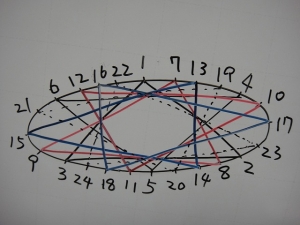
Finally, 19–24.
If you tighten the nipples in this number sequence, all by the same amount,
twanging should become less likely. That's the theory, anyway.
But if you lose track of the numbers or positions during such a complicated building process,
radial runout will be completely messed up.
Best not to do it.
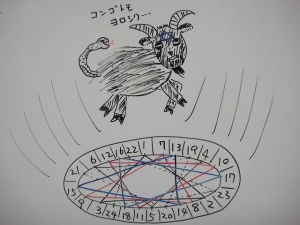
Moreover, this sequence is
strikingly similar to the summoning process of the demon Black Goat-san (→here),
so you might accidentally open a door to another realm.
Black Goat-san loves paper, especially letters and documents,
and won't go home until it's eaten its fill.
Even if it were true, the tax office won't accept
the excuse "the Black Goat-san ate my receipts,"
so you have to be careful.
The front wheel is all Revolution, but I built it right at the threshold where twanging could theoretically occur with probability.
The rear wheel is Competition/Revolution, but if the freewheel side had been Revolution,
twanging would definitely occur (but it doesn't because it's Competition) — I built it at that tension level.
If you look at left-right different-diameter builds regardless of spoke shape (round or flattened),
considering only spoke weight-ratio differences, Competition/Revolution is
equivalent to Competition/CX-RAY (← semi-Competition).
That concludes my reply to the comment.
Next, I'll write down what I'm empirically certain about regarding twanging occurrence.
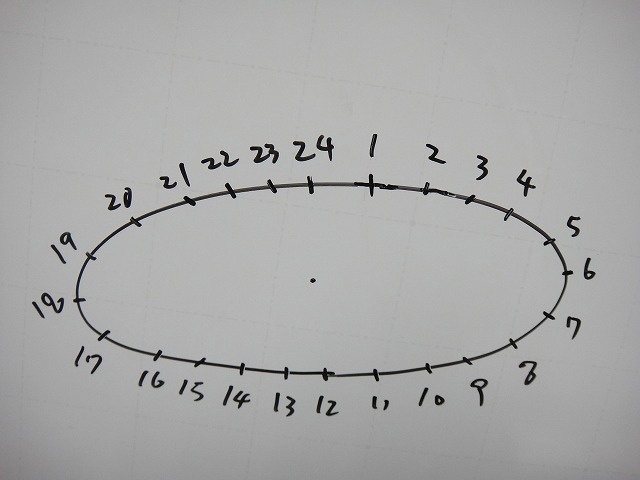
Let me think about this using a hypothetical 24-hole front wheel.
A rear wheel would work too, but with a rear wheel, spoke tension
alternates up and down at each rim hole.
Since I want to think simply, let's go with a front wheel.
I'm using 24 holes because I want to draw a six-pointed star for the punchline,
and there's no deeper meaning than that.
With 20 holes you'd get a five-pointed star instead.
Anyway, I numbered the 24 rim holes.
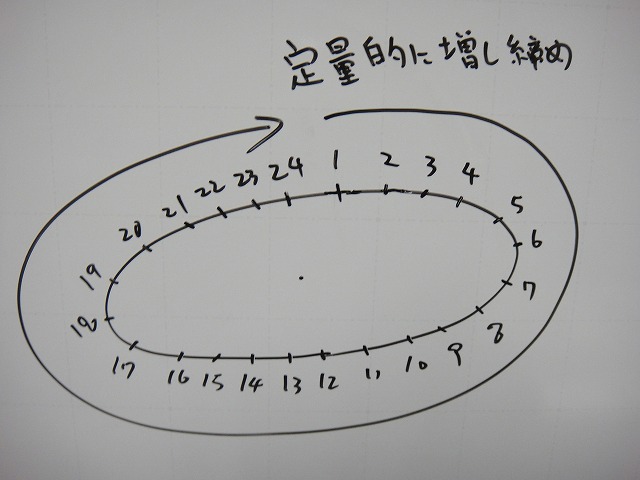
In the stage well before the final true-up of wheel building,
not for trueing but purely for spoke tension,
I tighten the nipples by the same amount in sequence (in number order from the diagram above),

and twanging is most likely to occur near the end of this tightening process.
This is definitely true from experience.
For example, if a spoke starts twanging above 1000N,
and before tightening it's 950N and after tightening it becomes 1020N,
then toward the end all spokes exceed 1000N,
but twanging usually won't happen unless the spoke is
"exceeding 1000N while its nipple is being turned."
The stress from the stretch when you tighten one particular nipple
is not the same as the stress from the tension increase of the other 23 nipples happening at that moment.
With a front wheel, you can aim for nearly the final tension during rough assembly,
but if you try to reduce steps — for example, "turn each nipple five full turns at once" —
twanging becomes more likely. Especially near the end of each rim lap.
So in those cases, if you do "tighten 3 turns, then tighten 2 turns," it becomes
less likely to twang.
Going further, with five turns, "one turn at a time × 5" or "half turn at a time × 10" might be
kinder to the spokes,
but when I can see exactly how many tightening steps it'll take to finish building,
I just try to build it in as few steps as possible.
That said, within the range of wheel building I do,
twanging normally only happens with DT Revolution and
Sapim Laser spokes,
so I don't worry that much unless it's one of these spokes.

I thought about a tightening sequence that might make
twanging less likely to occur.
First, I draw a triangle like in the diagram above
and number them clockwise.

Next, I number them like this.
In the six-pointed star, clockwise gives 1・4・2・5・3・6.

Then I shift the phase and do the same thing.
I've determined positions 7–9.
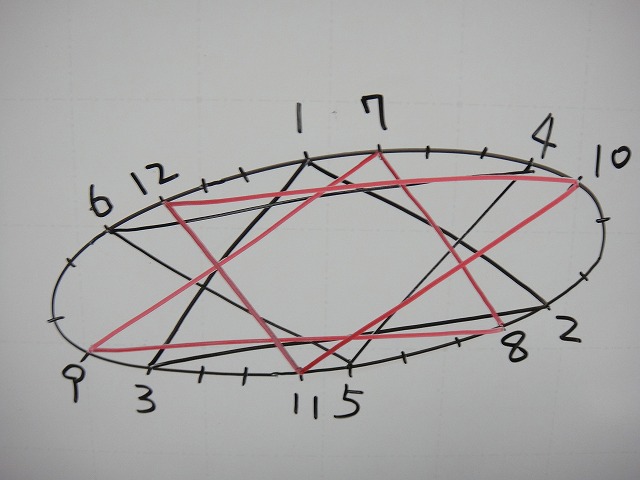
Then positions 10–12.
From here I go in groups of six. I've determined positions 13–18.
Finally, 19–24.
If you tighten the nipples in this number sequence, all by the same amount,
twanging should become less likely. That's the theory, anyway.
But if you lose track of the numbers or positions during such a complicated building process,
radial runout will be completely messed up.
Best not to do it.

Moreover, this sequence is
strikingly similar to the summoning process of the demon Black Goat-san (→here),
so you might accidentally open a door to another realm.
Black Goat-san loves paper, especially letters and documents,
and won't go home until it's eaten its fill.
Even if it were true, the tax office won't accept
the excuse "the Black Goat-san ate my receipts,"
so you have to be careful.