Finally got here!
What I'm about to write is close to my overall conclusion.
There's still plenty more material, but I've been writing about inpokes and all sorts of things
just to get to this point. As usual, it's ridiculously long.
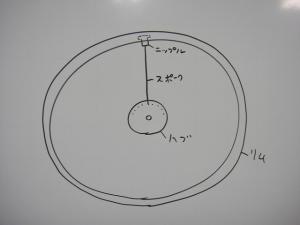
Regarding spoke tension left-right differences on rear wheels,
last time I wrote about correction methods when viewing the wheel from front and back.
The answer was offset rims and high-low flanges, but
today it's about viewing the wheel from left and right.
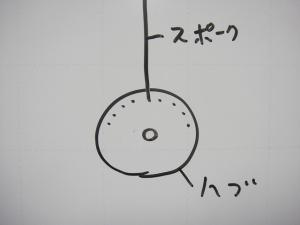
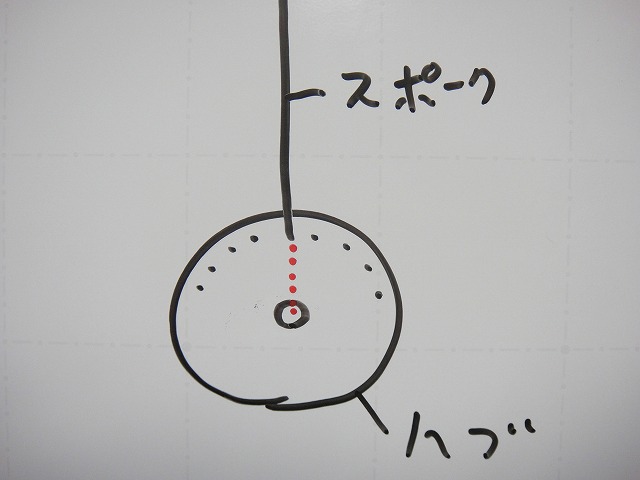
In this diagram I'm drawing inpoke radial spokes, but
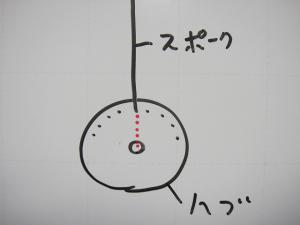
when you look at radial-laced spokes from the side, the extension line of the spoke
(the red dashed line in the diagram above) passes through the hub center.
I'll call this the "radial line" going forward.
You can also think of it as a line segment derived from the radius of a circle.
The term "radial line" exists in the amateur radio world too, but
it's completely unrelated. It's my original terminology.
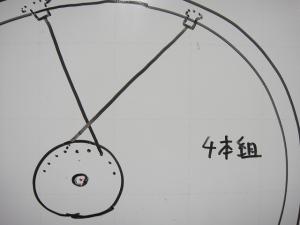
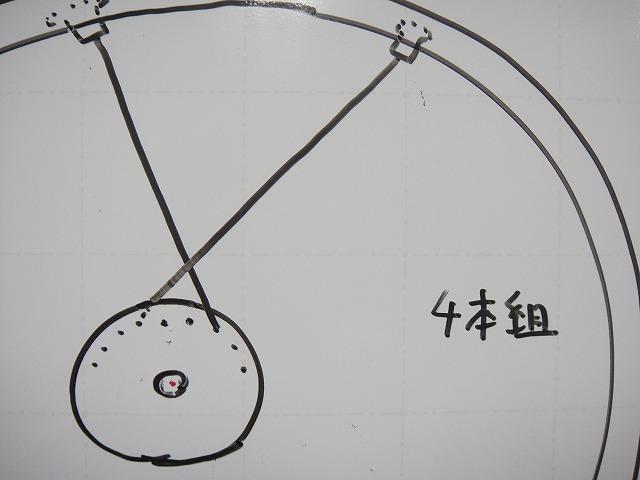
Next, let me consider the case of 4-cross lacing with both inpokes and outpokes.
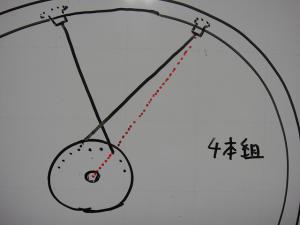
Here's what the radial line looks like from the inpoke hub holes.

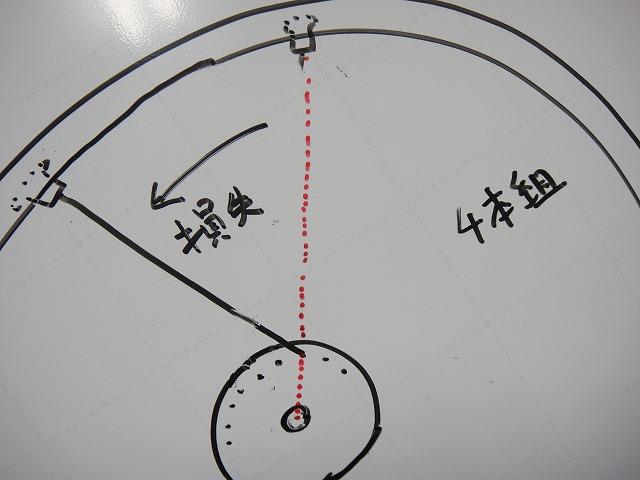
It's hard to see, so I removed the outpokes and left only the inpokes.
Spokes coming out of the hub pull the rim most directly
when the spoke overlaps with the radial line (radial lacing).
From there, as the tangential lacing cross count increases and the spoke
deviates further from the radial line, spoke tension loss occurs.
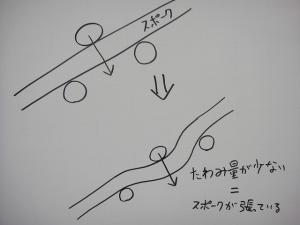
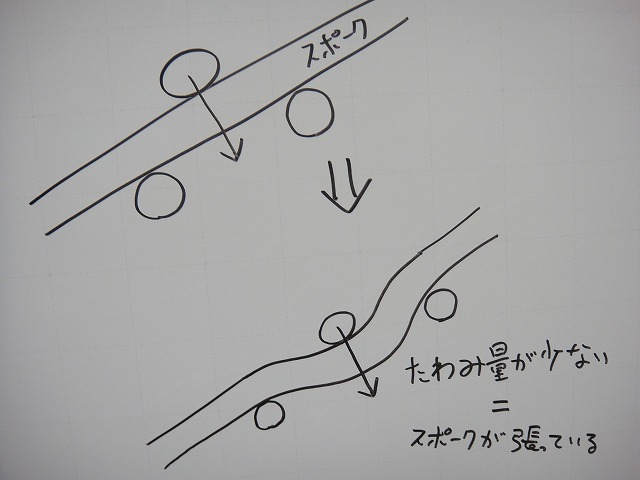
Spoke tension (the taut feel of the spoke) can be measured
by observing deflection amount using the method shown in the diagram above.
Thicker spokes are harder to deform (harder to deflect), so
it's actually not a definitive measurement method,
but since there's no other method, this is how we measure it.
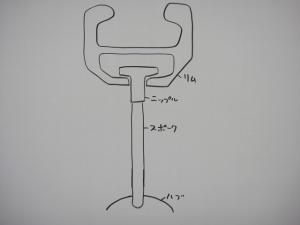
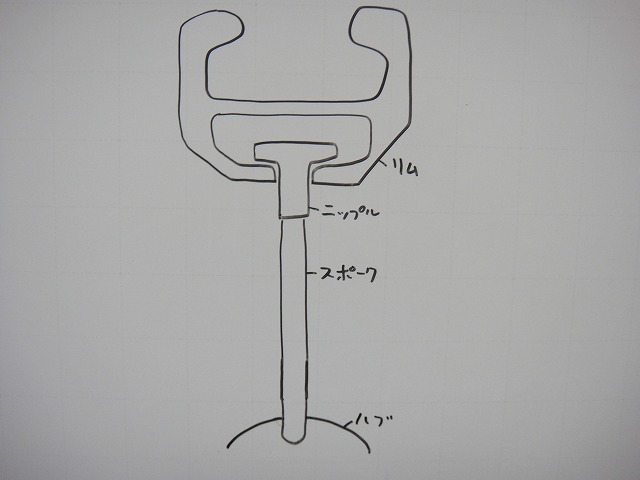
↑This diagram shows the rim and hub at 90° to each other, which is odd,
but please overlook that for now.
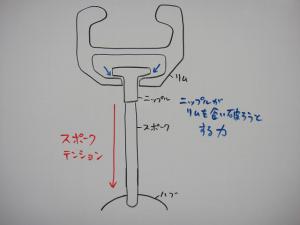
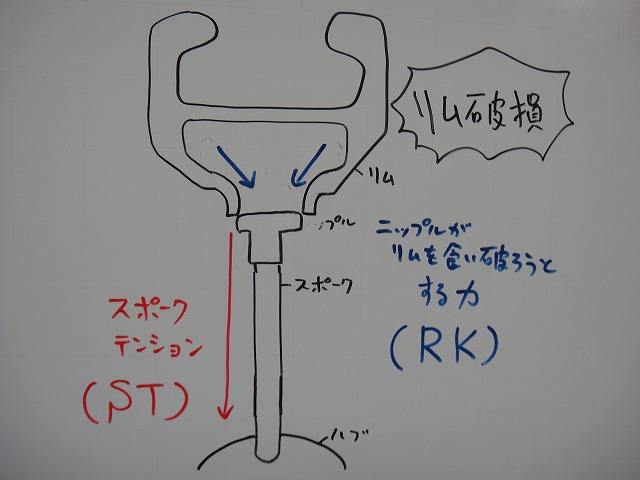
Tightening the nipple increases spoke tension.
(shown by the red arrow in the diagram above)
At the same time, the nipple's neck digs in against the rim.
(shown by the blue arrow in the diagram above)
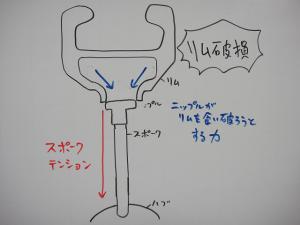
If you keep increasing spoke tension indefinitely from here,
one of the four components—rim, nipple, spoke, hub—will break
and the wheel becomes unusable.
If the hub is weak, the hub flange will tear off.
I haven't seen this happen during wheel building,
but it has genuinely happened where a flange tore weeks after building radial lacing.
It's the least likely phenomenon of the four.
If the spoke is weak, it will break at the neck/elbow.
This also rarely happens during building, but spoke breakage does occur when using the wheel
(metal fatigue). When truing a well-used wheel, sometimes the moment you tighten the nipple
the spoke will snap at the neck elastically.
This is the most common phenomenon of the four.
If the nipple is weak, a crack forms around the nipple's rim contact point,
and the spoke pulls out from the rim.
This is the second most common failure after spoke breakage.
Many non-professionals call this "spoke breakage" too.
Since there's a broken part in the spoke area that needs repair, it's not wrong.
Nipple materials come in brass and aluminum, and lighter aluminum supposedly
tends toward this failure more.
Aluminum nipples are certainly prone to stripping the square during wheel building,
but as for whether the tensile strength is weaker than brass... I'm not so sure.
From my personal experience, aluminum might actually be stronger once the wheel is built,
but my theoretical reasoning is thin, so I won't say it for certain.
If aluminum were stronger, then (not for the wheel builder but for the user)
you'd achieve weight savings with zero risk.
If the rim is weak, the rim breaks as shown in the diagram above.
(though the diagram is hard to see because the text is so long)
This can happen from aging through use, but on rims with low tensile strength at spoke holes,
it can happen during building.
Carbon rims are weaker than aluminum rims in this regard—or rather, I'd like to say that,
but lately there are also aluminum rims that can handle spoke tensions equal to or higher than carbon rims,
so it's not a blanket statement. Rim manufacturers specify maximum spoke tension limits
to prevent this from happening.

Here I'll express spoke tension as ST,
and the force by which the nipple tries to bore through the rim as RK.
SpokeTension is ST, and
Rim Kui-breaking is RK.
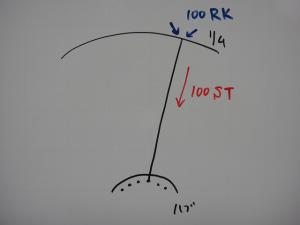
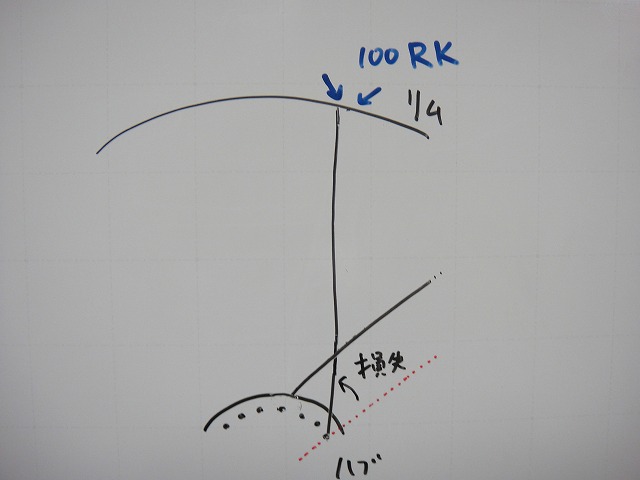
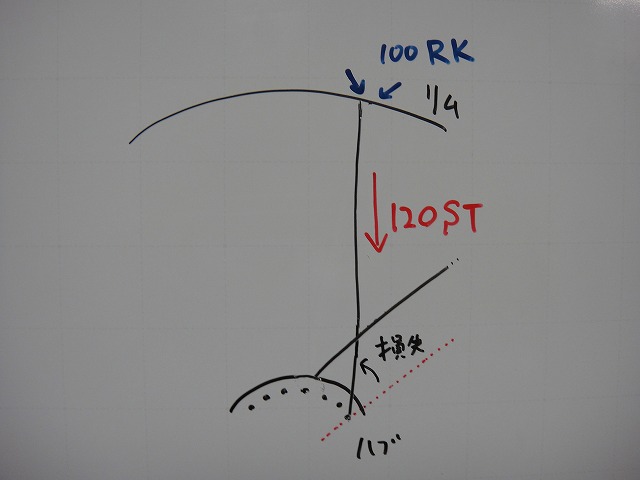
Going back to a diagram similar to the opening, when radial lacing pulls spokes at 100 ST,
I'm assuming the rim experiences 100 RK of pulling force.
Manufacturers are concerned with RK regarding rim damage,
but RK can't be measured directly (maybe at specialized testing labs),
so normally we measure ST using the method described earlier.
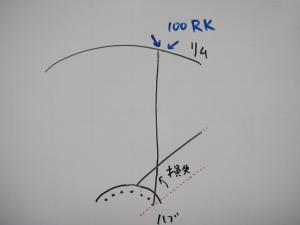
Next, let me consider achieving 100 RK of pulling force with 4-cross lacing.
4-cross spokes have a pulling direction that deviates from the radial line, so
there's a loss of pulling force. To reach 100 RK on top of that,

you need to pull at more than 100 ST.
In the diagram above it says 120 ST, but that's not the exact value.
It's definitely over 100 ST—just a rough guess at what seems reasonable.
If the manufacturer says "don't build over 100 ST," then
even with 4-cross you'd stay at 100 ST as the limit, but
at that point the RK would probably be around 80 RK.

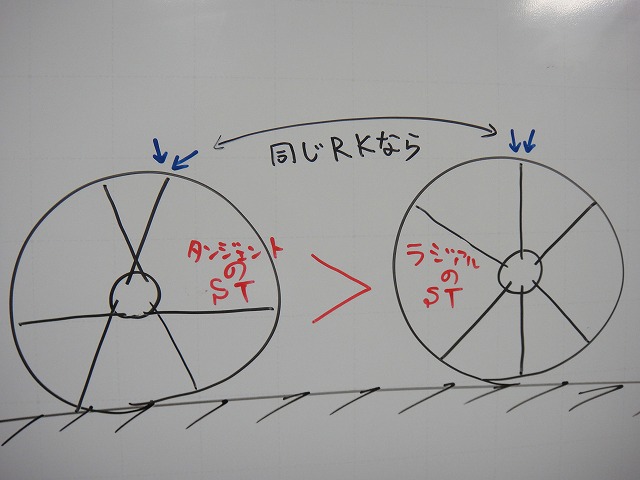
What's important here is that at the same RK, radial lacing has lower
spoke tension than tangential lacing.
This whole section of writing was just to say that.
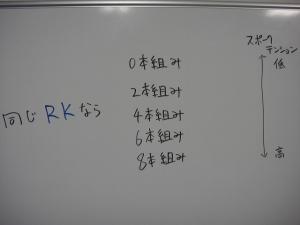
RK connects directly to the wheel's vertical stiffness, but since rim manufacturers specify the limit on ST,
when ST is tensioned to the manufacturer's limit,
the highest RK is achieved with 0-cross lacing (radial lacing).
"Radial lacing makes a vertically stiff wheel" is no myth or anything like that.
From there, as you go 2→4→6→8 cross and into tangential lacing,
the increase in RK per ST decreases due to losses from the radial line deviation.
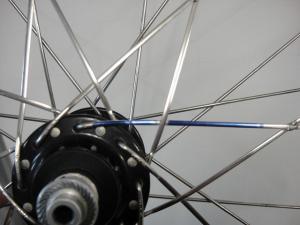
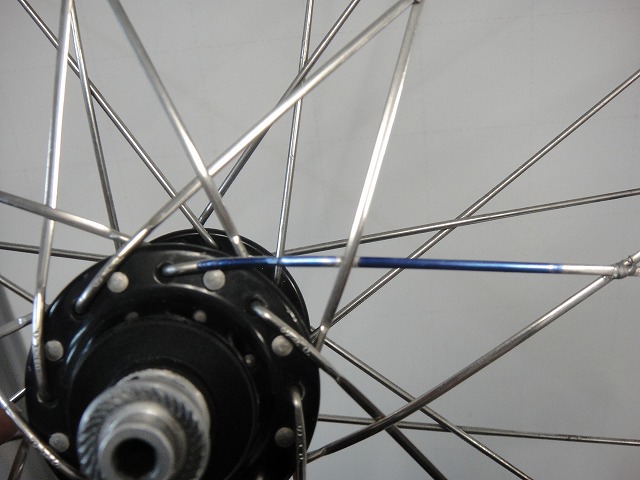
↑The inpoke spokes colored blue in this image are 8-cross, and
they're nearly perpendicular to the radial line, aren't they?
Almost tangent to the circle (hub flange). Since tangential lacing's "tangential" means
tangent—as in tangent line—it's literally tangent lacing.
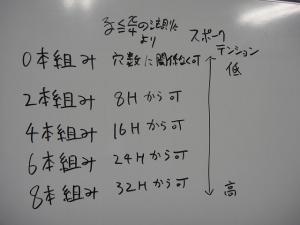
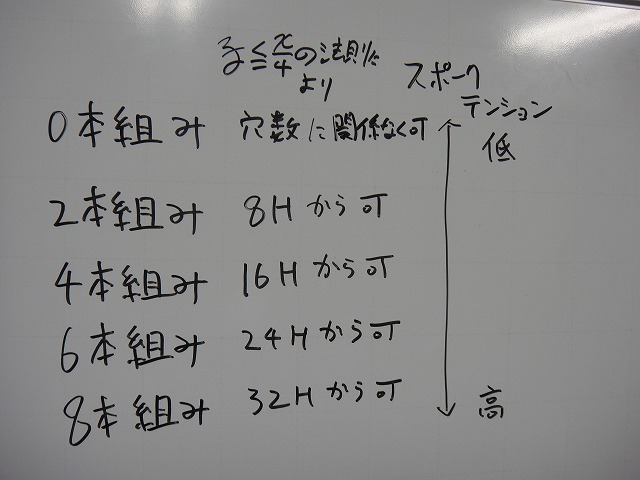
When doing 0–8 cross lacing, I'll note what hub hole count (H) is required.
I use y≤4/x here. Yeah, it's handy.

When viewing the wheel front to back, I usually draw from directly behind, but
this time I'm viewing from directly above.
The eye placement is sharp, Sharp!—well, it looks that way, but
it's unrelated to the Sharp electronics brand.
If Sharp were thinking about bicycle wheels, they'd probably
add Plasmacluster to it.
A wheel built with a Plasmacluster-generating hub running down the road, and
I blow Eheh bugs at it from the front. Due to the negative ion effect,
the Eheh bugs became beautiful.
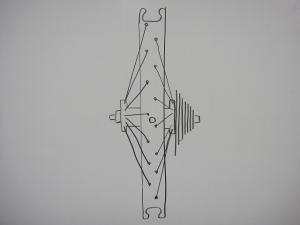
The Eheh bugs don't matter (then why write it?), but
let's look at a wheelset without tires from above.
Say the valve hole is at the top.
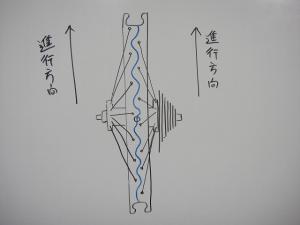
I'll slice this wheel open with the magical knife from Inpoke Part 1 (→here)
carefully avoiding the spoke holes on the rim, cutting
the hub straight in half down the middle.
From the sprocket side visible, the screen's upward direction is the forward direction.
Both sides are radial lacing for clarity, so please accept that (laugh).
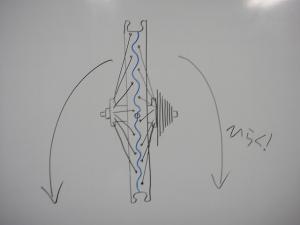
This time I'm just opening it without flattening it.
Like a clam shell opened to its maximum.

The above diagram shows that view not from the rim cut surface, but from the brake zone side.
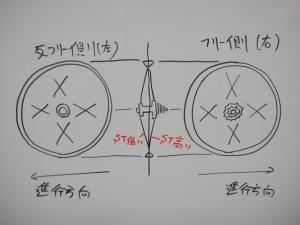
Last time I mentioned that rear wheels have a dish, so
the freewheel side has higher spoke tension.
In the diagram above, both sides are tangential lacing.
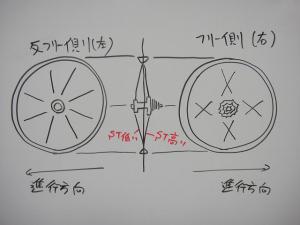
↑For a wheel with the non-freewheel side as radial lacing, it looks like this.
The thinking is "front and rear wheels all radial lacing would be best for aerodynamics and weight,
but the freewheel side experiences intense torsion, so
let's keep it in torsion-resistant tangential lacing." Many wheel manufacturers
do this, with Easton being a typical example. There are plenty of others too.
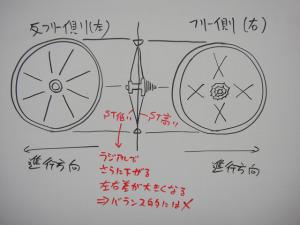
As mentioned earlier, radial lacing lowers spoke tension.
Making the non-freewheel side, which already has low spoke tension, even lower
means the left-right spoke tension difference becomes even worse. This is the worst
lacing pattern for wheel balance.
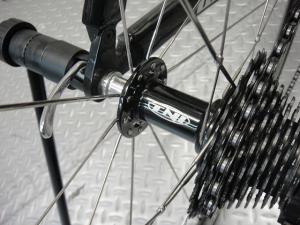
My mysterious cosmic carbon has the non-freewheel side as radial lacing because
the spoke holes in the rim forced me to lace it that way.
Grabbing the non-freewheel spokes, they're actually quite loose.
However, with radial lacing there's no spoke-to-spoke contact, so
there's no clicking noise from contact, making the weakness on the left
harder to detect. Using inpoke for the radial lacing is a small act of rebellion.
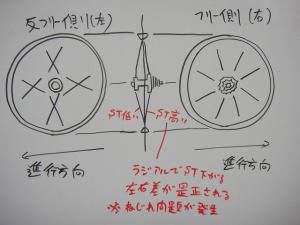
↑What if we try freewheel-side radial and non-freewheel-side tangential?
That way the freewheel-side spoke tension drops, so
relatively the left-right spoke balance comes closer. This is the best lacing
for wheel balance. But...
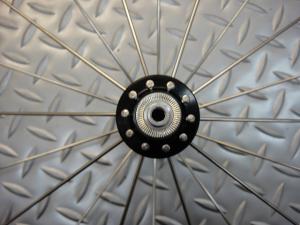
Radial lacing is
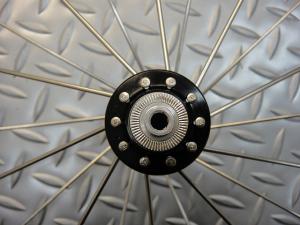
↑weak against this kind of torsion.
The torsion from rim brakes on the front wheel is the only source,
so it's not a major issue, but on the rear wheel the freewheel body's torsion
from pedaling is tremendous, so problems emerge.
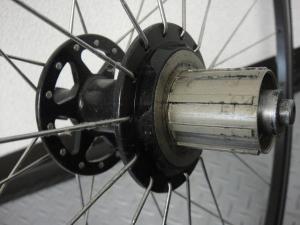
I actually hand-built a wheel with freewheel-side radial lacing.
This is inpoke radial, and there's a reason for that.
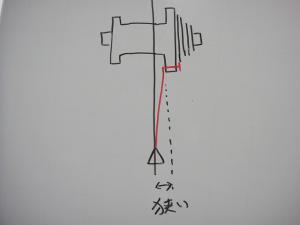
Outpoke radial doesn't easily secure lateral stiffness.
The reference point for lateral stiffness calculation is where the spoke exits
the hub flange, and for outpokes this is very narrow.
Furthermore, lowered spoke tension from radial lacing also means
it can't handle the freewheel's intense torsion well.
In hand-built wheels, this outpoke radial pattern is the worst lacing
in terms of spoke neck-break risk.
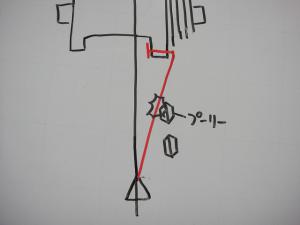
Yet if I do inpoke for radial lacing, spokes aren't woven together, so
spokes protrude laterally more than usual, and when the derailleur is set to the lowest gear,
the pulley cage can hit the spokes—a problem that easily happens.
There's a workaround, but even with it, during standing climbs or hard pedaling on the flats
contact can still happen, so this lacing method should be avoided.
If 2-cross lacing weaves the spokes, then
Both inpoke 2-cross → derailleur contact possible
Both outpoke 2-cross → low lateral stiffness
so neither is recommended.
However, freewheel-side radial lacing does have major merit for correcting
spoke tension left-right differences. What can be done about this...?
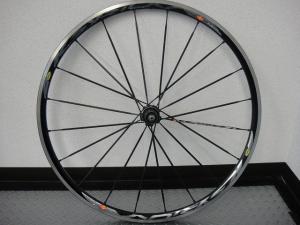
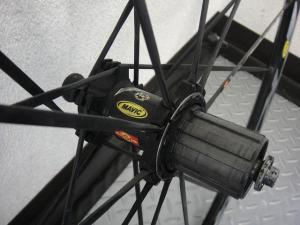
↑A wheel that's like "what if we custom-designed the hub and spokes, made the spokes large-diameter aluminum?"—that brilliance is the "Kyserium." キシリウムキター
Looking at the hub flange structure, it seems spokes won't distort from freewheel body torsion, and aluminum spokes look rock-solid.
The fact Mavic conceived of this back in 1999 is Mavic's greatness.
This is my speculation, but I think the Kyserium's starting point was
not "let's make a wheel with aluminum spokes" but rather
"let's make a freewheel-side radial lacing wheel." In that process,
seeking a structure unaffected by freewheel torsion
led to adopting aluminum spokes.
~Digression~
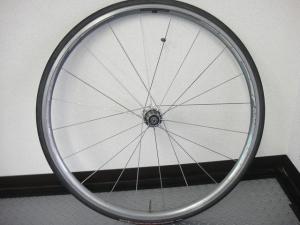
↑This is a 7800-series Dura-Ace OEM wheelset.
Freewheel-side radial lacing. In current models, Zipp and
Mavic Kyserium Elite have steel spokes with radial freewheel lacing, and
with straight spokes' high-tension capability and smart hub design, they manage
freewheel radial without problems despite steel spokes.
This wheel similarly has steel spokes with freewheel radial.
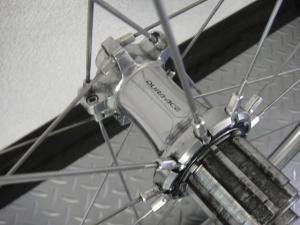
People often complain that Dura-Ace wheels of this era are "hard to adjust,"
but that's irrelevant to whether the wheel rides smoothly. It's not my problem.
Fixing them is my job. Inside hub structure is a straight copy of Campagnolo, and
lacing is a straight copy of Kyserium, but in terms of wheel theory sophistication,
this is what I consider Shimano's greatest rear wheel ever.
After this, when they try thinking for themselves, mediocre wheels result.
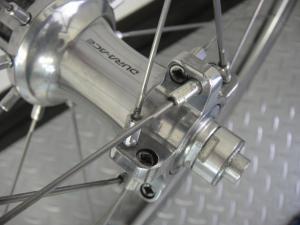
The left flange position is pushed way out too. Smart!
WH-9000 claims to be wide-flange or something, but
the width is about the same as this.
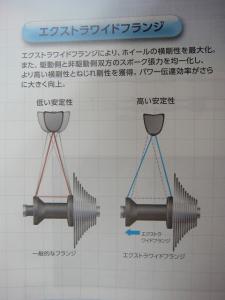
They call it extra-wide-flange now, but
back in the WH-7800 era it was basically extra-wide-flange already.
And then they trash their own previous product (WH-7900) from the day before. Amazing.
~Digression over~
To T-san who cooperated with wheel photography:
That wheel's a masterpiece, so don't sell it.
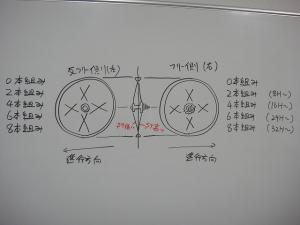
Freewheel-side radial lacing is only possible with factory-built wheels!
(Like how a certain manga is only readable in Jump!)
So I want to think about lacing methods to correct spoke tension
left-right differences with hand-built wheels.
The diagram above shows 0–8 cross for both sides, but

radial and 2-cross have too much downside, so I'm excluding them.
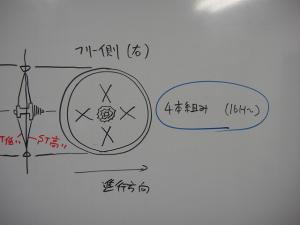
Among remaining methods, the one with freewheel-side cross lacing
and closest to radial is 4-cross. 4-cross is possible from 16H,
but hand-built wheels under 16H are rare anyway.
I'll make the freewheel side 4-cross.
For the non-freewheel side, I want more tangential lacing if spoke count allows.
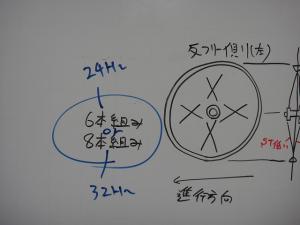
From 24H, 6-cross becomes possible, and from 32H, 8-cross becomes possible, so
for 24H and above, making the non-freewheel side 6-cross or 8-cross means
the non-freewheel side spoke tension becomes higher relative to the
freewheel side spoke tension. Left-right difference decreases.
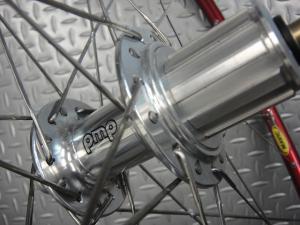
When I mentioned earlier that I incorporate left-right difference correction techniques
in a certain rear wheel, that's what I meant. This is 28H,
with 4-cross on the freewheel side and 6-cross on the non-freewheel side.
Compared to making both sides 4-cross, the left side builds much tighter.
It's genuinely completely different. Though honestly, result-lacing with solder
contributes more to reducing apparent spoke deflection, so
with result-lacing done, 4-cross on the non-freewheel side wouldn't be that different.
I personally call this lacing pattern "4-6 lacing," but
without result-lacing, 4-4 and 4-6 are completely different.
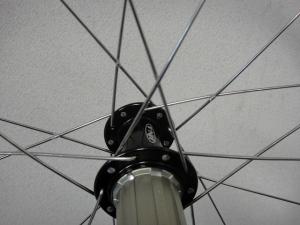
This is my point when I say 20H and 24H rear wheels are different.
20H can't do 4-6 lacing.
Of course there's also the general opinion that given stiffness and rider weight considerations,
20H hand-built rear wheels aren't recommended.
That said, even a 20H wheel like my Nomu Lab Wheel No. 1
would work fine for people under 70kg.

↑This is my wheel, a Mavic Reflex WO
CD Ceramic model.
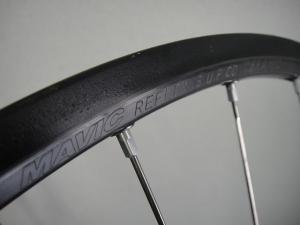
Laser engraving—that's meticulous work.
An Open Pro with the same treatment exists too, but
that one has the oxide coating formula engraved, which looks even cooler.
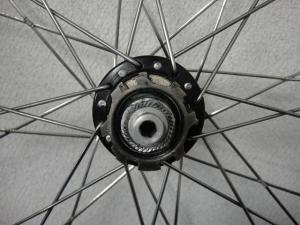
Freewheel side 4-cross,
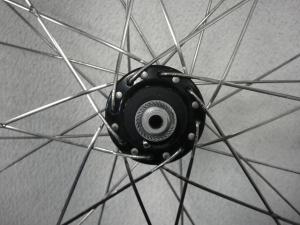
non-freewheel side 8-cross.
I call this "4-8 lacing" on my own.
I think 32H 4-8 lacing is the best method for hand-built wheels to mitigate
spoke tension left-right differences. 36H 4-8 is also possible, but
why 32H is better I'll write about later.
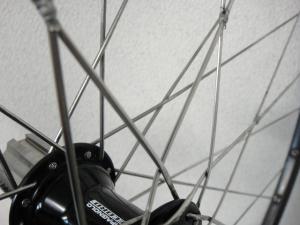
With 6-cross and 8-cross, you can also weave the crossing just before the final one.
Double-cross lacing. Combined with result-lacing with solder on this wheel,
when a spoke breaks, you have to undo the result-lacing of that spoke, and
to thread the new spoke through, you need to undo the adjacent result-lacing too.
That propagates around the whole side. In other words, doing double-cross and result-lacing together
means if one spoke breaks, you end up replacing the entire side.
So with customer wheels I don't do that unless requested.
Without double-cross, worst case is replacing two result-laced spokes.
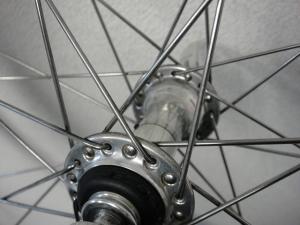
↑This is not double-cross.
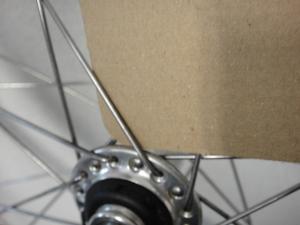
↑Weaving the part where the paper is inserted is double-cross.
Double-cross can reduce apparent spoke deflection, but
I think the effect is bigger with 4-8 lacing itself.
My Reflex above is "4-8 lacing + double-cross + result-lacing with solder,"
like ramen with all the toppings. With all that, it's genuinely a different beast
compared to a normally built wheel. Nomu Lab Wheel No. 2 will incorporate
this reasoning too. ↑I wrote all that to set up just this one sentence.
Thank you for reading, and sorry for the length (laugh).
Spoke Tension Left-Right Difference in Wheels Part 2
was also about "Kyserium is great!," so
Part 3 will be about "Fulcrum is great!" I'll write that later too.
What I'm about to write is close to my overall conclusion.
There's still plenty more material, but I've been writing about inpokes and all sorts of things
just to get to this point. As usual, it's ridiculously long.

Regarding spoke tension left-right differences on rear wheels,
last time I wrote about correction methods when viewing the wheel from front and back.
The answer was offset rims and high-low flanges, but
today it's about viewing the wheel from left and right.

In this diagram I'm drawing inpoke radial spokes, but
when you look at radial-laced spokes from the side, the extension line of the spoke
(the red dashed line in the diagram above) passes through the hub center.
I'll call this the "radial line" going forward.
You can also think of it as a line segment derived from the radius of a circle.
The term "radial line" exists in the amateur radio world too, but
it's completely unrelated. It's my original terminology.
Next, let me consider the case of 4-cross lacing with both inpokes and outpokes.

Here's what the radial line looks like from the inpoke hub holes.
It's hard to see, so I removed the outpokes and left only the inpokes.
Spokes coming out of the hub pull the rim most directly
when the spoke overlaps with the radial line (radial lacing).
From there, as the tangential lacing cross count increases and the spoke
deviates further from the radial line, spoke tension loss occurs.
Spoke tension (the taut feel of the spoke) can be measured
by observing deflection amount using the method shown in the diagram above.
Thicker spokes are harder to deform (harder to deflect), so
it's actually not a definitive measurement method,
but since there's no other method, this is how we measure it.
↑This diagram shows the rim and hub at 90° to each other, which is odd,
but please overlook that for now.

Tightening the nipple increases spoke tension.
(shown by the red arrow in the diagram above)
At the same time, the nipple's neck digs in against the rim.
(shown by the blue arrow in the diagram above)

If you keep increasing spoke tension indefinitely from here,
one of the four components—rim, nipple, spoke, hub—will break
and the wheel becomes unusable.
If the hub is weak, the hub flange will tear off.
I haven't seen this happen during wheel building,
but it has genuinely happened where a flange tore weeks after building radial lacing.
It's the least likely phenomenon of the four.
If the spoke is weak, it will break at the neck/elbow.
This also rarely happens during building, but spoke breakage does occur when using the wheel
(metal fatigue). When truing a well-used wheel, sometimes the moment you tighten the nipple
the spoke will snap at the neck elastically.
This is the most common phenomenon of the four.
If the nipple is weak, a crack forms around the nipple's rim contact point,
and the spoke pulls out from the rim.
This is the second most common failure after spoke breakage.
Many non-professionals call this "spoke breakage" too.
Since there's a broken part in the spoke area that needs repair, it's not wrong.
Nipple materials come in brass and aluminum, and lighter aluminum supposedly
tends toward this failure more.
Aluminum nipples are certainly prone to stripping the square during wheel building,
but as for whether the tensile strength is weaker than brass... I'm not so sure.
From my personal experience, aluminum might actually be stronger once the wheel is built,
but my theoretical reasoning is thin, so I won't say it for certain.
If aluminum were stronger, then (not for the wheel builder but for the user)
you'd achieve weight savings with zero risk.
If the rim is weak, the rim breaks as shown in the diagram above.
(though the diagram is hard to see because the text is so long)
This can happen from aging through use, but on rims with low tensile strength at spoke holes,
it can happen during building.
Carbon rims are weaker than aluminum rims in this regard—or rather, I'd like to say that,
but lately there are also aluminum rims that can handle spoke tensions equal to or higher than carbon rims,
so it's not a blanket statement. Rim manufacturers specify maximum spoke tension limits
to prevent this from happening.
Here I'll express spoke tension as ST,
and the force by which the nipple tries to bore through the rim as RK.
SpokeTension is ST, and
Rim Kui-breaking is RK.

Going back to a diagram similar to the opening, when radial lacing pulls spokes at 100 ST,
I'm assuming the rim experiences 100 RK of pulling force.
Manufacturers are concerned with RK regarding rim damage,
but RK can't be measured directly (maybe at specialized testing labs),
so normally we measure ST using the method described earlier.
Next, let me consider achieving 100 RK of pulling force with 4-cross lacing.
4-cross spokes have a pulling direction that deviates from the radial line, so
there's a loss of pulling force. To reach 100 RK on top of that,
you need to pull at more than 100 ST.
In the diagram above it says 120 ST, but that's not the exact value.
It's definitely over 100 ST—just a rough guess at what seems reasonable.
If the manufacturer says "don't build over 100 ST," then
even with 4-cross you'd stay at 100 ST as the limit, but
at that point the RK would probably be around 80 RK.
What's important here is that at the same RK, radial lacing has lower
spoke tension than tangential lacing.
This whole section of writing was just to say that.

RK connects directly to the wheel's vertical stiffness, but since rim manufacturers specify the limit on ST,
when ST is tensioned to the manufacturer's limit,
the highest RK is achieved with 0-cross lacing (radial lacing).
"Radial lacing makes a vertically stiff wheel" is no myth or anything like that.
From there, as you go 2→4→6→8 cross and into tangential lacing,
the increase in RK per ST decreases due to losses from the radial line deviation.
↑The inpoke spokes colored blue in this image are 8-cross, and
they're nearly perpendicular to the radial line, aren't they?
Almost tangent to the circle (hub flange). Since tangential lacing's "tangential" means
tangent—as in tangent line—it's literally tangent lacing.
When doing 0–8 cross lacing, I'll note what hub hole count (H) is required.
I use y≤4/x here. Yeah, it's handy.

When viewing the wheel front to back, I usually draw from directly behind, but
this time I'm viewing from directly above.
The eye placement is sharp, Sharp!—well, it looks that way, but
it's unrelated to the Sharp electronics brand.
If Sharp were thinking about bicycle wheels, they'd probably
add Plasmacluster to it.
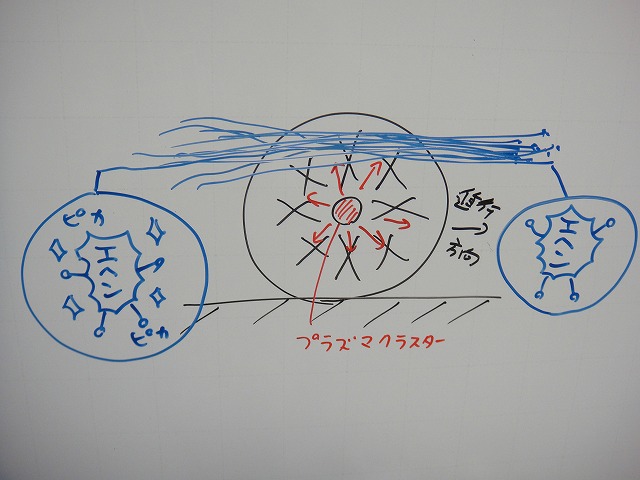
A wheel built with a Plasmacluster-generating hub running down the road, and
I blow Eheh bugs at it from the front. Due to the negative ion effect,
the Eheh bugs became beautiful.
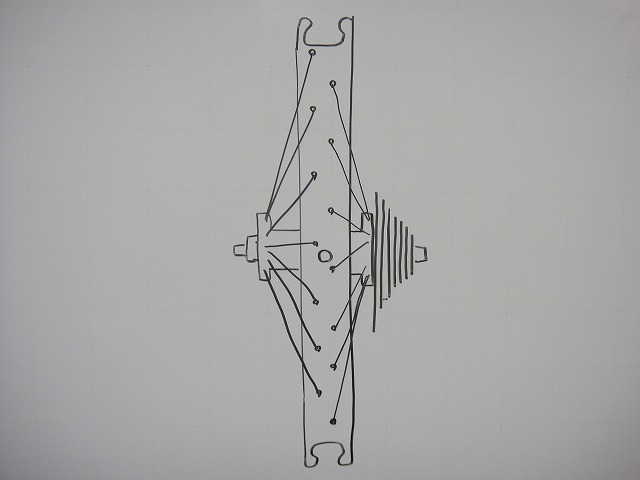
The Eheh bugs don't matter (then why write it?), but
let's look at a wheelset without tires from above.
Say the valve hole is at the top.
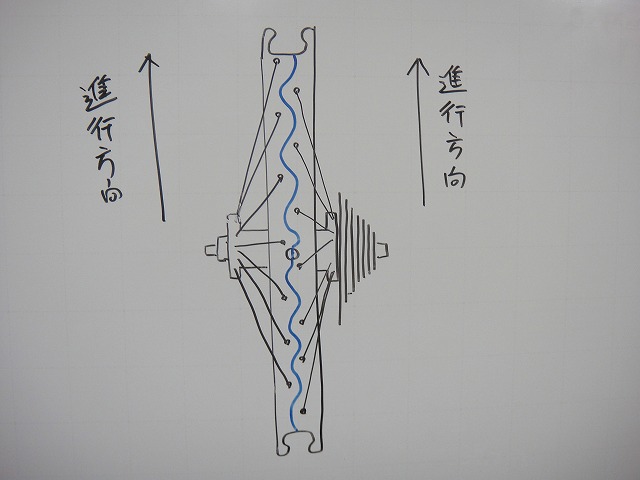
I'll slice this wheel open with the magical knife from Inpoke Part 1 (→here)
carefully avoiding the spoke holes on the rim, cutting
the hub straight in half down the middle.
From the sprocket side visible, the screen's upward direction is the forward direction.
Both sides are radial lacing for clarity, so please accept that (laugh).
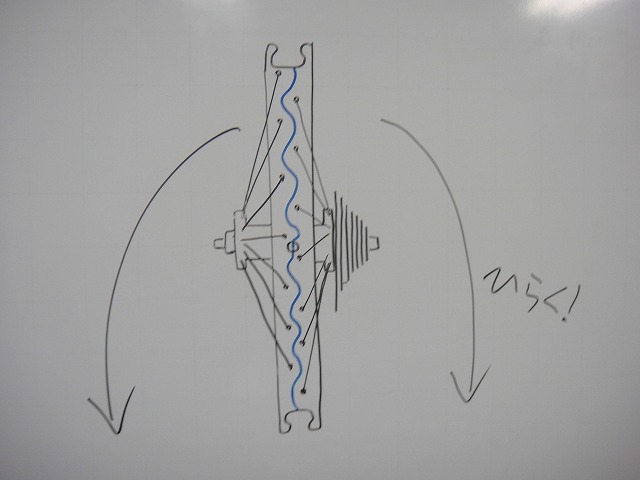
This time I'm just opening it without flattening it.
Like a clam shell opened to its maximum.
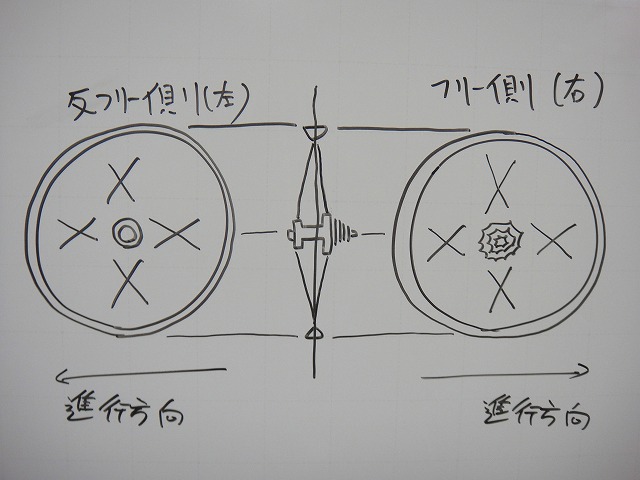
The above diagram shows that view not from the rim cut surface, but from the brake zone side.
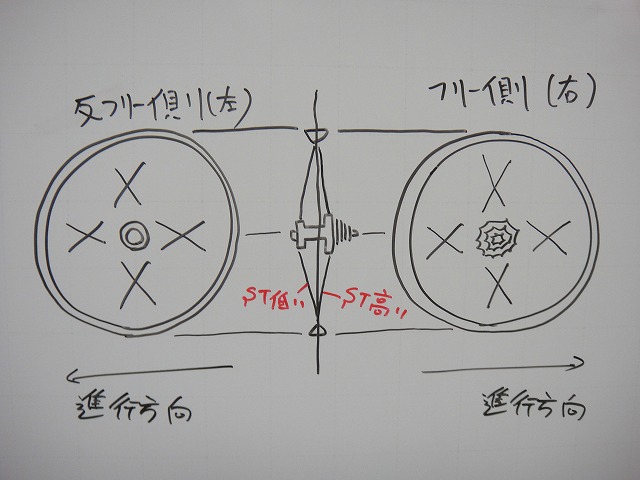
Last time I mentioned that rear wheels have a dish, so
the freewheel side has higher spoke tension.
In the diagram above, both sides are tangential lacing.
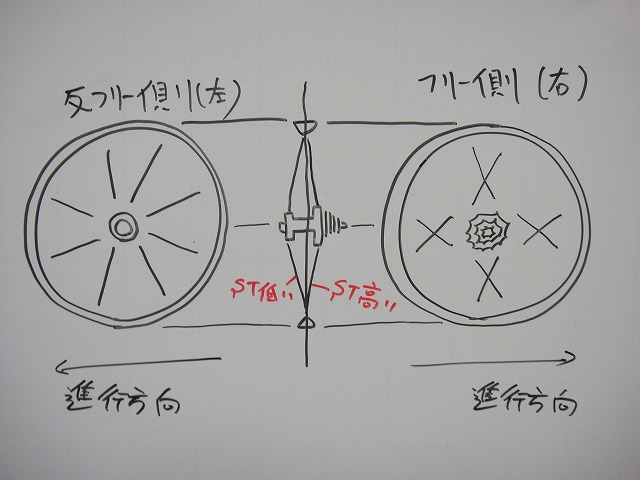
↑For a wheel with the non-freewheel side as radial lacing, it looks like this.
The thinking is "front and rear wheels all radial lacing would be best for aerodynamics and weight,
but the freewheel side experiences intense torsion, so
let's keep it in torsion-resistant tangential lacing." Many wheel manufacturers
do this, with Easton being a typical example. There are plenty of others too.
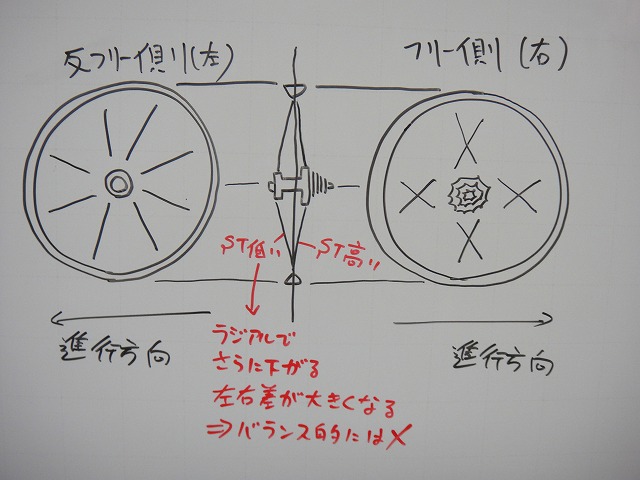
As mentioned earlier, radial lacing lowers spoke tension.
Making the non-freewheel side, which already has low spoke tension, even lower
means the left-right spoke tension difference becomes even worse. This is the worst
lacing pattern for wheel balance.
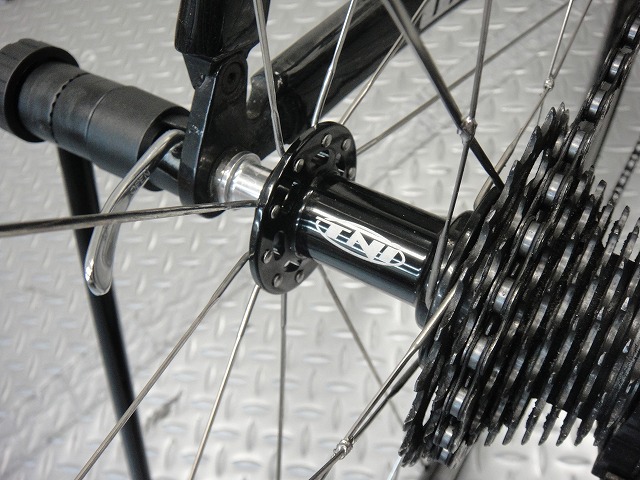
My mysterious cosmic carbon has the non-freewheel side as radial lacing because
the spoke holes in the rim forced me to lace it that way.
Grabbing the non-freewheel spokes, they're actually quite loose.
However, with radial lacing there's no spoke-to-spoke contact, so
there's no clicking noise from contact, making the weakness on the left
harder to detect. Using inpoke for the radial lacing is a small act of rebellion.
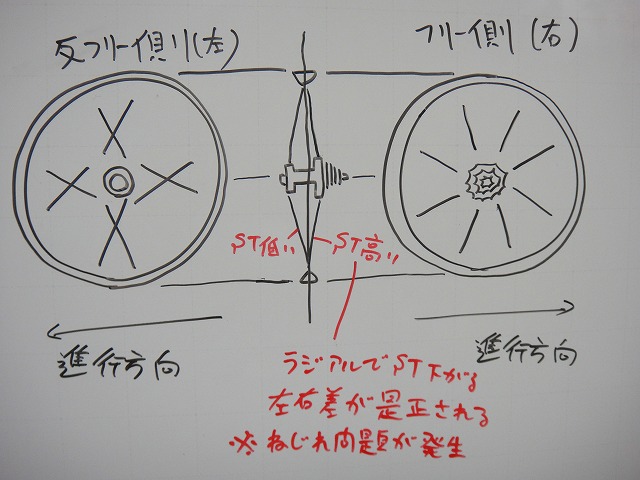
↑What if we try freewheel-side radial and non-freewheel-side tangential?
That way the freewheel-side spoke tension drops, so
relatively the left-right spoke balance comes closer. This is the best lacing
for wheel balance. But...
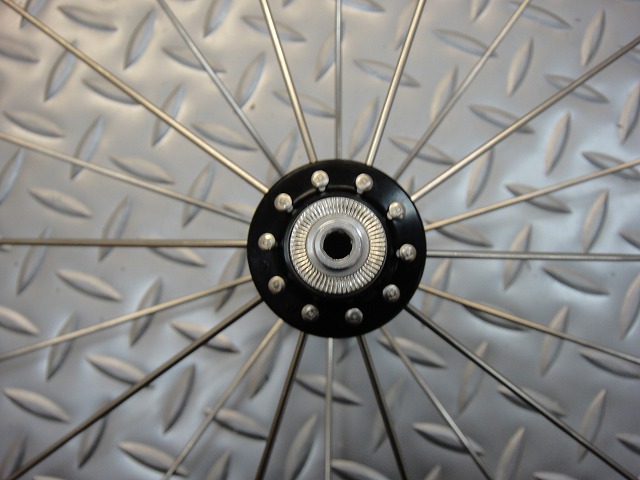
Radial lacing is
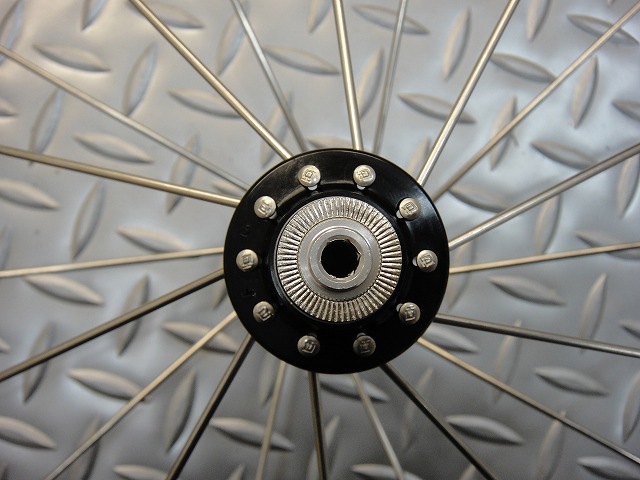
↑weak against this kind of torsion.
The torsion from rim brakes on the front wheel is the only source,
so it's not a major issue, but on the rear wheel the freewheel body's torsion
from pedaling is tremendous, so problems emerge.
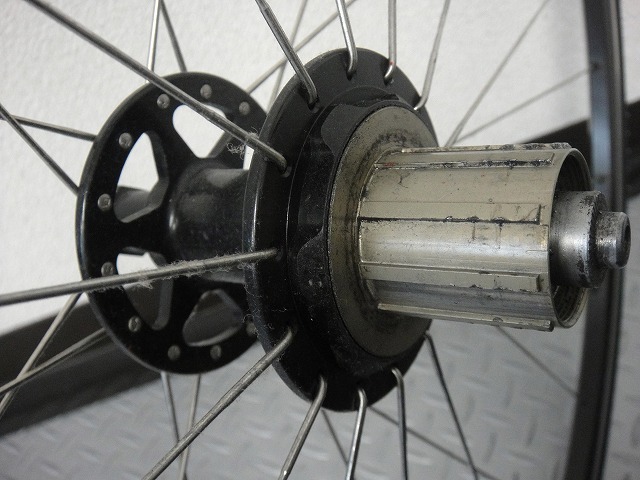
I actually hand-built a wheel with freewheel-side radial lacing.
This is inpoke radial, and there's a reason for that.
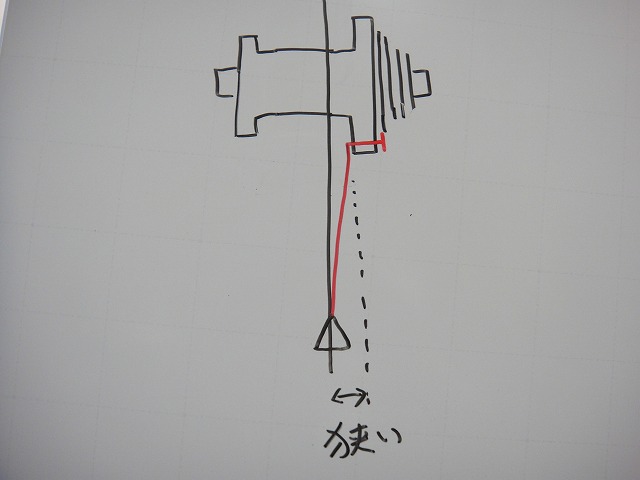
Outpoke radial doesn't easily secure lateral stiffness.
The reference point for lateral stiffness calculation is where the spoke exits
the hub flange, and for outpokes this is very narrow.
Furthermore, lowered spoke tension from radial lacing also means
it can't handle the freewheel's intense torsion well.
In hand-built wheels, this outpoke radial pattern is the worst lacing
in terms of spoke neck-break risk.
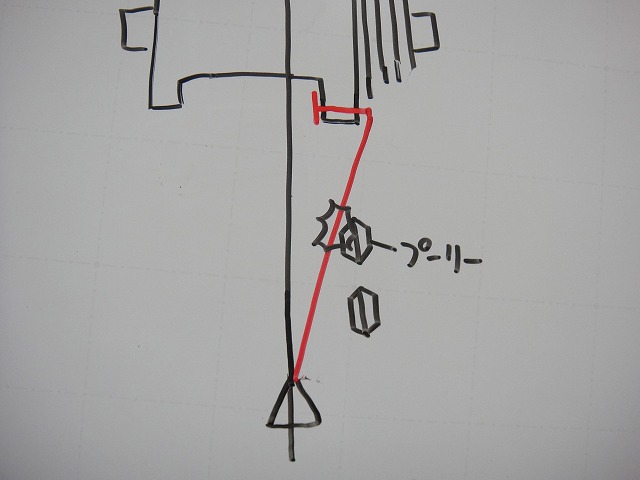
Yet if I do inpoke for radial lacing, spokes aren't woven together, so
spokes protrude laterally more than usual, and when the derailleur is set to the lowest gear,
the pulley cage can hit the spokes—a problem that easily happens.
There's a workaround, but even with it, during standing climbs or hard pedaling on the flats
contact can still happen, so this lacing method should be avoided.
If 2-cross lacing weaves the spokes, then
Both inpoke 2-cross → derailleur contact possible
Both outpoke 2-cross → low lateral stiffness
so neither is recommended.
However, freewheel-side radial lacing does have major merit for correcting
spoke tension left-right differences. What can be done about this...?
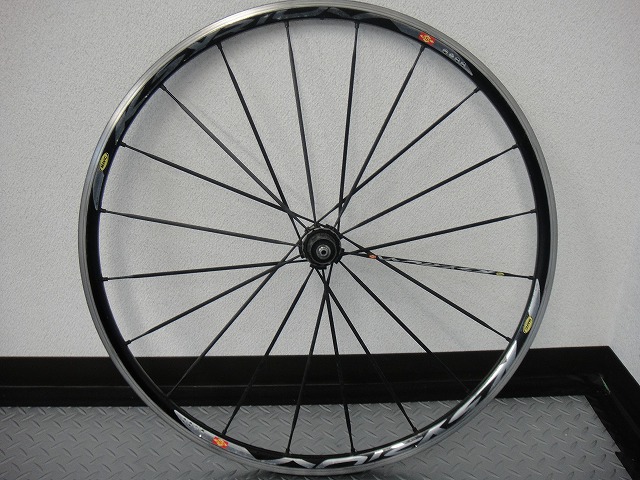
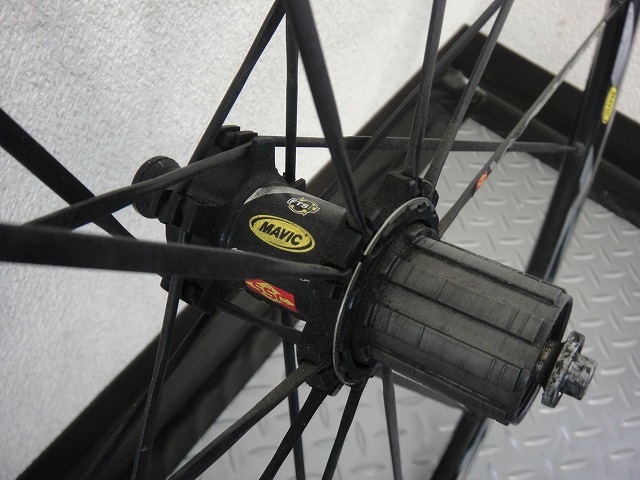
↑A wheel that's like "what if we custom-designed the hub and spokes, made the spokes large-diameter aluminum?"—that brilliance is the "Kyserium." キシリウムキター
Looking at the hub flange structure, it seems spokes won't distort from freewheel body torsion, and aluminum spokes look rock-solid.
The fact Mavic conceived of this back in 1999 is Mavic's greatness.
This is my speculation, but I think the Kyserium's starting point was
not "let's make a wheel with aluminum spokes" but rather
"let's make a freewheel-side radial lacing wheel." In that process,
seeking a structure unaffected by freewheel torsion
led to adopting aluminum spokes.
~Digression~
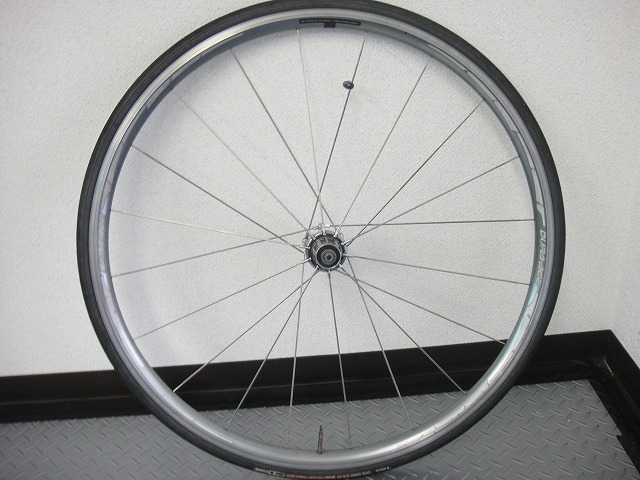
↑This is a 7800-series Dura-Ace OEM wheelset.
Freewheel-side radial lacing. In current models, Zipp and
Mavic Kyserium Elite have steel spokes with radial freewheel lacing, and
with straight spokes' high-tension capability and smart hub design, they manage
freewheel radial without problems despite steel spokes.
This wheel similarly has steel spokes with freewheel radial.

People often complain that Dura-Ace wheels of this era are "hard to adjust,"
but that's irrelevant to whether the wheel rides smoothly. It's not my problem.
Fixing them is my job. Inside hub structure is a straight copy of Campagnolo, and
lacing is a straight copy of Kyserium, but in terms of wheel theory sophistication,
this is what I consider Shimano's greatest rear wheel ever.
After this, when they try thinking for themselves, mediocre wheels result.
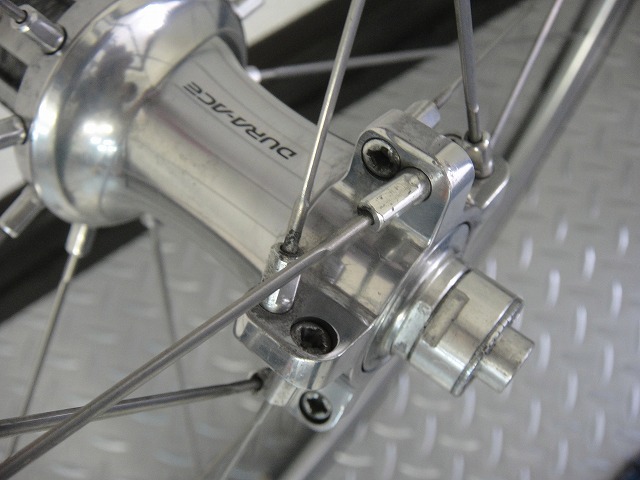
The left flange position is pushed way out too. Smart!
WH-9000 claims to be wide-flange or something, but
the width is about the same as this.
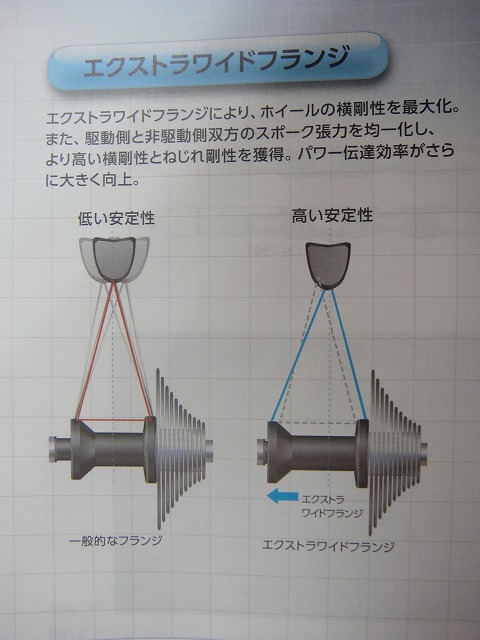
They call it extra-wide-flange now, but
back in the WH-7800 era it was basically extra-wide-flange already.
And then they trash their own previous product (WH-7900) from the day before. Amazing.
~Digression over~
To T-san who cooperated with wheel photography:
That wheel's a masterpiece, so don't sell it.
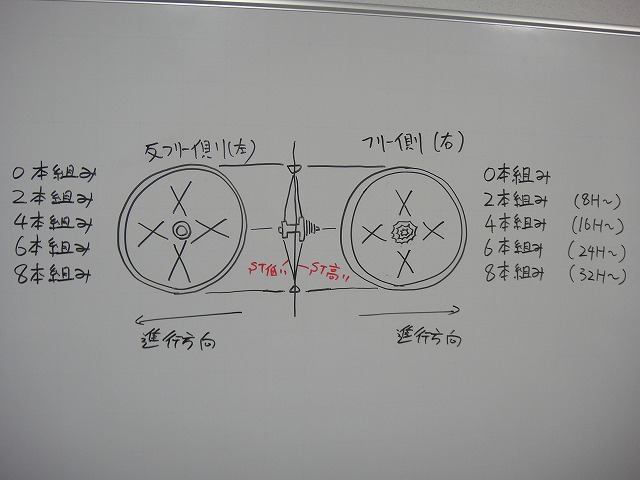
Freewheel-side radial lacing is only possible with factory-built wheels!
(Like how a certain manga is only readable in Jump!)
So I want to think about lacing methods to correct spoke tension
left-right differences with hand-built wheels.
The diagram above shows 0–8 cross for both sides, but
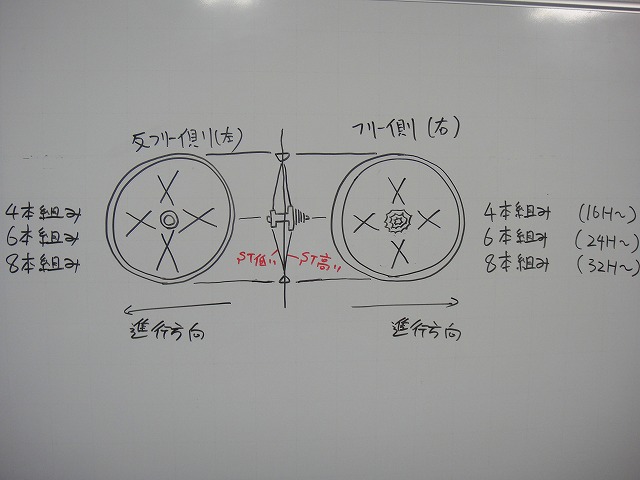
radial and 2-cross have too much downside, so I'm excluding them.
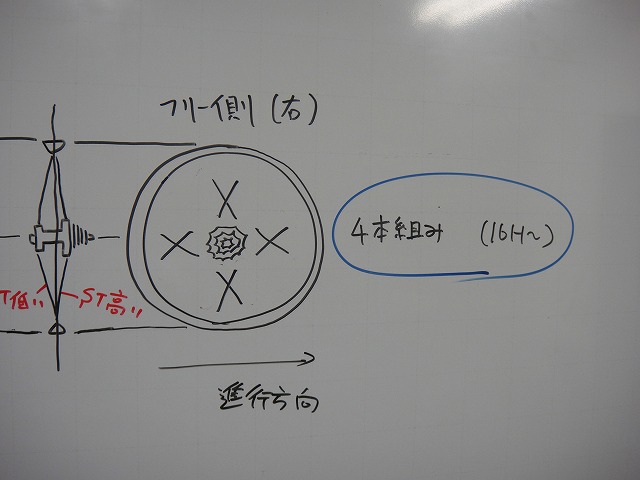
Among remaining methods, the one with freewheel-side cross lacing
and closest to radial is 4-cross. 4-cross is possible from 16H,
but hand-built wheels under 16H are rare anyway.
I'll make the freewheel side 4-cross.

For the non-freewheel side, I want more tangential lacing if spoke count allows.
From 24H, 6-cross becomes possible, and from 32H, 8-cross becomes possible, so
for 24H and above, making the non-freewheel side 6-cross or 8-cross means
the non-freewheel side spoke tension becomes higher relative to the
freewheel side spoke tension. Left-right difference decreases.
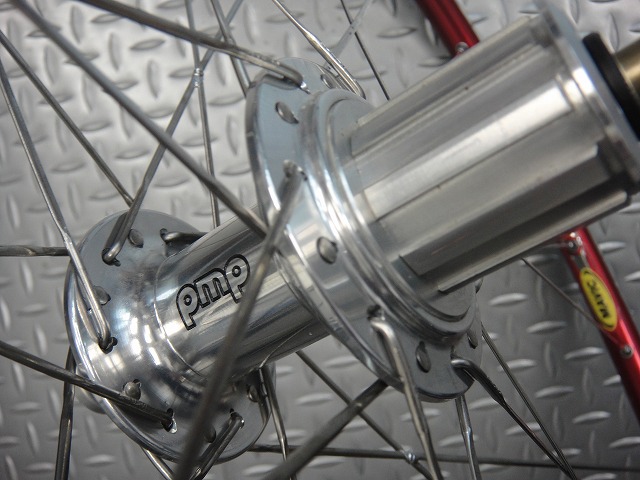
When I mentioned earlier that I incorporate left-right difference correction techniques
in a certain rear wheel, that's what I meant. This is 28H,
with 4-cross on the freewheel side and 6-cross on the non-freewheel side.
Compared to making both sides 4-cross, the left side builds much tighter.
It's genuinely completely different. Though honestly, result-lacing with solder
contributes more to reducing apparent spoke deflection, so
with result-lacing done, 4-cross on the non-freewheel side wouldn't be that different.
I personally call this lacing pattern "4-6 lacing," but
without result-lacing, 4-4 and 4-6 are completely different.
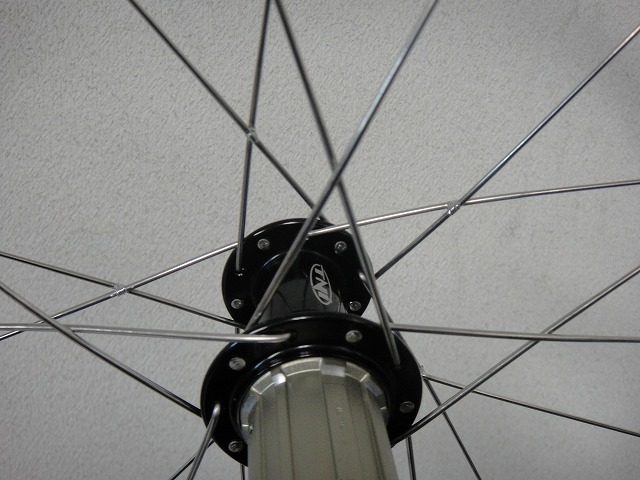
This is my point when I say 20H and 24H rear wheels are different.
20H can't do 4-6 lacing.
Of course there's also the general opinion that given stiffness and rider weight considerations,
20H hand-built rear wheels aren't recommended.
That said, even a 20H wheel like my Nomu Lab Wheel No. 1
would work fine for people under 70kg.
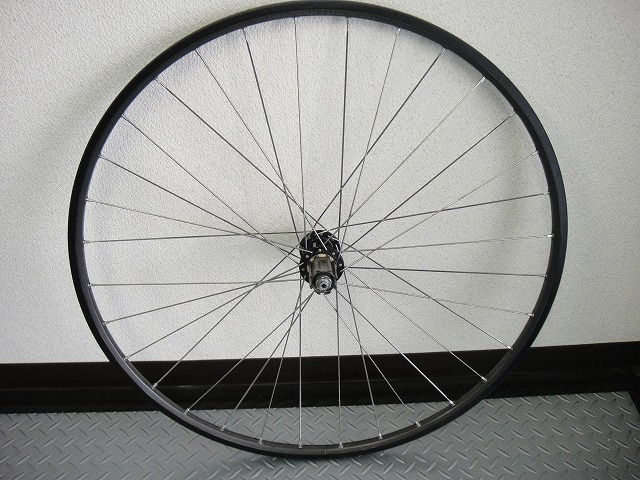
↑This is my wheel, a Mavic Reflex WO
CD Ceramic model.
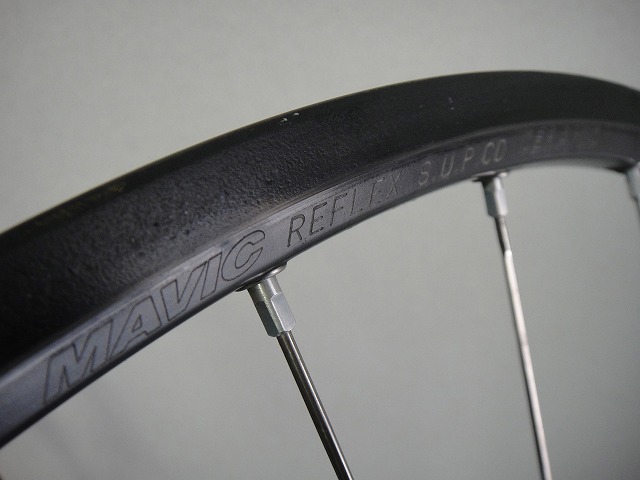
Laser engraving—that's meticulous work.
An Open Pro with the same treatment exists too, but
that one has the oxide coating formula engraved, which looks even cooler.
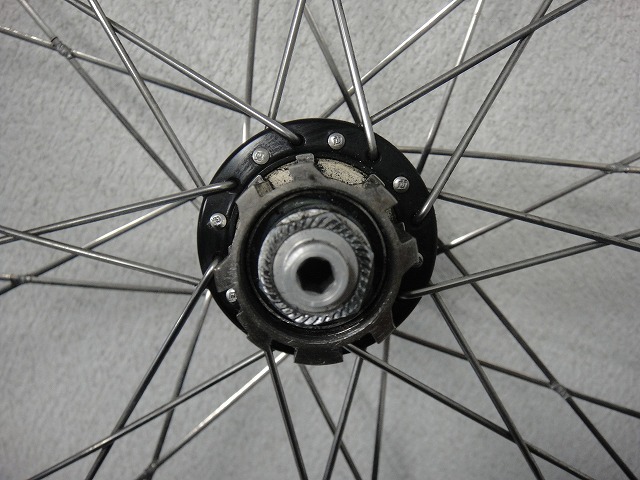
Freewheel side 4-cross,
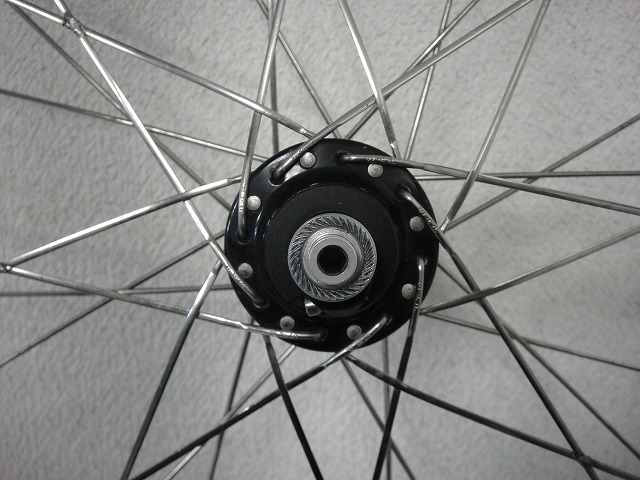
non-freewheel side 8-cross.
I call this "4-8 lacing" on my own.
I think 32H 4-8 lacing is the best method for hand-built wheels to mitigate
spoke tension left-right differences. 36H 4-8 is also possible, but
why 32H is better I'll write about later.
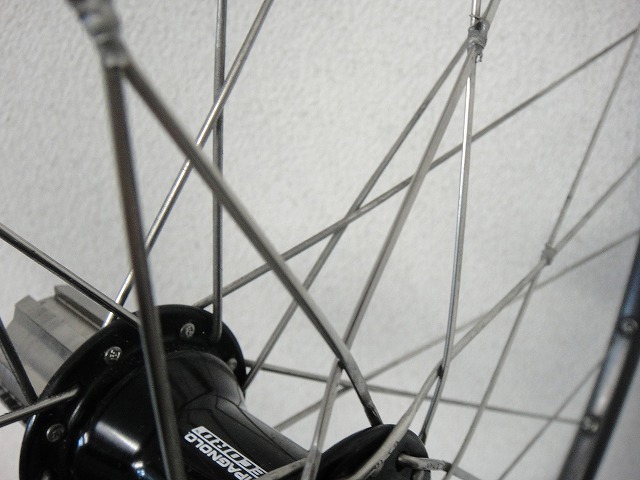
With 6-cross and 8-cross, you can also weave the crossing just before the final one.
Double-cross lacing. Combined with result-lacing with solder on this wheel,
when a spoke breaks, you have to undo the result-lacing of that spoke, and
to thread the new spoke through, you need to undo the adjacent result-lacing too.
That propagates around the whole side. In other words, doing double-cross and result-lacing together
means if one spoke breaks, you end up replacing the entire side.
So with customer wheels I don't do that unless requested.
Without double-cross, worst case is replacing two result-laced spokes.

↑This is not double-cross.
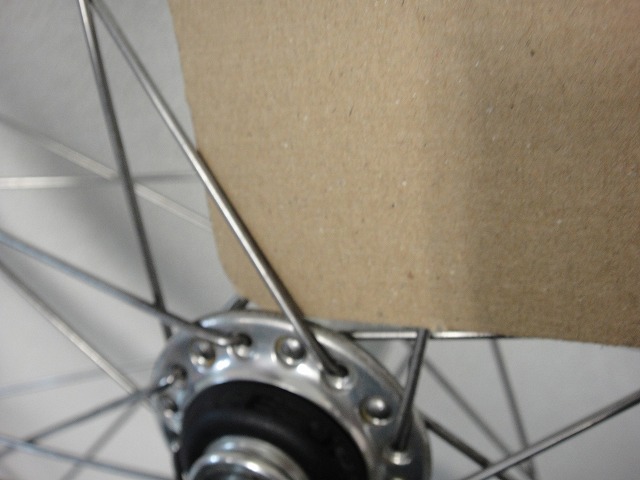
↑Weaving the part where the paper is inserted is double-cross.
Double-cross can reduce apparent spoke deflection, but
I think the effect is bigger with 4-8 lacing itself.
My Reflex above is "4-8 lacing + double-cross + result-lacing with solder,"
like ramen with all the toppings. With all that, it's genuinely a different beast
compared to a normally built wheel. Nomu Lab Wheel No. 2 will incorporate
this reasoning too. ↑I wrote all that to set up just this one sentence.
Thank you for reading, and sorry for the length (laugh).
Spoke Tension Left-Right Difference in Wheels Part 2
was also about "Kyserium is great!," so
Part 3 will be about "Fulcrum is great!" I'll write that later too.
Related Products on Amazon
* Amazon affiliate links — prices may vary
Original Japanese post: のむラボ日記 #76