This is a continuation from two posts ago
so please read that first if you haven't.
A customer brought in ROVAL carbon 700C cyclocross
disc brake wheels for us to work on.
Regarding how to pronounce ROVAL, I think it's "Rōvalu,"
but since the current distributor calls it "Rovāru,"
I'm going to call it Rōvalu from now on without following them.
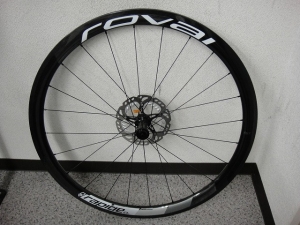
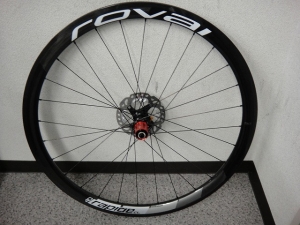
They bought these at some shop and brought them straight to us.
Man, you should have had them check it there.
They want us to check for run-out and centering, plus mount tubular tires.
Both front and rear centering checked out perfectly.
It was so spot-on that they must be getting their tolerances dialed in before shipping.
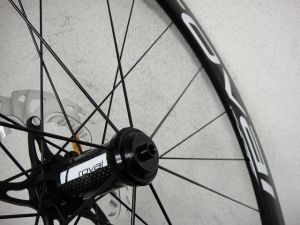
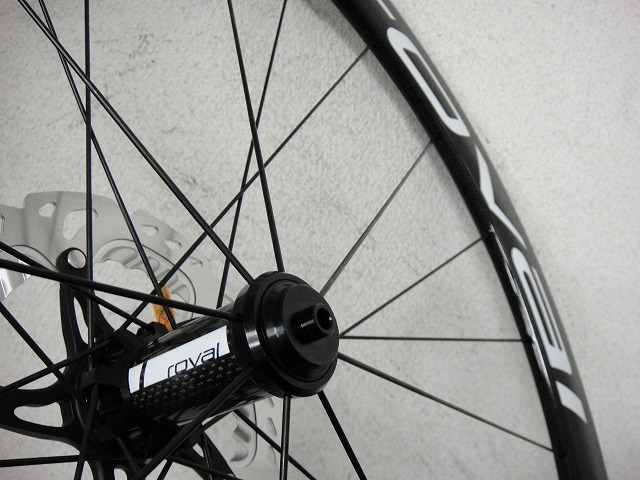
↑They're using the 2:1 build pattern, which is characteristic of Rōvalu.
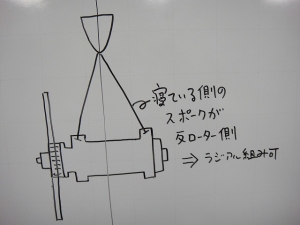
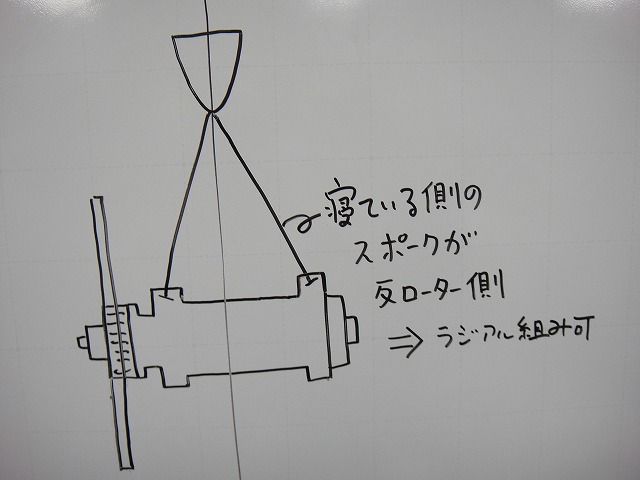
On the front wheel, due to the disc rotor arrangement, the side where the spokes lay at a flatter angle
is opposite the rotor side, making radial lacing possible.
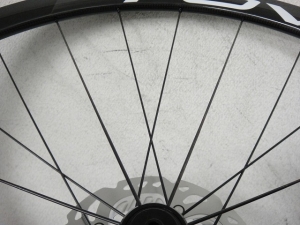
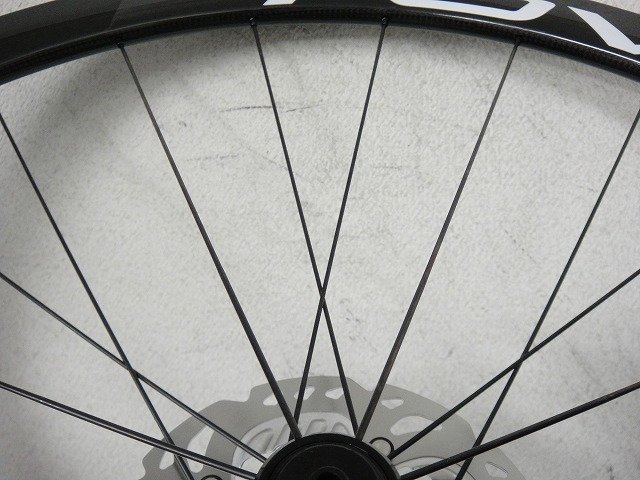
This 2:1 build turned out to be an F3-spoke asymmetrical pattern.
After checking wheel center, I checked for lateral run-out,
and if I really pushed it there was some run-out.
But compared to a normal front wheel with equal spoke counts on both sides,
the lateral run-out couldn't be completely eliminated
(if I pushed too hard, radial run-out appeared)
so this might just be the nature of this lacing pattern.
This wheel is disc-brake only and can't use rim brakes, but
even if you hypothetically used it with rim brakes, there wouldn't be any brake drag inconsistency—
that's how well finished it is.
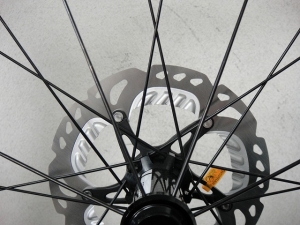
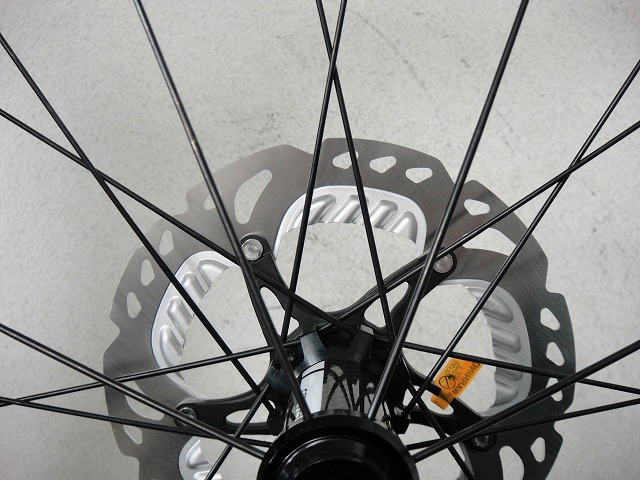
The spokes are the same diameter on both sides, but
comparing tension between one spoke on the tangential-laced side
and one spoke on the radial-laced side,
the radial-laced side is under more tension.
Since they're the same diameter, the spoke deformation
on the tangential-laced side is larger.
If this were a rear wheel with a single-speed rotor
and the rotor on the right side, the spoke tension difference would be close
or even reversed.
This is what's amazing about the 2:1 build.
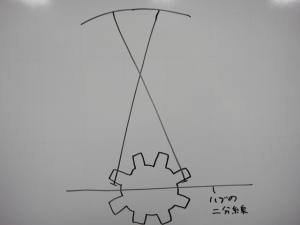
The tangential-laced side is 8H 16 spokes.
By hub flange hole count it would be 4-cross,
but this hub flange is 1H 2-spoke type,
so reading the cross count to the final cross is more reliable.
It's 3-cross, which is equivalent to 6-spoke, and it's semi-tangential.
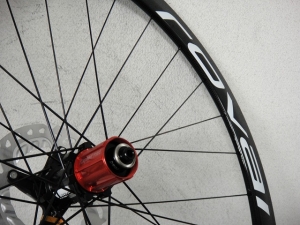
On the rear wheel, due to the rotor arrangement, if you're doing a 2:1 build
you have to make the rotor side radial-laced.
(If you use tangential lacing on the non-freewheel side with a 2:1 build,
spoke tension can reverse depending on conditions)
It seems they decided not to break the rule about radial lacing on the rotor side—
that would be too risky—so they used equal spoke counts on both sides.
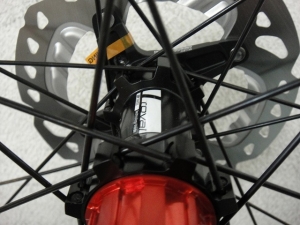
↑Straight-pull spokes, but it's equivalent to JIS lacing.
This rear wheel has 28 spokes, which is 4 times an odd number, so
the F3-spoke phase is at the midpoint between hub holes (spoke head positions).
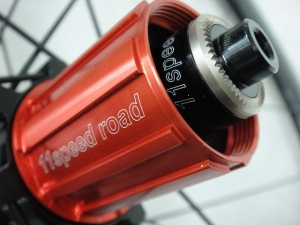
Actually the answer is written on the hub body,
this freehub uses a distinctive ratchet mechanism
directly adopted from another manufacturer.
I won't say which one here.
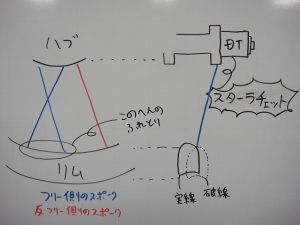
↑This shows a 2:1 build rear wheel, but don't mind that.
With an F3-spoke asymmetrical 2:1 build, the final-crossing spokes end up adjacent to each other,
and this lacing pattern inevitably means some compromise in lateral run-out truing accuracy.
In the area marked in the diagram above, when trueing lateral run-out
and you want to move the rim from solid line toward the dashed line,
you can pull the rim in either direction by tightening the tangential spokes,
but radial run-out will actually get worse.
With a symmetrical build you'd have the option to loosen the non-rotor side,
but with asymmetrical that's not possible.
If the radial run-out is slight, the tire contact patch deformation is larger anyway,
so it's not much of a problem.
But if lateral run-out is the same magnitude, it'll show up in brake feel.
Of course we tighten up the run-out to make this situation less likely,
but the fact remains that we can't dial in lateral run-out as tightly
as we can with equal spoke counts on both sides.
so please read that first if you haven't.
A customer brought in ROVAL carbon 700C cyclocross
disc brake wheels for us to work on.
Regarding how to pronounce ROVAL, I think it's "Rōvalu,"
but since the current distributor calls it "Rovāru,"
I'm going to call it Rōvalu from now on without following them.
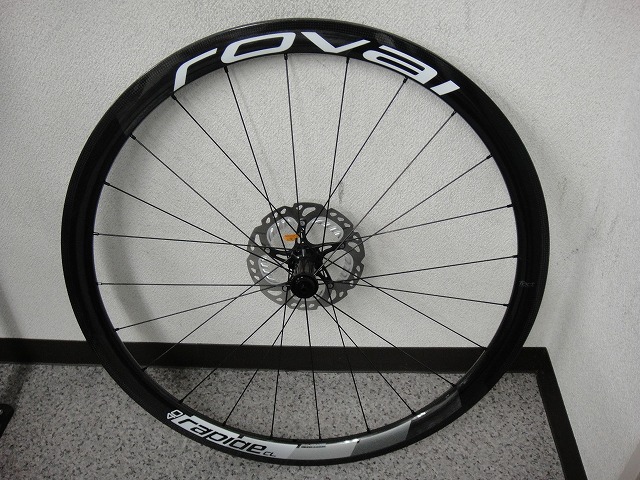

They bought these at some shop and brought them straight to us.
Man, you should have had them check it there.
They want us to check for run-out and centering, plus mount tubular tires.
Both front and rear centering checked out perfectly.
It was so spot-on that they must be getting their tolerances dialed in before shipping.
↑They're using the 2:1 build pattern, which is characteristic of Rōvalu.
On the front wheel, due to the disc rotor arrangement, the side where the spokes lay at a flatter angle
is opposite the rotor side, making radial lacing possible.
This 2:1 build turned out to be an F3-spoke asymmetrical pattern.
After checking wheel center, I checked for lateral run-out,
and if I really pushed it there was some run-out.
But compared to a normal front wheel with equal spoke counts on both sides,
the lateral run-out couldn't be completely eliminated
(if I pushed too hard, radial run-out appeared)
so this might just be the nature of this lacing pattern.
This wheel is disc-brake only and can't use rim brakes, but
even if you hypothetically used it with rim brakes, there wouldn't be any brake drag inconsistency—
that's how well finished it is.
The spokes are the same diameter on both sides, but
comparing tension between one spoke on the tangential-laced side
and one spoke on the radial-laced side,
the radial-laced side is under more tension.
Since they're the same diameter, the spoke deformation
on the tangential-laced side is larger.
If this were a rear wheel with a single-speed rotor
and the rotor on the right side, the spoke tension difference would be close
or even reversed.
This is what's amazing about the 2:1 build.
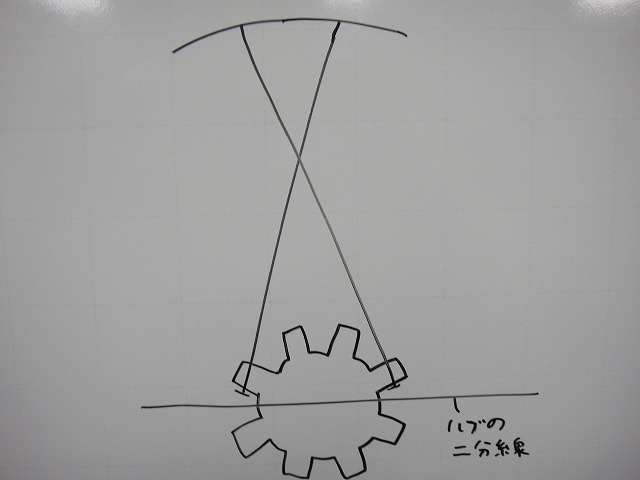
The tangential-laced side is 8H 16 spokes.
By hub flange hole count it would be 4-cross,
but this hub flange is 1H 2-spoke type,
so reading the cross count to the final cross is more reliable.
It's 3-cross, which is equivalent to 6-spoke, and it's semi-tangential.
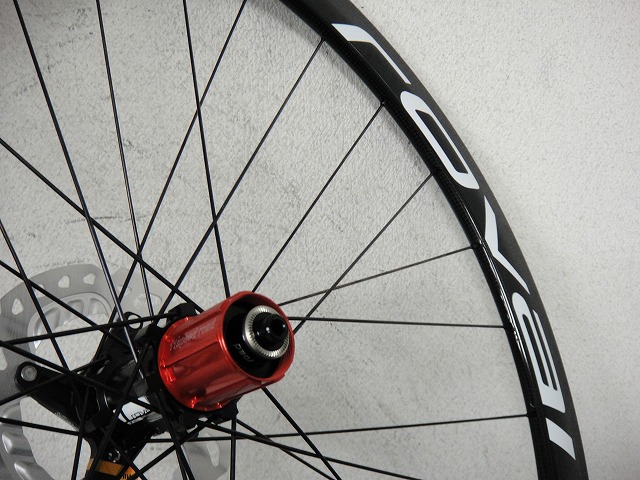
On the rear wheel, due to the rotor arrangement, if you're doing a 2:1 build
you have to make the rotor side radial-laced.
(If you use tangential lacing on the non-freewheel side with a 2:1 build,
spoke tension can reverse depending on conditions)
It seems they decided not to break the rule about radial lacing on the rotor side—
that would be too risky—so they used equal spoke counts on both sides.
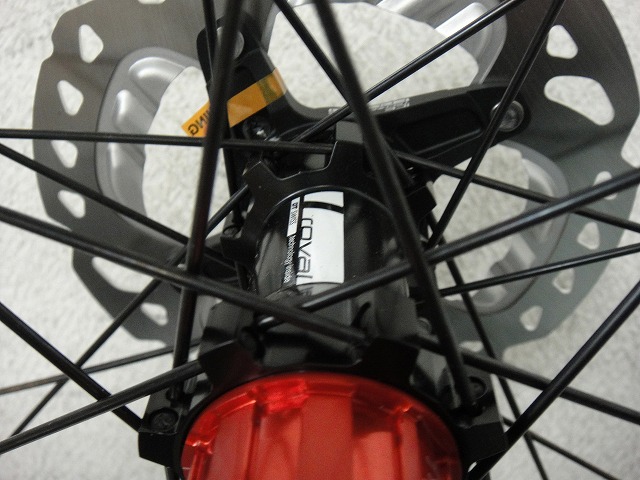
↑Straight-pull spokes, but it's equivalent to JIS lacing.
This rear wheel has 28 spokes, which is 4 times an odd number, so
the F3-spoke phase is at the midpoint between hub holes (spoke head positions).

Actually the answer is written on the hub body,
this freehub uses a distinctive ratchet mechanism
directly adopted from another manufacturer.
I won't say which one here.
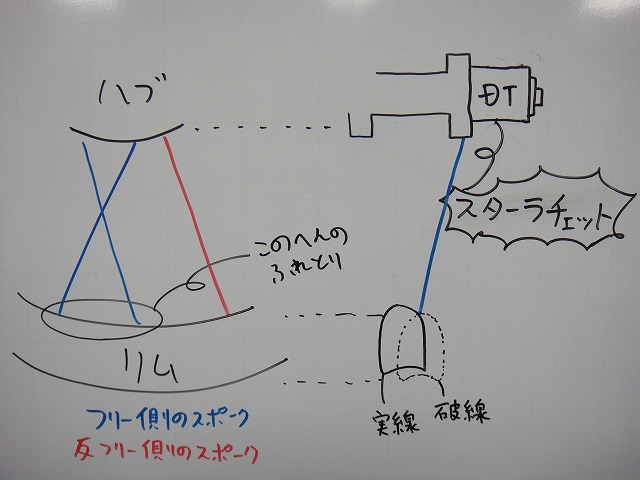
↑This shows a 2:1 build rear wheel, but don't mind that.
With an F3-spoke asymmetrical 2:1 build, the final-crossing spokes end up adjacent to each other,
and this lacing pattern inevitably means some compromise in lateral run-out truing accuracy.
In the area marked in the diagram above, when trueing lateral run-out
and you want to move the rim from solid line toward the dashed line,
you can pull the rim in either direction by tightening the tangential spokes,
but radial run-out will actually get worse.
With a symmetrical build you'd have the option to loosen the non-rotor side,
but with asymmetrical that's not possible.
If the radial run-out is slight, the tire contact patch deformation is larger anyway,
so it's not much of a problem.
But if lateral run-out is the same magnitude, it'll show up in brake feel.
Of course we tighten up the run-out to make this situation less likely,
but the fact remains that we can't dial in lateral run-out as tightly
as we can with equal spoke counts on both sides.