A customer brought in a WH-R500 for service.
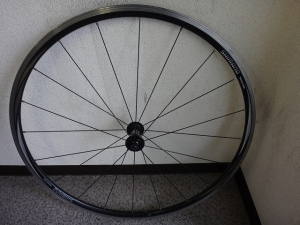
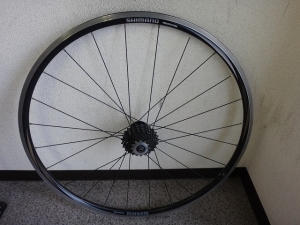
I checked the ball bearings in the front hub. Due to bearing ball tolerances, I couldn't completely eliminate the subtle grinding sound during rotation, but it got considerably better. There's no pitting on the ball races. The front wheel only needed minor lateral truing, but the rear wheel's center was significantly off. The customer mentioned they'd adjusted it a bit themselves, so if they know what caused it, there's no problem.
Pre-built wheels, in their origins, were what manufacturers produced when something "impossible to hand-build" needed to be done. Shimano wheels started with the WH-7700, featuring low spoke counts and paired spokes with a look far removed from hand-built wheels. The lower-tier models back then were the WH-6500 and WH-R535. These entry models had nearly the same appearance as the WH-7700, and even the R535 had a list price of around 26,000 yen before tax. This was a price range that made you wonder whether to go with a hand-built or pre-built wheel for training. The budget pre-built offerings from third-party makers at that time included things like the A-CLASS ALX280, which also sold for just over 20,000 yen. There wasn't anything cheaper than that.
The next generation WH-7701's entry model was the WH-R540, which also looked nearly identical to the WH-7701.
The WH-R500 came out in 2005 as the cheapest model in the WH-7800 generation. The specs were essentially the same as hand-built wheels—just an ordinary wheel—and it was priced at a shocking 10,000 yen or so. It's actually pretty recent. Building a hand-built wheel using Sora or Tiagra hubs with finishing comparable to the WH-R500 would be impossible to compete with at that price (materials alone would exceed 10,000 yen).
This was the beginning of the end for hand-built wheels. The WH-R500 had enough destructive power to make shops think that building their own wheels was pointless. Among all the work of assembling frame and components and setting up hand-built wheels, you no longer had to build the wheels yourself.
In the first place, the term "hand-built wheel" itself only came into use after pre-built wheels appeared, to distinguish between the two.
But rather than having its fangs pulled, the bigger impact was that even people without fangs to begin with could now run a shop without building wheels. It's become the standard situation where, even in large shops, most staff—if not all—can't build a decent wheel properly.
You might ask if it's really so impressive to be able to build hand-built wheels. But when it comes to assembling road bike parts, the qualities of tackling things with high precision and understanding compromises really show up clearly in wheel building. The WH-R500 was a major turning point that took away the opportunity for that kind of training.
(Of course, the WH-R500 didn't take it away—the shops are just indulging in the convenience of pre-built wheels.)
I've often fixed wheels that other shops gave up on with "we can't fix this." But I don't arbitrarily straighten rims that are bent, or say something is still usable when it's really finished. Most of what comes in is the kind of thing that can be fixed with just a little work.
I often tend to call it out like—rather than "this can't be fixed," more like "this is beyond what a small-timer like me can fix," which I'm aware of—but shops that have a low threshold for "this can't be fixed" regarding wheels have that same low threshold for things like derailleur adjustment and installing tricky parts: "we can't go further than this," "we can't do that."
For example, thinking about how to lighten brake lever pull while maintaining that initial lightness over the long term is conceptually almost the same as what I think about when hand-building wheels. Shimano's current coated brake inner cables don't give the "almost identical result regardless of who assembles them," but they're much closer to that than the traditional uncoated stainless steel inners. Today's brake outer end caps have a tiny bit of liner showing and are designed to reduce friction against the frame's outer stop, but I've been hand-making the exact same thing for over 15 years. Now I can get nearly the same results just using what comes on the lever, so the gap between stock parts and my custom specials has closed a bit in this area too. It's good that parts get better, but you need to realize that you're losing—(no, you're NOT losing, you're just getting lazy)—the opportunity to think about "how can we make this even better?"
Lately, parts have been getting better maintenance characteristics and fool-proofing across the board, so it's become harder to distinguish between sloppy work and proper work. But people who can tell, can tell. And if you slack off thinking "this customer probably won't know anyway," you'll eventually pay the price.
Going back to what I wrote about "parts getting better"—when you apply that logic to "the effort of building budget-range wheels," what you end up with is the scary answer: "you don't have to build wheels at all."
Wait, I've gone way off on a tangent here.
It wouldn't be an exaggeration to say the WH-R500 changed not just the concept of wheels but the very nature of the bicycle shop itself. Apart from raw performance, it's definitely a "masterpiece" wheel. I've been meaning to write about this for a while, which is why this turned into such a long post.
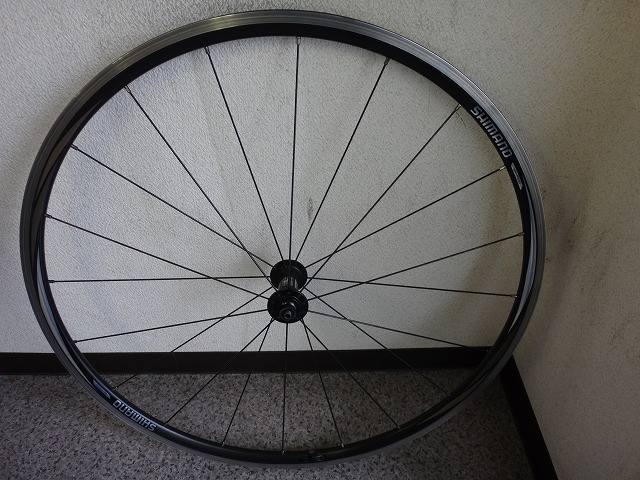
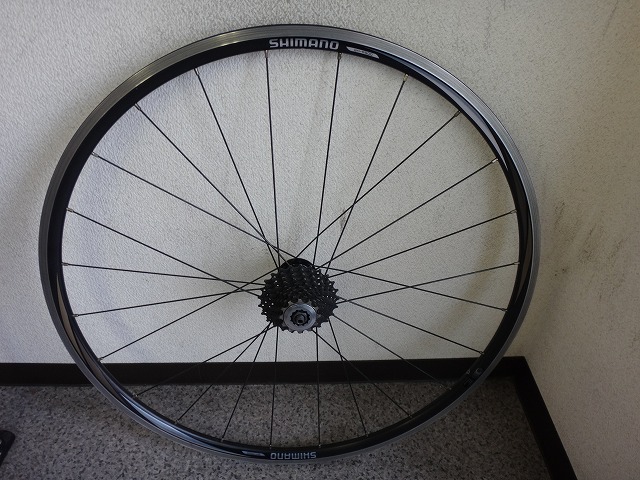
I checked the ball bearings in the front hub. Due to bearing ball tolerances, I couldn't completely eliminate the subtle grinding sound during rotation, but it got considerably better. There's no pitting on the ball races. The front wheel only needed minor lateral truing, but the rear wheel's center was significantly off. The customer mentioned they'd adjusted it a bit themselves, so if they know what caused it, there's no problem.
Pre-built wheels, in their origins, were what manufacturers produced when something "impossible to hand-build" needed to be done. Shimano wheels started with the WH-7700, featuring low spoke counts and paired spokes with a look far removed from hand-built wheels. The lower-tier models back then were the WH-6500 and WH-R535. These entry models had nearly the same appearance as the WH-7700, and even the R535 had a list price of around 26,000 yen before tax. This was a price range that made you wonder whether to go with a hand-built or pre-built wheel for training. The budget pre-built offerings from third-party makers at that time included things like the A-CLASS ALX280, which also sold for just over 20,000 yen. There wasn't anything cheaper than that.
The next generation WH-7701's entry model was the WH-R540, which also looked nearly identical to the WH-7701.
The WH-R500 came out in 2005 as the cheapest model in the WH-7800 generation. The specs were essentially the same as hand-built wheels—just an ordinary wheel—and it was priced at a shocking 10,000 yen or so. It's actually pretty recent. Building a hand-built wheel using Sora or Tiagra hubs with finishing comparable to the WH-R500 would be impossible to compete with at that price (materials alone would exceed 10,000 yen).
This was the beginning of the end for hand-built wheels. The WH-R500 had enough destructive power to make shops think that building their own wheels was pointless. Among all the work of assembling frame and components and setting up hand-built wheels, you no longer had to build the wheels yourself.
In the first place, the term "hand-built wheel" itself only came into use after pre-built wheels appeared, to distinguish between the two.
But rather than having its fangs pulled, the bigger impact was that even people without fangs to begin with could now run a shop without building wheels. It's become the standard situation where, even in large shops, most staff—if not all—can't build a decent wheel properly.
You might ask if it's really so impressive to be able to build hand-built wheels. But when it comes to assembling road bike parts, the qualities of tackling things with high precision and understanding compromises really show up clearly in wheel building. The WH-R500 was a major turning point that took away the opportunity for that kind of training.
(Of course, the WH-R500 didn't take it away—the shops are just indulging in the convenience of pre-built wheels.)
I've often fixed wheels that other shops gave up on with "we can't fix this." But I don't arbitrarily straighten rims that are bent, or say something is still usable when it's really finished. Most of what comes in is the kind of thing that can be fixed with just a little work.
I often tend to call it out like—rather than "this can't be fixed," more like "this is beyond what a small-timer like me can fix," which I'm aware of—but shops that have a low threshold for "this can't be fixed" regarding wheels have that same low threshold for things like derailleur adjustment and installing tricky parts: "we can't go further than this," "we can't do that."
For example, thinking about how to lighten brake lever pull while maintaining that initial lightness over the long term is conceptually almost the same as what I think about when hand-building wheels. Shimano's current coated brake inner cables don't give the "almost identical result regardless of who assembles them," but they're much closer to that than the traditional uncoated stainless steel inners. Today's brake outer end caps have a tiny bit of liner showing and are designed to reduce friction against the frame's outer stop, but I've been hand-making the exact same thing for over 15 years. Now I can get nearly the same results just using what comes on the lever, so the gap between stock parts and my custom specials has closed a bit in this area too. It's good that parts get better, but you need to realize that you're losing—(no, you're NOT losing, you're just getting lazy)—the opportunity to think about "how can we make this even better?"
Lately, parts have been getting better maintenance characteristics and fool-proofing across the board, so it's become harder to distinguish between sloppy work and proper work. But people who can tell, can tell. And if you slack off thinking "this customer probably won't know anyway," you'll eventually pay the price.
Going back to what I wrote about "parts getting better"—when you apply that logic to "the effort of building budget-range wheels," what you end up with is the scary answer: "you don't have to build wheels at all."
Wait, I've gone way off on a tangent here.
It wouldn't be an exaggeration to say the WH-R500 changed not just the concept of wheels but the very nature of the bicycle shop itself. Apart from raw performance, it's definitely a "masterpiece" wheel. I've been meaning to write about this for a while, which is why this turned into such a long post.