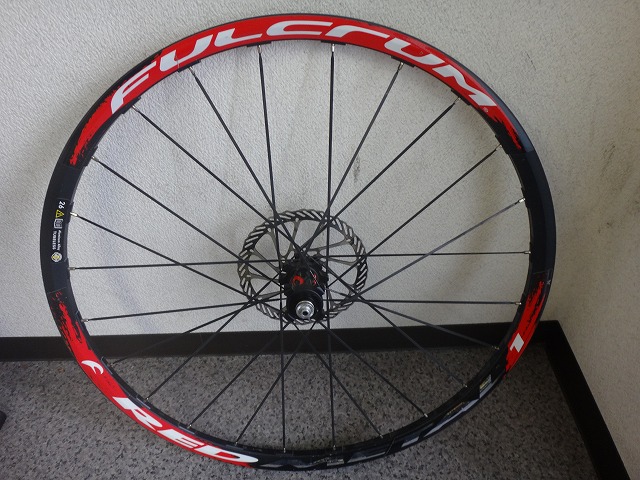
I took in a Fulcrum MTB wheel, the Red Metal 1, from a customer.
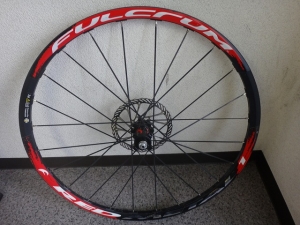
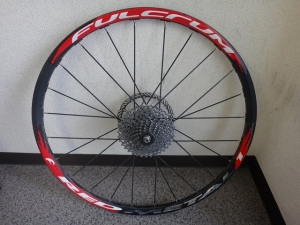
It's a 26-inch spec.
The rear wheel had enough runout that the customer mentioned it right away.
It also had centering issues, so I fixed both at the same time.
The front wheel barely needed any work.
I wish they wouldn't cover the entire rim side with stickers.
(This one did have some gaps here and there)
When they initially build these wheels, I wonder how they true them with the stickers on.
I doubt they apply the stickers after building.
That would be too much extra work.
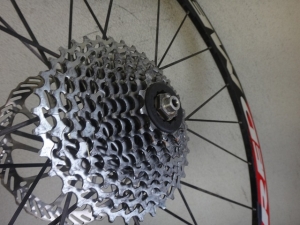
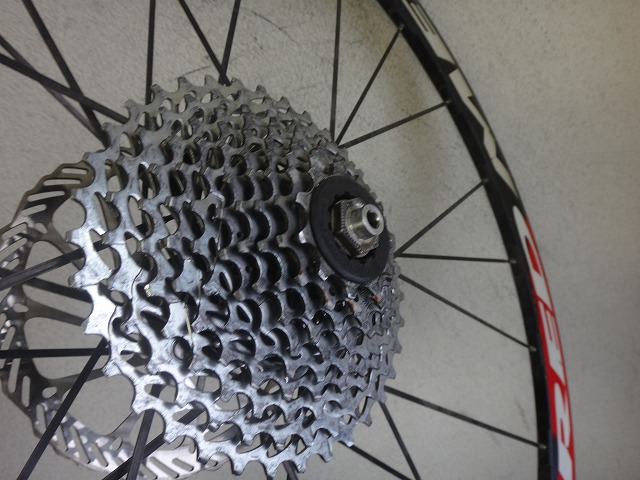
The low gear is supposedly 36T, but when you're used to looking at 29-inch rear wheels,
it looks abnormally large.

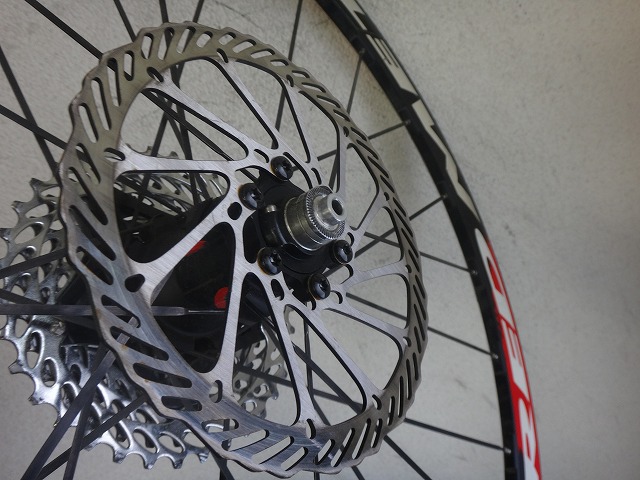
Similarly, the disc rotor also looks oversized.
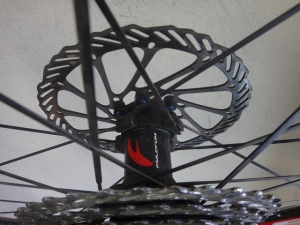
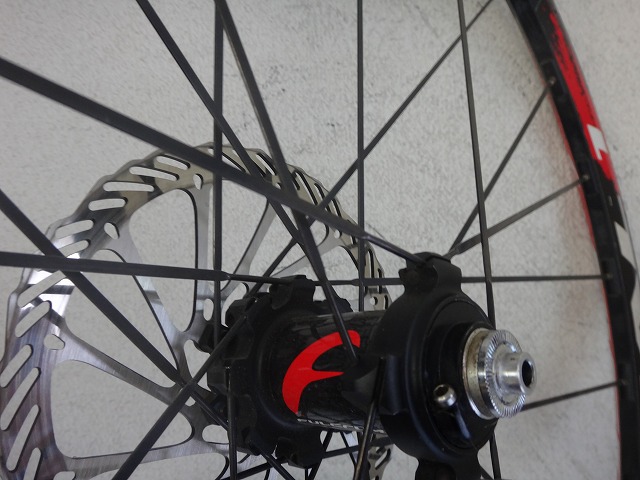
The bearing adjustment nut is naturally on the non-freewheel side (left side in the direction of travel), but

On the front wheel, perhaps considering how awkward it would be to work with the nut on the rotor side,
the bearing adjustment nut is positioned on the apparent right side.
It doesn't seem like it would be impossible to set it on the rotor side,
but they probably went this way as an exception for workability.
Also, both wheels are 16:8H with 2:1 spoke pattern, 24H total,
and it seems radial spoking on the rotor side proved impossible after all,
so they used asymmetric lacing with the smaller spoke count side tanged.
I generally avoid radial spoking on the freewheel side because I think the drawbacks outweigh the benefits in most conditions,
but with 2:1 lacing it's an exception.
If you tange-spoke the freewheel side,
the freewheel side ends up with higher spoke tension.
I inspected both wheels carefully,
and the smaller spoke count side (right side on front, left side on rear) has higher spoke tension,
with such a clear difference that the maximum value on the larger spoke count side
doesn't even come close to the minimum value on the smaller spoke count side.
You can feel the difference just by squeezing the spokes without using a tension gauge.
Still, even the freewheel side of the rear wheel is tensioned above the typical hand-built limit,
so there shouldn't be any issues like poor engagement or play when riding.
If you could control the high-low flange geometry and spoke weight distribution smoothly from this state,
there should be a point somewhere under some conditions where the left and right spoke tensions
match perfectly.
Whether you change only the flange dimensions, only the spoke weight, or both,
I think there would be a balancing point,
but making the freewheel side spokes thinner causes poor engagement,
and extreme high-low flanges, while only affecting the hub area,
add to the wheel's weight,
so it makes you want to run the thought experiment of weighing the pros and cons.
Though even if you found that balance,
it would just be
「obsessing over matching spoke tension」
and you might be misjudging the larger factors at play.
Unrelated to this wheel, but
Campagnolo's aluminum spoke G3 wheels in older models had
the same length for front spokes and freewheel side spokes, and they could be shared as spare parts,
but since Mega G3, front spokes and freewheel side spokes have
become the same part number,
and in both cases they manage with just two spoke types.
This is certainly no coincidence—
they intentionally set the hub flange diameter for each.
Even if there's a case where「making the flange a bit bigger would theoretically be better」,
if that would needlessly multiply the spare parts varieties,
then having a wheel that's easier to repair is better.
That actually helped me out when I had to do that spoke repair on the Shamal Ultra recently.

It's a 26-inch spec.
The rear wheel had enough runout that the customer mentioned it right away.
It also had centering issues, so I fixed both at the same time.
The front wheel barely needed any work.
I wish they wouldn't cover the entire rim side with stickers.
(This one did have some gaps here and there)
When they initially build these wheels, I wonder how they true them with the stickers on.
I doubt they apply the stickers after building.
That would be too much extra work.
The low gear is supposedly 36T, but when you're used to looking at 29-inch rear wheels,
it looks abnormally large.
Similarly, the disc rotor also looks oversized.
The bearing adjustment nut is naturally on the non-freewheel side (left side in the direction of travel), but
On the front wheel, perhaps considering how awkward it would be to work with the nut on the rotor side,
the bearing adjustment nut is positioned on the apparent right side.
It doesn't seem like it would be impossible to set it on the rotor side,
but they probably went this way as an exception for workability.
Also, both wheels are 16:8H with 2:1 spoke pattern, 24H total,
and it seems radial spoking on the rotor side proved impossible after all,
so they used asymmetric lacing with the smaller spoke count side tanged.
I generally avoid radial spoking on the freewheel side because I think the drawbacks outweigh the benefits in most conditions,
but with 2:1 lacing it's an exception.
If you tange-spoke the freewheel side,
the freewheel side ends up with higher spoke tension.
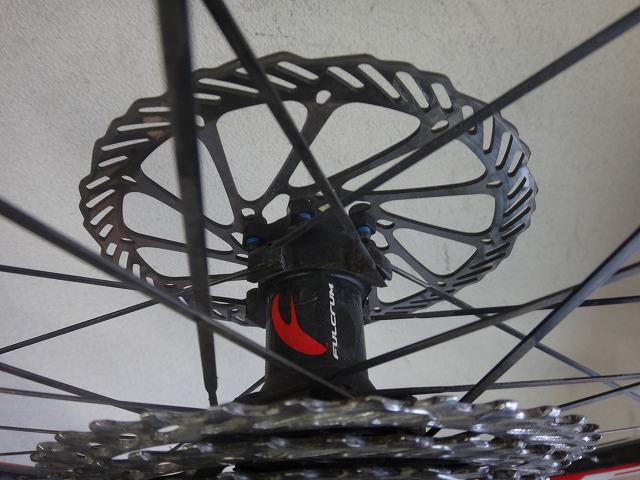
I inspected both wheels carefully,
and the smaller spoke count side (right side on front, left side on rear) has higher spoke tension,
with such a clear difference that the maximum value on the larger spoke count side
doesn't even come close to the minimum value on the smaller spoke count side.
You can feel the difference just by squeezing the spokes without using a tension gauge.
Still, even the freewheel side of the rear wheel is tensioned above the typical hand-built limit,
so there shouldn't be any issues like poor engagement or play when riding.
If you could control the high-low flange geometry and spoke weight distribution smoothly from this state,
there should be a point somewhere under some conditions where the left and right spoke tensions
match perfectly.
Whether you change only the flange dimensions, only the spoke weight, or both,
I think there would be a balancing point,
but making the freewheel side spokes thinner causes poor engagement,
and extreme high-low flanges, while only affecting the hub area,
add to the wheel's weight,
so it makes you want to run the thought experiment of weighing the pros and cons.
Though even if you found that balance,
it would just be
「obsessing over matching spoke tension」
and you might be misjudging the larger factors at play.
Unrelated to this wheel, but
Campagnolo's aluminum spoke G3 wheels in older models had
the same length for front spokes and freewheel side spokes, and they could be shared as spare parts,
but since Mega G3, front spokes and freewheel side spokes have
become the same part number,
and in both cases they manage with just two spoke types.
This is certainly no coincidence—
they intentionally set the hub flange diameter for each.
Even if there's a case where「making the flange a bit bigger would theoretically be better」,
if that would needlessly multiply the spare parts varieties,
then having a wheel that's easier to repair is better.
That actually helped me out when I had to do that spoke repair on the Shamal Ultra recently.