Another day, another wheel (and so on).

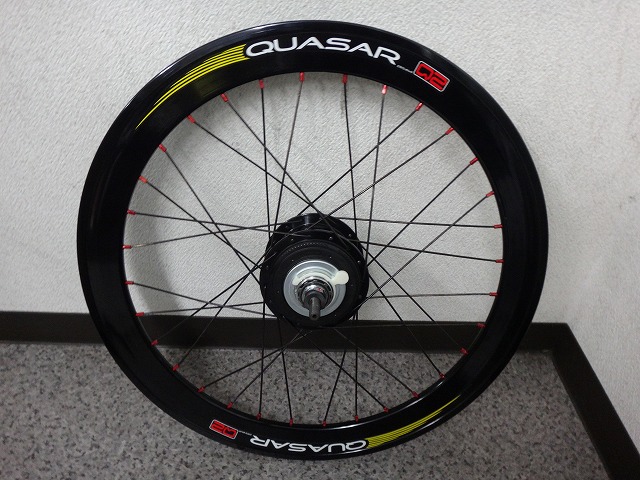
I built a 20-inch small-diameter rim with an Alfine hub.
The rim says "Q2 QUASAR" on it, but
I can't tell if this is a QUASAR rim made by Q2,
or a Q2 rim made by QUASAR.
As I've written before, this is
the same as when you look at a minor band's music CD jacket and
can't figure out which is the group name and which is the song title.
But this time it's neither—
the brand name is "Q2 QUASAR"
and this is one model within that lineup.
The customer's only request was
black spokes and red nipples, everything else is up to me.
With such a large flange and a non-high-rise small-diameter rim,
the incident angle of the spokes into the rim becomes steep,
so I would have preferred brass nipples,
but with red nipples, only aluminum is available, so I went with aluminum nipples.
The spokes are Wheelsmith's black 14-gauge plain (SS14).
Butted spokes short enough for this wheel
aren't available within the range of reliably stocked lengths,
and that's even more true if we're talking black spokes.
Even though the shop has "black 14-gauge" in stock—
DT's Champion and Sapim's Leader—
there's a reason I chose the Wheelsmith SS14.

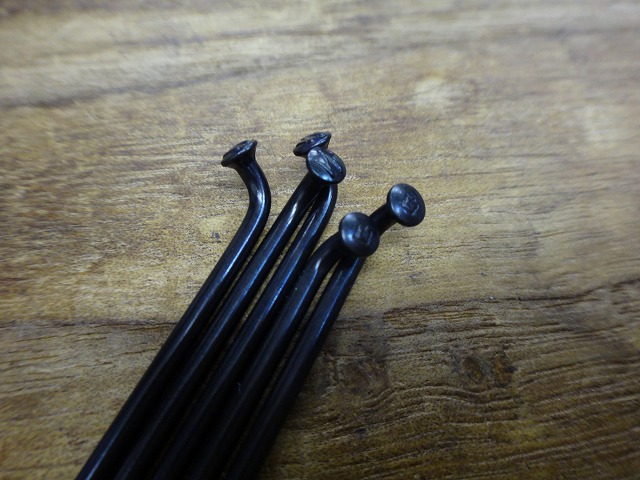
↑Of the five spokes in the image,
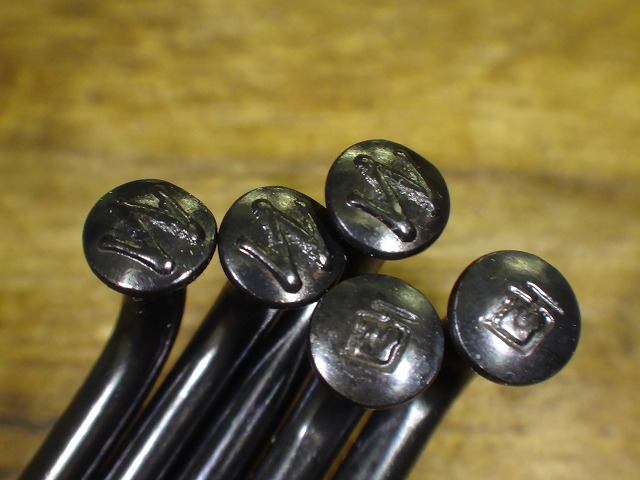
the three on the left are SS14, the two on the right are Champion.

↑The "W" stamp is Wheelsmith; the stamp with D and T overlapping is DT.

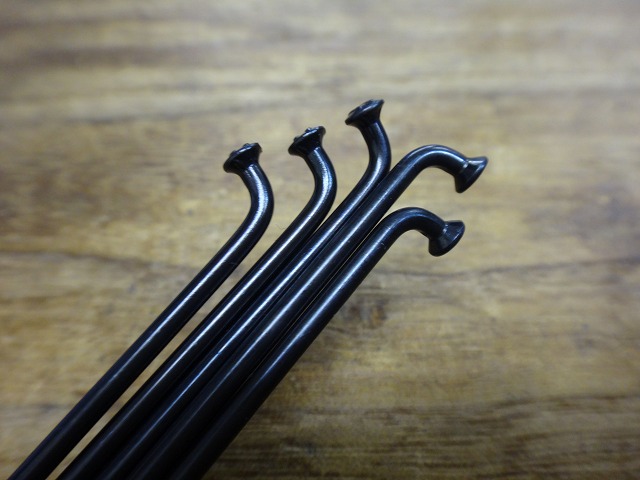
↑Like this, you can see that
Wheelsmith spokes have a special design where
the bend angle at the neck is significantly more obtuse than 90°.
Wheelsmith once outsourced spoke manufacturing to Asahi Spokes,
but this appears to involve a patent, and Asahi Spokes never had this neck design.
After Asahi Spokes went out of business, I don't know
who Wheelsmith's manufacturing partner is now, but I have a pretty good idea.
As a side note,
Asahi Spokes' black spokes had a sticky surface quality—
whether from the paint or oil seeping through—
and Wheelsmith's black spokes from the same period had the same stickiness.
Current models don't have it.

The neck angle of outpoke spokes on a large-diameter rim
looks something like this when you draw it,

but on a small-diameter rim it becomes even more obtuse.
With inpoke spokes, you can bend the neck angle
in the direction that makes it more acute,
but you can't expand it in the other direction,
so small-diameter rims and spokes with obtuse neck angles are a good match.


The hub is a Shimano Alfine SG-S700 32H.
I laced it as a 6-cross JIS pattern.
I didn't think there was enough dish to warrant a 4-cross pattern.
It's JIS lacing because of the disc brake mount,
but since the rim side has anodizing all the way to the brake zone,
the customer may have chosen a rim with no brake zone finish
specifically because they're planning to use disc brakes.

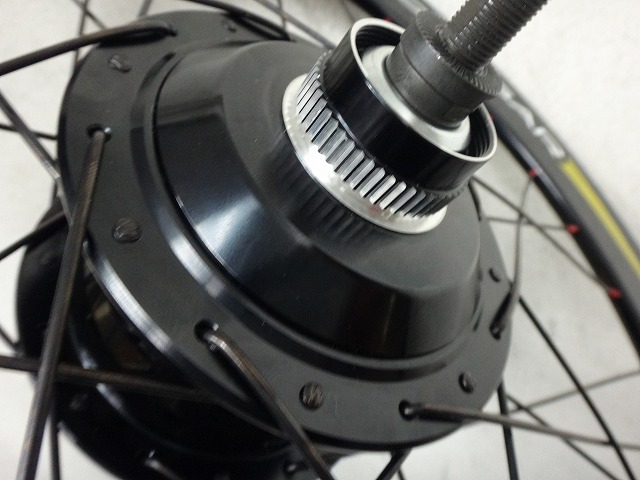
The flange dimensions are roughly right 26.2mm and left 31.9mm.
These are measured values, so there might be some caliper variation,
but even if the nominal value differs by 0.1mm, it won't throw off spoke length calculation.
Adding left and right gives 58.1mm, but
modern road hubs are typically around 57mm
(DT is 53mm, American Classic is 50mm),
so even if this were built with a 700C rim, lateral stiffness would be secured.
Road hub right flange widths are
20.8mm on the FH-7700,
21.1mm on 7700-era Ultegra and 105 (close to maximum),
and recent hubs are mostly around 19mm,
but this is 26.2mm, so the spoke tension on the gear side
won't be excessively high either.
Based on the shape of the hub shell on the rotor side,
the left flange dimension seems to be adjustable
anywhere from "same as right with no dish, narrow" to "wide, to the limits of the rotor mount,"
so this must be Shimano's compromise.
The reason the right flange can be wider is that
it's an internal-gear hub, so there's no external multi-speed cog,
but the 135mm over-locknut dimension also plays a role.

The hub's right side has a three-notch spline,
and you mount a single sprocket that fits this.

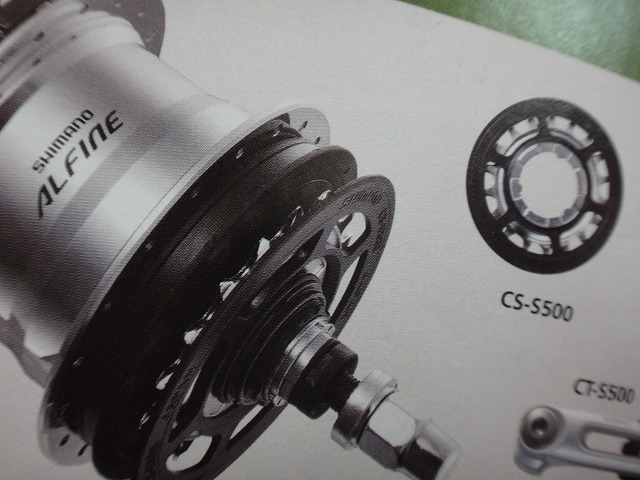
The Alfine sprocket is model number CS-S500 (S five-hundred),
but be careful not to confuse it with the 105 9-speed cassette CS-5500 (five-five-hundred).
The CS-S500 is a guard-equipped sprocket available in 18T and 20T, but

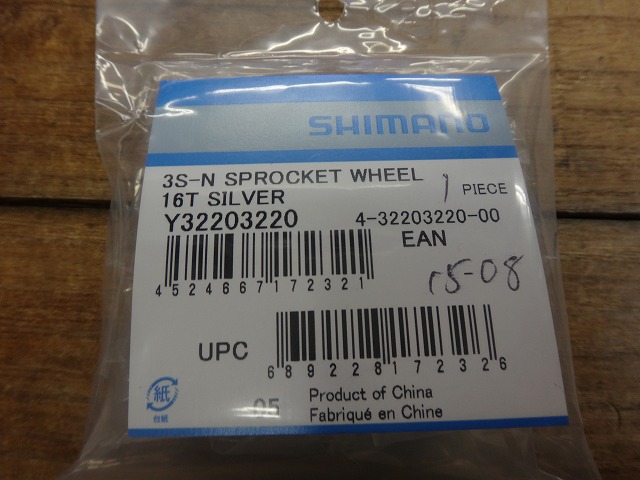
there's a non-graded product—a guard-less 16T sprocket—
with the same spline, which I'd recommend for anyone who wants a smaller tooth count.

↑This one

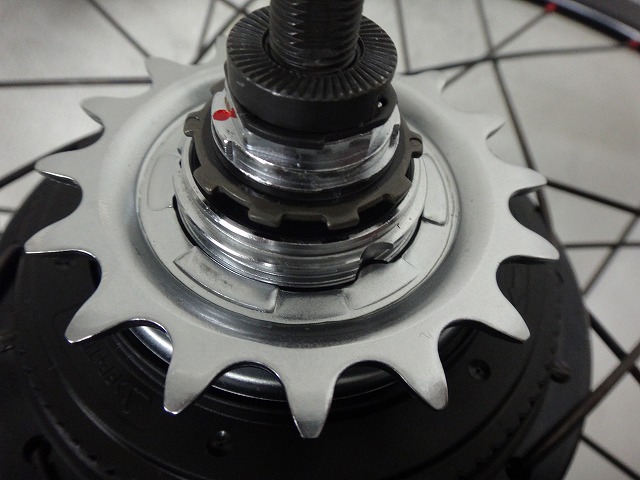
I installed it.

The C-clip snap ring that secures the single sprocket
(the equivalent of a lockring on a cassette sprocket)
is sold separately—I just realized that now.
あばっばっばあばあbっばあばばああばb
I built a 20-inch small-diameter rim with an Alfine hub.
The rim says "Q2 QUASAR" on it, but
I can't tell if this is a QUASAR rim made by Q2,
or a Q2 rim made by QUASAR.
As I've written before, this is
the same as when you look at a minor band's music CD jacket and
can't figure out which is the group name and which is the song title.
But this time it's neither—
the brand name is "Q2 QUASAR"
and this is one model within that lineup.
The customer's only request was
black spokes and red nipples, everything else is up to me.
With such a large flange and a non-high-rise small-diameter rim,
the incident angle of the spokes into the rim becomes steep,
so I would have preferred brass nipples,
but with red nipples, only aluminum is available, so I went with aluminum nipples.
The spokes are Wheelsmith's black 14-gauge plain (SS14).
Butted spokes short enough for this wheel
aren't available within the range of reliably stocked lengths,
and that's even more true if we're talking black spokes.
Even though the shop has "black 14-gauge" in stock—
DT's Champion and Sapim's Leader—
there's a reason I chose the Wheelsmith SS14.
↑Of the five spokes in the image,
the three on the left are SS14, the two on the right are Champion.
↑The "W" stamp is Wheelsmith; the stamp with D and T overlapping is DT.
↑Like this, you can see that
Wheelsmith spokes have a special design where
the bend angle at the neck is significantly more obtuse than 90°.
Wheelsmith once outsourced spoke manufacturing to Asahi Spokes,
but this appears to involve a patent, and Asahi Spokes never had this neck design.
After Asahi Spokes went out of business, I don't know
who Wheelsmith's manufacturing partner is now, but I have a pretty good idea.
As a side note,
Asahi Spokes' black spokes had a sticky surface quality—
whether from the paint or oil seeping through—
and Wheelsmith's black spokes from the same period had the same stickiness.
Current models don't have it.
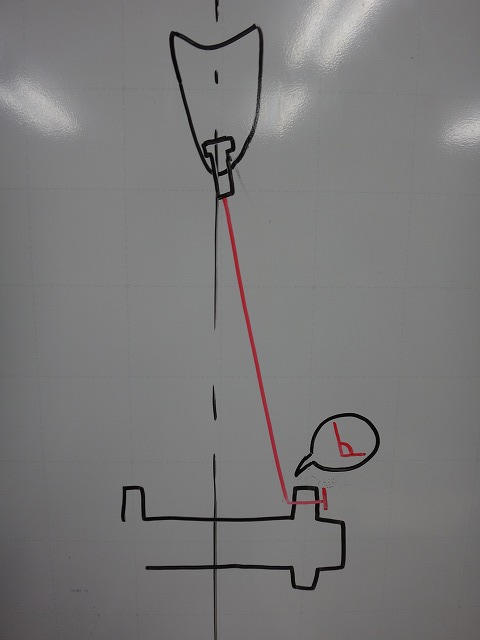
The neck angle of outpoke spokes on a large-diameter rim
looks something like this when you draw it,
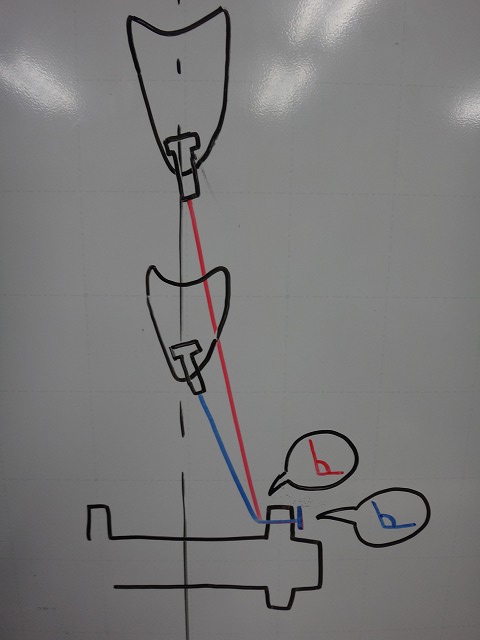
but on a small-diameter rim it becomes even more obtuse.
With inpoke spokes, you can bend the neck angle
in the direction that makes it more acute,
but you can't expand it in the other direction,
so small-diameter rims and spokes with obtuse neck angles are a good match.
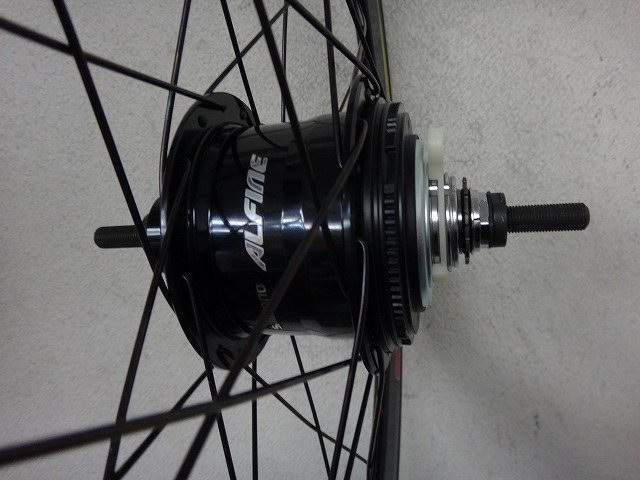
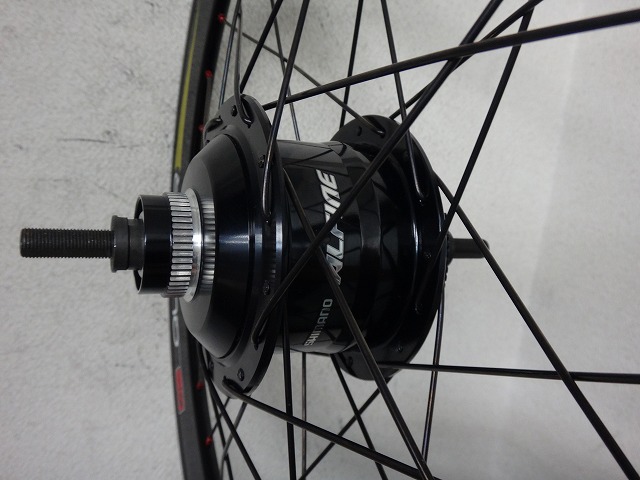
The hub is a Shimano Alfine SG-S700 32H.
I laced it as a 6-cross JIS pattern.
I didn't think there was enough dish to warrant a 4-cross pattern.
It's JIS lacing because of the disc brake mount,
but since the rim side has anodizing all the way to the brake zone,
the customer may have chosen a rim with no brake zone finish
specifically because they're planning to use disc brakes.
The flange dimensions are roughly right 26.2mm and left 31.9mm.
These are measured values, so there might be some caliper variation,
but even if the nominal value differs by 0.1mm, it won't throw off spoke length calculation.
Adding left and right gives 58.1mm, but
modern road hubs are typically around 57mm
(DT is 53mm, American Classic is 50mm),
so even if this were built with a 700C rim, lateral stiffness would be secured.
Road hub right flange widths are
20.8mm on the FH-7700,
21.1mm on 7700-era Ultegra and 105 (close to maximum),
and recent hubs are mostly around 19mm,
but this is 26.2mm, so the spoke tension on the gear side
won't be excessively high either.
Based on the shape of the hub shell on the rotor side,
the left flange dimension seems to be adjustable
anywhere from "same as right with no dish, narrow" to "wide, to the limits of the rotor mount,"
so this must be Shimano's compromise.
The reason the right flange can be wider is that
it's an internal-gear hub, so there's no external multi-speed cog,
but the 135mm over-locknut dimension also plays a role.

The hub's right side has a three-notch spline,
and you mount a single sprocket that fits this.
The Alfine sprocket is model number CS-S500 (S five-hundred),
but be careful not to confuse it with the 105 9-speed cassette CS-5500 (five-five-hundred).
The CS-S500 is a guard-equipped sprocket available in 18T and 20T, but
there's a non-graded product—a guard-less 16T sprocket—
with the same spline, which I'd recommend for anyone who wants a smaller tooth count.

↑This one
I installed it.

The C-clip snap ring that secures the single sprocket
(the equivalent of a lockring on a cassette sprocket)
is sold separately—I just realized that now.
あばっばっばあばあbっばあばばああばb