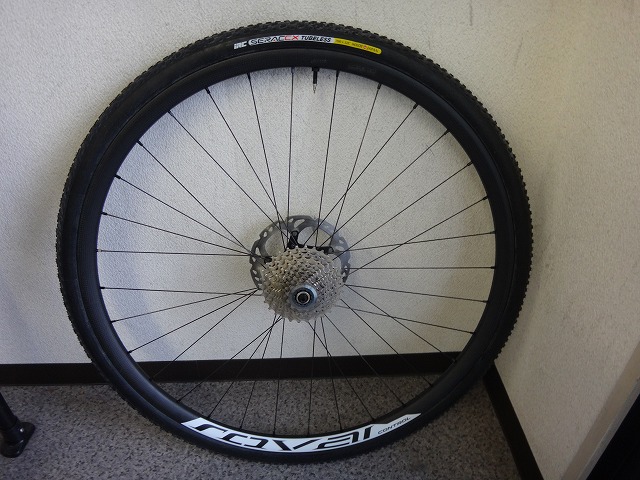
A customer brought in a Roval Control 29 for service.


He's using it for cyclocross, and wanted me to do a general inspection
plus mount some tubeless tires while I had it.

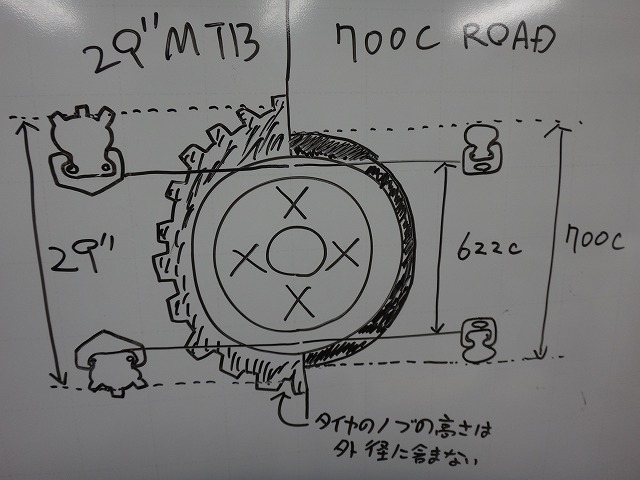
The 29-inch MTB designation works like this:
a 622C rim (used for 700C) fitted with tires that are 2.0 inches wide (about 50C)
or 2.2 inches wide (about 56C) will have an overall diameter of 29 inches (about 735C),
which is where the name comes from.
Put simply, it's just a wider 700C WO rim with fatter tires on it.
When you mount a road tire on a 622C rim,
the overall diameter theoretically becomes 700C (1C = 1mm),
but in reality you only get a true 700C diameter with a 28C tire—
with a 23C tire, the actual measurement comes out to around 685C.

Also, 700C converts to roughly 27.5 inches.
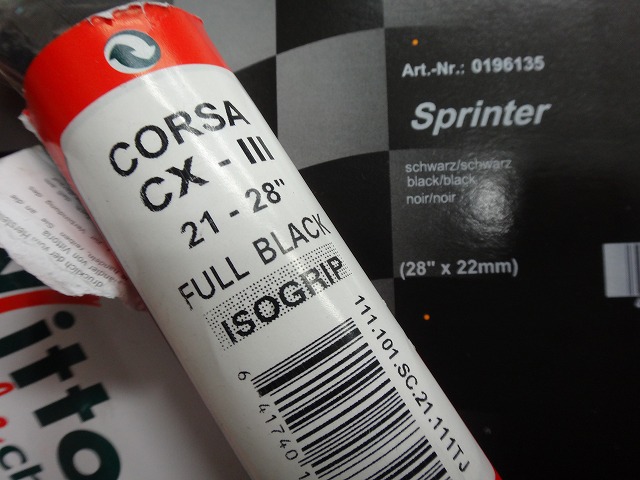
Since tubular tires are typically marked in inches,
most tire makers (especially European ones)
label them as 28 inch.
Tubular tires have a smaller outer diameter than WO tires (at the same tire width),
so strictly speaking 27 inch would be more accurate if we're being literal,
but lately there's a size that uses a 650B rim (the B size standard, not C)
with MTB tires, calling it 27.5 inch based on that diameter.
To avoid confusion, 28 inch labeling is probably the safer bet.
Now, about the wheels the customer brought in—
the name says "29" (twenty-nine) on them, so these are MTB wheels.
The manufacturer also sells them as such, for XC race MTBs.
This time, the customer requested cyclocross 32C tires.
The rim width leans toward the MTB side (which makes sense since they're MTB wheels),
but given the XC racing heritage, it wasn't so wide that mounting 32C tires posed problems.
Since 700C and 29-inch have the same internal rim diameter of 622C,
wheel sharing between cyclocross and MTB might become the norm.
Cyclocross front hubs are normally quick-release like road bikes,
so they don't match MTBs, which use thru-axles as standard.
However, the front wheel this customer brought could switch between systems
by changing the axle nuts, so it was set up as quick-release.
(When used as an MTB wheel, this front wheel uses a 15mm thru-axle.)

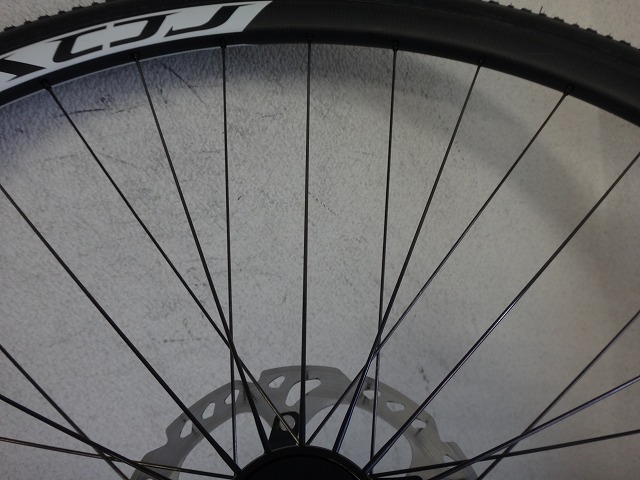
Even Roval has given up on doing a 2:1 spoke pattern on the rear wheel.
They must have weighed the manufacturer's design philosophy against the risk
of reducing spokes on the rotor side and landed on this.
The Fulcrum Red Metal I mentioned the other day (→here) did push that envelope,
but that's only possible because the rim is stout("heavy" in euphemistic terms).

The front wheel also has equal spoke counts left and right,
but because of the offset, spoke tension is higher on the rotor side
(on the rear, it's the non-rotor side = the freebody side).
Even radial lacing would be fine, I think.
With only modest offset from the rotor mounting bracket—nowhere near what the freebody creates—
left-right spoke balance might actually work out okay.
If you're worried about torsional stiffness against the rotor's braking force,
tangential lacing on the non-rotor side would be better.

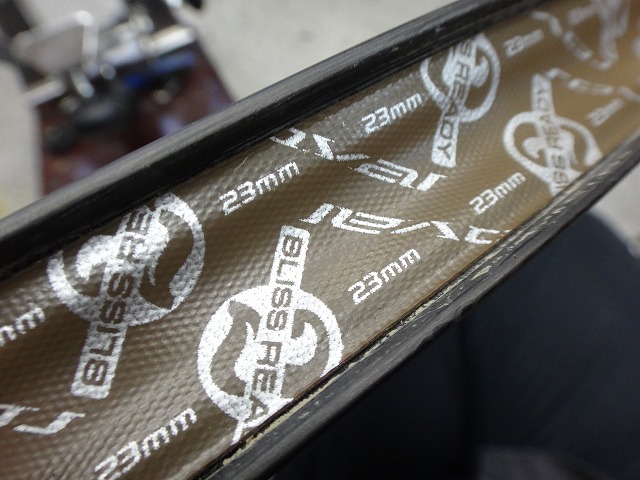
Bliss, pure bliss!
BLISS means "bliss," but Specialized's tubeless tires
have long been marked "2 BLISS" to indicate tubeless.
This uses rim tape to achieve tubeless setup,
so it's labeled "tubeless ready,"
but I'd always assumed "tubeless ready" was Japanese English.

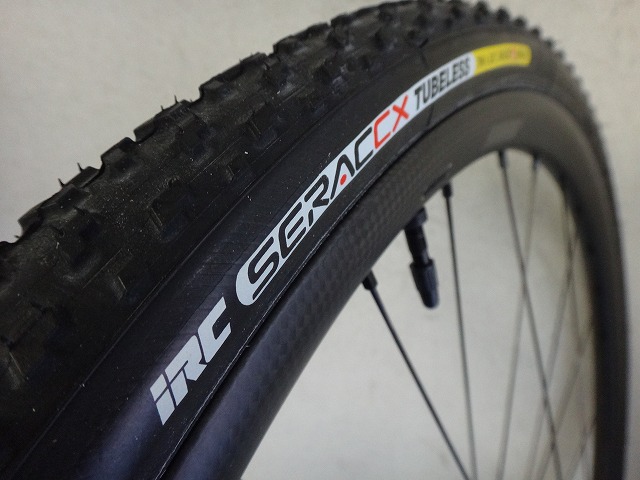
The tire is an IRC Sirac CX Tubeless.
They've clearly paid attention to bead lock at low pressure,
and the recommended pressure is 3–5 bar.
In cyclocross races, you're running under 2 bar no matter what,
usually around 1.6 bar in actual use,
but they probably couldn't guarantee performance at pressures that low.
Still, at least with this tire I've never heard of bead dropout at low pressure
(ahem... other makers, though, that's another story).

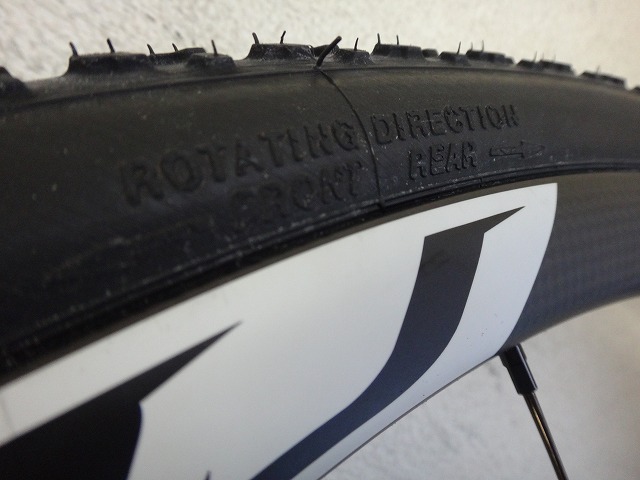
↑ The tread pattern looks like this.
Top right of the photo is the direction of travel.

The rear came with instructions to mount it reversed—
if this were the Sirac XC (not CX), the MTB version, I'd do that.
But for cyclocross, I don't think reversed mounting is necessary,
so after consulting with the customer,
we mounted both wheels in the front-tire direction.

He's using it for cyclocross, and wanted me to do a general inspection
plus mount some tubeless tires while I had it.
The 29-inch MTB designation works like this:
a 622C rim (used for 700C) fitted with tires that are 2.0 inches wide (about 50C)
or 2.2 inches wide (about 56C) will have an overall diameter of 29 inches (about 735C),
which is where the name comes from.
Put simply, it's just a wider 700C WO rim with fatter tires on it.
When you mount a road tire on a 622C rim,
the overall diameter theoretically becomes 700C (1C = 1mm),
but in reality you only get a true 700C diameter with a 28C tire—
with a 23C tire, the actual measurement comes out to around 685C.
Also, 700C converts to roughly 27.5 inches.
Since tubular tires are typically marked in inches,
most tire makers (especially European ones)
label them as 28 inch.
Tubular tires have a smaller outer diameter than WO tires (at the same tire width),
so strictly speaking 27 inch would be more accurate if we're being literal,
but lately there's a size that uses a 650B rim (the B size standard, not C)
with MTB tires, calling it 27.5 inch based on that diameter.
To avoid confusion, 28 inch labeling is probably the safer bet.
Now, about the wheels the customer brought in—
the name says "29" (twenty-nine) on them, so these are MTB wheels.
The manufacturer also sells them as such, for XC race MTBs.
This time, the customer requested cyclocross 32C tires.
The rim width leans toward the MTB side (which makes sense since they're MTB wheels),
but given the XC racing heritage, it wasn't so wide that mounting 32C tires posed problems.
Since 700C and 29-inch have the same internal rim diameter of 622C,
wheel sharing between cyclocross and MTB might become the norm.
Cyclocross front hubs are normally quick-release like road bikes,
so they don't match MTBs, which use thru-axles as standard.
However, the front wheel this customer brought could switch between systems
by changing the axle nuts, so it was set up as quick-release.
(When used as an MTB wheel, this front wheel uses a 15mm thru-axle.)

Even Roval has given up on doing a 2:1 spoke pattern on the rear wheel.
They must have weighed the manufacturer's design philosophy against the risk
of reducing spokes on the rotor side and landed on this.
The Fulcrum Red Metal I mentioned the other day (→here) did push that envelope,
but that's only possible because the rim is stout
The front wheel also has equal spoke counts left and right,
but because of the offset, spoke tension is higher on the rotor side
(on the rear, it's the non-rotor side = the freebody side).
Even radial lacing would be fine, I think.
With only modest offset from the rotor mounting bracket—nowhere near what the freebody creates—
left-right spoke balance might actually work out okay.
If you're worried about torsional stiffness against the rotor's braking force,
tangential lacing on the non-rotor side would be better.
Bliss, pure bliss!
BLISS means "bliss," but Specialized's tubeless tires
have long been marked "2 BLISS" to indicate tubeless.
This uses rim tape to achieve tubeless setup,
so it's labeled "tubeless ready,"
but I'd always assumed "tubeless ready" was Japanese English.
The tire is an IRC Sirac CX Tubeless.
They've clearly paid attention to bead lock at low pressure,
and the recommended pressure is 3–5 bar.
In cyclocross races, you're running under 2 bar no matter what,
usually around 1.6 bar in actual use,
but they probably couldn't guarantee performance at pressures that low.
Still, at least with this tire I've never heard of bead dropout at low pressure
(ahem... other makers, though, that's another story).

↑ The tread pattern looks like this.
Top right of the photo is the direction of travel.
The rear came with instructions to mount it reversed—
if this were the Sirac XC (not CX), the MTB version, I'd do that.
But for cyclocross, I don't think reversed mounting is necessary,
so after consulting with the customer,
we mounted both wheels in the front-tire direction.