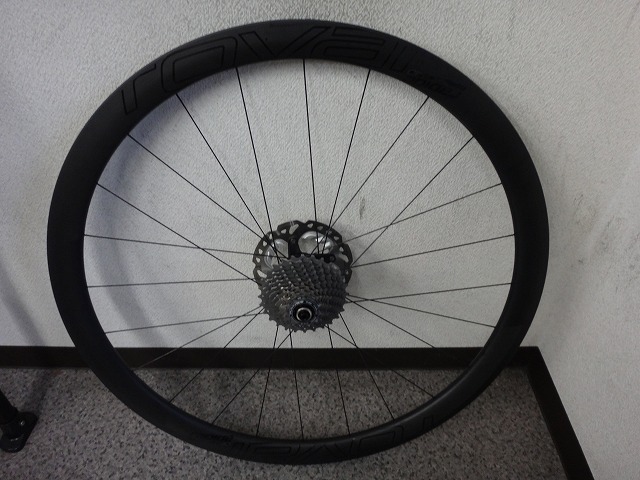
A customer dropped off a Rapide CLX40 with me.


There are four other posts with this same title on this blog,
but I've never seen rim lettering like this before.
The rim sidewall is textured,
and I kept thinking it was catching on the truing stand's gauge—
turns out it was just hitting the rim text.
The front wheel had just a tiny bit of centering offset,
and both wheels showed the kind of minor lateral runout
you'd expect from initial truing on a used set.
This wheel is pretty interesting to me.
You can see a thought trap here where manufacturers feel compelled to showcase
their proprietary design characteristics in "all situations no matter what,"
as if not doing so would be self-denial.
For example, with Rolf Prima wheels, pair-spoke lacing is that signature feature.
If there were a Rolf wheel without pair-spoke lacing,
you'd think, "Wait, did they switch philosophies?"
Similarly, for Roval wheels, 2:1 spoke arrangement is their thing.
So if a Roval wheel didn't have 2:1 lacing,
it would mean there were circumstances preventing it.
On disc brake hub front wheels, the rotor side has
steeper spoke angles (the side with more spokes in asymmetric lacing),
so 2:1 lacing is possible.
Radial lacing on the anti-rotor side feels like a bold design choice,
but then again, 2:1 lacing on disc brake hubs at all is pretty bold.
But on the rear wheel, they played it safe with equal-sided lacing.
Since the freehub dish is more pronounced, if you used 2:1 lacing,
the rotor would end up on the spoke-sparse side.
Fulcrum's MTB rear wheels do have
a pretty aggressive spec—"anti-freehub side is tangent-laced but still 2:1"—
but the fact that even Roval got nervous here and went with equal-sided lacing
is actually worth respecting.

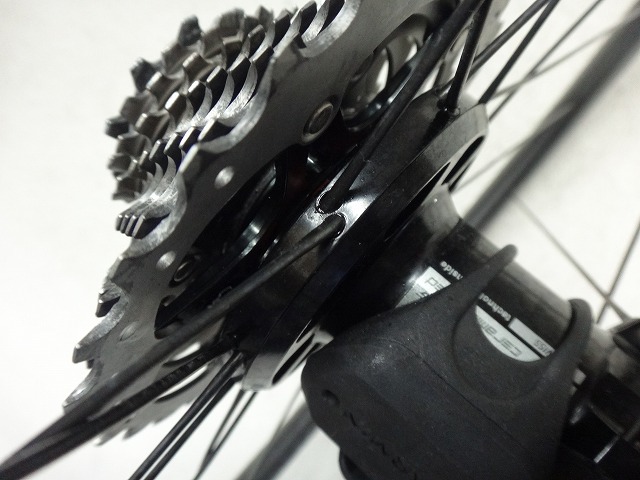
The freehub side straight spokes use coaxial flanges.
You might say, "Hey, the spoke exit positions are offset by about one spoke!"
But with bent-head tangent-laced spokes,
the difference between inpoke and outpoke spoke paths is about this much,
so I'd call this close enough to count as coaxial (single flange).

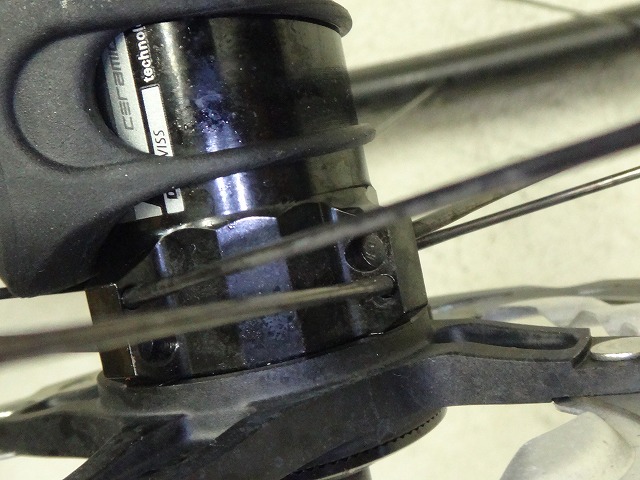
The anti-freehub side uses separate-axis flanges, like you see on Shimano, Zipp, and DT.

The freehub-side coaxial flange has a woven final crossing,
but the anti-freehub separate-axis flange doesn't have the spokes close enough together
to weave the final crossing—as you can see in the photo above.
Since the anti-freehub side has lower spoke tension anyway,
they probably wanted to avoid creaking noises from crossing contact and such,
and there are various reasons you could imagine,
but what I think is Roval's real biggest reason for this...
I won't write it here, but there's probably something else going on.
Man, wheels really are deep.
If DT's off-the-shelf straight-spoke hubs were already this design from the start,
then DT would be the clever one,
but their 240 straight-spoke disc hub has separate-axis flanges on both sides,
so Roval's rear hub looks like a custom piece.

There are four other posts with this same title on this blog,
but I've never seen rim lettering like this before.
The rim sidewall is textured,
and I kept thinking it was catching on the truing stand's gauge—
turns out it was just hitting the rim text.
The front wheel had just a tiny bit of centering offset,
and both wheels showed the kind of minor lateral runout
you'd expect from initial truing on a used set.
This wheel is pretty interesting to me.
You can see a thought trap here where manufacturers feel compelled to showcase
their proprietary design characteristics in "all situations no matter what,"
as if not doing so would be self-denial.
For example, with Rolf Prima wheels, pair-spoke lacing is that signature feature.
If there were a Rolf wheel without pair-spoke lacing,
you'd think, "Wait, did they switch philosophies?"
Similarly, for Roval wheels, 2:1 spoke arrangement is their thing.
So if a Roval wheel didn't have 2:1 lacing,
it would mean there were circumstances preventing it.
On disc brake hub front wheels, the rotor side has
steeper spoke angles (the side with more spokes in asymmetric lacing),
so 2:1 lacing is possible.
Radial lacing on the anti-rotor side feels like a bold design choice,
but then again, 2:1 lacing on disc brake hubs at all is pretty bold.
But on the rear wheel, they played it safe with equal-sided lacing.
Since the freehub dish is more pronounced, if you used 2:1 lacing,
the rotor would end up on the spoke-sparse side.
Fulcrum's MTB rear wheels do have
a pretty aggressive spec—"anti-freehub side is tangent-laced but still 2:1"—
but the fact that even Roval got nervous here and went with equal-sided lacing
is actually worth respecting.
The freehub side straight spokes use coaxial flanges.
You might say, "Hey, the spoke exit positions are offset by about one spoke!"
But with bent-head tangent-laced spokes,
the difference between inpoke and outpoke spoke paths is about this much,
so I'd call this close enough to count as coaxial (single flange).

The anti-freehub side uses separate-axis flanges, like you see on Shimano, Zipp, and DT.
The freehub-side coaxial flange has a woven final crossing,
but the anti-freehub separate-axis flange doesn't have the spokes close enough together
to weave the final crossing—as you can see in the photo above.
Since the anti-freehub side has lower spoke tension anyway,
they probably wanted to avoid creaking noises from crossing contact and such,
and there are various reasons you could imagine,
but what I think is Roval's real biggest reason for this...
I won't write it here, but there's probably something else going on.
Man, wheels really are deep.
If DT's off-the-shelf straight-spoke hubs were already this design from the start,
then DT would be the clever one,
but their 240 straight-spoke disc hub has separate-axis flanges on both sides,
so Roval's rear hub looks like a custom piece.