I received a comment about my wheel centering work:
"You always center the wheel perfectly without any tire pressure,
but do you just ignore the centering shift that happens when you inflate the tire?"
Oh, this is a very good question (nervous laugh).
Thank you for asking.
Yes, I do ignore it. Well, that sounds bad, so let me explain in detail.
First, regarding tire pressure: when you inflate to several times atmospheric pressure, the rim gets compressed by that pressure
(especially noticeable on road bikes), which reduces spoke tension.
The rim doesn't behave like a completely rigid body against tire pressure.
(We build the wheel before tensioning the tire, but the rim doesn't act completely rigid against spoke tension either.
With some rims, the amount of compression on the inner circumference is not negligible, so
we've learned that certain rims need spoke length to be calculated about 0.5mm or 1mm shorter than the theoretical value.)
When that happens, if the wheel has runout, the rim shifts toward the side where the spokes are more angled.
This can sometimes be observed with a centering gauge.
Even if not observable, it should happen in small amounts.
The amount varies depending on rim rigidity, but
from experience, heavier rims shift less, and high-profile rims shift less.
However, actually, the tire and rim format matters more than rim rigidity as a factor.
Regarding how easily center shift occurs at a given pressure (how prone to shifting),
the order is: tubeless, tubed (WO and HE), tubular.
To be specific, with Shimano WH-6800 or Easton's old EA90RT,
center shift of more than "about one sheet of paper" occurs at 8 bar with a tubeless tire.
In the case of the old EA90RT, I've even done centering work with the customer's usual tire
at their usual air pressure.
I'm aware that a perfectly centered wheel without any load
doesn't necessarily maintain that centering in actual use conditions with the tire mounted and pressurized,
but since I don't know the customer's tire and pressure conditions,
perfectly centered without load becomes the basic standard for the work.
If someone asks me to center it with their usual tire at their usual pressure,
I'll do that, but
with a certain WO tire that gets wider from 23mm to 25mm with age,
once it gets wider, the rim shift amount at the same pressure decreases.
So doing centering work as precisely as possible under actual use conditions
is extremely difficult.
(Not technically—it's because the conditions themselves keep changing.)
Also, the centering gauge I use with the tire mounted
isn't very reliable as a measuring tool.
Someone will probably tell me to just buy a decent centering gauge that works with the tire mounted,
but as far as I know, none exist.
If one does, please tell me. I'll buy it.
Also, on rear wheels other than R-SYS, we know that with age the rim shifts toward the freewheel side.
(I'll explain the reason from a different angle another time.)
The Nomulab Wheel #4 (ノムラボホイール4号) that I use
was slightly shifted anti-freewheel side when unloaded,
but when I checked with the centering gauge at each tire change,
I confirmed that it did shift toward the freewheel side.
This isn't noticeable while riding, but
the amount is larger than the shift caused by tire pressure.
With the freewheel-side shift that occurs with age, I've also learned from experience that
on rear wheels with different spoke counts on each side (like 2:1 lacing),
the shift happens faster.
So the question becomes: does my regular unloaded centering work have any meaning?
Well, bringing uncentered wheels—the kind with center shift of one yen coin's worth or more—
to at least perfectly centered without load at that moment
should be much better than the condition before you brought them in.
So there is meaning in eliminating roughly-finished wheels through this work.
As I mentioned earlier,
if you tell me to center it with your current tire at your current pressure,
I'll do it that way.
If the tire changes after that (changing includes getting wider),
I can't guarantee perfect centering under actual use conditions though.
It's definitely true from experience that rear wheel centers shift toward the freewheel side with age.
Whether it's Nomulab wheels or complete wheels,
when I later do truing work on rear wheels where I previously set the unloaded center,
I pretty often do "chase centering" by tightening the anti-freewheel side.
The reason I haven't written much about this before is that if mechanics who know about it,
they'd blame all freewheel-side centering shift on age, which is annoying.
I remove the tire as much as possible when doing truing work,
partly to also set the unloaded center while I'm at it.
With the latest Campagnolo Bora tubular model,
the wide rim means the centering gauge can sometimes fit without interference even with the tire mounted,
and since it doesn't have internal nipples, you can adjust without removing the tire.
In those cases I do check with the tire on.

As a good opportunity,
about centering shift on WH-6800 rear wheels with tubeless tires.
The image above is something I had stocked for an article,
but I took it on March 14, 2015.
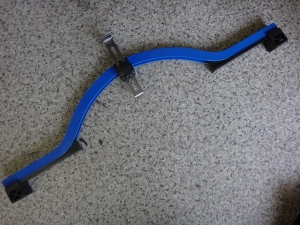
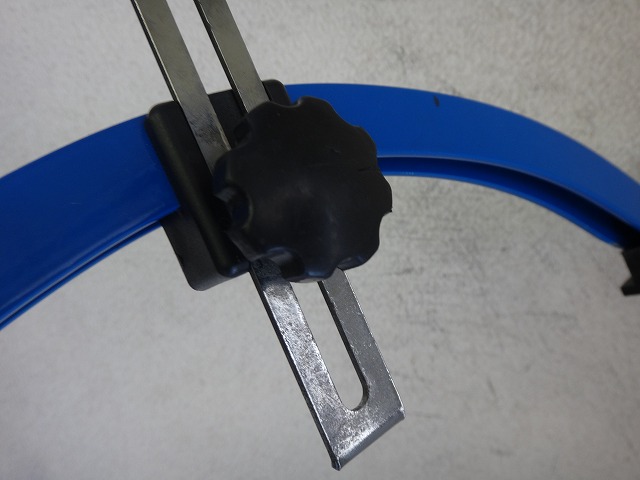
This is the centering gauge I mentioned that can be used even with the tire mounted.
(This photo is from today, just to be clear)
The part at the edge that contacts the rim slides,
so even if the tire's sidewall overhangs past the rim width,
you can position it without the tire interfering.
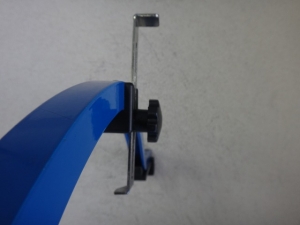
The overall shape of the part that contacts the axle end is like this:
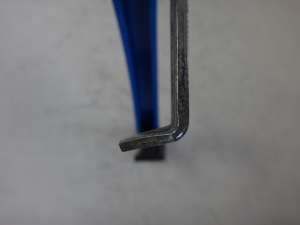
The tip curves at an obtuse angle rather than a right angle.
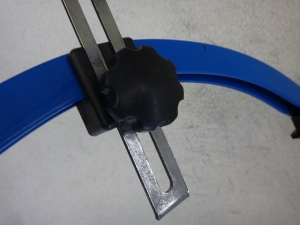
You tighten this Verian bolt (ユリヤボルト) to fix it, but...

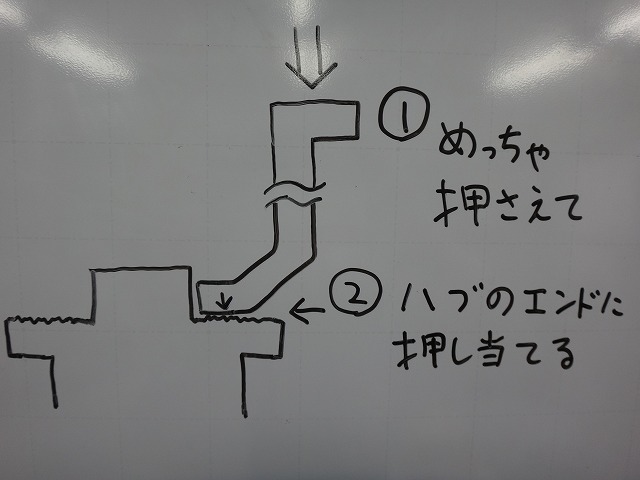
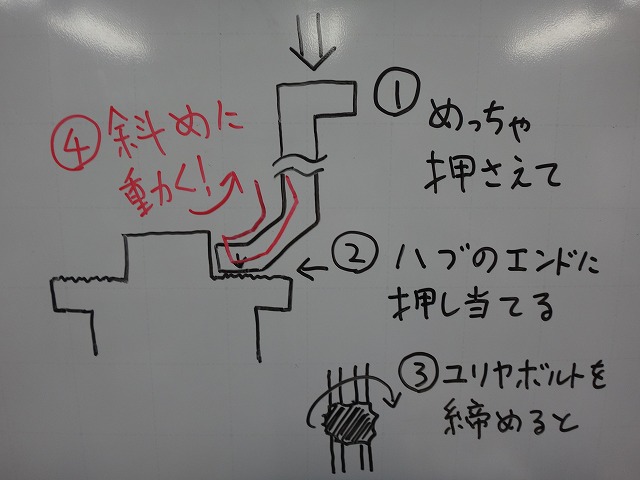
When tightening the Verian bolt,
even though the tip is pressed hard against the axle end,
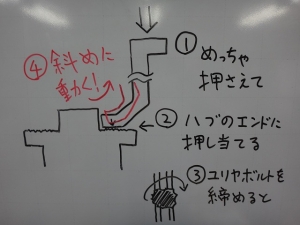
when you tighten the bolt, the tip floats up at an angle.This damn tool!
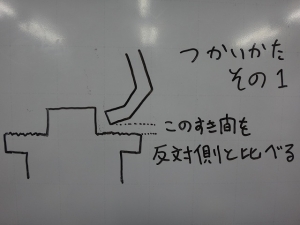
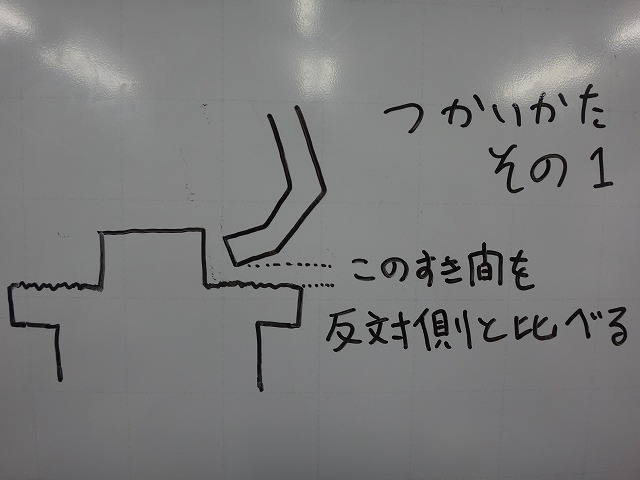
So I think about how to use it.
First method: "The tip floating from the axle end is unavoidable,"
so you memorize that gap visually and compare it to the opposite side.
Or, even if the opposite side gets tighter, as long as it doesn't contact the axle end,
you think "it's not off enough to notice while riding, so it's fine."
My standards are a bit higher than that,
which I think you can confirm from my regular centering gauge photos.
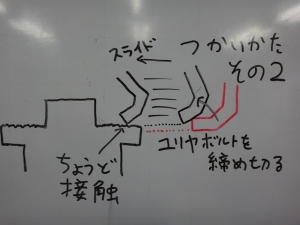
Next, the second method.
You position the tip lower than the axle end, then adjust it so it aligns with the axle end face when the Verian bolt is fully tightened.
When I absolutely have to use this centering gauge, I do it this way,
but when I took the following photos, I used method one.
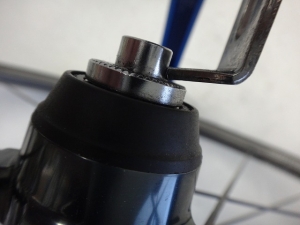
Setting the unloaded center without the tire.
The tool's tip floats slightly from the axle end,
but it's the same amount on the freewheel side.
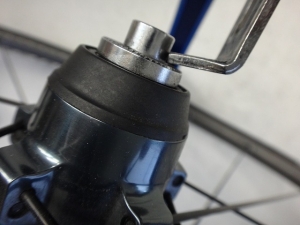
To make the shift amount as large as possible,
I pressurized the tubeless tire (made by IRC, by the way) to 9 bar.
The tool tip, which hasn't moved at all since the previous photo, is now touching.
This shows the kind of shift that can occur,
and since the amount really does change depending on the tire conditions,
I'm aware of this phenomenon, but
in regular adjustment work I end up ignoring it.
I accidentally wrote something that touches on confidential information in the text,
but since I won't write which part it is, it should be safe (probably)
"You always center the wheel perfectly without any tire pressure,
but do you just ignore the centering shift that happens when you inflate the tire?"
Oh, this is a very good question (nervous laugh).
Thank you for asking.
Yes, I do ignore it. Well, that sounds bad, so let me explain in detail.
First, regarding tire pressure: when you inflate to several times atmospheric pressure, the rim gets compressed by that pressure
(especially noticeable on road bikes), which reduces spoke tension.
The rim doesn't behave like a completely rigid body against tire pressure.
(We build the wheel before tensioning the tire, but the rim doesn't act completely rigid against spoke tension either.
With some rims, the amount of compression on the inner circumference is not negligible, so
we've learned that certain rims need spoke length to be calculated about 0.5mm or 1mm shorter than the theoretical value.)
When that happens, if the wheel has runout, the rim shifts toward the side where the spokes are more angled.
This can sometimes be observed with a centering gauge.
Even if not observable, it should happen in small amounts.
The amount varies depending on rim rigidity, but
from experience, heavier rims shift less, and high-profile rims shift less.
However, actually, the tire and rim format matters more than rim rigidity as a factor.
Regarding how easily center shift occurs at a given pressure (how prone to shifting),
the order is: tubeless, tubed (WO and HE), tubular.
To be specific, with Shimano WH-6800 or Easton's old EA90RT,
center shift of more than "about one sheet of paper" occurs at 8 bar with a tubeless tire.
In the case of the old EA90RT, I've even done centering work with the customer's usual tire
at their usual air pressure.
I'm aware that a perfectly centered wheel without any load
doesn't necessarily maintain that centering in actual use conditions with the tire mounted and pressurized,
but since I don't know the customer's tire and pressure conditions,
perfectly centered without load becomes the basic standard for the work.
If someone asks me to center it with their usual tire at their usual pressure,
I'll do that, but
with a certain WO tire that gets wider from 23mm to 25mm with age,
once it gets wider, the rim shift amount at the same pressure decreases.
So doing centering work as precisely as possible under actual use conditions
is extremely difficult.
(Not technically—it's because the conditions themselves keep changing.)
Also, the centering gauge I use with the tire mounted
isn't very reliable as a measuring tool.
Someone will probably tell me to just buy a decent centering gauge that works with the tire mounted,
but as far as I know, none exist.
If one does, please tell me. I'll buy it.
Also, on rear wheels other than R-SYS, we know that with age the rim shifts toward the freewheel side.
(I'll explain the reason from a different angle another time.)
The Nomulab Wheel #4 (ノムラボホイール4号) that I use
was slightly shifted anti-freewheel side when unloaded,
but when I checked with the centering gauge at each tire change,
I confirmed that it did shift toward the freewheel side.
This isn't noticeable while riding, but
the amount is larger than the shift caused by tire pressure.
With the freewheel-side shift that occurs with age, I've also learned from experience that
on rear wheels with different spoke counts on each side (like 2:1 lacing),
the shift happens faster.
So the question becomes: does my regular unloaded centering work have any meaning?
Well, bringing uncentered wheels—the kind with center shift of one yen coin's worth or more—
to at least perfectly centered without load at that moment
should be much better than the condition before you brought them in.
So there is meaning in eliminating roughly-finished wheels through this work.
As I mentioned earlier,
if you tell me to center it with your current tire at your current pressure,
I'll do it that way.
If the tire changes after that (changing includes getting wider),
I can't guarantee perfect centering under actual use conditions though.
It's definitely true from experience that rear wheel centers shift toward the freewheel side with age.
Whether it's Nomulab wheels or complete wheels,
when I later do truing work on rear wheels where I previously set the unloaded center,
I pretty often do "chase centering" by tightening the anti-freewheel side.
The reason I haven't written much about this before is that if mechanics who know about it,
they'd blame all freewheel-side centering shift on age, which is annoying.
I remove the tire as much as possible when doing truing work,
partly to also set the unloaded center while I'm at it.
With the latest Campagnolo Bora tubular model,
the wide rim means the centering gauge can sometimes fit without interference even with the tire mounted,
and since it doesn't have internal nipples, you can adjust without removing the tire.
In those cases I do check with the tire on.

As a good opportunity,
about centering shift on WH-6800 rear wheels with tubeless tires.
The image above is something I had stocked for an article,
but I took it on March 14, 2015.
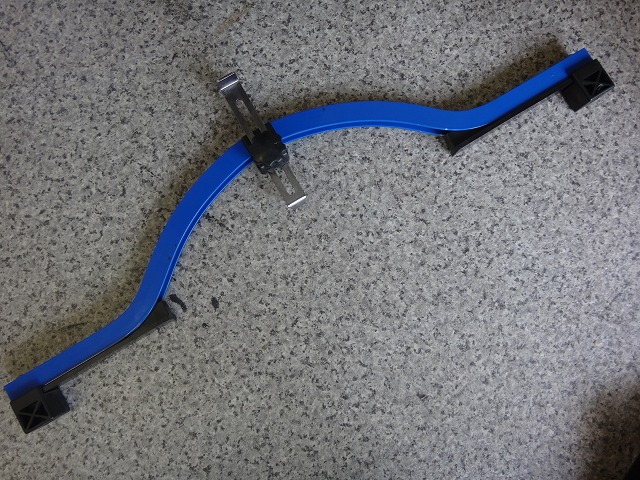
This is the centering gauge I mentioned that can be used even with the tire mounted.
(This photo is from today, just to be clear)
The part at the edge that contacts the rim slides,
so even if the tire's sidewall overhangs past the rim width,
you can position it without the tire interfering.
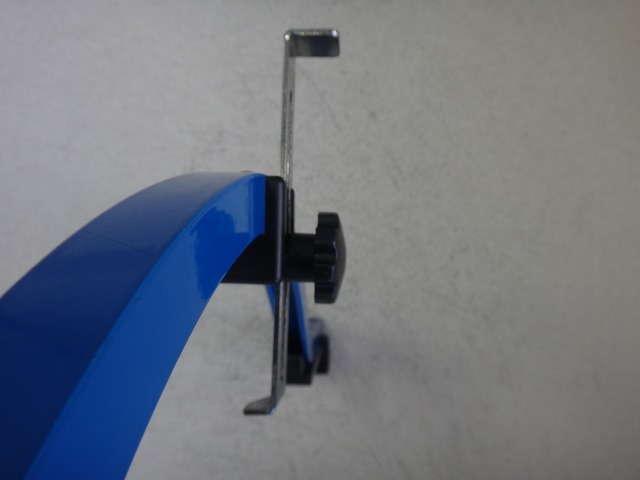
The overall shape of the part that contacts the axle end is like this:
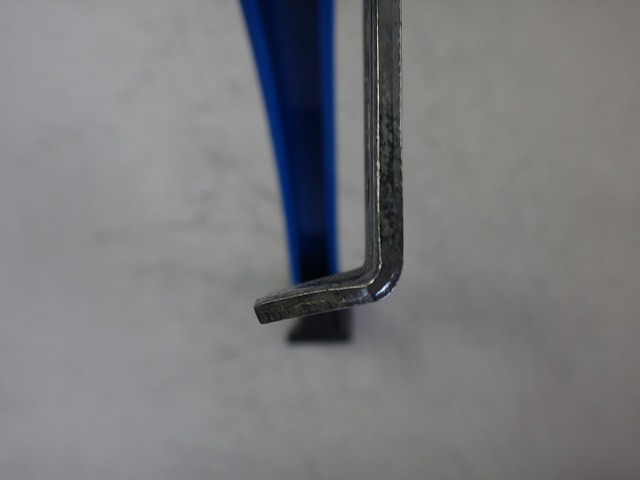
The tip curves at an obtuse angle rather than a right angle.
You tighten this Verian bolt (ユリヤボルト) to fix it, but...
When tightening the Verian bolt,
even though the tip is pressed hard against the axle end,
when you tighten the bolt, the tip floats up at an angle.
So I think about how to use it.
First method: "The tip floating from the axle end is unavoidable,"
so you memorize that gap visually and compare it to the opposite side.
Or, even if the opposite side gets tighter, as long as it doesn't contact the axle end,
you think "it's not off enough to notice while riding, so it's fine."
My standards are a bit higher than that,
which I think you can confirm from my regular centering gauge photos.

Next, the second method.
You position the tip lower than the axle end, then adjust it so it aligns with the axle end face when the Verian bolt is fully tightened.
When I absolutely have to use this centering gauge, I do it this way,
but when I took the following photos, I used method one.

Setting the unloaded center without the tire.
The tool's tip floats slightly from the axle end,
but it's the same amount on the freewheel side.
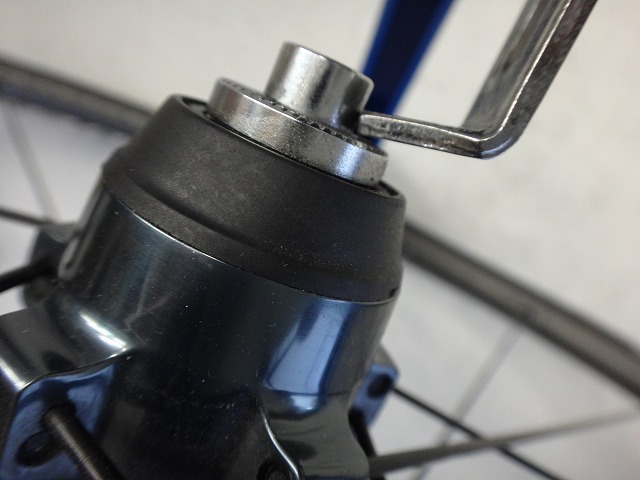
To make the shift amount as large as possible,
I pressurized the tubeless tire (made by IRC, by the way) to 9 bar.
The tool tip, which hasn't moved at all since the previous photo, is now touching.
This shows the kind of shift that can occur,
and since the amount really does change depending on the tire conditions,
I'm aware of this phenomenon, but
in regular adjustment work I end up ignoring it.
but since I won't write which part it is, it should be safe (probably)