I wrote so much that I decided to split this into a separate article.
About the spokes on the Kolima S+ from the earlier post.

↑Non-drive side

↑Drive side
Except in cases of extremely unusual hub dimensions, the general order of effectiveness for correcting left-right spoke tension differences is:
asymmetric spoke count > asymmetric spoke diameter > asymmetric spoke pattern
(Just to be clear, the > symbols don't represent equal differences)
When I absolutely must build a hand-built wheel with asymmetric spoke counts, I don't use asymmetric spoke diameters.
(With asymmetric spoke counts, the non-drive side lacing only has one option—radial lacing—so there's nothing to consider)
However, with the Zonda, which is a variant of 2:1 lacing called G3 lacing, I do use asymmetric spoke diameters—not extremely different, but the drive side is thicker.
With this S+, despite using 3:2 lacing, which should have lower correction power than 2:1 lacing, they're using reverse asymmetric spoke diameters. The drive side uses an elliptical aero spoke equivalent to CX-RAY, while the non-drive side uses a square aero-ish spoke with greater spoke mass.
I don't know if this is the right approach or if it should be done, but I'm amazed that the Kolima people had the idea to use asymmetric spoke diameters as a counterweight to asymmetric spoke counts.
I figured out this spec's intention!
At least there's one person here who's impressed by your thoughtfulness!

A wheel completely unrelated to Kolima, but a good opportunity to discuss it anyway.
A budget-grade pre-built wheel from DT.

Drive side: 20H,

Non-drive side: 10H—a 2:1, 30H wheel. But

it has the same diameter spokes left and right.
On this wheel, the drive side spoke tension is lower.
With 20H on one side, I think it would have been better to do 8-spoke (or 10-spoke) lacing instead of 6-spoke lacing. But since these are butted spokes, I thought "Hey, I could try that" (hehe) and proceeded to true it before handing it over to the customer.
I've written about this before, but among pre-built wheel manufacturers that feature 2:1 lacing, how they handle the rear wheel of MTBs with disc brake rotors varies:
Roval → Non-drive side radial lacing is dangerous, so they use equal spoke counts in that case only
Fulcrum → Non-drive side radial lacing is dangerous, so they keep the 2:1 lacing but use tangent lacing instead
Fulcrum's rear wheel had the non-drive side tensioned extremely tight. Whether or not Kolima's S+ reverse asymmetric spoke diameter approach is correct, I suddenly thought today that Fulcrum's MTB wheels might benefit from adopting reverse asymmetric spoke diameters.
Also, I should write this now or I might never get around to it, so let me add one more thing about wheels from the brand black inc.
They have a lineup of 35mm rim height THIRTY, 50mm rim height FIFTY, and 80mm rim height EIGHTY (for tubular; WO models are 5mm lower), and both FIFTY and EIGHTY use CX-RAY spokes on all four sides—front and rear.
However, THIRTY has DT Aerolite on the front wheel, and on the rear wheel the drive side uses DT Champion while the non-drive side uses Aerolite—a mixed spoke configuration. Since the Aerolite spoke mass is nearly the same as CX-RAY, this is essentially a "half-Champion" build, something a wheel manufacturer is doing.
Using 14-gauge plain spokes, even if only on the drive side, puts them at a disadvantage in terms of stated weight specs, creating a risk that the majority of users who choose wheels based purely on appearance-level specs won't select them.
To be specific, at 35mm height with THIRTY's drive-side lacing and outboard nipples, spoke length would be around 275mm, but assuming 275mm, twelve Champion spokes would weigh approximately 169.6g. With Aerolite, that becomes 109.4g, so the weight difference between all-Aerolite and half-Champion is about 60g.
THIRTY's stated weight is 1298g for the complete wheel (no front/rear breakdown), but FIFTY is 1350g total with 593g front + 757g rear, so if THIRTY had all-Aerolite on the rear as well, it probably would have been around 1238g total (537g front + 701g rear). Since the actual rear wheel is half-Champion, it works out to roughly 1298g total with 537g front + 761g rear.
It's quite bold that they chose a heavier spoke spec for the most low-height rim (where lightness is generally sought) in their lineup.
All models use straight-gauge hubs, and rather than avoiding non-drive side radial lacing, they use tangent lacing on the non-drive side while keeping the same spoke count left and right.
Just like THIRTY's "heavier spokes in a lightweight low-height model," EIGHTY features "non-drive side tangent lacing that seems to churn the air more, despite it being a deep rim where aerodynamics should matter." At first glance it looks like a bad spec, but actually it's "only the ones who get it will understand" kind of construction, and I can't help but smirk.
Furthermore, to appeal to the majority of users who choose wheels based only on surface specs, they have a separate selling point: "By running tires 23–25C wide, the aerodynamics are maximized with our adopted rim width." But that's really just saying it's a wide rim, so it doesn't resonate much with me.
black inc wheels are handled by Trysports, but I'm not being paid to shill for them, just so you know.
Even if I were running THIRTY, I would have just bought them normally. Believe me.
About the spokes on the Kolima S+ from the earlier post.
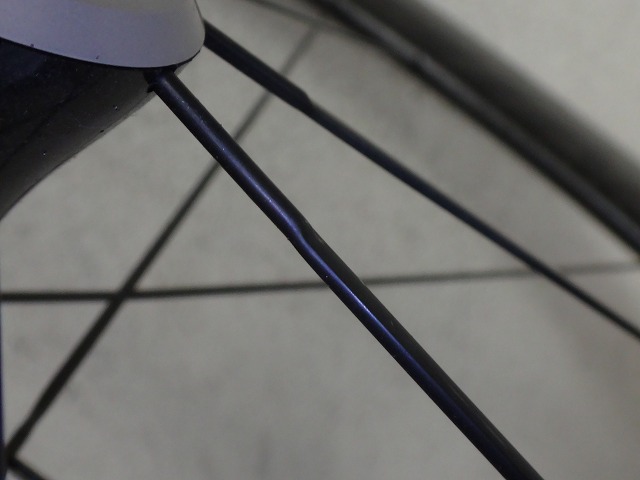
↑Non-drive side
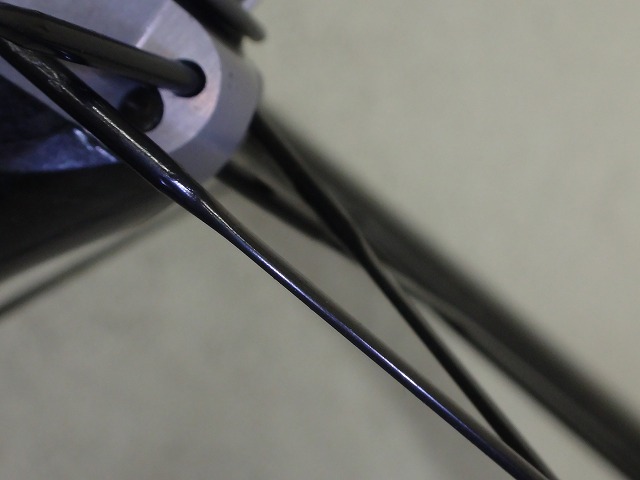
↑Drive side
Except in cases of extremely unusual hub dimensions, the general order of effectiveness for correcting left-right spoke tension differences is:
asymmetric spoke count > asymmetric spoke diameter > asymmetric spoke pattern
(Just to be clear, the > symbols don't represent equal differences)
When I absolutely must build a hand-built wheel with asymmetric spoke counts, I don't use asymmetric spoke diameters.
(With asymmetric spoke counts, the non-drive side lacing only has one option—radial lacing—so there's nothing to consider)
However, with the Zonda, which is a variant of 2:1 lacing called G3 lacing, I do use asymmetric spoke diameters—not extremely different, but the drive side is thicker.
With this S+, despite using 3:2 lacing, which should have lower correction power than 2:1 lacing, they're using reverse asymmetric spoke diameters. The drive side uses an elliptical aero spoke equivalent to CX-RAY, while the non-drive side uses a square aero-ish spoke with greater spoke mass.
I don't know if this is the right approach or if it should be done, but I'm amazed that the Kolima people had the idea to use asymmetric spoke diameters as a counterweight to asymmetric spoke counts.
I figured out this spec's intention!
At least there's one person here who's impressed by your thoughtfulness!
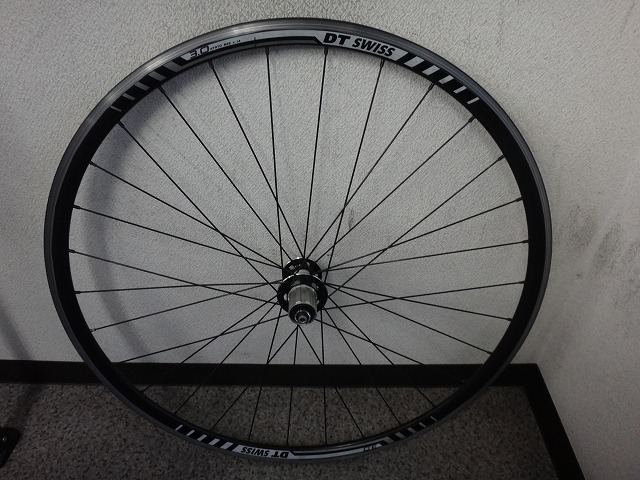
A wheel completely unrelated to Kolima, but a good opportunity to discuss it anyway.
A budget-grade pre-built wheel from DT.

Drive side: 20H,
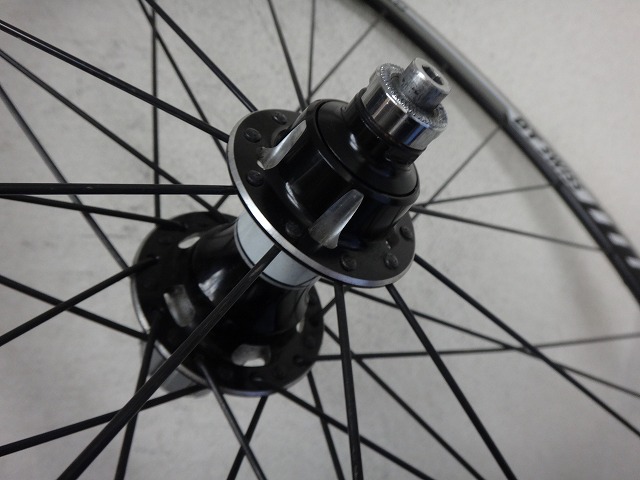
Non-drive side: 10H—a 2:1, 30H wheel. But

it has the same diameter spokes left and right.
On this wheel, the drive side spoke tension is lower.
With 20H on one side, I think it would have been better to do 8-spoke (or 10-spoke) lacing instead of 6-spoke lacing. But since these are butted spokes, I thought "Hey, I could try that" (hehe) and proceeded to true it before handing it over to the customer.
I've written about this before, but among pre-built wheel manufacturers that feature 2:1 lacing, how they handle the rear wheel of MTBs with disc brake rotors varies:
Roval → Non-drive side radial lacing is dangerous, so they use equal spoke counts in that case only
Fulcrum → Non-drive side radial lacing is dangerous, so they keep the 2:1 lacing but use tangent lacing instead
Fulcrum's rear wheel had the non-drive side tensioned extremely tight. Whether or not Kolima's S+ reverse asymmetric spoke diameter approach is correct, I suddenly thought today that Fulcrum's MTB wheels might benefit from adopting reverse asymmetric spoke diameters.
Also, I should write this now or I might never get around to it, so let me add one more thing about wheels from the brand black inc.
They have a lineup of 35mm rim height THIRTY, 50mm rim height FIFTY, and 80mm rim height EIGHTY (for tubular; WO models are 5mm lower), and both FIFTY and EIGHTY use CX-RAY spokes on all four sides—front and rear.
However, THIRTY has DT Aerolite on the front wheel, and on the rear wheel the drive side uses DT Champion while the non-drive side uses Aerolite—a mixed spoke configuration. Since the Aerolite spoke mass is nearly the same as CX-RAY, this is essentially a "half-Champion" build, something a wheel manufacturer is doing.
Using 14-gauge plain spokes, even if only on the drive side, puts them at a disadvantage in terms of stated weight specs, creating a risk that the majority of users who choose wheels based purely on appearance-level specs won't select them.
To be specific, at 35mm height with THIRTY's drive-side lacing and outboard nipples, spoke length would be around 275mm, but assuming 275mm, twelve Champion spokes would weigh approximately 169.6g. With Aerolite, that becomes 109.4g, so the weight difference between all-Aerolite and half-Champion is about 60g.
THIRTY's stated weight is 1298g for the complete wheel (no front/rear breakdown), but FIFTY is 1350g total with 593g front + 757g rear, so if THIRTY had all-Aerolite on the rear as well, it probably would have been around 1238g total (537g front + 701g rear). Since the actual rear wheel is half-Champion, it works out to roughly 1298g total with 537g front + 761g rear.
It's quite bold that they chose a heavier spoke spec for the most low-height rim (where lightness is generally sought) in their lineup.
All models use straight-gauge hubs, and rather than avoiding non-drive side radial lacing, they use tangent lacing on the non-drive side while keeping the same spoke count left and right.
Just like THIRTY's "heavier spokes in a lightweight low-height model," EIGHTY features "non-drive side tangent lacing that seems to churn the air more, despite it being a deep rim where aerodynamics should matter." At first glance it looks like a bad spec, but actually it's "only the ones who get it will understand" kind of construction, and I can't help but smirk.
Furthermore, to appeal to the majority of users who choose wheels based only on surface specs, they have a separate selling point: "By running tires 23–25C wide, the aerodynamics are maximized with our adopted rim width." But that's really just saying it's a wide rim, so it doesn't resonate much with me.
black inc wheels are handled by Trysports, but I'm not being paid to shill for them, just so you know.