Another wheel day (details omitted).

I built a wheel with a Gokiso hub and carbon tubular rims.
The front rim is 45mm deep, and the rear rim is 55mm deep.

The front wheel is 20H CX-RAY outpoke radial lacing,


And the rear wheel is 24H semi-comp four-cross lacing with wire-on.

Gokiso's complete wheels use radial lacing on the non-drive side, but
I had them do tangent lacing instead.
There's simply no way that radial lacing is better for resisting
the twisting and distortion forces that the freewheel body creates as it pulls forward
(≒ better engagement).
Gokiso's catalog states about why they use radial lacing:
"We minimize stress on the rim," but
in my experience, there's no case where a rim breaks under tangent lacing
but survives under radial lacing. And with the 500–600g carbon rims
found on Gokiso complete wheels, this concern is even less relevant.
When you build both sides the same way on the drive side
and then choose either tangent or radial for the non-drive side,
once the wheel is centered,
radial lacing has lower spoke tension,
so rim stress seems lower... but that might just seem that way.
If you factor in the angle of the force pulling straight into the rim,
tangent lacing—with higher tension but at an angle to the rim hole—
might actually be gentler.
But as I said before, I've never had the experience of "Oh no, the rim broke because I used tangent lacing
(it would've been fine with radial),"
and most rims out there are naturally
overspecced for this kind of stress anyway, so it's never an issue.
Of course, Gokiso has sound technical and theoretical reasons
for their non-drive radial lacing choice, and I wish they'd stick to that conviction
without backing down.
Unlike how ZIPP and Shimano rear wheels change their doctrine with every model update,
I hope Gokiso will keep believing in non-drive radial lacing.

Regarding Gokiso hubs being narrower in flange width than typical rear hubs,
their catalog says:
"Hubs with flanges that are too wide create large tension variation,
leading to spoke and rim failure."
But I think "tension variation" here doesn't mean
variation across all spokes on one side.
That's mainly determined by rim runout, etc.
So the variation mentioned here must be the tension difference between left and right spokes,
as shown in the diagram above.
If tension variation (left-right difference)
causes spoke and rim failure, then
non-drive radial lacing produces larger tension variation than bilateral tangent lacing,
which means Gokiso is deliberately
choosing a lacing pattern that causes spoke and rim failure.
The hub design rationale and wheel recipe don't match up.
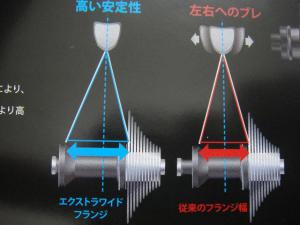
Here's the third image from Shimano's wide-flange fraud post (→here).
What's interesting is that Gokiso uses narrow flanges, Shimano uses wide flanges,
yet both claim superior stability using the exact same word.
By the way, the third wide-flange fraud post involved
going oval (converting to the 2:1 spoke sect), but
Gokiso says about unequal spoking on left and right:
"The rim receives uneven force, creating drivetrain loss."
For what it's worth, this only applies to upper-tier Fulcrum and Campagnolo models,
where aluminum spoke rigidity is so dramatically different from steel
that it's not really relevant.
I do think 2:1 wheels with butted spokes are risky for spoke breakage,
but with straight-gauge spokes, there's generally no problem.
Based on actual spoke replacement experience with complete wheels
and considering real-world failure rates,
2:1 spoke wheels don't stand out as particularly prone
to spoke breakage.

With this rear wheel, the non-drive side spoke tension tracking
is the best I've ever achieved.
But that's obvious—it's just because the flange offset is small.
I picture rear wheel spokes like the hypotenuses of right triangles
with different angles positioned back-to-back,
and how stiff each hypotenuse (spoke) is depends on
the angle difference (flange offset) and the stiffness of the spoke itself (spoke tension).
Just because the angle is half doesn't mean you can tension it twice as much.
It's true that a hub with small flange offset allows you to tension
the non-drive side higher relative to a given drive-side tension.
But as I've written before, the angle factor outweighs tension,
and you can't make up for angle loss with spoke tension.
Spokes aren't perfectly rigid, and
it's impossible to tension them up to the point where the wheel feels
completely rigid to most riders before the spokes yield.
(If you could, left-right radial would be fine.)
So the approach I use (and some complete wheel makers do too)
is: choose a wide-flange hub to avoid angle loss,
and solve the tension variance problem that angle difference creates
through spoke selection and lacing technique.
As for why Gokiso insists on narrow flanges—I think
it's not that they're philosophically committed to narrow flanges,
but rather that their pursuit of the one-trick pony of "the world's lightest rolling hub"
requires a structure that, as a racing part, is impossibly heavy
and has dimensions that force them into a narrow flange.
I'm not denying that Gokiso hubs roll extremely lightly (probably the lowest friction in the world).
That rolling lightness does mean the wheel (and whole bike) goes forward with less effort,
and in modern terms, it saves watts—in certain situations, this is genuinely true.
(Compared to a similarly-sized, similarly-heavy hub with ordinary bearings,
it's completely superior by the bearing margin.)
But when you compare it side-by-side with a wheel built on a hub with better dimensions or lower weight,
hub rolling resistance just isn't such a major factor that rigidity and lightness become irrelevant.
That's why I called it a "one-trick pony" earlier.
A stiff rim might gloss over some dimensional shortcomings of the hub, but
the rims Gokiso uses in their own complete wheels—even as carbon tubulars—
are 24mm deep/~500g, 38mm deep/~550g, 50mm deep/~600g (all catalog figures),
which is honestly just too heavy.
It barely needs saying (yet here I am saying it),
but rim weight (and peripheral wheel weight in general)
is hugely important for road bikes.
I don't worry much about internal wheel weight,
but this hub's catalog weight is 240g front, 455g rear.
Compare that to Evolite hub specs: 60g front, 228g rear.
Suppose there was some "mysterious device that wraps around the hub and makes rotation world-lightest"—
if someone riding Evolite hubs saw a 180g weight increase on front
and 227g on rear (407g total) but zero flange-dimension loss,
would they want to install it?
Skeptical that many would say yes.
Not that Evolite hubs are heavy-rolling either.
A $40 bar tape or $300 saddle—if you touch it and think "Wow, this seems amazing!" go ahead and buy it.
If you're smitten with how this hub rolls and can spend $2100, spend it.
I myself just bought a $1000 light the other day.
They should just write in the catalog: "It rolls light!" and leave it at that.
Instead, they make weird justifications about narrow flanges and non-drive radial lacing—
explanations that are clearly off, which just feels sketchy and unsatisfying.
Gokiso's catalog language about other wheels includes phrases like
"leads to rim failure," but
I've also heard stories that the carbon rims Gokiso chose (or used to choose)
for their complete wheels deformed from brake heat in short order
and became unusable. I even have sources beyond hearsay—
customer inquiry records sent to Gokiso—though I won't share them here.
They actually caused rim-selection problems leading to failure,
but I think this is a different problem from the one mentioned in the wide-flange tension diagram above.
I've never personally confirmed any problems caused by wide flanges themselves.
If I stretch to find one, maybe wide flange offset can make
non-drive nipples a bit looser since they run lower tension than narrow-flange designs.
But then again, radial lacing (lacking final crossover tie points)
shows "one spoke rattling wildly loose" symptoms more readily than tangent lacing—
I'm certain of this from experience (same goes for front wheels).
So to say it another way: "wide flange + non-drive radial"
is the setup that creates maximum left-right tension difference,
yet Gokiso rejects wide flanges and adopts non-drive radial—
that's the illogic in Gokiso's approach.
This time, the customer brought their own rim and
requested the rear in semi-comp four-cross wire-on (not my call alone)—
I suspect that might've been shrewd thinking based on knowing something,
though I could be reading too much into it.
Scary to ask, so I won't.

The cosmetic carbon on the rim side has
an infinite-tiling pattern of irregular hexagons (not perfect regular hexagons).

Cyclocross sometimes, sometimes not—but
lately I've been getting a lot more requests for tire mounting
or bed preparation using rim cement.
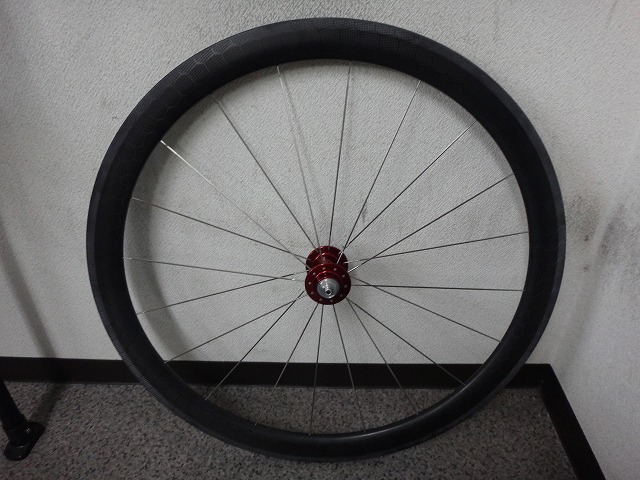
I built a wheel with a Gokiso hub and carbon tubular rims.
The front rim is 45mm deep, and the rear rim is 55mm deep.
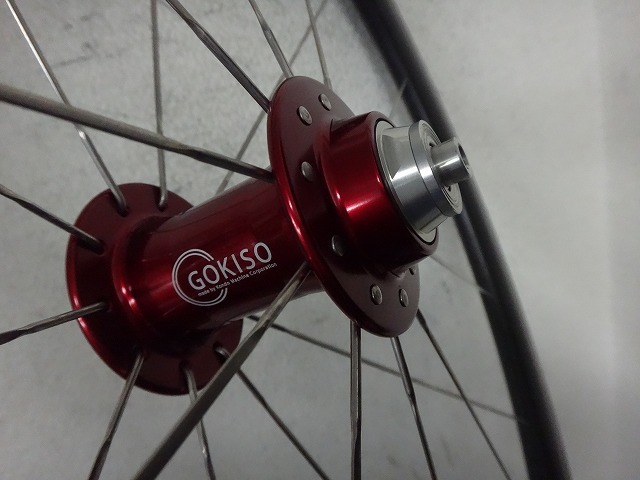
The front wheel is 20H CX-RAY outpoke radial lacing,

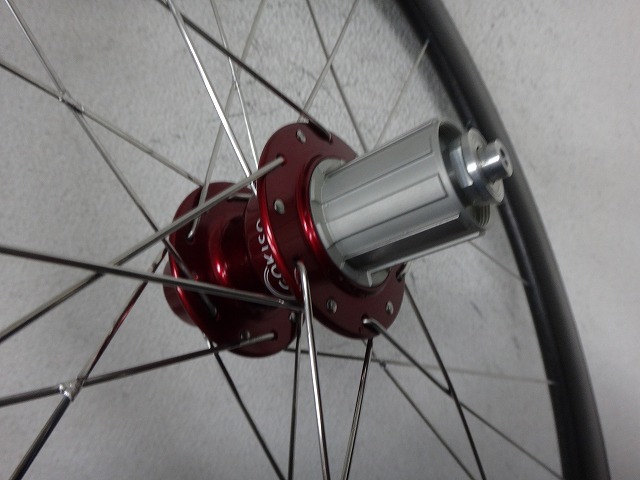
And the rear wheel is 24H semi-comp four-cross lacing with wire-on.
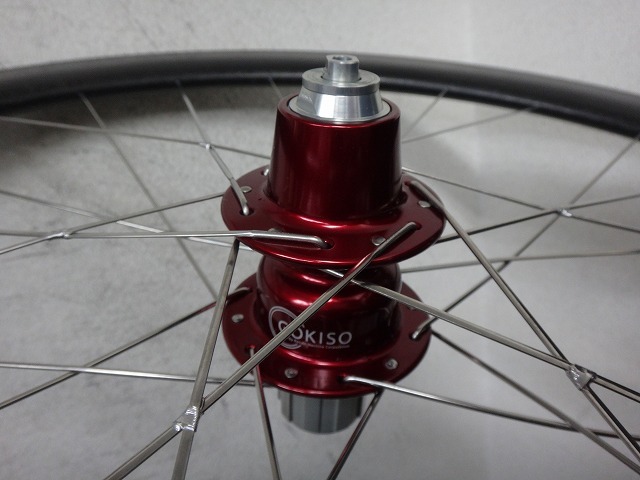
Gokiso's complete wheels use radial lacing on the non-drive side, but
I had them do tangent lacing instead.
There's simply no way that radial lacing is better for resisting
the twisting and distortion forces that the freewheel body creates as it pulls forward
(≒ better engagement).
Gokiso's catalog states about why they use radial lacing:
"We minimize stress on the rim," but
in my experience, there's no case where a rim breaks under tangent lacing
but survives under radial lacing. And with the 500–600g carbon rims
found on Gokiso complete wheels, this concern is even less relevant.
When you build both sides the same way on the drive side
and then choose either tangent or radial for the non-drive side,
once the wheel is centered,
radial lacing has lower spoke tension,
so rim stress seems lower... but that might just seem that way.
If you factor in the angle of the force pulling straight into the rim,
tangent lacing—with higher tension but at an angle to the rim hole—
might actually be gentler.
But as I said before, I've never had the experience of "Oh no, the rim broke because I used tangent lacing
(it would've been fine with radial),"
and most rims out there are naturally
overspecced for this kind of stress anyway, so it's never an issue.
Of course, Gokiso has sound technical and theoretical reasons
for their non-drive radial lacing choice, and I wish they'd stick to that conviction
without backing down.
Unlike how ZIPP and Shimano rear wheels change their doctrine with every model update,
I hope Gokiso will keep believing in non-drive radial lacing.
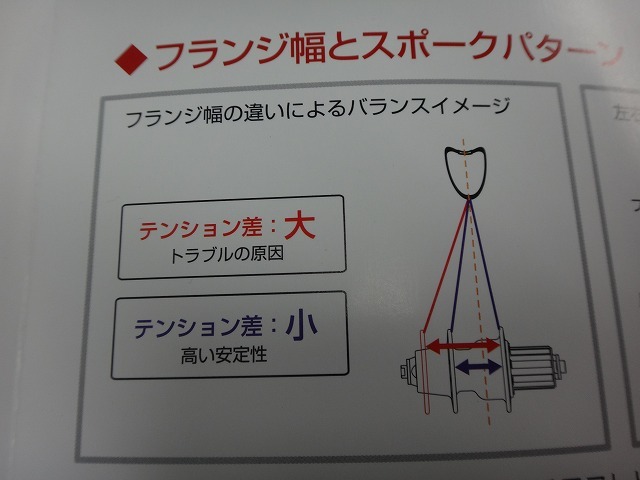
Regarding Gokiso hubs being narrower in flange width than typical rear hubs,
their catalog says:
"Hubs with flanges that are too wide create large tension variation,
leading to spoke and rim failure."
But I think "tension variation" here doesn't mean
variation across all spokes on one side.
That's mainly determined by rim runout, etc.
So the variation mentioned here must be the tension difference between left and right spokes,
as shown in the diagram above.
If tension variation (left-right difference)
causes spoke and rim failure, then
non-drive radial lacing produces larger tension variation than bilateral tangent lacing,
which means Gokiso is deliberately
choosing a lacing pattern that causes spoke and rim failure.
The hub design rationale and wheel recipe don't match up.
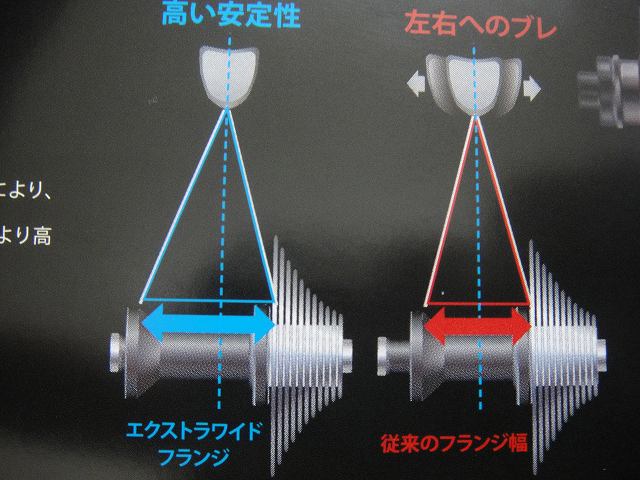
Here's the third image from Shimano's wide-flange fraud post (→here).
What's interesting is that Gokiso uses narrow flanges, Shimano uses wide flanges,
yet both claim superior stability using the exact same word.
By the way, the third wide-flange fraud post involved
going oval (converting to the 2:1 spoke sect), but
Gokiso says about unequal spoking on left and right:
"The rim receives uneven force, creating drivetrain loss."
For what it's worth, this only applies to upper-tier Fulcrum and Campagnolo models,
where aluminum spoke rigidity is so dramatically different from steel
that it's not really relevant.
I do think 2:1 wheels with butted spokes are risky for spoke breakage,
but with straight-gauge spokes, there's generally no problem.
Based on actual spoke replacement experience with complete wheels
and considering real-world failure rates,
2:1 spoke wheels don't stand out as particularly prone
to spoke breakage.
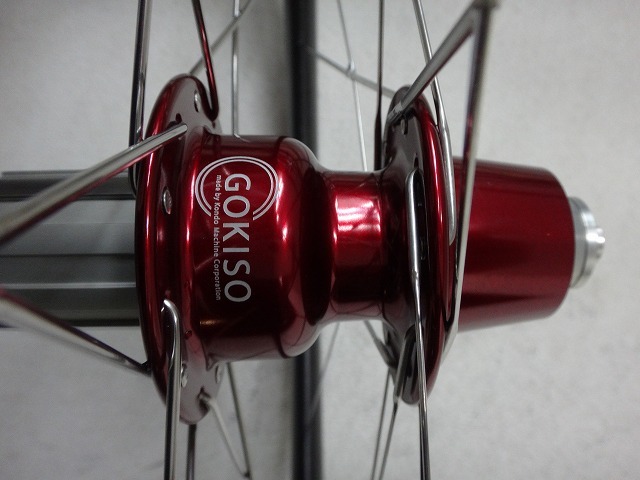
With this rear wheel, the non-drive side spoke tension tracking
is the best I've ever achieved.
But that's obvious—it's just because the flange offset is small.
I picture rear wheel spokes like the hypotenuses of right triangles
with different angles positioned back-to-back,
and how stiff each hypotenuse (spoke) is depends on
the angle difference (flange offset) and the stiffness of the spoke itself (spoke tension).
Just because the angle is half doesn't mean you can tension it twice as much.
It's true that a hub with small flange offset allows you to tension
the non-drive side higher relative to a given drive-side tension.
But as I've written before, the angle factor outweighs tension,
and you can't make up for angle loss with spoke tension.
Spokes aren't perfectly rigid, and
it's impossible to tension them up to the point where the wheel feels
completely rigid to most riders before the spokes yield.
(If you could, left-right radial would be fine.)
So the approach I use (and some complete wheel makers do too)
is: choose a wide-flange hub to avoid angle loss,
and solve the tension variance problem that angle difference creates
through spoke selection and lacing technique.
As for why Gokiso insists on narrow flanges—I think
it's not that they're philosophically committed to narrow flanges,
but rather that their pursuit of the one-trick pony of "the world's lightest rolling hub"
requires a structure that, as a racing part, is impossibly heavy
and has dimensions that force them into a narrow flange.
I'm not denying that Gokiso hubs roll extremely lightly (probably the lowest friction in the world).
That rolling lightness does mean the wheel (and whole bike) goes forward with less effort,
and in modern terms, it saves watts—in certain situations, this is genuinely true.
(Compared to a similarly-sized, similarly-heavy hub with ordinary bearings,
it's completely superior by the bearing margin.)
But when you compare it side-by-side with a wheel built on a hub with better dimensions or lower weight,
hub rolling resistance just isn't such a major factor that rigidity and lightness become irrelevant.
That's why I called it a "one-trick pony" earlier.
A stiff rim might gloss over some dimensional shortcomings of the hub, but
the rims Gokiso uses in their own complete wheels—even as carbon tubulars—
are 24mm deep/~500g, 38mm deep/~550g, 50mm deep/~600g (all catalog figures),
which is honestly just too heavy.
It barely needs saying (yet here I am saying it),
but rim weight (and peripheral wheel weight in general)
is hugely important for road bikes.
I don't worry much about internal wheel weight,
but this hub's catalog weight is 240g front, 455g rear.
Compare that to Evolite hub specs: 60g front, 228g rear.
Suppose there was some "mysterious device that wraps around the hub and makes rotation world-lightest"—
if someone riding Evolite hubs saw a 180g weight increase on front
and 227g on rear (407g total) but zero flange-dimension loss,
would they want to install it?
Skeptical that many would say yes.
Not that Evolite hubs are heavy-rolling either.
A $40 bar tape or $300 saddle—if you touch it and think "Wow, this seems amazing!" go ahead and buy it.
If you're smitten with how this hub rolls and can spend $2100, spend it.
I myself just bought a $1000 light the other day.
They should just write in the catalog: "It rolls light!" and leave it at that.
Instead, they make weird justifications about narrow flanges and non-drive radial lacing—
explanations that are clearly off, which just feels sketchy and unsatisfying.
Gokiso's catalog language about other wheels includes phrases like
"leads to rim failure," but
I've also heard stories that the carbon rims Gokiso chose (or used to choose)
for their complete wheels deformed from brake heat in short order
and became unusable. I even have sources beyond hearsay—
customer inquiry records sent to Gokiso—though I won't share them here.
They actually caused rim-selection problems leading to failure,
but I think this is a different problem from the one mentioned in the wide-flange tension diagram above.
I've never personally confirmed any problems caused by wide flanges themselves.
If I stretch to find one, maybe wide flange offset can make
non-drive nipples a bit looser since they run lower tension than narrow-flange designs.
But then again, radial lacing (lacking final crossover tie points)
shows "one spoke rattling wildly loose" symptoms more readily than tangent lacing—
I'm certain of this from experience (same goes for front wheels).
So to say it another way: "wide flange + non-drive radial"
is the setup that creates maximum left-right tension difference,
yet Gokiso rejects wide flanges and adopts non-drive radial—
that's the illogic in Gokiso's approach.
This time, the customer brought their own rim and
requested the rear in semi-comp four-cross wire-on (not my call alone)—
I suspect that might've been shrewd thinking based on knowing something,
though I could be reading too much into it.
Scary to ask, so I won't.
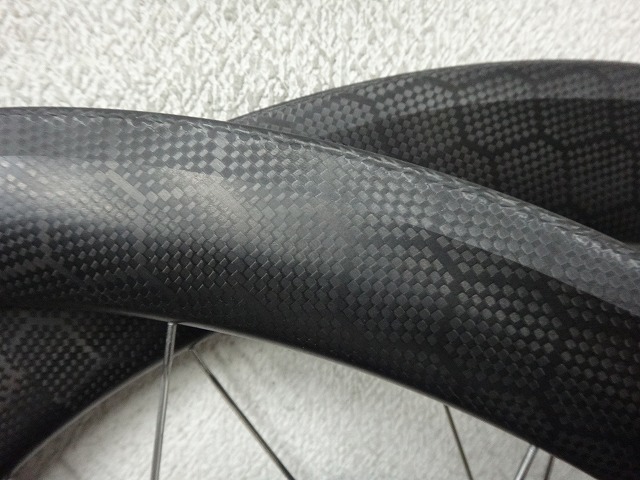
The cosmetic carbon on the rim side has
an infinite-tiling pattern of irregular hexagons (not perfect regular hexagons).
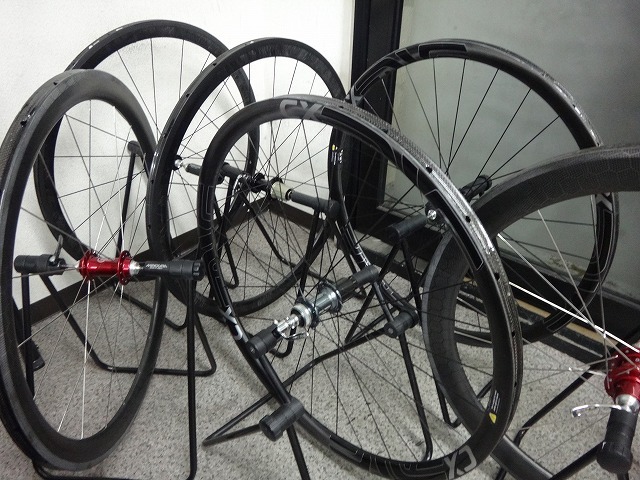
Cyclocross sometimes, sometimes not—but
lately I've been getting a lot more requests for tire mounting
or bed preparation using rim cement.