A customer brought in a 3T Mercurio 60 for service.
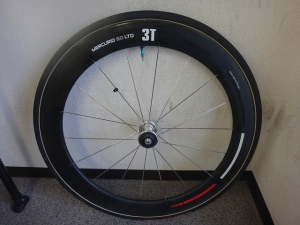
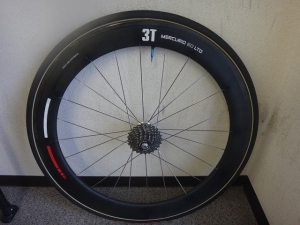
Both wheels had some lateral runout, but
the preliminary center gauge reading showed no offset.
I took measurements with the gauge at the point of maximum runout,
and if I shifted the rim's phase and looked elsewhere on the opposite side,
an offset might be detected.
But in cases like this, I treat it as "virtually no center offset" and
do a complete truing job, then apply the gauge again—
if there's any offset, I just correct it.
The reason I check the preliminary center is to avoid results like
"the rim was biased toward the non-drive side, so I did the truing
focused on tightening the non-drive side, which actually made
the center offset worse."
So both wheels had runout in both directions, but
when I applied the center gauge after truing, it was dead-on.
Turns out there was no offset to begin with.
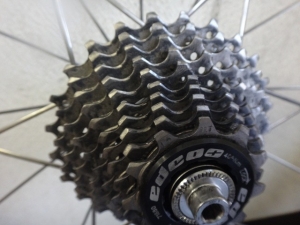
The real issue was with this Edco hub.
The freebody spline is compatible with both Shimano and Campagnolo,
with a design that looks like two types of splines overlaid,
but since the Campagnolo spline has a smaller diameter,
it's built as if "Shimano splines were added on top of Campagnolo's"
(which is why the lockring is also compatible with Campagnolo tools).
Even with the lockring installed,
the Shimano sprockets were rattling in the spline's rotational direction (axially).
The noise from this area is why the customer brought it in.
I suspected the spacer inside the lowest gear might have the wrong dimensions
and couldn't lock the sprocket properly, so I removed the sprockets to check—
but the measurements were correct.
I wondered if the freebody was loose relative to the hub body,
so I checked that too, but
the play was actually between the sprocket and spline.
To prevent this, a round shaft is inserted in the gap between sprocket and spline,
which reduces the rattling somewhat, but doesn't eliminate it completely.
When I tightened the lockring a bit more firmly, it settled down, so
it seems the correct approach is to tighten it until the play is gone.
Before the lockring is tightened firmly, the sprocket moves axially somewhat,
so I tighten the lockring while the sprocket is bottomed out in the direction
it gets squeezed during pedaling (from the image orientation, rotating
clockwise while holding the sprocket).

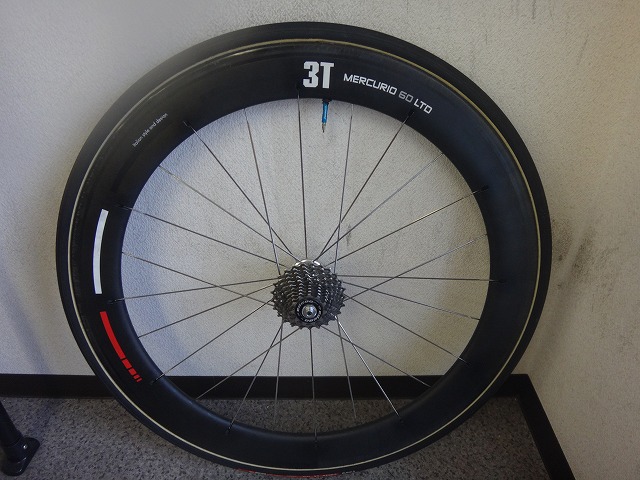
Both wheels had some lateral runout, but
the preliminary center gauge reading showed no offset.
I took measurements with the gauge at the point of maximum runout,
and if I shifted the rim's phase and looked elsewhere on the opposite side,
an offset might be detected.
But in cases like this, I treat it as "virtually no center offset" and
do a complete truing job, then apply the gauge again—
if there's any offset, I just correct it.
The reason I check the preliminary center is to avoid results like
"the rim was biased toward the non-drive side, so I did the truing
focused on tightening the non-drive side, which actually made
the center offset worse."
So both wheels had runout in both directions, but
when I applied the center gauge after truing, it was dead-on.
Turns out there was no offset to begin with.
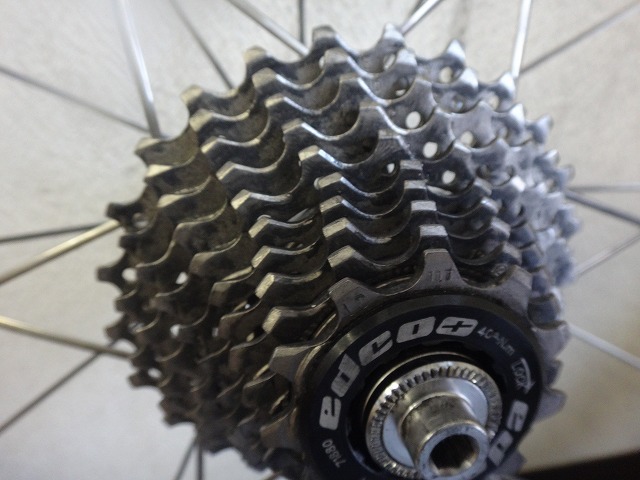
The real issue was with this Edco hub.
The freebody spline is compatible with both Shimano and Campagnolo,
with a design that looks like two types of splines overlaid,
but since the Campagnolo spline has a smaller diameter,
it's built as if "Shimano splines were added on top of Campagnolo's"
(which is why the lockring is also compatible with Campagnolo tools).
Even with the lockring installed,
the Shimano sprockets were rattling in the spline's rotational direction (axially).
The noise from this area is why the customer brought it in.
I suspected the spacer inside the lowest gear might have the wrong dimensions
and couldn't lock the sprocket properly, so I removed the sprockets to check—
but the measurements were correct.
I wondered if the freebody was loose relative to the hub body,
so I checked that too, but
the play was actually between the sprocket and spline.
To prevent this, a round shaft is inserted in the gap between sprocket and spline,
which reduces the rattling somewhat, but doesn't eliminate it completely.
When I tightened the lockring a bit more firmly, it settled down, so
it seems the correct approach is to tighten it until the play is gone.
Before the lockring is tightened firmly, the sprocket moves axially somewhat,
so I tighten the lockring while the sprocket is bottomed out in the direction
it gets squeezed during pedaling (from the image orientation, rotating
clockwise while holding the sprocket).