I need to finish writing about this topic, so
I'm writing about spoke phasing again today.
Today it's about the phasing of pair-spoked wheels.
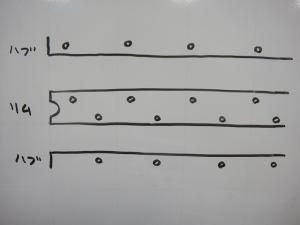
↑I'll continue with this diagram.
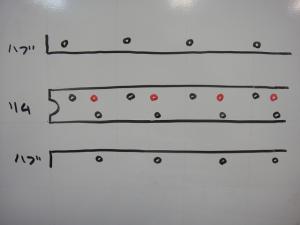
Pair-spoked wheels are rims where the spacing between nipples
is not uniform.
In most cases the spokes are arranged in a phasing where they nestle together,
so they're often called pair-spoked from their appearance.
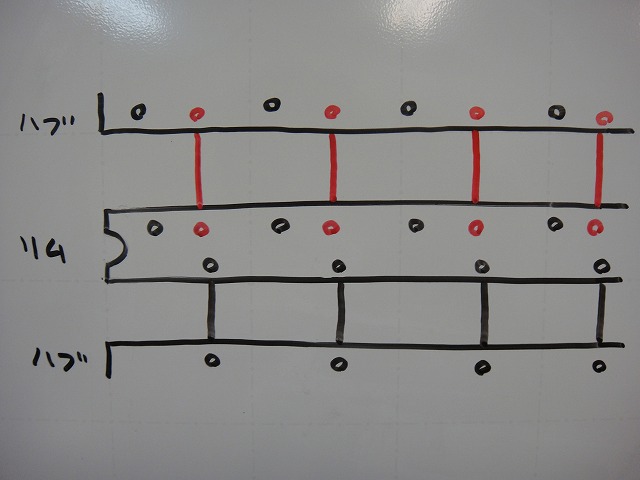
In the diagram above, one side of the rim holes stays as-is,
while I've added pair-spoked phasing holes (red circles) to the other side.

I've also drilled corresponding holes in the hub.

First I tried radial lacing.
This should give you an idea of what a "pair-spoked wheel opening" looks like.

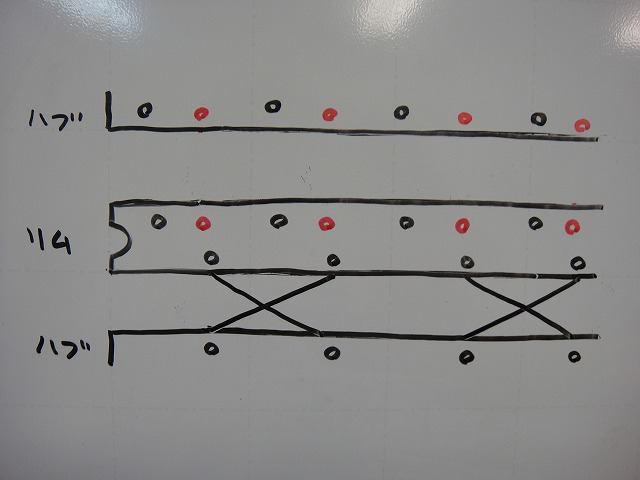
Next, let's see what happens when you lace a "pair-spoked rim with a normal hub."
First I tried tangential lacing on one side.

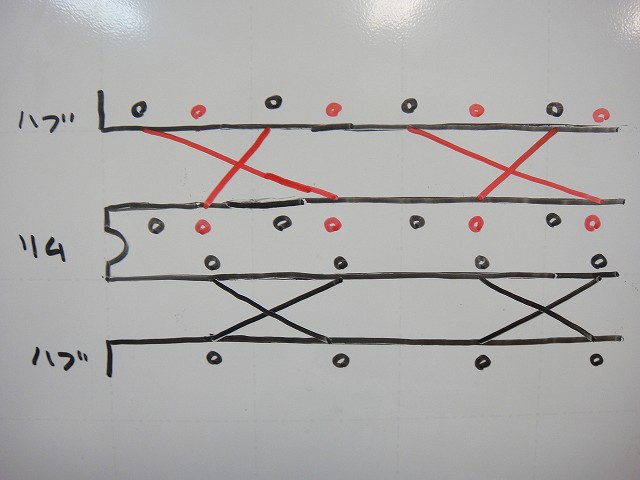
The other side involves "connecting the black circle (normal hub) with the red circle (pair-spoked rim)"
but as you can see, something looks warped.

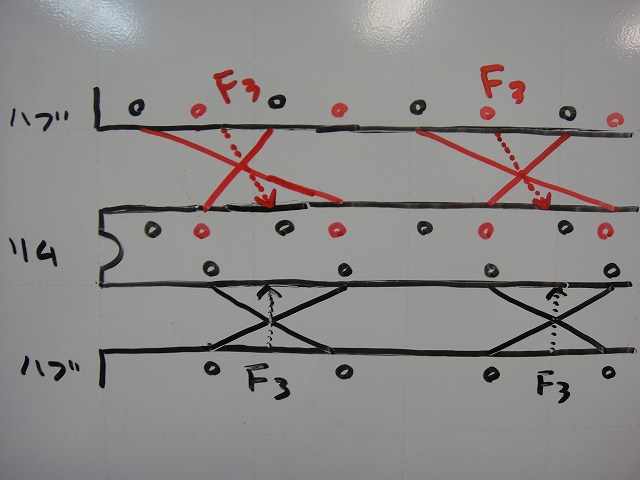
I've drawn in the composite direction of the tensioning force (F3 in the diagram above)
of the crossing spokes in the tangential lacing.
If you actually increase spoke tension like this,
the side that isn't currently warped will also warp.
You get the "anti-porcupine direction warp" I mentioned before.
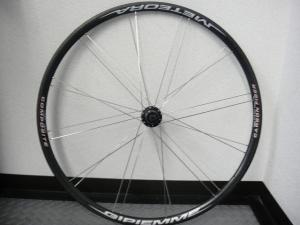
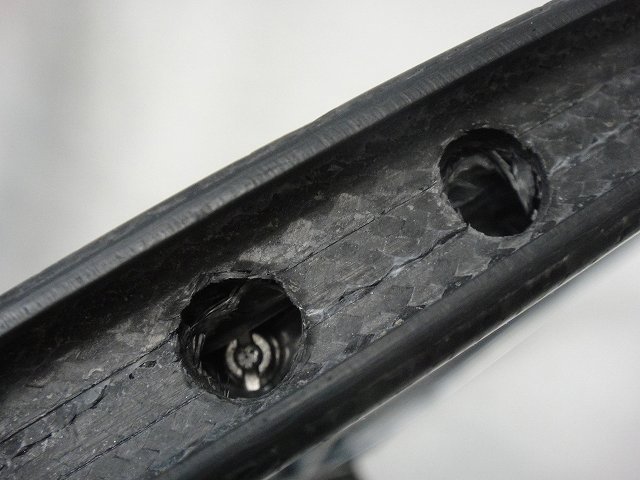
This is one of my prototype wheels,
a wheel with a Gypiemme (Italian rim manufacturer) Meteora rim.
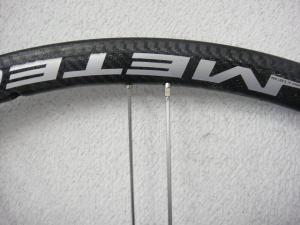
As you can see, it's pair-spoked.

It's probably a model from around 2002,
one of the early carbon clincher models,
but it has a lot of porosity—a bit scary, really.
↑I couldn't convert that character with "porosity" conversion. I pulled it from "osteoporosis."
When I put about 8 atmospheres of air pressure in the tire, it creaks (scary!).
Anyway, when I laced this with a normal hub using "F3 twist-tolerant lacing"
with different spoke lengths on the same flange,
the nipples loosened at an abnormal rate.
When the spokes went completely slack on the Wakayama side of Nabeya on the way back from Koyasan,
I was truly shocked.
(Sorry for the local references only people around the Osaka area would know)
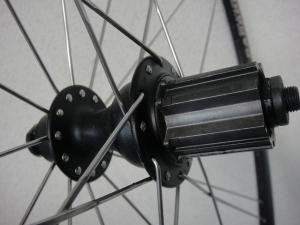
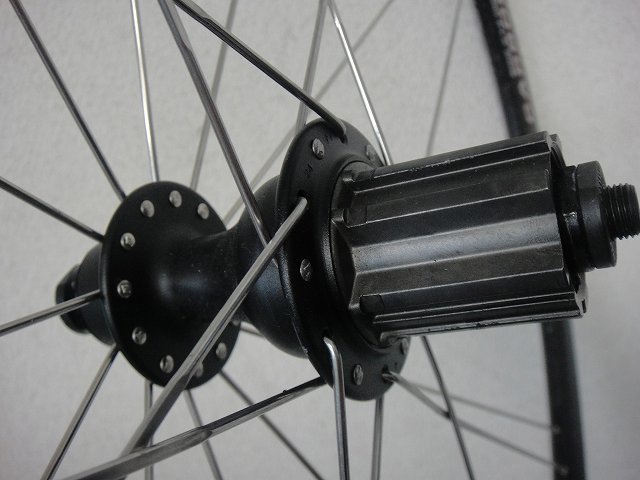
So I relaced it using the hub from A-CLASS's ALX400,
which has a similar pair-spoke configuration.
Unusually for me, the non-freewheel side is radial laced, but there's a reason for this.
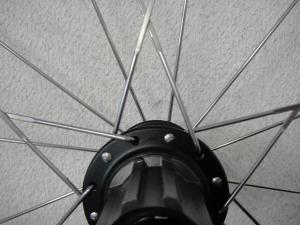
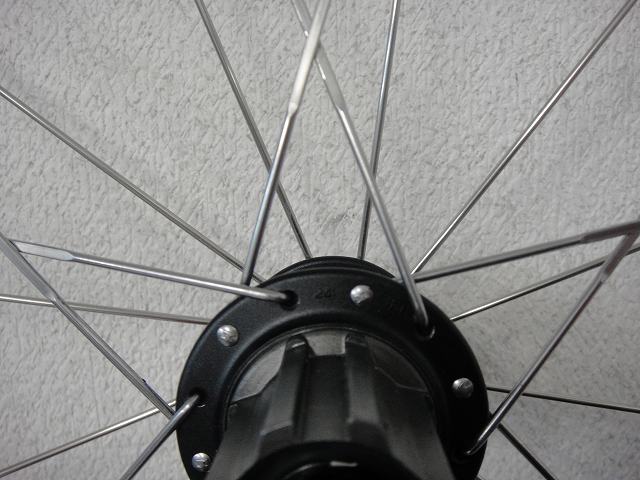
↑The freewheel-side spokes are Sapim Aero Star Bright III, but
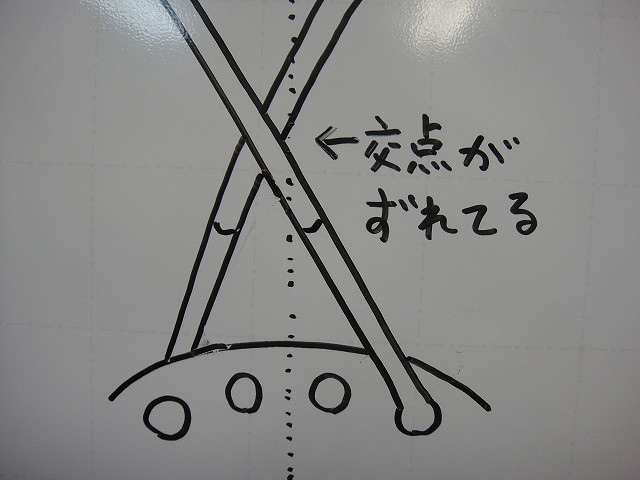
looking closely at the spoke crossings, you can see twisting caused by phasing mismatch.

↑Try looking at it this way.
There's a subtle offset.
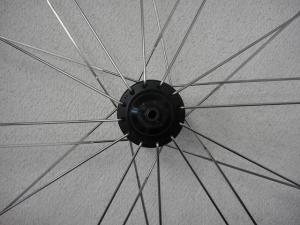
The radial-laced spokes on the non-freewheel side are
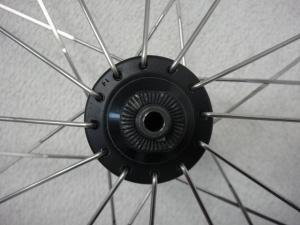
subtly twisted in the porcupine direction (from the forward view).
You can see this clearly if you think about how the spokes wouldn't pass through the hub axle
if you extended them inward.
The Meteora and ALX-400 have similar but not identical
pair-spoke configurations.
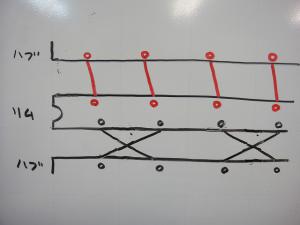
↑The diagram looks like this.
Though it's not perfectly shown in the diagram,
the tangential-laced side also has a subtle twist.
I thought if I didn't use radial lacing on one side,
the spoke loosening would be severe, so that's what I did.
I once stopped someone who was about to lace a Colima pair-spoked rim rim-only purchase,
for this very reason.
That's essentially a replacement part that requires a matching hub.
I've been thinking about building a wheel with a Rolf high-low—or rather, low-high flange hub,
but since the hub needs to be acquired,
if the rim doesn't have the pair-spoke configuration
that hub is designed for, you can't lace it, so I've abandoned the idea.
I'm writing about spoke phasing again today.
Today it's about the phasing of pair-spoked wheels.
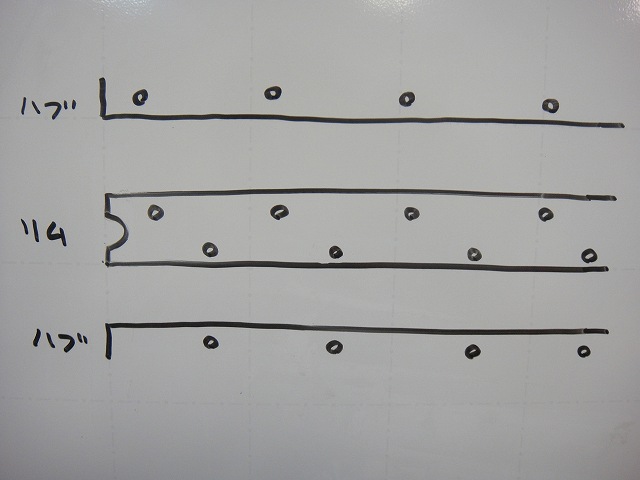
↑I'll continue with this diagram.
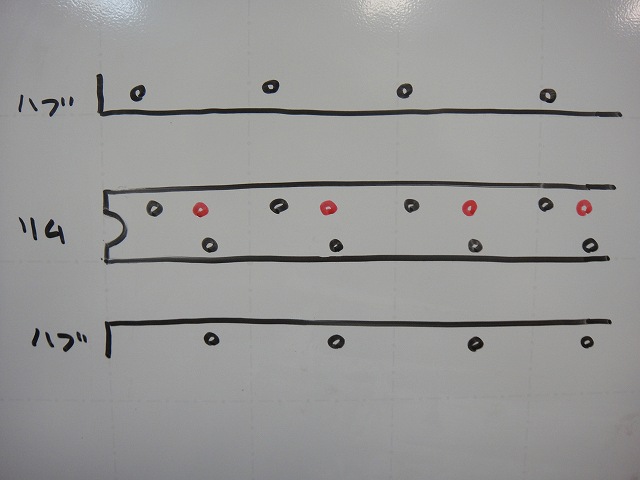
Pair-spoked wheels are rims where the spacing between nipples
is not uniform.
In most cases the spokes are arranged in a phasing where they nestle together,
so they're often called pair-spoked from their appearance.
In the diagram above, one side of the rim holes stays as-is,
while I've added pair-spoked phasing holes (red circles) to the other side.
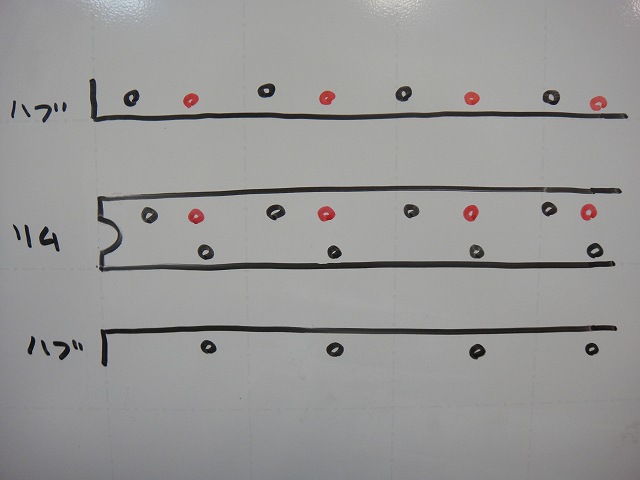
I've also drilled corresponding holes in the hub.
First I tried radial lacing.
This should give you an idea of what a "pair-spoked wheel opening" looks like.
Next, let's see what happens when you lace a "pair-spoked rim with a normal hub."
First I tried tangential lacing on one side.
The other side involves "connecting the black circle (normal hub) with the red circle (pair-spoked rim)"
but as you can see, something looks warped.
I've drawn in the composite direction of the tensioning force (F3 in the diagram above)
of the crossing spokes in the tangential lacing.
If you actually increase spoke tension like this,
the side that isn't currently warped will also warp.
You get the "anti-porcupine direction warp" I mentioned before.

This is one of my prototype wheels,
a wheel with a Gypiemme (Italian rim manufacturer) Meteora rim.

As you can see, it's pair-spoked.
It's probably a model from around 2002,
one of the early carbon clincher models,
but it has a lot of porosity—a bit scary, really.
↑I couldn't convert that character with "porosity" conversion. I pulled it from "osteoporosis."
When I put about 8 atmospheres of air pressure in the tire, it creaks (scary!).
Anyway, when I laced this with a normal hub using "F3 twist-tolerant lacing"
with different spoke lengths on the same flange,
the nipples loosened at an abnormal rate.
When the spokes went completely slack on the Wakayama side of Nabeya on the way back from Koyasan,
I was truly shocked.
(Sorry for the local references only people around the Osaka area would know)
So I relaced it using the hub from A-CLASS's ALX400,
which has a similar pair-spoke configuration.
Unusually for me, the non-freewheel side is radial laced, but there's a reason for this.
↑The freewheel-side spokes are Sapim Aero Star Bright III, but
looking closely at the spoke crossings, you can see twisting caused by phasing mismatch.
↑Try looking at it this way.
There's a subtle offset.
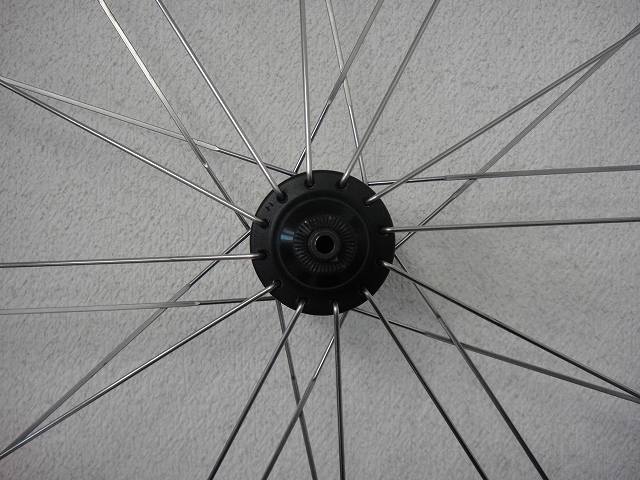
The radial-laced spokes on the non-freewheel side are

subtly twisted in the porcupine direction (from the forward view).
You can see this clearly if you think about how the spokes wouldn't pass through the hub axle
if you extended them inward.
The Meteora and ALX-400 have similar but not identical
pair-spoke configurations.
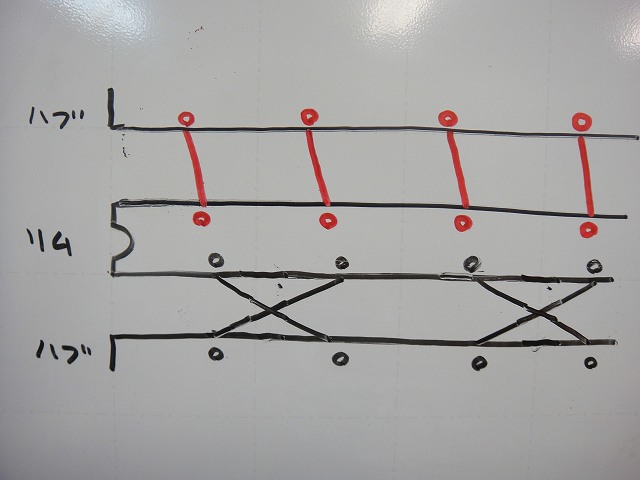
↑The diagram looks like this.
Though it's not perfectly shown in the diagram,
the tangential-laced side also has a subtle twist.
I thought if I didn't use radial lacing on one side,
the spoke loosening would be severe, so that's what I did.
I once stopped someone who was about to lace a Colima pair-spoked rim rim-only purchase,
for this very reason.
That's essentially a replacement part that requires a matching hub.
I've been thinking about building a wheel with a Rolf high-low—or rather, low-high flange hub,
but since the hub needs to be acquired,
if the rim doesn't have the pair-spoke configuration
that hub is designed for, you can't lace it, so I've abandoned the idea.