Another day of wheel building (and so on).

Continuing from the other day.
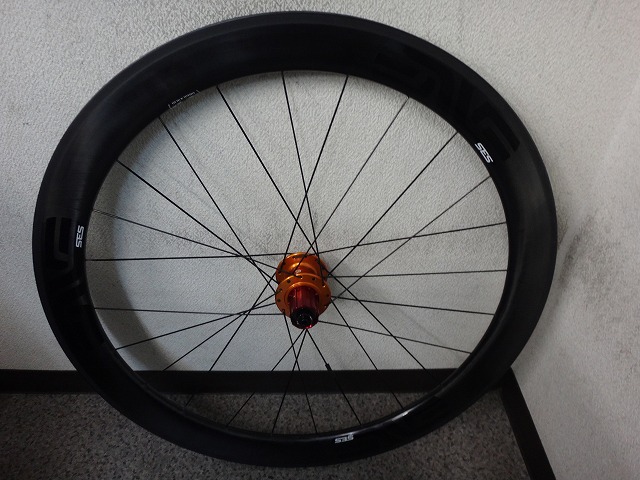
I built the rear wheel for the Smart Envy System 4.5.
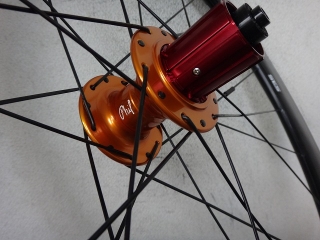
Using a Filwood Road Hub Rear 24H,
and on the freewheel side, I'm using round-butted spokes that the customer brought in.
In terms of spoke weight, they're equivalent to DT Competition spokes, so this is semi-competition grade.
I also built it as a 46-cross lacing.
I'll do the spoke lacing later.
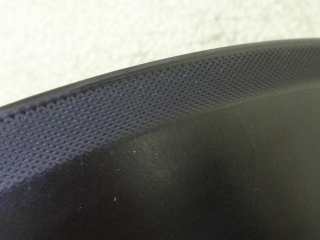
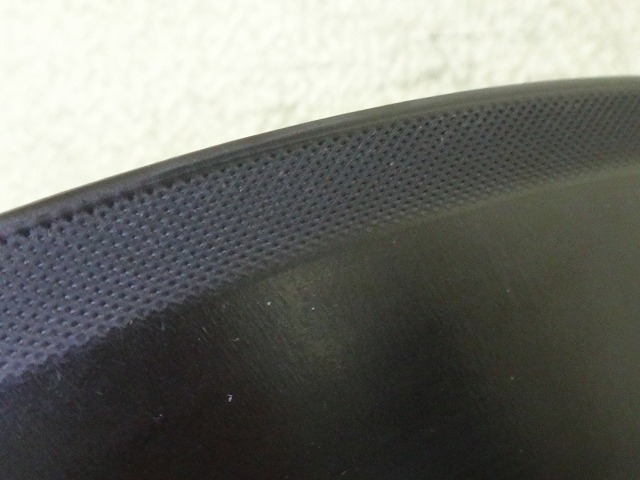
This rim has the recently trendy file-finishing on the brake zone.
They call it "Molded In Brake Track Technology" and with this they've achieved
"brake performance that's nearly identical in dry and wet conditions"
and "30% less braking force needed for the same stopping power."

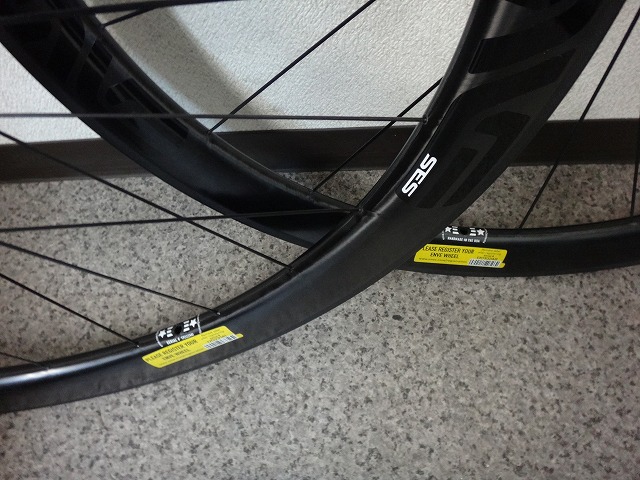
On this rim, there are stickers on both sides of the valve hole—
"Handmade in USA" on one side and "Serial Number" on the other.
I built both wheels treating the "Handmade in USA" side as the right side.
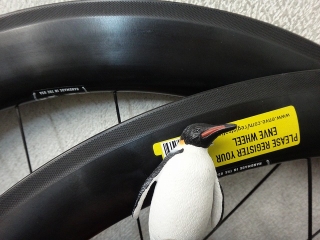
The yellow sticker with the matching serial number
ended up on the right side of the front wheel but on the left side of the rear wheel.
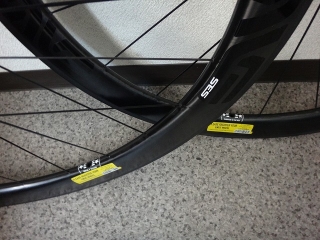
Actually, these stickers are supposed to be peeled off before using the wheel,
so I made sure the basis for distinguishing left and right is consistent after removal.

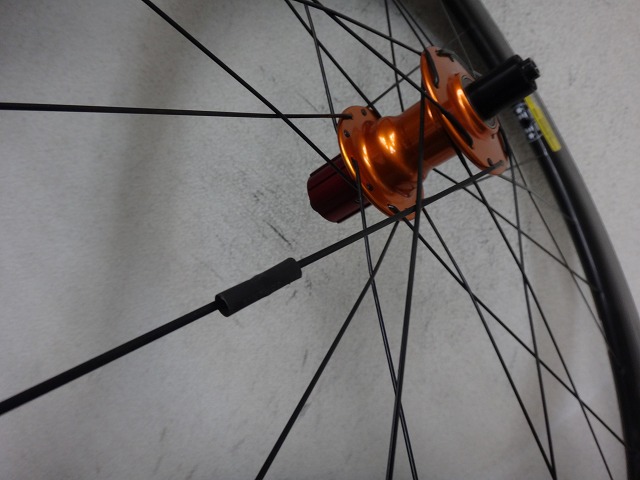
I plan to secure the wheel magnet to the spoke with heat-shrink tubing,
but it looks like I don't have enough tubing, so I'll do that another time.
If I need to add more, I'll have to remove the spokes first.
This is unrelated to this wheel, but
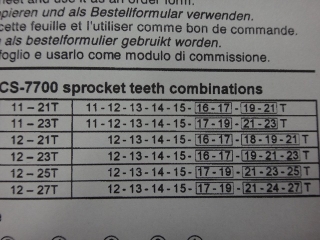
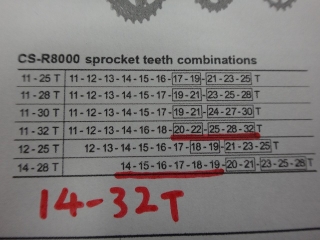
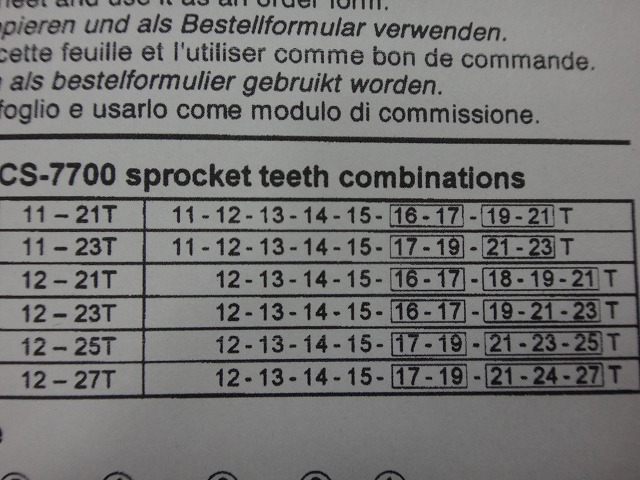
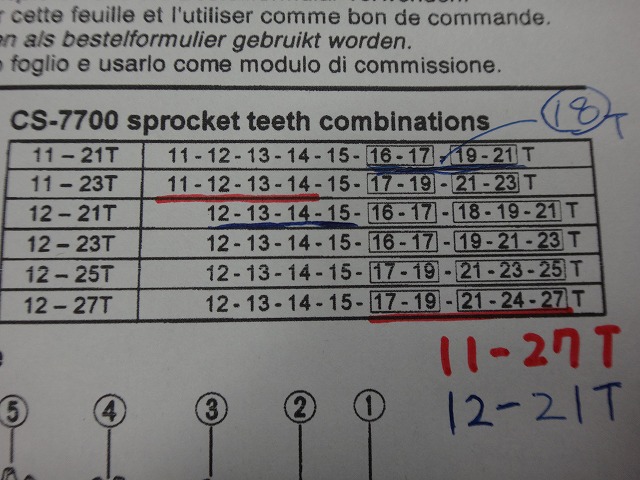
this is a list of tooth count combinations for 9-speed Dura-Ace sprockets.
The areas enclosed in squares are spider arms—
they're one integrated unit, so they can't be separated.
Here, if you try to create a combination outside the tooth counts offered in the lineup
by buying parts individually, you get problems like
"jumping from 17T to 21T," "two 19T cogs in a row," or "going backward from 19T to 18T."
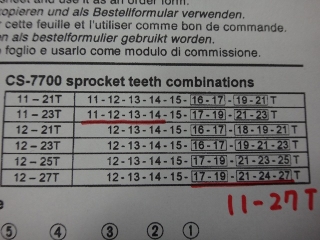
If you create an 11-27T that's not in the lineup,
you get the combination shown by the red line, but there's a jump from 14T to 17T.
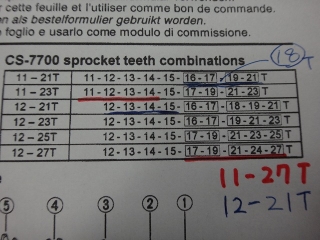
If you try to make a 12-21T, the blue line shows the combination,
but you'd need a single 18T cog by itself.
However, 9-speed Dura-Ace and Ultegra
don't have a single 18T cog specification.
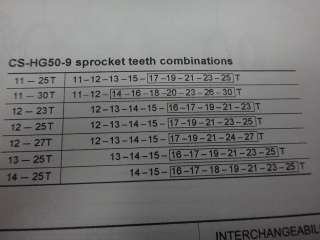
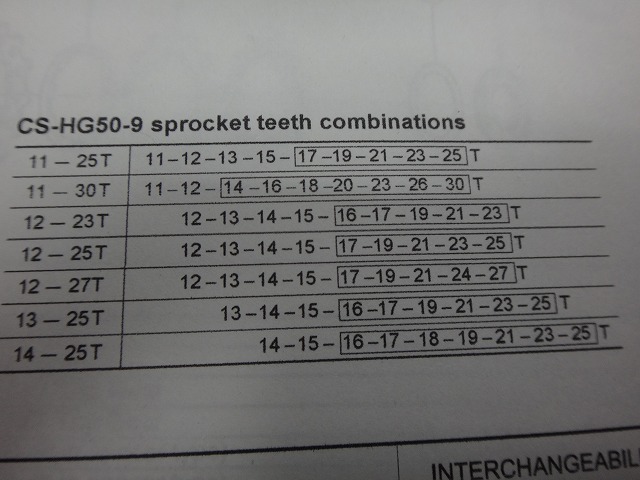
With 105 9-speed sprockets, the units are just held together by three pins,
so they can be separated.
If you buy the integrated cogs shown in the diagram—either 11-30T or 14-25T—
and split them, you can get an 18T, but
I don't think anyone would go that far with 9-speed just to make a 12-21T no matter what.
That said, regardless of whether anyone does it or not,
Shimano's sprocket design is cleverly done to discourage unnecessary tinkering.
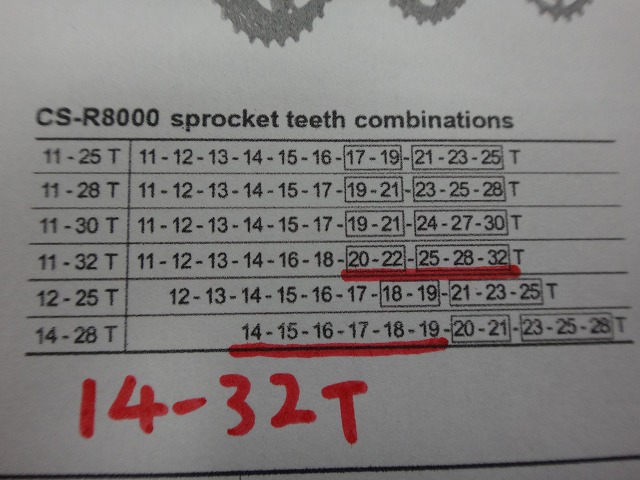
For this ENVE rear wheel, the customer requested
a 14-32T 11-speed sprocket,
and using the current Ultegra following the red line in the diagram above,
I was able to build it without any awkward tooth count jumps.
There's no 21T, but the gaps between teeth are 1/1/1/1/1/1/2/3/3/4, which is fine.
For a 10-speed sprocket example where it turned out as 2/3/3/2/3/4/4/4/4 (→see here).
About Smart Envy's attention to detail.
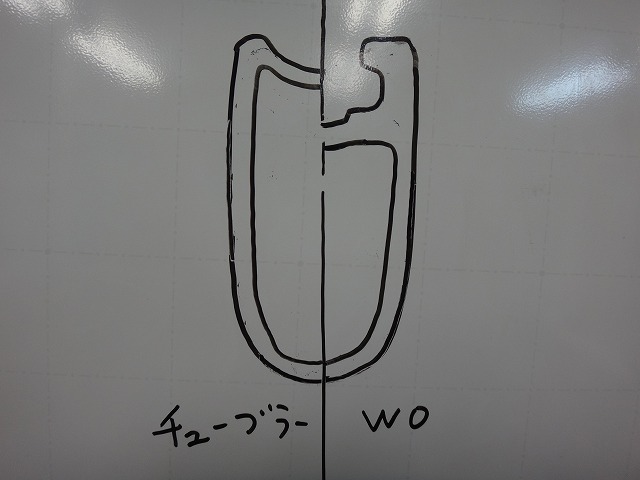
Usually when the same rim model is sold in both tubular and clincher versions,
the clincher version tends to have greater rim depth.
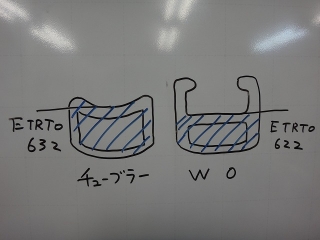
That said, if you add the "tubular rim depth plus bead hook" measurement,
it becomes so different that it can't really be called the same rim,
so in most cases the clincher rim has
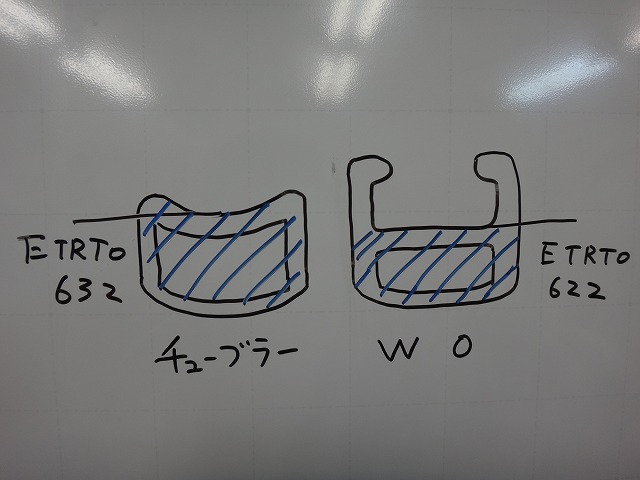
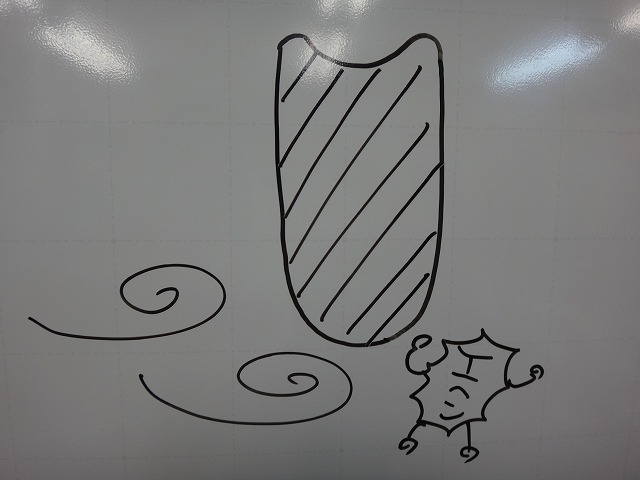
a smaller cross-sectional area of the hollow section (the blue hatched area in the diagram above).
A larger cross-sectional area means, like frame tubes,
you can make it lighter by reducing thickness,
so apart from whether there's a bead hook or not,
tubular rims have an advantage in being lighter.
There's no strict standard for this, but
the weight of the blue hatched section in the two rims shown above is about the same—
the clincher rim is heavier by roughly just the weight of the bead hook alone.
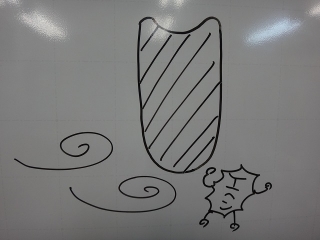
Smart Envy's approach is to rigorously design rim depth and width
based on aerodynamic testing. From this commitment,
regardless of the rim type,
they decide that "for this rim depth, this width is best, and this curve radius is optimal!"
So when both tubular and clincher versions exist with the same model name,
they can't change the rim depth.
If the clincher is deeper but has the same width as the tubular,
the aspect ratio changes.

So with Smart Envy, the same model in both tubular and clincher versions
has exactly the same rim height and width.
The "sameness" refers to aerodynamic characteristics
(though technically they differ when different tire types are mounted),
but the weight is still lighter with the tubular rim.
Also, something that might feel a bit "pushy and ignoring user needs"
is that front rims come only in 20H and rear rims only in 24H.
(The discontinued 8.9 model had front 16H and rear 20H options,
but the current lineup is all front 20H, rear 24H.)
There seems to be an uncompromising philosophy behind this too, so it can't be helped.
With the SES 2.2 and 3.4, the front and rear rim widths are the same,
but with the 4.5 and 7.8, the rim width differs front to rear,
with the front rim clearly being wider.
So with clincher rims, the rim tape width included also differs between front and rear.
Continuing from the other day.
I built the rear wheel for the Smart Envy System 4.5.

Using a Filwood Road Hub Rear 24H,
and on the freewheel side, I'm using round-butted spokes that the customer brought in.
In terms of spoke weight, they're equivalent to DT Competition spokes, so this is semi-competition grade.
I also built it as a 46-cross lacing.
I'll do the spoke lacing later.
This rim has the recently trendy file-finishing on the brake zone.
They call it "Molded In Brake Track Technology" and with this they've achieved
"brake performance that's nearly identical in dry and wet conditions"
and "30% less braking force needed for the same stopping power."

On this rim, there are stickers on both sides of the valve hole—
"Handmade in USA" on one side and "Serial Number" on the other.
I built both wheels treating the "Handmade in USA" side as the right side.

The yellow sticker with the matching serial number
ended up on the right side of the front wheel but on the left side of the rear wheel.
Actually, these stickers are supposed to be peeled off before using the wheel,
so I made sure the basis for distinguishing left and right is consistent after removal.
I plan to secure the wheel magnet to the spoke with heat-shrink tubing,
but it looks like I don't have enough tubing, so I'll do that another time.
If I need to add more, I'll have to remove the spokes first.
This is unrelated to this wheel, but
this is a list of tooth count combinations for 9-speed Dura-Ace sprockets.
The areas enclosed in squares are spider arms—
they're one integrated unit, so they can't be separated.
Here, if you try to create a combination outside the tooth counts offered in the lineup
by buying parts individually, you get problems like
"jumping from 17T to 21T," "two 19T cogs in a row," or "going backward from 19T to 18T."

If you create an 11-27T that's not in the lineup,
you get the combination shown by the red line, but there's a jump from 14T to 17T.
If you try to make a 12-21T, the blue line shows the combination,
but you'd need a single 18T cog by itself.
However, 9-speed Dura-Ace and Ultegra
don't have a single 18T cog specification.
With 105 9-speed sprockets, the units are just held together by three pins,
so they can be separated.
If you buy the integrated cogs shown in the diagram—either 11-30T or 14-25T—
and split them, you can get an 18T, but
I don't think anyone would go that far with 9-speed just to make a 12-21T no matter what.
That said, regardless of whether anyone does it or not,
Shimano's sprocket design is cleverly done to discourage unnecessary tinkering.
For this ENVE rear wheel, the customer requested
a 14-32T 11-speed sprocket,
and using the current Ultegra following the red line in the diagram above,
I was able to build it without any awkward tooth count jumps.
There's no 21T, but the gaps between teeth are 1/1/1/1/1/1/2/3/3/4, which is fine.
For a 10-speed sprocket example where it turned out as 2/3/3/2/3/4/4/4/4 (→see here).
About Smart Envy's attention to detail.
Usually when the same rim model is sold in both tubular and clincher versions,
the clincher version tends to have greater rim depth.
That said, if you add the "tubular rim depth plus bead hook" measurement,
it becomes so different that it can't really be called the same rim,
so in most cases the clincher rim has
a smaller cross-sectional area of the hollow section (the blue hatched area in the diagram above).
A larger cross-sectional area means, like frame tubes,
you can make it lighter by reducing thickness,
so apart from whether there's a bead hook or not,
tubular rims have an advantage in being lighter.
There's no strict standard for this, but
the weight of the blue hatched section in the two rims shown above is about the same—
the clincher rim is heavier by roughly just the weight of the bead hook alone.
Smart Envy's approach is to rigorously design rim depth and width
based on aerodynamic testing. From this commitment,
regardless of the rim type,
they decide that "for this rim depth, this width is best, and this curve radius is optimal!"
So when both tubular and clincher versions exist with the same model name,
they can't change the rim depth.
If the clincher is deeper but has the same width as the tubular,
the aspect ratio changes.
So with Smart Envy, the same model in both tubular and clincher versions
has exactly the same rim height and width.
The "sameness" refers to aerodynamic characteristics
(though technically they differ when different tire types are mounted),
but the weight is still lighter with the tubular rim.
Also, something that might feel a bit "pushy and ignoring user needs"
is that front rims come only in 20H and rear rims only in 24H.
(The discontinued 8.9 model had front 16H and rear 20H options,
but the current lineup is all front 20H, rear 24H.)
There seems to be an uncompromising philosophy behind this too, so it can't be helped.
With the SES 2.2 and 3.4, the front and rear rim widths are the same,
but with the 4.5 and 7.8, the rim width differs front to rear,
with the front rim clearly being wider.
So with clincher rims, the rim tape width included also differs between front and rear.