It might be the first time since we opened, but I took off on the
last Saturday of the month, which is supposed to be our regular day off.
Though even then I ended up coming to the shop for wheel shipments, office work,
and to meet with customers who had appointments.
Anyway, I've been receiving various comments, so
I'll respond to them.
First, regarding inventory questions about the OVAL R700 handlebars—
someone inquired but didn't include an email address, so I'll post it here.
The 26.0mm diameter is sold out; the 31.8mm diameter is available from the wholesaler
in both 400mm and 420mm center-to-center lengths. Please consider those options.
Also, to "TeslaCoil Crab Rays" user:
I haven't written a blog post about it, but
I always read your comments.
I've been meaning to write a thank-you post at some point.
I'd like to take this opportunity to thank you.
Your various comments are very helpful.
Now, let me reply to the comments.
I've received a comment regarding spoke tension and wheel lateral stiffness.
(Not from TeslaCoil)
"You wrote that increasing tension doesn't increase lateral stiffness much,
but I think lateral stiffness is proportional to spoke tension.
At first I also thought stiffness and tension were unrelated (since f=kx),
and that loose-free was enough.
But that was only for vertical stiffness (up-down direction).
Why can a tension meter measure the difference in tension?
Isn't it because the force against lateral changes (i.e., lateral stiffness)
is proportional to tension?
Further, lateral stiffness = tension × sin(flange angle?) can be expressed,
and I think flange width and tension have an equivalent relationship.
So within the upper limit of spoke tension due to durability,
by reducing the difference in left-right tension, gaining tension (lateral stiffness),
and adding angle, doesn't large flange make sense?"
That's the content.
I've posted the original text as-is.
First, regarding "I think flange width and tension have an equivalent relationship"—
that's simply not true.
If that were factual, it would mean you could build a wheel with no lateral deflection
using a narrow-flange hub simply by applying high spoke tension.
Unless all materials were perfectly rigid bodies, in practice
it's impossible to gain lateral stiffness with a narrow flange width.
For example, suppose there's a rim with an allowable tension of 120 kgf.
With a 50mm flange width hub (like Amoeba) and a 57mm hub (like Thnī Dura, etc.),
we tension each to 120 kgf on the freehub side.
Let's say we use equal spoke count on both sides.
The non-freehub spoke tension on the 50mm hub would be around 90 kgf,
and on the 57mm hub around 80 kgf.
Though the 57mm hub has lower non-freehub spoke tension,
its wider flange width means superior lateral stiffness.
The wheel builds properly at this point (rim center is true),
but the freehub side is at limit tension so it can't be tightened further,
and the non-freehub side can't be tightened either without throwing off center—
a dead end.
Say hypothetically someone tensioned the 50mm hub wheel
at their own risk to 140 kgf on the freehub side.
The non-freehub side tension would then be around 110 kgf or so.
But I'll state it plainly: even in that state,
the 57mm hub wheel at 120 kgf freehub side
has superior lateral stiffness.
As I've said many times, narrow flange width is
regarding lateral stiffness, the worst kind of problem with no workaround.
The loss from narrow flange width can't be recovered by going large flange.
For details, see(→here).
Only with the sort of large flange described in that article
can the angular loss from a 7mm narrower flange width be compensated for.
And regarding "by reducing left-right tension differences (omitted)...
doesn't large flange make sense?"—
making the non-freehub side large flange actually increases spoke tension difference.
For example, with Campagnolo wheels, the rear hub is high-low flange.
If the aim were to reduce spoke deformation, you'd use high-high flange,
yet they use high-low because clearly reducing left-right spoke tension differences
is more beneficial for the wheel.
This applies to G3, 2:1, high-end hubs like Hyperon and Neutron,
and even pre-G3 high-profile aluminum-rim Shamals, and so on.
If large flange hubs were advantageous for stiffness,
more front hubs would use them.
But in reality, I can't think of many.
(You'd have to go back to the low-height rim era to find them)
Large flange, at this point, is simply a means—
leveraging the gap with small flange to create favorable spoke tension conditions—
used on the rear freehub side, that's all.
Your comment mentioned you've never built an Amoeba wheel.
If you get the chance, please try building one.
If you think a squishy wheel that wobbles on descents is "good," then it's "good."
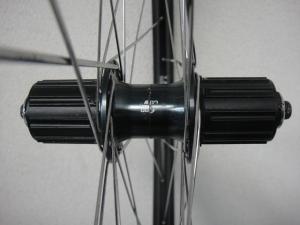
↑This is my custom double-freehub, which lets you build both sides with equal tension,
so if the rim's allowable limit is 120 kgf, you can build both sides at 120 kgf.
I actually do almost exactly that.
The lateral stiffness is terrible, so I tried to compensate with spoke tension, but
no matter how tight you go, it doesn't convert to lateral stiffness.
This too is evidence that "flange width and tension aren't equivalent."
This hub's flange width is about 42mm,
and the Amoeba hub's flange width is roughly midway between this and a Dura-Ace hub.
If this double-freehub were large flange, could you build an even stiffer wheel?
No way.
Regarding lateral stiffness, flange width is overwhelmingly the dominant factor,
and spoke tension cannot compensate enough to overcome it.
Next.
"The Amoeba flange width of about 49mm is the old model (15mm axle),
and after the model change (17mm axle) it's narrower at 42mm.
That's a measured value so I'm confident, but is the current one wider again??"
I received this comment.
Hub flange width is measured outer-to-outer,
so 42mm would be about the same as the double-freehub shown above.
The Amoeba hub, both the old HH-220
and the current RD-205, were around 50mm width, I think.
The current RD-205 specs list freehub side at 20.0mm,
non-freehub side at 30.0mm.
Today was supposed to be my day off (it turned into yesterday while I was writing),
but the phone still rang.
And the caller said "Wait, aren't you closed?"
If you know it's closed, you wouldn't call.
They had certainty that I was lurking in the shop despite it being the day off
so they called. About two people like that.
I'm not trying to set a record for "consecutive days building wheels
excluding regular days off,"
but please don't count today since I came in (laughs).
I'll work hard building wheels starting tomorrow.
This post has no whiteboard doodles because I'm writing from home.
In the end, it was hardly a day off at all.
last Saturday of the month, which is supposed to be our regular day off.
Though even then I ended up coming to the shop for wheel shipments, office work,
and to meet with customers who had appointments.
Anyway, I've been receiving various comments, so
I'll respond to them.
First, regarding inventory questions about the OVAL R700 handlebars—
someone inquired but didn't include an email address, so I'll post it here.
The 26.0mm diameter is sold out; the 31.8mm diameter is available from the wholesaler
in both 400mm and 420mm center-to-center lengths. Please consider those options.
Also, to "TeslaCoil Crab Rays" user:
I haven't written a blog post about it, but
I always read your comments.
I've been meaning to write a thank-you post at some point.
I'd like to take this opportunity to thank you.
Your various comments are very helpful.
Now, let me reply to the comments.
I've received a comment regarding spoke tension and wheel lateral stiffness.
(Not from TeslaCoil)
"You wrote that increasing tension doesn't increase lateral stiffness much,
but I think lateral stiffness is proportional to spoke tension.
At first I also thought stiffness and tension were unrelated (since f=kx),
and that loose-free was enough.
But that was only for vertical stiffness (up-down direction).
Why can a tension meter measure the difference in tension?
Isn't it because the force against lateral changes (i.e., lateral stiffness)
is proportional to tension?
Further, lateral stiffness = tension × sin(flange angle?) can be expressed,
and I think flange width and tension have an equivalent relationship.
So within the upper limit of spoke tension due to durability,
by reducing the difference in left-right tension, gaining tension (lateral stiffness),
and adding angle, doesn't large flange make sense?"
That's the content.
I've posted the original text as-is.
First, regarding "I think flange width and tension have an equivalent relationship"—
that's simply not true.
If that were factual, it would mean you could build a wheel with no lateral deflection
using a narrow-flange hub simply by applying high spoke tension.
Unless all materials were perfectly rigid bodies, in practice
it's impossible to gain lateral stiffness with a narrow flange width.
For example, suppose there's a rim with an allowable tension of 120 kgf.
With a 50mm flange width hub (like Amoeba) and a 57mm hub (like Thnī Dura, etc.),
we tension each to 120 kgf on the freehub side.
Let's say we use equal spoke count on both sides.
The non-freehub spoke tension on the 50mm hub would be around 90 kgf,
and on the 57mm hub around 80 kgf.
Though the 57mm hub has lower non-freehub spoke tension,
its wider flange width means superior lateral stiffness.
The wheel builds properly at this point (rim center is true),
but the freehub side is at limit tension so it can't be tightened further,
and the non-freehub side can't be tightened either without throwing off center—
a dead end.
Say hypothetically someone tensioned the 50mm hub wheel
at their own risk to 140 kgf on the freehub side.
The non-freehub side tension would then be around 110 kgf or so.
But I'll state it plainly: even in that state,
the 57mm hub wheel at 120 kgf freehub side
has superior lateral stiffness.
As I've said many times, narrow flange width is
regarding lateral stiffness, the worst kind of problem with no workaround.
The loss from narrow flange width can't be recovered by going large flange.
For details, see(→here).
Only with the sort of large flange described in that article
can the angular loss from a 7mm narrower flange width be compensated for.
And regarding "by reducing left-right tension differences (omitted)...
doesn't large flange make sense?"—
making the non-freehub side large flange actually increases spoke tension difference.
For example, with Campagnolo wheels, the rear hub is high-low flange.
If the aim were to reduce spoke deformation, you'd use high-high flange,
yet they use high-low because clearly reducing left-right spoke tension differences
is more beneficial for the wheel.
This applies to G3, 2:1, high-end hubs like Hyperon and Neutron,
and even pre-G3 high-profile aluminum-rim Shamals, and so on.
If large flange hubs were advantageous for stiffness,
more front hubs would use them.
But in reality, I can't think of many.
(You'd have to go back to the low-height rim era to find them)
Large flange, at this point, is simply a means—
leveraging the gap with small flange to create favorable spoke tension conditions—
used on the rear freehub side, that's all.
Your comment mentioned you've never built an Amoeba wheel.
If you get the chance, please try building one.
If you think a squishy wheel that wobbles on descents is "good," then it's "good."
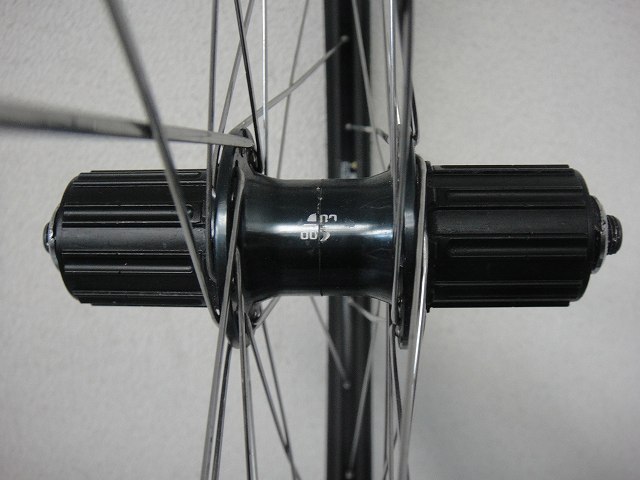
↑This is my custom double-freehub, which lets you build both sides with equal tension,
so if the rim's allowable limit is 120 kgf, you can build both sides at 120 kgf.
I actually do almost exactly that.
The lateral stiffness is terrible, so I tried to compensate with spoke tension, but
no matter how tight you go, it doesn't convert to lateral stiffness.
This too is evidence that "flange width and tension aren't equivalent."
This hub's flange width is about 42mm,
and the Amoeba hub's flange width is roughly midway between this and a Dura-Ace hub.
If this double-freehub were large flange, could you build an even stiffer wheel?
No way.
Regarding lateral stiffness, flange width is overwhelmingly the dominant factor,
and spoke tension cannot compensate enough to overcome it.
Next.
"The Amoeba flange width of about 49mm is the old model (15mm axle),
and after the model change (17mm axle) it's narrower at 42mm.
That's a measured value so I'm confident, but is the current one wider again??"
I received this comment.
Hub flange width is measured outer-to-outer,
so 42mm would be about the same as the double-freehub shown above.
The Amoeba hub, both the old HH-220
and the current RD-205, were around 50mm width, I think.
The current RD-205 specs list freehub side at 20.0mm,
non-freehub side at 30.0mm.
Today was supposed to be my day off (it turned into yesterday while I was writing),
but the phone still rang.
And the caller said "Wait, aren't you closed?"
If you know it's closed, you wouldn't call.
They had certainty that I was lurking in the shop despite it being the day off
so they called. About two people like that.
I'm not trying to set a record for "consecutive days building wheels
excluding regular days off,"
but please don't count today since I came in (laughs).
I'll work hard building wheels starting tomorrow.
This post has no whiteboard doodles because I'm writing from home.
In the end, it was hardly a day off at all.