Spoke quantity, by my definition, is expressed as
the percentage of spoke weight ratio × number of spokes.
What I was thinking of writing has mostly already been covered in a past article (→here)
but this time I'm focusing especially on front wheel spoke quantity.
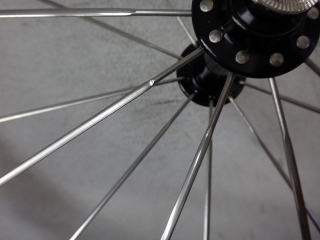
In the previous article I built a front wheel with CX spokes, and
CX has a weight ratio of 100.3%, while CX-RAY is 64.5%.
For easier calculation, I usually use 100% and 65% respectively,
and I'll do the same this time.
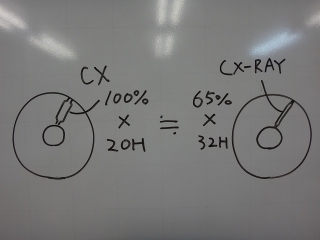
A radial-laced front wheel for rim brake use (non-offset rim) is
the most straightforward to consider, so let's go with that.
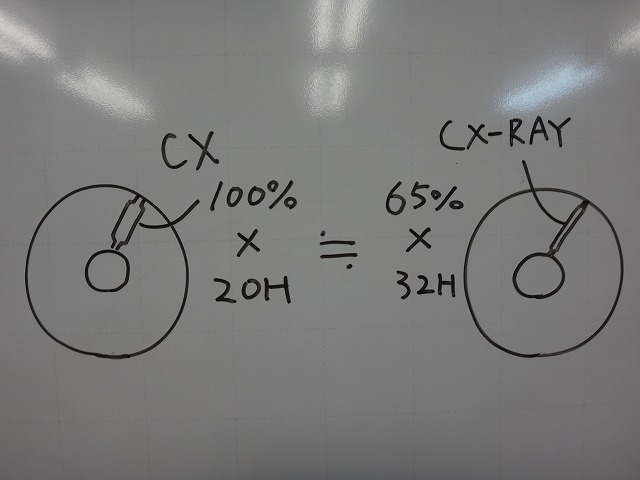
A 20H front wheel with CX spokes has a spoke quantity of 100×20, which equals 2000.
The same spoke quantity would be 30.7H with CX-RAY, so
a 20H CX and a 30.7H CX-RAY would
be wheels of exactly the same weight, but
as a practical approximation,
let's say a 20H CX and a 32H CX-RAY have the same (or nearly the same) weight.
Between these two front wheels, which is superior?
The advantage of 20H is lower aerodynamic drag.
The disadvantage is that with the same 2.0mm spoke elbow measurement, each spoke in a 20H wheel bears more load,
so there's a higher risk of spoke breakage. In practice, spoke breakage doesn't happen frequently at around 20H,
and if a complete wheel manufacturer uses straight-pull spokes,
it's a factor you barely need to worry about.
I believe that given the same spoke quantity, more spokes is advantageous.
So you might ask, taking it to extremes, if spoke quantity is 2000, wouldn't 10% weight ratio × 200 spokes be ideal?
Or even without going that far, what about 50% weight ratio × 40 spokes?
But in reality, even if spokes with such a weight ratio existed,
they'd break or develop oscillation before you could finish building the wheel.
So the conclusion is "within a range where spokes don't develop oscillation,
use as many spokes as possible."
When building wheels as tight as possible within practical limits,
based on experience with current materials and manufacturing methods,
round butted spokes at 65% weight ratio won't work,
but flat butted spokes at the same 65% will be OK.
As I've written many times before, what I expect from CX-RAY isn't primarily
the aerodynamic characteristics from its flattened profile,
but rather its resistance to oscillation from work hardening.
Spokes like CX-RAY have a high yield point, but a short distance to the breaking point after that
(oscillation happens, then it snaps right away), or so I think,
but the rim and nipples give out first before reaching that point,
so in practice it's limitless.
So, for example, if a front wheel must be built with CX-RAY in radial lacing exclusively,
how many spokes would it take so most people wouldn't call it "soft"?
From experience, I know the answer: 20H.
To avoid being called "soft" with 18H or 16H, you'd need
correspondingly shorter spokes (i.e., higher rim).
Shorter spokes don't necessarily equal higher rim.
That's true for 700C rims alone,
but a 700C 80mm-high rim and a 24-inch low-height rim
have nearly the same spoke length.
Kolima and Rolf Prima tend to prefer wheels with fewer spokes,
and their 650C wheels typically have fewer spokes than 700C.
Also, sports compact wheels sometimes show extremely low spoke counts.
But let's say for 700C rims specifically, shorter spokes = higher rim is valid.
Based on experience, a 20H CX-RAY front wheel with spoke quantity 1300
won't be called "soft" by most people, regardless of rim height
(even with a low-height rim).
What's striking about Shimano's front wheel, in a negative sense, is that
even with a low-height rim (C24), they use 16H
with 65% weight ratio × 16H, giving spoke quantity 1040.
If rim height is around 60mm, there's no particular problem, but...
Spoke quantity 1040 is equivalent to CX 10H.
This is probably a result of over-emphasizing UCI regulations requiring 16H minimum
and wind tunnel test results.
Someone might say, "Hey, stop bashing Shimano wheels—Racing 3 (16H) and
Ksilium Elite (18H) have similar spoke counts," and that's true,
but those wheels don't have rims under 400g of light weight,
so you don't see spoke tension causing lateral wobble,
and regarding spoke quantity in this discussion,
they don't use unnecessarily thin spokes.
They probably don't use the のむラボ (Nomunomu Lab) terminology of weight ratio or spoke quantity,
but they seem to grasp the same concept at a higher level.
Kolima, Campagnolo/Fulcrum, Mavic and others clearly pursue wheel building
that's moved beyond the "everyone uses CX-RAY" thinking,
and regarding rear wheels, I suspect Reynolds and ZIPP rear wheels feel soft
not because of using CX-RAY on both sides, but for other reasons.
No one's ever said my rebuilt wheel was worse than before!
Now, over the past 2-3 years, regarding front wheels,
I haven't completely changed my thinking, but I've reconsidered
whether a higher spoke quantity front wheel is necessarily bad
just because 1300 spoke quantity doesn't get called "soft."
So for my personal wheels I built the のむラボ Wheel #1 with CX 20H
and のむラボ Wheel #4 with CX-RAY 24H (spoke quantity 1560),
and from riding them I've started to think that depending on the rider's conditions,
you might find benefits that outweigh the weight and aerodynamic disadvantages.
Not that the current のむラボ radial-laced front wheels with spoke quantity 1300 are bad, mind you.
Building the front wheel tangential instead of radial does increase spoke quantity slightly
(varying by hub hole count and lacing pattern,
but the total spoke weight = length extends about 4%),
and some people might actually prefer this to radial lacing.
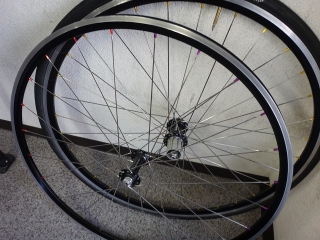
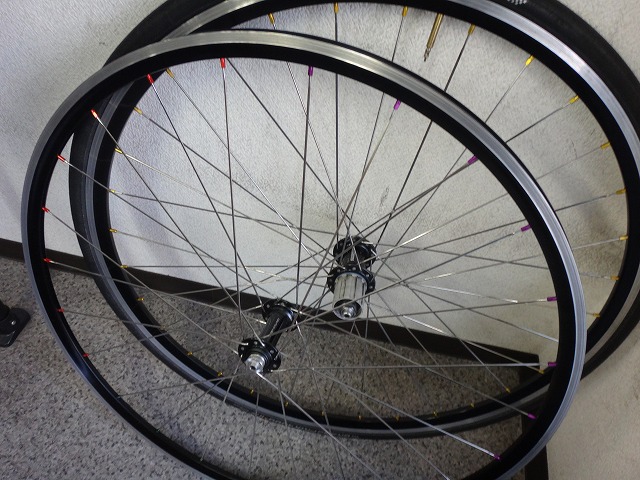
↑This is a prototype のむラボ Wheel #5, and
I lent it for about two months to an athlete who also has a regular のむラボ Wheel #5, and
they said this one is far stiffer and faster.
By the way, this is a rider with enough leg strength to break an hour on Norinkyo climb.
Since they can go sub-hour on Norinkyo,
it's not just that a heavier rider suited the stiffer wheel.
Front wheel is HB-9000 24H CX-RAY 4-cross lacing,
rear wheel is Record hub 32H semi-comp 4-6 cross with cable connection, but
the rear hub is CULTified, and the front hub is slightly modified too
(though not ceramic bearing conversion).
The Evolite hub is far lighter in pure weight too,
and spoke count is higher than the regular のむラボ wheels I usually build
(especially the rear), but
I've tried to direct the weight increase toward high rigidity.
You might say, "why not mass-produce this?",
but because of undisclosable costs, this is abnormally expensive to make cheaply.
You could build something similar with 24/32H front and rear with Evolite hubs, but...
The customer of the のむラボ Wheel #2 from the previous article
has several wheels I built, and
they always ask for the wheel "as tight as possible," which is why I built it with CX.
Not long ago, a customer who had me build their のむラボ Wheel #1 front wheel
in tangential lacing mentioned (though it might not be the only reason)
recently that the firmness felt good,
but tangential lacing's classical appearance
doesn't match modern road bikes, so I'm somewhat reluctant
to offer it as an option.
Plus, as I mentioned, most people aren't dissatisfied with the spoke quantity 1300 radial lacing anyway.
With the spread of disc brakes, resistance to mounting
tangentially-laced front wheels on road bikes might decrease.

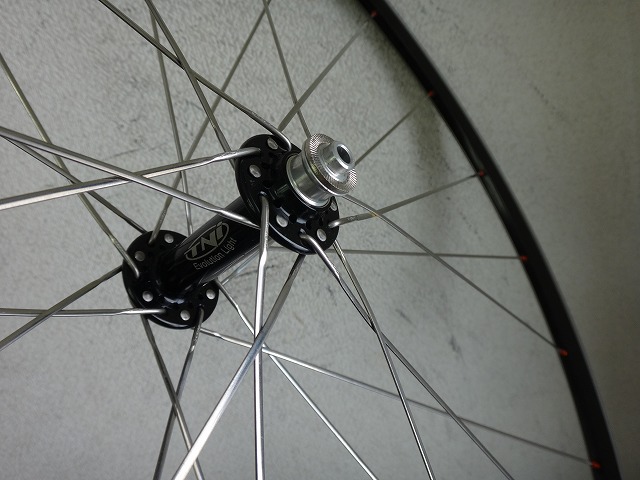
↑This is alsoa wheel I don't use a personal wheel,
a のむラボ Wheel #5 Evolite hub 24H CX-RAY 4-cross front wheel.
So, while I've been talking about spoke quantity,
the point is that increasing weight ratio, using tangential lacing, or
Sapim's CX is a flat-profile spoke with 100% weight ratio and
is the only stably-supplied spoke (at least in our range),
but Japanese distributor stock is only in silver with a maximum length of 278mm,
which means Wheel #1 can be built but #5 cannot.
Black is sold out, with only tiny remaining stock,
and useful lengths are completely gone.
So when increasing spoke quantity for のむラボ Wheel #5 front wheel,
I can only work with spoke count and lacing pattern.
With CX, I'm planning to get help building a 16H front wheel in the near future.
the percentage of spoke weight ratio × number of spokes.
What I was thinking of writing has mostly already been covered in a past article (→here)
but this time I'm focusing especially on front wheel spoke quantity.
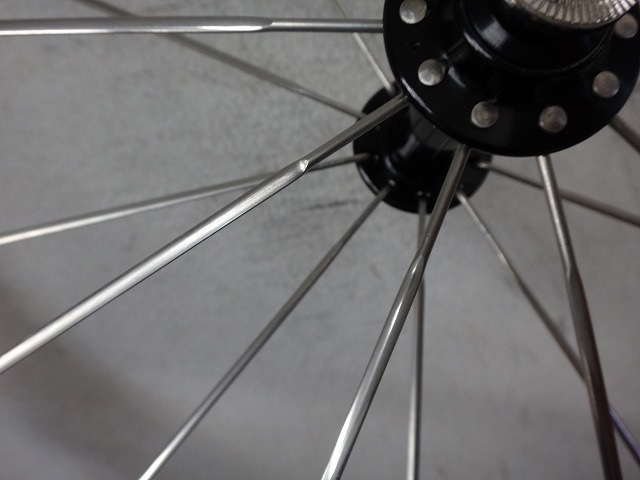
In the previous article I built a front wheel with CX spokes, and
CX has a weight ratio of 100.3%, while CX-RAY is 64.5%.
For easier calculation, I usually use 100% and 65% respectively,
and I'll do the same this time.
A radial-laced front wheel for rim brake use (non-offset rim) is
the most straightforward to consider, so let's go with that.
A 20H front wheel with CX spokes has a spoke quantity of 100×20, which equals 2000.
The same spoke quantity would be 30.7H with CX-RAY, so
a 20H CX and a 30.7H CX-RAY would
be wheels of exactly the same weight, but
as a practical approximation,
let's say a 20H CX and a 32H CX-RAY have the same (or nearly the same) weight.
Between these two front wheels, which is superior?
The advantage of 20H is lower aerodynamic drag.
The disadvantage is that with the same 2.0mm spoke elbow measurement, each spoke in a 20H wheel bears more load,
so there's a higher risk of spoke breakage. In practice, spoke breakage doesn't happen frequently at around 20H,
and if a complete wheel manufacturer uses straight-pull spokes,
it's a factor you barely need to worry about.
I believe that given the same spoke quantity, more spokes is advantageous.
So you might ask, taking it to extremes, if spoke quantity is 2000, wouldn't 10% weight ratio × 200 spokes be ideal?
Or even without going that far, what about 50% weight ratio × 40 spokes?
But in reality, even if spokes with such a weight ratio existed,
they'd break or develop oscillation before you could finish building the wheel.
So the conclusion is "within a range where spokes don't develop oscillation,
use as many spokes as possible."
When building wheels as tight as possible within practical limits,
based on experience with current materials and manufacturing methods,
round butted spokes at 65% weight ratio won't work,
but flat butted spokes at the same 65% will be OK.
As I've written many times before, what I expect from CX-RAY isn't primarily
the aerodynamic characteristics from its flattened profile,
but rather its resistance to oscillation from work hardening.
Spokes like CX-RAY have a high yield point, but a short distance to the breaking point after that
(oscillation happens, then it snaps right away), or so I think,
but the rim and nipples give out first before reaching that point,
so in practice it's limitless.
So, for example, if a front wheel must be built with CX-RAY in radial lacing exclusively,
how many spokes would it take so most people wouldn't call it "soft"?
From experience, I know the answer: 20H.
To avoid being called "soft" with 18H or 16H, you'd need
correspondingly shorter spokes (i.e., higher rim).
Shorter spokes don't necessarily equal higher rim.
That's true for 700C rims alone,
but a 700C 80mm-high rim and a 24-inch low-height rim
have nearly the same spoke length.
Kolima and Rolf Prima tend to prefer wheels with fewer spokes,
and their 650C wheels typically have fewer spokes than 700C.
Also, sports compact wheels sometimes show extremely low spoke counts.
But let's say for 700C rims specifically, shorter spokes = higher rim is valid.
Based on experience, a 20H CX-RAY front wheel with spoke quantity 1300
won't be called "soft" by most people, regardless of rim height
(even with a low-height rim).
What's striking about Shimano's front wheel, in a negative sense, is that
even with a low-height rim (C24), they use 16H
with 65% weight ratio × 16H, giving spoke quantity 1040.
If rim height is around 60mm, there's no particular problem, but...
Spoke quantity 1040 is equivalent to CX 10H.
This is probably a result of over-emphasizing UCI regulations requiring 16H minimum
and wind tunnel test results.
Someone might say, "Hey, stop bashing Shimano wheels—Racing 3 (16H) and
Ksilium Elite (18H) have similar spoke counts," and that's true,
but those wheels don't have rims under 400g of light weight,
so you don't see spoke tension causing lateral wobble,
and regarding spoke quantity in this discussion,
they don't use unnecessarily thin spokes.
They probably don't use the のむラボ (Nomunomu Lab) terminology of weight ratio or spoke quantity,
but they seem to grasp the same concept at a higher level.
Kolima, Campagnolo/Fulcrum, Mavic and others clearly pursue wheel building
that's moved beyond the "everyone uses CX-RAY" thinking,
and regarding rear wheels, I suspect Reynolds and ZIPP rear wheels feel soft
not because of using CX-RAY on both sides, but for other reasons.
Now, over the past 2-3 years, regarding front wheels,
I haven't completely changed my thinking, but I've reconsidered
whether a higher spoke quantity front wheel is necessarily bad
just because 1300 spoke quantity doesn't get called "soft."
So for my personal wheels I built the のむラボ Wheel #1 with CX 20H
and のむラボ Wheel #4 with CX-RAY 24H (spoke quantity 1560),
and from riding them I've started to think that depending on the rider's conditions,
you might find benefits that outweigh the weight and aerodynamic disadvantages.
Not that the current のむラボ radial-laced front wheels with spoke quantity 1300 are bad, mind you.
Building the front wheel tangential instead of radial does increase spoke quantity slightly
(varying by hub hole count and lacing pattern,
but the total spoke weight = length extends about 4%),
and some people might actually prefer this to radial lacing.
↑This is a prototype のむラボ Wheel #5, and
I lent it for about two months to an athlete who also has a regular のむラボ Wheel #5, and
they said this one is far stiffer and faster.
By the way, this is a rider with enough leg strength to break an hour on Norinkyo climb.
Since they can go sub-hour on Norinkyo,
it's not just that a heavier rider suited the stiffer wheel.
Front wheel is HB-9000 24H CX-RAY 4-cross lacing,
rear wheel is Record hub 32H semi-comp 4-6 cross with cable connection, but
the rear hub is CULTified, and the front hub is slightly modified too
(though not ceramic bearing conversion).
The Evolite hub is far lighter in pure weight too,
and spoke count is higher than the regular のむラボ wheels I usually build
(especially the rear), but
I've tried to direct the weight increase toward high rigidity.
You might say, "why not mass-produce this?",
but because of undisclosable costs, this is abnormally expensive to make cheaply.
You could build something similar with 24/32H front and rear with Evolite hubs, but...
The customer of the のむラボ Wheel #2 from the previous article
has several wheels I built, and
they always ask for the wheel "as tight as possible," which is why I built it with CX.
Not long ago, a customer who had me build their のむラボ Wheel #1 front wheel
in tangential lacing mentioned (though it might not be the only reason)
recently that the firmness felt good,
but tangential lacing's classical appearance
doesn't match modern road bikes, so I'm somewhat reluctant
to offer it as an option.
Plus, as I mentioned, most people aren't dissatisfied with the spoke quantity 1300 radial lacing anyway.
With the spread of disc brakes, resistance to mounting
tangentially-laced front wheels on road bikes might decrease.
↑This is also
a のむラボ Wheel #5 Evolite hub 24H CX-RAY 4-cross front wheel.
So, while I've been talking about spoke quantity,
the point is that increasing weight ratio, using tangential lacing, or
Sapim's CX is a flat-profile spoke with 100% weight ratio and
is the only stably-supplied spoke (at least in our range),
but Japanese distributor stock is only in silver with a maximum length of 278mm,
which means Wheel #1 can be built but #5 cannot.
Black is sold out, with only tiny remaining stock,
and useful lengths are completely gone.
So when increasing spoke quantity for のむラボ Wheel #5 front wheel,
I can only work with spoke count and lacing pattern.
With CX, I'm planning to get help building a 16H front wheel in the near future.