Another day working on wheels (you know the drill).

A customer brought in a rear wheel built with a 24mm high carbon tubular rim.
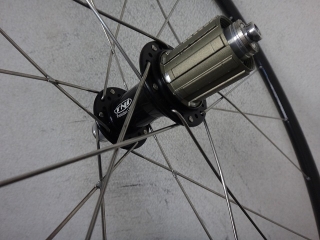
It's an Evolite hub 20H, semi-championship lacing with spoke nipple wrap—something I built in the past. They want me to use this rim to build a front wheel, so I also have an Evolite front hub 20H on hand.
At the same time, I also have a 24H version of the same rim and an Evolite rear hub 24H. They want a pair built: a 20H front wheel and a 24H rear wheel.
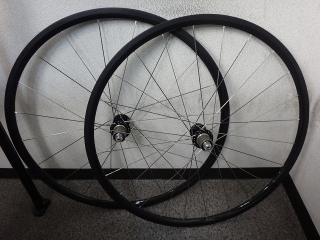
Since I can build the 24H rear wheel without disassembling the 20H rear wheel, I went ahead and built that one first.
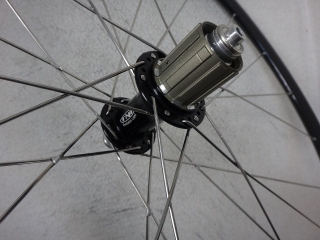
Evolite hub 24H, semi-competition lacing with spoke nipple wrap.
You can express "spoke volume" using spoke gravity ratio (%) × number of spokes × spoke length. If you leave out the length for a rough calculation, the free-side of the 20H semi-championship is 100 × 10 = 1000, and the free-side of the 24H semi-competition is 85 × 12 = 1020. In other words, the volume of spoke material used on the free-side is basically the same. The difference is in the spoke volume on the non-drive side, and the 24H uses asymmetrical left-right lacing. But from experience, it's clearly noticeable that the 24H rear wheel has better pickup—though it's hard to say what's actually making the difference.
If the rim height is high enough (around 60mm and up), the spokes get shorter, so a 20H rear wheel should work fine. But with a lower rim, I think a 20H rear wheel gets a bit tight. I'm talking about semi-championship lacing with spoke nipple wrap here. If you're using spokes equivalent to CX-RAY on both sides with no nipple wrap, or not weaving the final crossing, that's a different story altogether.

A customer brought in a rear wheel built with a 24mm high carbon tubular rim.

It's an Evolite hub 20H, semi-championship lacing with spoke nipple wrap—something I built in the past. They want me to use this rim to build a front wheel, so I also have an Evolite front hub 20H on hand.
At the same time, I also have a 24H version of the same rim and an Evolite rear hub 24H. They want a pair built: a 20H front wheel and a 24H rear wheel.

Since I can build the 24H rear wheel without disassembling the 20H rear wheel, I went ahead and built that one first.

Evolite hub 24H, semi-competition lacing with spoke nipple wrap.
You can express "spoke volume" using spoke gravity ratio (%) × number of spokes × spoke length. If you leave out the length for a rough calculation, the free-side of the 20H semi-championship is 100 × 10 = 1000, and the free-side of the 24H semi-competition is 85 × 12 = 1020. In other words, the volume of spoke material used on the free-side is basically the same. The difference is in the spoke volume on the non-drive side, and the 24H uses asymmetrical left-right lacing. But from experience, it's clearly noticeable that the 24H rear wheel has better pickup—though it's hard to say what's actually making the difference.
If the rim height is high enough (around 60mm and up), the spokes get shorter, so a 20H rear wheel should work fine. But with a lower rim, I think a 20H rear wheel gets a bit tight. I'm talking about semi-championship lacing with spoke nipple wrap here. If you're using spokes equivalent to CX-RAY on both sides with no nipple wrap, or not weaving the final crossing, that's a different story altogether.