Another day, another wheel (and so on).
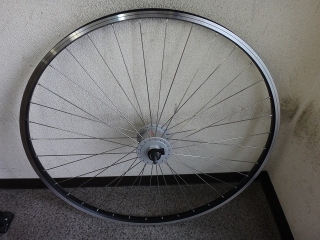
Built a front wheel with a Shimano hub dynamo.
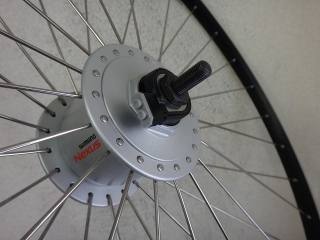
The hub is DH-C3000-3N-NT with 36 holes
laced radial with all Campagnolo #14 spokes as outpokes.
The "3N" in the model number means 3.0W output for rim brake use,
if the number is 2 it's 2.4W, and with no number it's 0.9W,
if the letter is R it's for front roller brake use,
and D means disc brake use.
The "NT" at the end means the hub shaft is nut-fixed,
whereas QR would indicate quick-release.
With higher-grade hubs that don't have a nut-fixed option,
there's no need to specify QR at all,
so sometimes the model suffix doesn't exist.
This hub comes in 28, 32, or 36 holes,
but since 36H was the only spec in stock
and the rear wheel is 36H, I went with 36H.
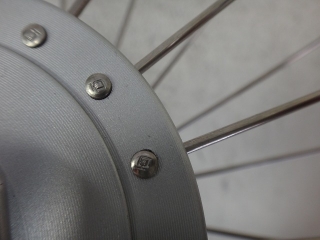
I went with radial lacing because the distance from the flange holes to the outer edge
is considerably thicker than on sports bike hubs,
and also because with rim brakes, well, it works just fine—
but there's actually a more decisive reason beyond that.
I won't go into the details here,
but it's a specific reason tied to this particular wheel's situation.
If I were to build another wheel with the same hub and rim down the road,
there's a chance I'd go with tangent lacing instead.
With tangent lacing, since it's a hub dynamo,
you can't accidentally install it backwards either,
so I'd probably have done Italian lacing,
but on utility bikes' off-the-shelf wheels (in the rim brake case),
even with a hub dynamo, it's customary and standard spec
to use JIS lacing. Looking at Shimano's instruction manual diagram
of the connector insertion area, it shows reverse Italian lacing,
but that might be because the manual is shared
with hub-brake wheels (the hub's left side isn't visible in the diagram).
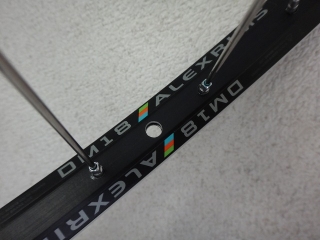
The rim is an ALEXRIMS DM18,
and the rim sticker had been changed to match the look of
the company's recent complete wheelsets.
It's different from the sticker on the matching rear wheel I built earlier (→here), but that's just how it goes.
The bigger difference, though, is that
the DM18 I used before had a single eyelets,
but this rim has no eyelets at all.
Looking into it, the stickers from one and two model years back
show a mix of single eyelets and no eyelets,
while earlier generations have no eyelets.
Both the front and rear rim came from the same distributor.
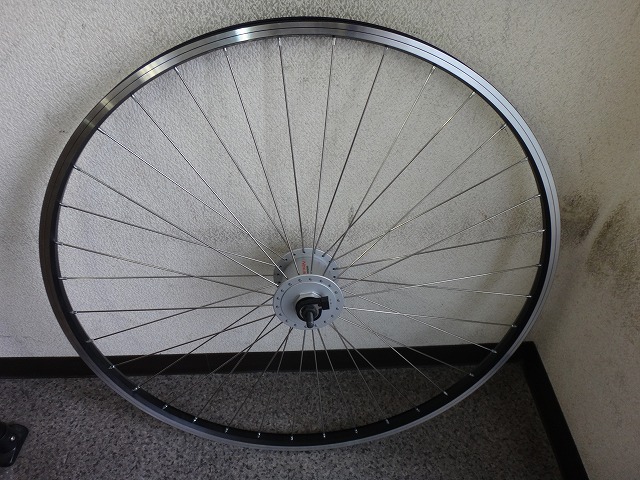
Built a front wheel with a Shimano hub dynamo.
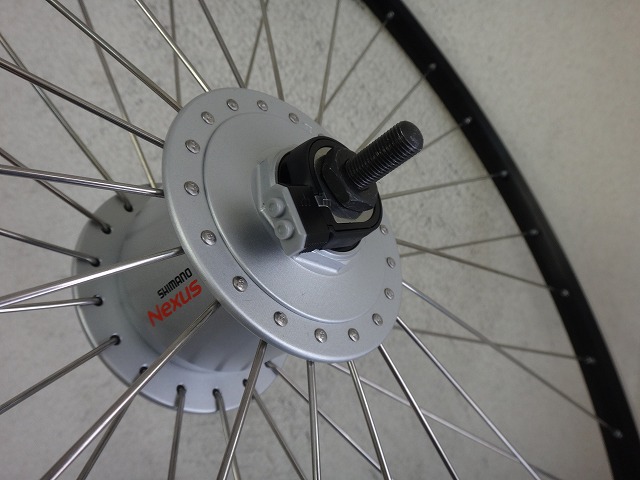
The hub is DH-C3000-3N-NT with 36 holes
laced radial with all Campagnolo #14 spokes as outpokes.
The "3N" in the model number means 3.0W output for rim brake use,
if the number is 2 it's 2.4W, and with no number it's 0.9W,
if the letter is R it's for front roller brake use,
and D means disc brake use.
The "NT" at the end means the hub shaft is nut-fixed,
whereas QR would indicate quick-release.
With higher-grade hubs that don't have a nut-fixed option,
there's no need to specify QR at all,
so sometimes the model suffix doesn't exist.
This hub comes in 28, 32, or 36 holes,
but since 36H was the only spec in stock
and the rear wheel is 36H, I went with 36H.
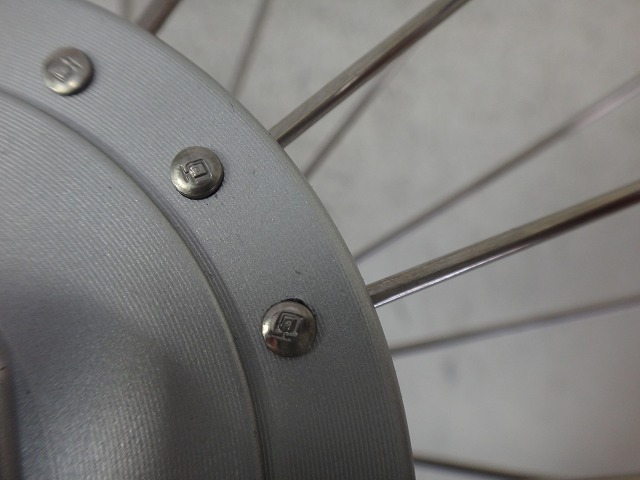
I went with radial lacing because the distance from the flange holes to the outer edge
is considerably thicker than on sports bike hubs,
and also because with rim brakes, well, it works just fine—
but there's actually a more decisive reason beyond that.
I won't go into the details here,
but it's a specific reason tied to this particular wheel's situation.
If I were to build another wheel with the same hub and rim down the road,
there's a chance I'd go with tangent lacing instead.
With tangent lacing, since it's a hub dynamo,
you can't accidentally install it backwards either,
so I'd probably have done Italian lacing,
but on utility bikes' off-the-shelf wheels (in the rim brake case),
even with a hub dynamo, it's customary and standard spec
to use JIS lacing. Looking at Shimano's instruction manual diagram
of the connector insertion area, it shows reverse Italian lacing,
but that might be because the manual is shared
with hub-brake wheels (the hub's left side isn't visible in the diagram).

The rim is an ALEXRIMS DM18,
and the rim sticker had been changed to match the look of
the company's recent complete wheelsets.
It's different from the sticker on the matching rear wheel I built earlier (→here), but that's just how it goes.
The bigger difference, though, is that
the DM18 I used before had a single eyelets,
but this rim has no eyelets at all.
Looking into it, the stickers from one and two model years back
show a mix of single eyelets and no eyelets,
while earlier generations have no eyelets.
Both the front and rear rim came from the same distributor.