I'm currently responding to comments and emails right now.
Since I have work to do, I'll handle the rest of my replies after I get home.
Among those emails, there was an inquiry asking,
"What do you think about using Champion spokes on the freewheel side and Competition spokes on the non-freewheel side for an asymmetrical build?"
Hmm, that's sharp insight.
When expressing spoke specific gravity (for plain spokes it stays the same,
for butted or aero spokes it's proportional to the cross-sectional area when converted to an equivalent plain spoke)
as freewheel side : non-freewheel side,
with the freewheel side set to 100,
Champion/Competition comes to 100:85.6,
Competition/CX-RAY (what we call "semi-Competition") comes to 100:74.7,
and Champion/CX-RAY comes to 100:64.0.
While left-right difference is important, weight also matters,
so I think Competition/CX-RAY is the best balance for most people.
But since I don't like the attitude of "just use the wheels I built for you without question!"
if you prefer the maximum left-right difference of Champion/CX-RAY,
or you want Competition/Champion for even more emphasis on spoke tension,
of course I'll build it for you. Feel free to place an order.

I don't post every wheel I've built here.
This one has a strong experimental element so I didn't post it,
but it's Champion spokes on the freewheel side and Competition spokes on the non-freewheel side.
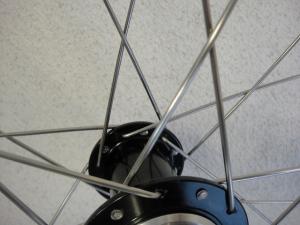
↑Freewheel side Champion 2.0mm plain
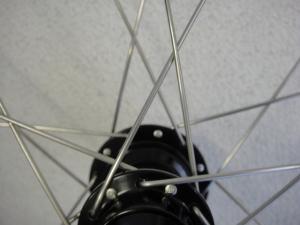
↑Non-freewheel side Competition 2.0-1.8-2.0mm
By the way, the freewheel side uses brass nipples.
The reason this has such a strong experimental element is that
while this specification matches the customer's request,
I chose the spokes on my own. Ha ha.
This hub has an extremely wide flange width of about 59mm (large dish),
so unless you use asymmetrical spoke diameters or asymmetrical spoke counts, the non-freewheel side tends to become loose.
So even when building a super-stiff wheel, I wanted to avoid same-diameter spoke builds on both sides.
Since I have work to do, I'll handle the rest of my replies after I get home.
Among those emails, there was an inquiry asking,
"What do you think about using Champion spokes on the freewheel side and Competition spokes on the non-freewheel side for an asymmetrical build?"
Hmm, that's sharp insight.
When expressing spoke specific gravity (for plain spokes it stays the same,
for butted or aero spokes it's proportional to the cross-sectional area when converted to an equivalent plain spoke)
as freewheel side : non-freewheel side,
with the freewheel side set to 100,
Champion/Competition comes to 100:85.6,
Competition/CX-RAY (what we call "semi-Competition") comes to 100:74.7,
and Champion/CX-RAY comes to 100:64.0.
While left-right difference is important, weight also matters,
so I think Competition/CX-RAY is the best balance for most people.
But since I don't like the attitude of "just use the wheels I built for you without question!"
if you prefer the maximum left-right difference of Champion/CX-RAY,
or you want Competition/Champion for even more emphasis on spoke tension,
of course I'll build it for you. Feel free to place an order.
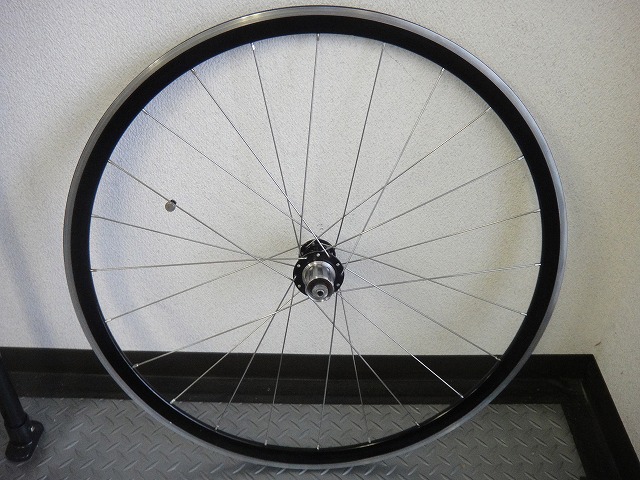
I don't post every wheel I've built here.
This one has a strong experimental element so I didn't post it,
but it's Champion spokes on the freewheel side and Competition spokes on the non-freewheel side.
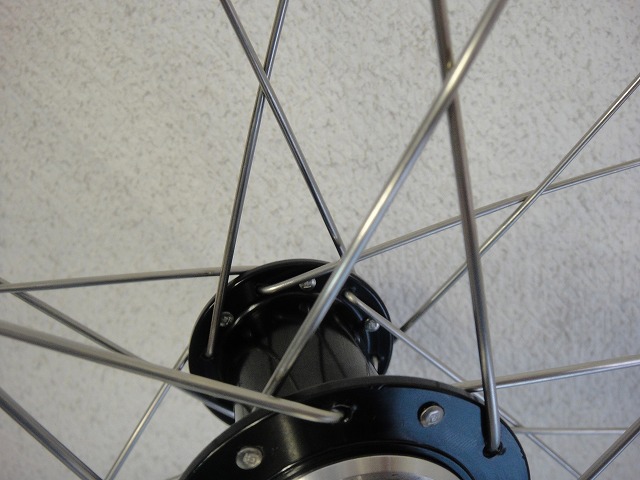
↑Freewheel side Champion 2.0mm plain
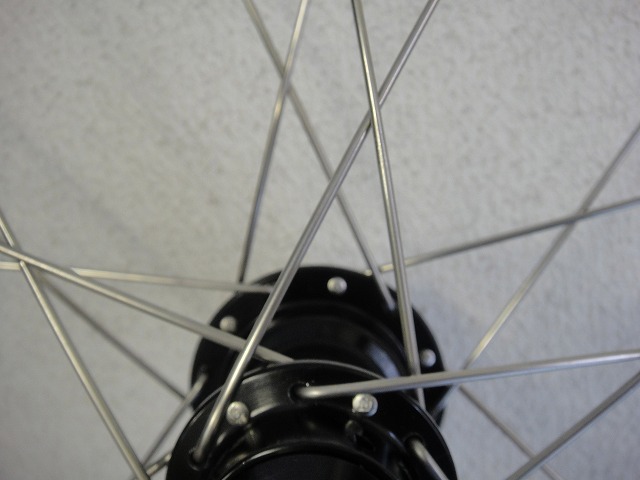
↑Non-freewheel side Competition 2.0-1.8-2.0mm
By the way, the freewheel side uses brass nipples.
The reason this has such a strong experimental element is that
while this specification matches the customer's request,
I chose the spokes on my own. Ha ha.
This hub has an extremely wide flange width of about 59mm (large dish),
so unless you use asymmetrical spoke diameters or asymmetrical spoke counts, the non-freewheel side tends to become loose.
So even when building a super-stiff wheel, I wanted to avoid same-diameter spoke builds on both sides.