Tomorrow, February 18th (Thursday), I'll be taking the day off
due to pressing personal matters.
I apologize for any inconvenience and appreciate your understanding.


The reason there are two days this month when I have pressing matters
and why the program is Beethoven's "Fate"
is that it's a rescheduled performance from last year's concert
held for Beethoven's 250th birthday anniversary.
Ola Rudner is a Swedish conductor, and
I don't know if he's particularly fond of Japan (though he probably is),
but he comes to Japan fairly often.

The next pressing date is April 12th,
and that's also with Rudner conducting.
It's rare for a single orchestra to bring in a foreign conductor
for just one performance. Usually, several orchestras pool their money
to invite a conductor and essentially "recycle" him across performances.
But if he came to Japan in these times,
whether he'd return to Sweden afterward is unclear,
but he'd spend two weeks in a country after leaving Japan,
then return to Japan for the April performance and spend another two weeks in quarantine—
which means March would be basically lockdown.
Or is he staying in Japan the entire time from February through April...?
I had this question, so at the last performance I asked someone in the orchestra,
and they said that next time Rudner wouldn't be coming—
a Japanese conductor substitute would take over.
Fate doesn't really matter, but for the April Tchaikovsky 5,
I really hope it's Rudner...
Come on...
Let me write about bike stuff too.
Previously, I saw a disc road bike ridden by an acquaintance who's a professional athlete—
a Focus Izalco MAX—and
the disc rotor diameters were 140mm front and 160mm rear.
Normally you'd go larger in the rear if you're using different sizes,
but when I asked why they were doing it this way (or had to),
they said that for the rear, the brake caliper was mounted directly to the frame,
and it's designed for 160mm rotors to begin with, so 140mm rotors won't fit.
The front being 140mm wasn't for weight savings—
but rather, if you use the larger 160mm rotor diameter,
you get a whistling, squealing noise during standing climbs or hard efforts,
whereas with 140mm it's much less noticeable.
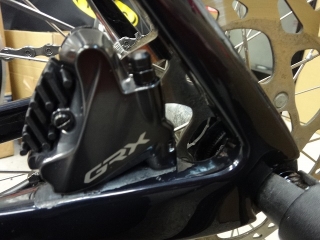
On a different note, this is a Merida Mission CX cyclocross bike
that we assembled here at the shop with a customer-supplied frame
(not that it matters, but the "Mission" model name was
originally used on their MTBs).
This bike's rear brake also has the caliper mounted directly to the frame and is designed for 160mm,
so it can't accommodate a 140mm rotor either.
The chainstay has a long vertical span,
and the caliper mounting bolt C that comes with the brake wasn't long enough,
so I used the appropriate length from a set I had on hand (→here).
If the standard included length works, you use that,
but if not, you end up using small parts instead,
which is the same as with rim brake countersunk nuts—
the standard lengths that come with brakes just keep accumulating...
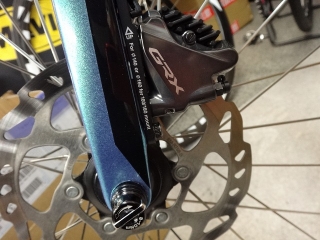
Next, the front. This also uses 160mm rotors.
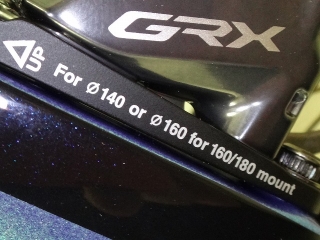
By flipping the tapered adapter top and bottom,
it accommodates two different rotor sizes.
The front brake's mounting surface isn't a through-hole,
so the brake can't be mounted directly.
It requires the adapter to be installed first.
Now, this adapter—for a fork designed for 140/160mm rotors,
if you install it with the wider side up, it works with 140mm rotors, but
this fork is designed for 160/180mm rotors,
so when installed with the wider side up it's for 160mm, and reversed it's for 180mm,
meaning 140mm rotors won't work.
Whether 140mm front and rear rotors are mainstream on cyclocross bikes, I'm not sure,
but the customer currently rides
a different cyclocross bike with 140mm rotors front and rear,
and we received the wheels from that bike,
but since the rotor diameters don't match,
we had the customer bring their original 160mm rotors and swapped them in.
If you want to share wheels between bikes, the other bike
would also need 160mm rotors (which is possible on that one).
The customer says that if they'd known this frame couldn't use 140mm rotors,
they wouldn't have bought it, and apparently
the manufacturer's website doesn't mention compatible rotor sizes.
Whether it's a disc road or cyclocross,
if you want to use 140mm rotors,
you need to research before purchasing.
If there's no info on the manufacturer's website and you can't find it anywhere else,
your only option is to contact the manufacturer or distributor directly...
due to pressing personal matters.
I apologize for any inconvenience and appreciate your understanding.


The reason there are two days this month when I have pressing matters
and why the program is Beethoven's "Fate"
is that it's a rescheduled performance from last year's concert
held for Beethoven's 250th birthday anniversary.
Ola Rudner is a Swedish conductor, and
I don't know if he's particularly fond of Japan (though he probably is),
but he comes to Japan fairly often.

The next pressing date is April 12th,
and that's also with Rudner conducting.
It's rare for a single orchestra to bring in a foreign conductor
for just one performance. Usually, several orchestras pool their money
to invite a conductor and essentially "recycle" him across performances.
But if he came to Japan in these times,
whether he'd return to Sweden afterward is unclear,
but he'd spend two weeks in a country after leaving Japan,
then return to Japan for the April performance and spend another two weeks in quarantine—
which means March would be basically lockdown.
Or is he staying in Japan the entire time from February through April...?
I had this question, so at the last performance I asked someone in the orchestra,
and they said that next time Rudner wouldn't be coming—
a Japanese conductor substitute would take over.
Fate doesn't really matter, but for the April Tchaikovsky 5,
I really hope it's Rudner...
Come on...
Let me write about bike stuff too.
Previously, I saw a disc road bike ridden by an acquaintance who's a professional athlete—
a Focus Izalco MAX—and
the disc rotor diameters were 140mm front and 160mm rear.
Normally you'd go larger in the rear if you're using different sizes,
but when I asked why they were doing it this way (or had to),
they said that for the rear, the brake caliper was mounted directly to the frame,
and it's designed for 160mm rotors to begin with, so 140mm rotors won't fit.
The front being 140mm wasn't for weight savings—
but rather, if you use the larger 160mm rotor diameter,
you get a whistling, squealing noise during standing climbs or hard efforts,
whereas with 140mm it's much less noticeable.

On a different note, this is a Merida Mission CX cyclocross bike
that we assembled here at the shop with a customer-supplied frame
(not that it matters, but the "Mission" model name was
originally used on their MTBs).
This bike's rear brake also has the caliper mounted directly to the frame and is designed for 160mm,
so it can't accommodate a 140mm rotor either.
The chainstay has a long vertical span,
and the caliper mounting bolt C that comes with the brake wasn't long enough,
so I used the appropriate length from a set I had on hand (→here).
If the standard included length works, you use that,
but if not, you end up using small parts instead,
which is the same as with rim brake countersunk nuts—
the standard lengths that come with brakes just keep accumulating...

Next, the front. This also uses 160mm rotors.

By flipping the tapered adapter top and bottom,
it accommodates two different rotor sizes.
The front brake's mounting surface isn't a through-hole,
so the brake can't be mounted directly.
It requires the adapter to be installed first.
Now, this adapter—for a fork designed for 140/160mm rotors,
if you install it with the wider side up, it works with 140mm rotors, but
this fork is designed for 160/180mm rotors,
so when installed with the wider side up it's for 160mm, and reversed it's for 180mm,
meaning 140mm rotors won't work.
Whether 140mm front and rear rotors are mainstream on cyclocross bikes, I'm not sure,
but the customer currently rides
a different cyclocross bike with 140mm rotors front and rear,
and we received the wheels from that bike,
but since the rotor diameters don't match,
we had the customer bring their original 160mm rotors and swapped them in.
If you want to share wheels between bikes, the other bike
would also need 160mm rotors (which is possible on that one).
The customer says that if they'd known this frame couldn't use 140mm rotors,
they wouldn't have bought it, and apparently
the manufacturer's website doesn't mention compatible rotor sizes.
Whether it's a disc road or cyclocross,
if you want to use 140mm rotors,
you need to research before purchasing.
If there's no info on the manufacturer's website and you can't find it anywhere else,
your only option is to contact the manufacturer or distributor directly...
Products Mentioned in This Article
* Amazon affiliate links — prices may vary
Original Japanese post: のむラボ日記 #5588