Another wheel day (and so on).
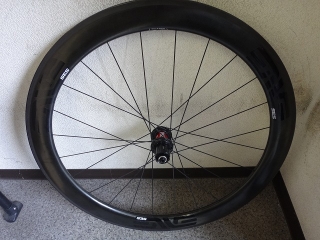
A customer brought in a rear wheel from a Smart Enve System 4.5 for me to work on.
Actually, I'd had them ask me before to do an inspection—or rather, to tension it more loosely—but the spokes were clearly too long, so I couldn't tension it much.
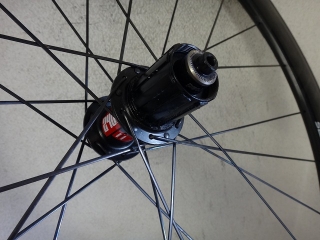
DT240S hub, 24H, all black CX-RAY, laced 6-spoke pattern.
If the manufacturer uses DT hubs as original equipment, the hub and spokes are the same, but in that case it would be 4-spoke, so this wasn't factory work.
It's work from some crappy shop somewhere in Japan.
As for what makes it so crappy—when I disassembled the wheel and yanked the inpokes carelessly from the hub flange, I found multiple scratches on the hub body where the threaded end of the spokes had gouged it. Not just one or two places either. If someone who had any sense had even made that mistake once, you'd think they'd be more careful after that. Apparently, that concept didn't exist for whoever did this.
The hub has reworking marks on it because they'd previously broken this rim with buckling and replaced it.
For just swapping the rim, there's no need to pull the spokes from the hub...
It doesn't seem like they had some strong conviction to rebuild it from a 4-spoke pattern to a 6-spoke. In that case, the hub flange would have two sets of marks—one from 4-spoke and one from 6-spoke lacing—so you could tell.
If the current state had been all CX-RAY 4-spoke, converting to a semi-comp 4/6 pattern would require different-length spokes on the freewheel side (not reusable) and longer spokes on the non-freewheel side due to the changed lacing pattern (also not reusable), so you'd need new spokes all around. But this time, I can reuse the CX-RAY 6-spokes from the non-freewheel side.

The rim model was 56AC. After this generation, the naming changed to A56 regardless of whether the rim is tubular, clincher, or tubeless. Since it's a clincher, the "C" comes after the "A".
By the way, as you can see on the rim tape in the image above, this rim is tubeless compatible...
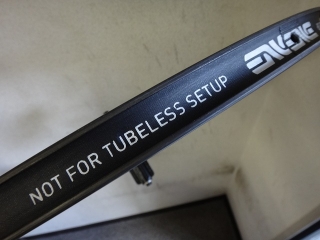
No it isn't.

Starting from the valve hole and going counterclockwise from the freewheel side, I disassembled it but left the last 4 spokes (a pair of final crossing left and right) without touching the nipples at all.
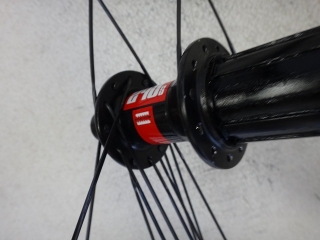
There's a reason why I didn't pull all the spokes from the non-freewheel side flange. I'll explain that later.
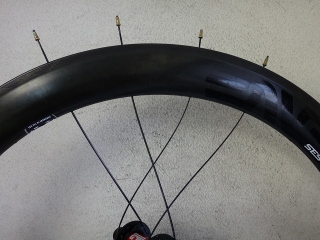
By doing this, you can clearly see the original spoke lengths.
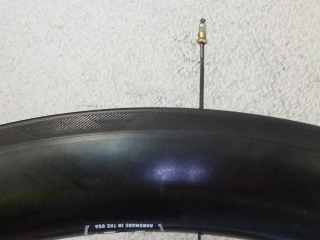
↑Next to the valve hole, non-freewheel side spoke.

↑Non-freewheel side spoke, same as the previous image
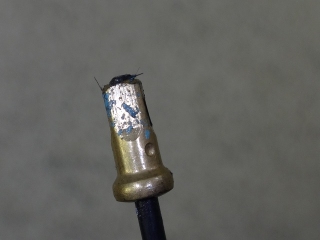
↑One more over, also non-freewheel side spoke
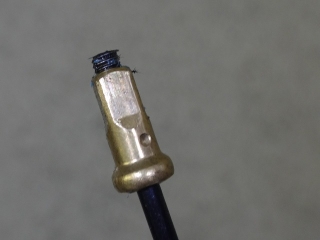
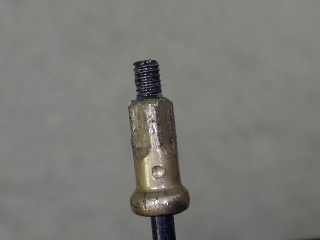
↑Both of these are freewheel side spokes.
The last image has the threads completely used up.
Normally, even if spoke length isn't quite right, either all the freewheel side spokes are long and all the non-freewheel side ones are short (or vice versa). The threaded portion between the spoke and nipple on the same side usually looks fairly uniform. But this wheel isn't like that.
I checked the lengths—they're 2mm different between freewheel and non-freewheel sides, but the same on each side.
(You can tell by looking at the end face or the length of the plain section on the threaded end.)
Since these were uncut CX-RAY spokes (both even-mm lengths), there's about 0.5mm of individual variation. (Spokes cut with a spoke cutter rather than hung off the spool show less runout during rough assembly, and that's why.) But in this case, the difference far exceeds that individual variance (↑wow, I'm using parentheses way more than usual).
So what does this mean? Well,
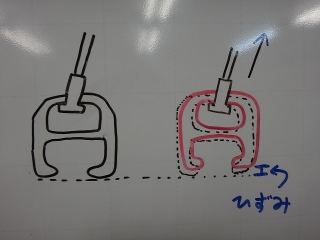
For example, with rims like Nomu Lab Wheel No. 5 or Shimano's C24 WO rim—lightweight, low-profile rims—the outer diameter shrinks inward quite noticeably due to spoke tension.
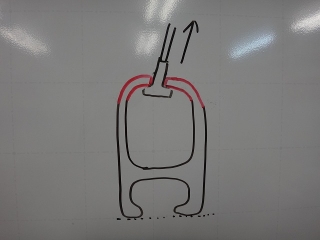
With a high-profile or rigid rim, even under considerable tension, the inner edge near the spoke holes does deform inward, but the outer edge of the rim doesn't deform inward as much.
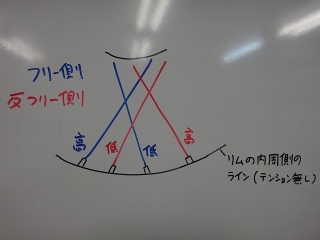
(With a normal wheel where spokes are even on both sides,) the innermost two crossing spokes, or the outermost two crossing spokes, must be one left and one right, but when the tension in the inner two is low and the outer two is high (or vice versa),
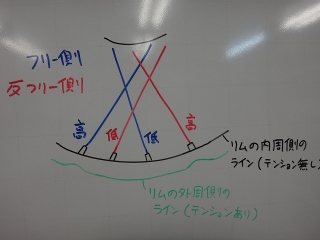
You get radial runout on a low-profile rim.
The four spokes on this Enve had higher tension on the outer two, so I drew it that way.
With a rim like this, if the thread wraps differ by 3 turns between the two spokes in the final crossing on the same side (which this wheel has roughly that much difference), you'd get serious radial runout. So with rims like this, you can often reduce tension variance quite a bit just by chasing down the radial runout.
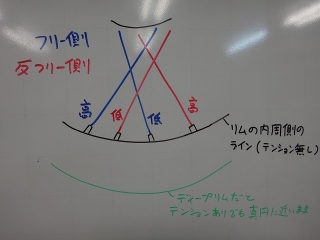
But with an Enve rim like this one—one that's absolutely rock-solid against spoke tension—while it's not completely rigid and immovable, the tension variance almost never shows up as radial runout on the rim's outer edge.
Actually, back when I first checked it, there wasn't noticeable radial runout (despite 3 turns' worth of difference in the final-crossing pair!). I noticed the tension variance, but fixing it would require loosening the nipples back nearly to a rough-assembly state and re-tensioning—basically as much work as building the whole wheel from scratch—so I didn't bother.
As for lateral runout, if the adjacent final crossing is also "high-low-low-high," the highs on the freewheel and non-freewheel sides next to each other cancel out fairly cleanly.
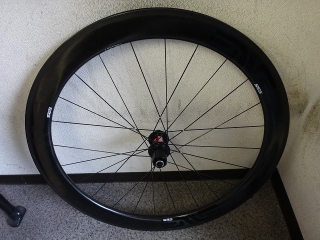
Built.
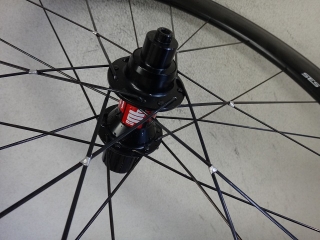
Black semi-comp 4/6 pattern with cross-threading.
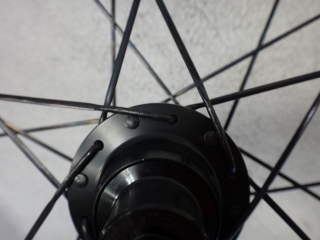
Before
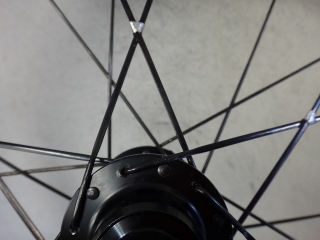
After
I've switched it from JIS lacing to Italian. I had to cut the non-freewheel side spokes a bit shorter, but as always, to distinguish the original inpokes from the original outpokes, I didn't pull the spokes from the non-freewheel flange even when I'd disassembled down to those final 4 spokes. (I could separate and set them aside properly if I wanted to, but... eh.)
This rim has a similar height and width to yesterday's Reynolds. The SES 56AC was lighter, but Reynolds is tubeless-ready, so if this world only had 56AC or AR58 rims to choose from, it'd be a tough call.
On a different note, if you search the blog archives for something like "やーめーろー ZIPP" (with full-width characters for ZIPP), you'll only get articles where crab-beam has actually measured and leaked the weight specs for ZIPP rims.
I've already built something of an archive.
I have no plans to expand it further, so I'm not going to reveal the measured weight of this rim.
The difference from Reynolds is something only I need to know.
↑ugh, bad vibes
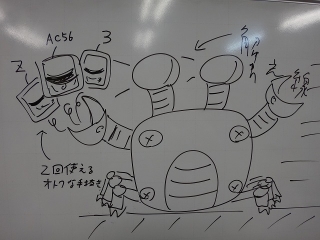
Sorr-y For The Wait!
As For This Image... The Reason I Have 3 Copies Will Be Revealed Later!
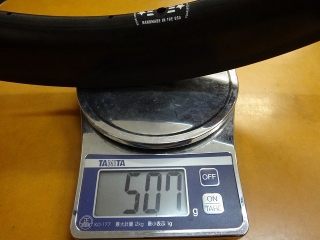
For Now Please Enjoy This Image!
↑Noooooo!

A customer brought in a rear wheel from a Smart Enve System 4.5 for me to work on.
Actually, I'd had them ask me before to do an inspection—or rather, to tension it more loosely—but the spokes were clearly too long, so I couldn't tension it much.

DT240S hub, 24H, all black CX-RAY, laced 6-spoke pattern.
If the manufacturer uses DT hubs as original equipment, the hub and spokes are the same, but in that case it would be 4-spoke, so this wasn't factory work.
It's work from some crappy shop somewhere in Japan.
As for what makes it so crappy—when I disassembled the wheel and yanked the inpokes carelessly from the hub flange, I found multiple scratches on the hub body where the threaded end of the spokes had gouged it. Not just one or two places either. If someone who had any sense had even made that mistake once, you'd think they'd be more careful after that. Apparently, that concept didn't exist for whoever did this.
The hub has reworking marks on it because they'd previously broken this rim with buckling and replaced it.
For just swapping the rim, there's no need to pull the spokes from the hub...
It doesn't seem like they had some strong conviction to rebuild it from a 4-spoke pattern to a 6-spoke. In that case, the hub flange would have two sets of marks—one from 4-spoke and one from 6-spoke lacing—so you could tell.
If the current state had been all CX-RAY 4-spoke, converting to a semi-comp 4/6 pattern would require different-length spokes on the freewheel side (not reusable) and longer spokes on the non-freewheel side due to the changed lacing pattern (also not reusable), so you'd need new spokes all around. But this time, I can reuse the CX-RAY 6-spokes from the non-freewheel side.

The rim model was 56AC. After this generation, the naming changed to A56 regardless of whether the rim is tubular, clincher, or tubeless. Since it's a clincher, the "C" comes after the "A".
By the way, as you can see on the rim tape in the image above, this rim is tubeless compatible...

No it isn't.

Starting from the valve hole and going counterclockwise from the freewheel side, I disassembled it but left the last 4 spokes (a pair of final crossing left and right) without touching the nipples at all.

There's a reason why I didn't pull all the spokes from the non-freewheel side flange. I'll explain that later.

By doing this, you can clearly see the original spoke lengths.

↑Next to the valve hole, non-freewheel side spoke.

↑Non-freewheel side spoke, same as the previous image

↑One more over, also non-freewheel side spoke


↑Both of these are freewheel side spokes.
The last image has the threads completely used up.
Normally, even if spoke length isn't quite right, either all the freewheel side spokes are long and all the non-freewheel side ones are short (or vice versa). The threaded portion between the spoke and nipple on the same side usually looks fairly uniform. But this wheel isn't like that.
I checked the lengths—they're 2mm different between freewheel and non-freewheel sides, but the same on each side.
(You can tell by looking at the end face or the length of the plain section on the threaded end.)
Since these were uncut CX-RAY spokes (both even-mm lengths), there's about 0.5mm of individual variation. (Spokes cut with a spoke cutter rather than hung off the spool show less runout during rough assembly, and that's why.) But in this case, the difference far exceeds that individual variance (↑wow, I'm using parentheses way more than usual).
So what does this mean? Well,

For example, with rims like Nomu Lab Wheel No. 5 or Shimano's C24 WO rim—lightweight, low-profile rims—the outer diameter shrinks inward quite noticeably due to spoke tension.

With a high-profile or rigid rim, even under considerable tension, the inner edge near the spoke holes does deform inward, but the outer edge of the rim doesn't deform inward as much.

(With a normal wheel where spokes are even on both sides,) the innermost two crossing spokes, or the outermost two crossing spokes, must be one left and one right, but when the tension in the inner two is low and the outer two is high (or vice versa),

You get radial runout on a low-profile rim.
The four spokes on this Enve had higher tension on the outer two, so I drew it that way.
With a rim like this, if the thread wraps differ by 3 turns between the two spokes in the final crossing on the same side (which this wheel has roughly that much difference), you'd get serious radial runout. So with rims like this, you can often reduce tension variance quite a bit just by chasing down the radial runout.

But with an Enve rim like this one—one that's absolutely rock-solid against spoke tension—while it's not completely rigid and immovable, the tension variance almost never shows up as radial runout on the rim's outer edge.
Actually, back when I first checked it, there wasn't noticeable radial runout (despite 3 turns' worth of difference in the final-crossing pair!). I noticed the tension variance, but fixing it would require loosening the nipples back nearly to a rough-assembly state and re-tensioning—basically as much work as building the whole wheel from scratch—so I didn't bother.
As for lateral runout, if the adjacent final crossing is also "high-low-low-high," the highs on the freewheel and non-freewheel sides next to each other cancel out fairly cleanly.

Built.

Black semi-comp 4/6 pattern with cross-threading.

Before

After
I've switched it from JIS lacing to Italian. I had to cut the non-freewheel side spokes a bit shorter, but as always, to distinguish the original inpokes from the original outpokes, I didn't pull the spokes from the non-freewheel flange even when I'd disassembled down to those final 4 spokes. (I could separate and set them aside properly if I wanted to, but... eh.)
This rim has a similar height and width to yesterday's Reynolds. The SES 56AC was lighter, but Reynolds is tubeless-ready, so if this world only had 56AC or AR58 rims to choose from, it'd be a tough call.
On a different note, if you search the blog archives for something like "やーめーろー ZIPP" (with full-width characters for ZIPP), you'll only get articles where crab-beam has actually measured and leaked the weight specs for ZIPP rims.
I've already built something of an archive.
I have no plans to expand it further, so I'm not going to reveal the measured weight of this rim.
The difference from Reynolds is something only I need to know.
↑ugh, bad vibes

Sorr-y For The Wait!
As For This Image... The Reason I Have 3 Copies Will Be Revealed Later!

For Now Please Enjoy This Image!
↑Noooooo!