Right now, I'm building front and rear wheels with the
M50, an MTB rim from a previous generation of ENVE,
and here's what I've researched about this.
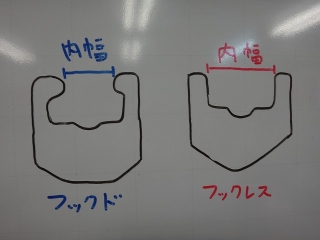
First, ENVE makes both hooked and hookless rims.
Regarding the inner width of hooked rims,
ENVE (and generally speaking, other manufacturers too)
measures the inner width as the distance between the tips of the bead hooks that curve inward.
It's not the width of the section where you apply rim tape.
So, except in extreme cases, if two rims have the same outer width,
the hooked rim will have a numerically smaller inner width.
The M50 rim (internal part number 29A) has actual measured dimensions of
rim height / inner width / outer width of
28.7 / 20.9 / 27.3 (mm), while the nominal values are
28 / 21 / 27 (mm).
Since I don't have actual measured data for all rims,
I'll write out all ENVE rim dimensions below using
the nominal values.
Also, on the whiteboard I use blue text for hooked rim inner widths
and red text for hookless rim inner widths.
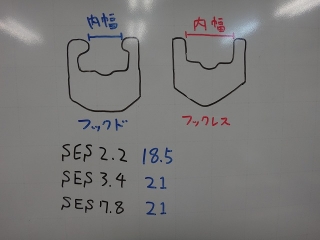
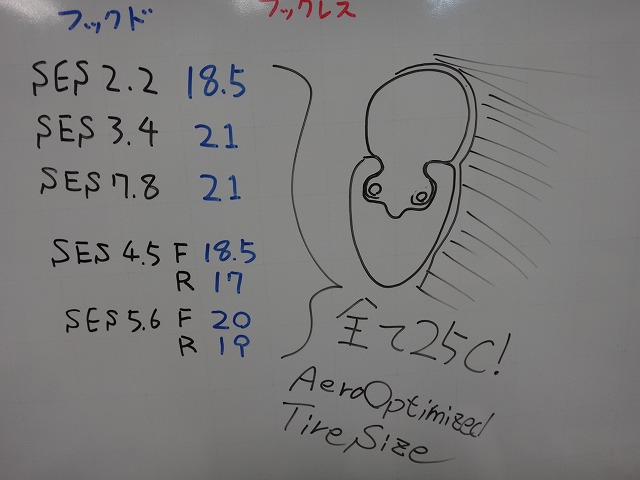
Of the current road bike SES series non-tubular rims,
I've written out the inner widths of the 2.2, 3.4, and 7.8 models.
They're in blue text because they're hooked rims.
The reason I pulled out these first is that
these are newer designs,
while slightly older SES models featured
the elaborate specification of varying rim widths between front and rear in the same set.
When stretch tape-type rim tape comes with them,
they even change that width by 1mm as well—that's the level of attention to detail.
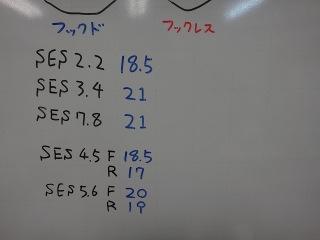
And so, I've also written out the inner widths of the 4.5 and 5.6,
which currently have different rim widths front and rear.
These rims have inner widths that differ by up to 4mm,
yet what ENVE advocates as
the "aerodynamically optimal tire width" is
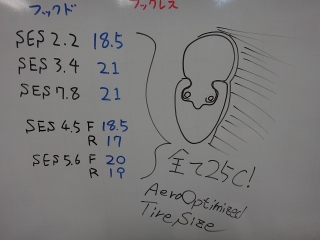
remarkably, all 25C.
They don't make fine adjustments to tire width based on rim inner width.
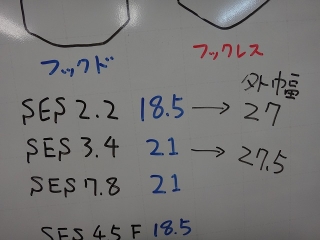
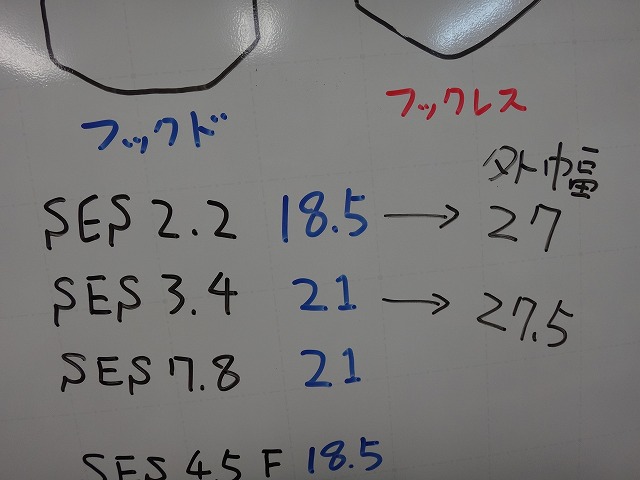
Comparing the 2.2 to the 3.4, the inner widths differ by 2.5mm,
but the outer widths differ by only 0.5mm.
This means the 2.2 has thicker bead hook sections.
So it's possible that when a tire is mounted,
the outer diameter difference won't be as pronounced as the inner width difference.
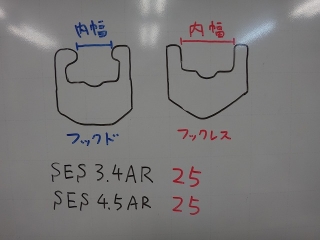
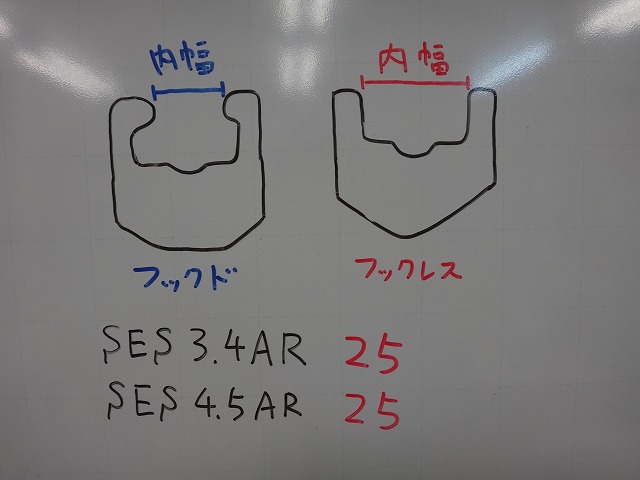
The inner widths of the SES AR series hookless rims for disc road bikes.
Since these are hookless rims, the numerical values are larger,
but both have an inner width of 25mm.
Regarding tire width specifications for this inner width,
the manufacturer's home site lists compatible tire sizes as 27–31C,
while the Japanese distributor's site states
the aerodynamically optimal width as 28C.
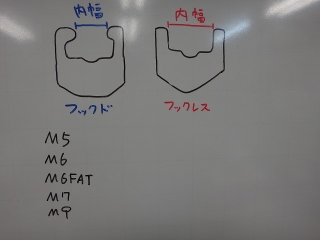
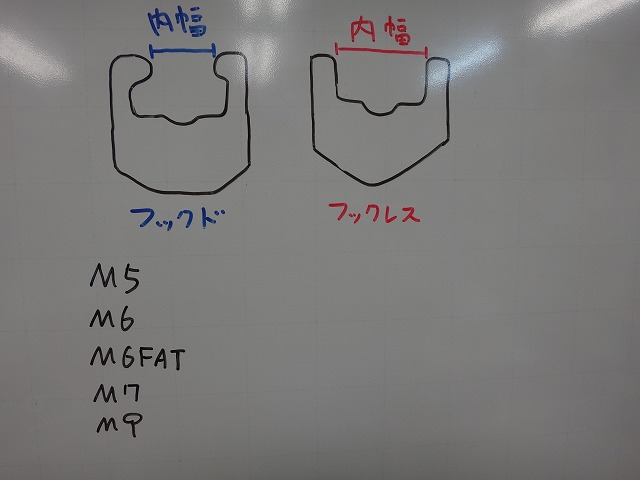
Next, the current MTB rims.
This is my own classification, but I'll call them the third generation in this article.
The digit after M is single, but
depending on the model, there can be multiple rim widths for the same number,
so after M + model number, we add a two-digit number for rim width (mm)
to make it three digits,
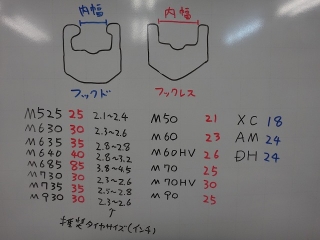
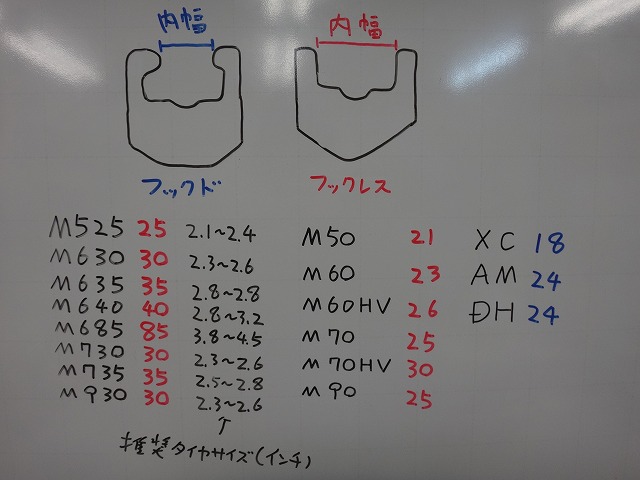
and following that convention, writing them all out gives
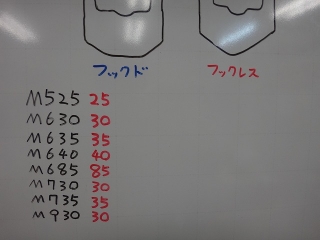
this.
The M6FAT fat rim that appeared in the previous image
becomes M685 in this image.
It means the M6 rim's 85mm inner width model.
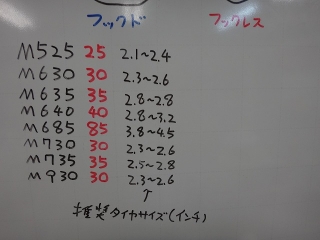
I've written out the recommended tire sizes for each rim.
In the chart above, M635 showing 2.8–2.8 is an error.
The correct specification is 2.5–2.8.
With SES (Smart Envi System),
the design is based on aerodynamic characteristics when tires are mounted, as advocated by Smart-san,
but MTB rims don't have anything like that.
What I want to note here is that if the rim inner width is the same,
the recommended tire sizes are also the same.
Also, for the M525 rim, 2.1–2.4 inches converts to about 53–61mm in metric,
and a hookless rim with 25mm inner width is the same as
the earlier SES 3.4 AR or SES 4.5 AR,
which list compatible tire sizes as 27–31C.
Wait—doesn't this contradict what I just wrote about "same rim width means same recommended tire size"?
It's possible that the design of the hookless flange height or similar differs,
and road and MTB rims may support different tire sizes for the same inner rim width.
Also, road rims may have deliberately different strength characteristics
to achieve higher maximum pressures than MTB rims
(even accounting for rim height differences, road rims tend to be heavier).
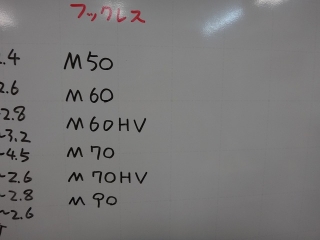
Next, the second generation MTB rims.
These have two digits after M,
and as the number gets larger, the intended category
shifts from XC-oriented to DH-oriented, same as the third generation.
When HV (Heavy) is appended at the end, it's a strength-focused spec
with wider rim width and heavier weight.
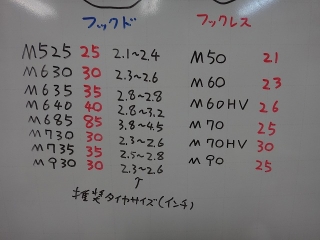
I've written out the rim inner widths.
Regarding recommended tire sizes,
they weren't listed in the manufacturer's archived website,
but even the narrowest M50 should be able to mount tires around 2 inches.
It's an MTB rim after all.
Compared to third generation rims, it's strange that
M90 and M525 have the same inner width.
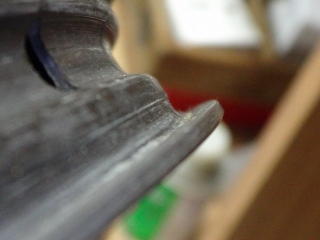
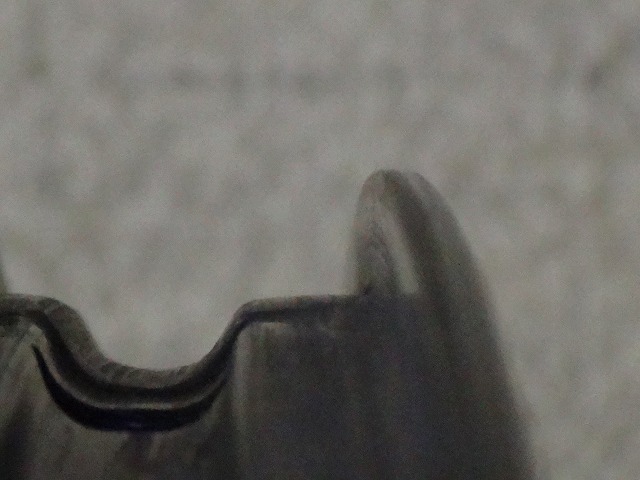
↑This is the SES 4.5 AR, and it has a flat hump.
The third generation MTB rims have this feature too.
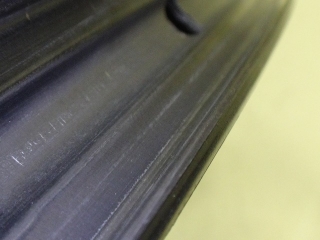
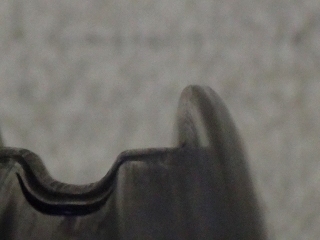
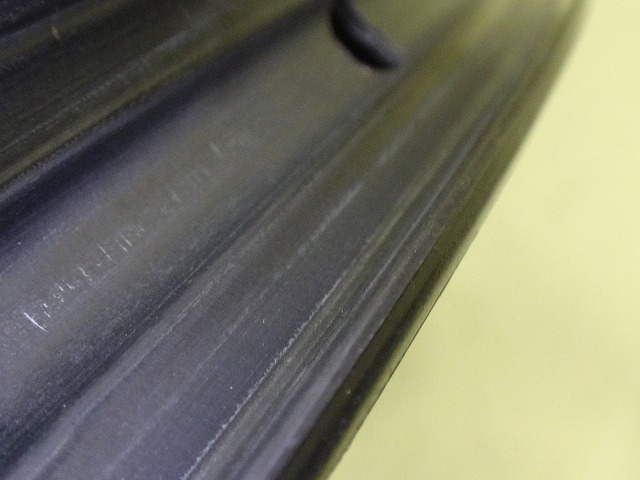
On the second generation M50 rim, by contrast,
while there are indentations for tire bead clearance,
there is no hump.
Also, the flank height is quite tall.
Regarding rims with low flanks (→here)
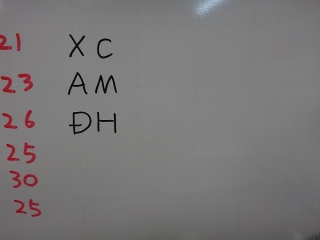
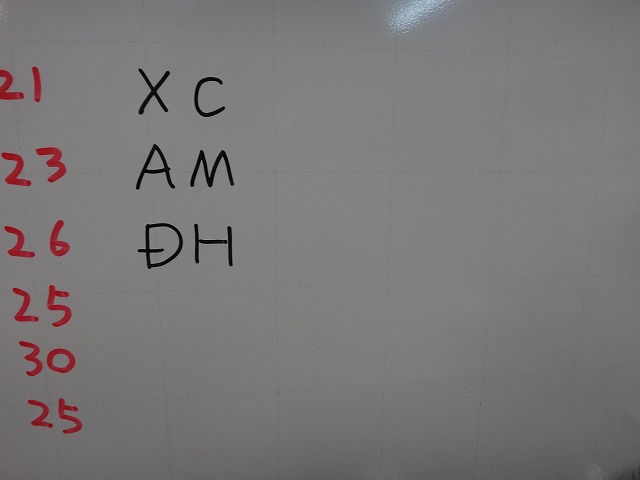
Finally, ENVE's first generation MTB rims.
With simple model names—XC for cross-country, AM for all-mountain,
and DH for downhill—
they offered three models.
The rim inner widths are as follows.
By the way, all of them are hooked rims.
These rims were produced during these periods:
XC from 2008–2014, AM and DH from 2008–2013.
Starting with the 2012 model, only XC and AM became tubeless-compatible rims.
Further, the XC even had a tubular rim version,
with tires available from TUFO and Challenge.
What I'm trying to say after all this is
that ENVE's basis for determining compatible tire widths for a given rim
seems to depend more on the intended role of the rim
rather than purely on inner rim width.
From this, the DH rim width from over 10 years ago
has become the rim width of current XC rims and disc road rims.
(It's also strange that XC and disc road have the same width.)

With DT (at least aluminum) rims,
compatible tire size and maximum pressure are determined solely by inner width.
The image above shows the XR331 rim.
Just because it's nominally an MTB rim doesn't mean
you can't fit narrow tires or use high pressure—
there's no such limitation.
This rim has only slightly wider inner and outer widths than DT's road RR411 series,
and it's actually narrower than some recent road rims designed for 28C tires.
Taking a 25C tire at the lower limit of the compatible size,
if it's a tubed setup, as shown in the table above, you can go up to 8.5 bar.
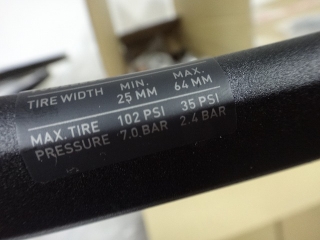
And here's the chart for tubeless,
which allows up to 7 bar.
Of course I follow the manufacturer's instructions,
but when the same manufacturer and same generation
has a flat-hump-equipped hookless 25mm inner width rim,
the SES AR series is compatible with 27–31C
while third generation MTB rims are compatible with 53–61C—
that does seem a bit odd.
Also, many recent road bike clincher tires,
with so-called appropriate tire sizing, tend to have
slightly pulled-tight outer diameters (especially 28C),
and I'm aware that newer ETTRTO follows this trend too,
yet it still feels counterintuitive to me
(like, does it really ride better than narrow rims + 23C tires?).
If wider tires are aerodynamically advantageous (including total rim design),
then for time trials
with higher competition speeds and far greater aerodynamic importance
and wheels that benefit from somewhat heavier rim weight—
like 1000m TT (averaging over 60 km/h from a standstill over one minute)
or hour records (averaging around 50 km/h over one hour)—
world records should be set soon enough
with tires around 28C wide (rolling resistance is lighter too, right?).
M50, an MTB rim from a previous generation of ENVE,
and here's what I've researched about this.
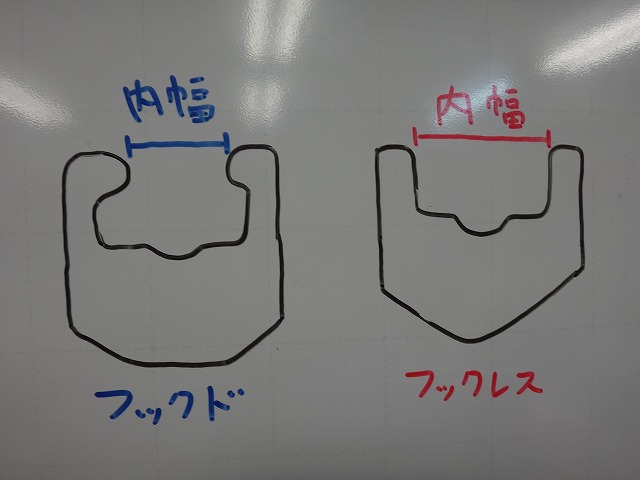
First, ENVE makes both hooked and hookless rims.
Regarding the inner width of hooked rims,
ENVE (and generally speaking, other manufacturers too)
measures the inner width as the distance between the tips of the bead hooks that curve inward.
It's not the width of the section where you apply rim tape.
So, except in extreme cases, if two rims have the same outer width,
the hooked rim will have a numerically smaller inner width.
The M50 rim (internal part number 29A) has actual measured dimensions of
rim height / inner width / outer width of
28.7 / 20.9 / 27.3 (mm), while the nominal values are
28 / 21 / 27 (mm).
Since I don't have actual measured data for all rims,
I'll write out all ENVE rim dimensions below using
the nominal values.
Also, on the whiteboard I use blue text for hooked rim inner widths
and red text for hookless rim inner widths.
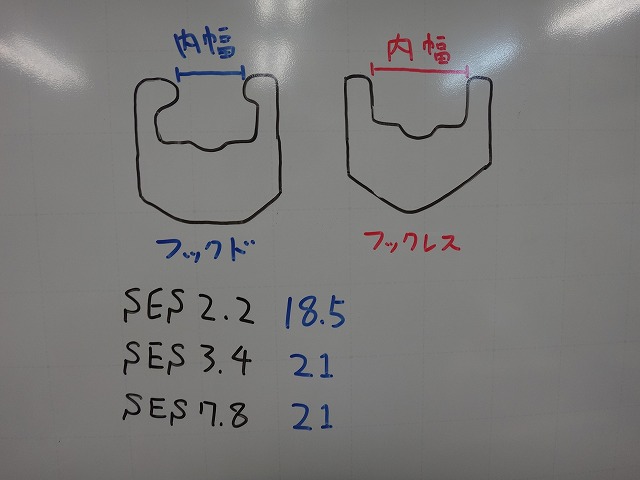
Of the current road bike SES series non-tubular rims,
I've written out the inner widths of the 2.2, 3.4, and 7.8 models.
They're in blue text because they're hooked rims.
The reason I pulled out these first is that
these are newer designs,
while slightly older SES models featured
the elaborate specification of varying rim widths between front and rear in the same set.
When stretch tape-type rim tape comes with them,
they even change that width by 1mm as well—that's the level of attention to detail.
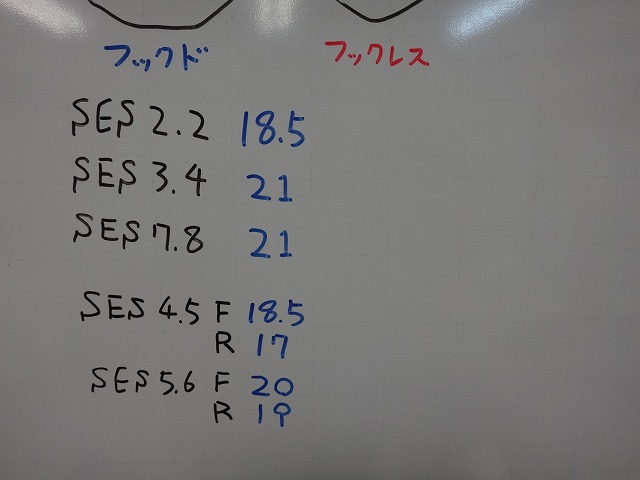
And so, I've also written out the inner widths of the 4.5 and 5.6,
which currently have different rim widths front and rear.
These rims have inner widths that differ by up to 4mm,
yet what ENVE advocates as
the "aerodynamically optimal tire width" is
remarkably, all 25C.
They don't make fine adjustments to tire width based on rim inner width.
Comparing the 2.2 to the 3.4, the inner widths differ by 2.5mm,
but the outer widths differ by only 0.5mm.
This means the 2.2 has thicker bead hook sections.
So it's possible that when a tire is mounted,
the outer diameter difference won't be as pronounced as the inner width difference.
The inner widths of the SES AR series hookless rims for disc road bikes.
Since these are hookless rims, the numerical values are larger,
but both have an inner width of 25mm.
Regarding tire width specifications for this inner width,
the manufacturer's home site lists compatible tire sizes as 27–31C,
while the Japanese distributor's site states
the aerodynamically optimal width as 28C.
Next, the current MTB rims.
This is my own classification, but I'll call them the third generation in this article.
The digit after M is single, but
depending on the model, there can be multiple rim widths for the same number,
so after M + model number, we add a two-digit number for rim width (mm)
to make it three digits,
and following that convention, writing them all out gives
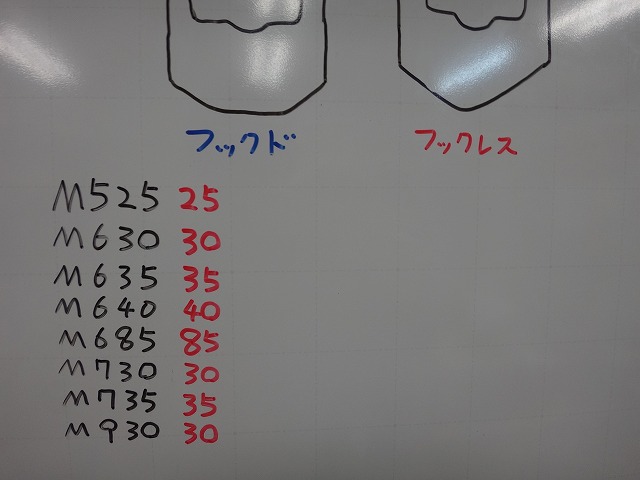
this.
The M6FAT fat rim that appeared in the previous image
becomes M685 in this image.
It means the M6 rim's 85mm inner width model.
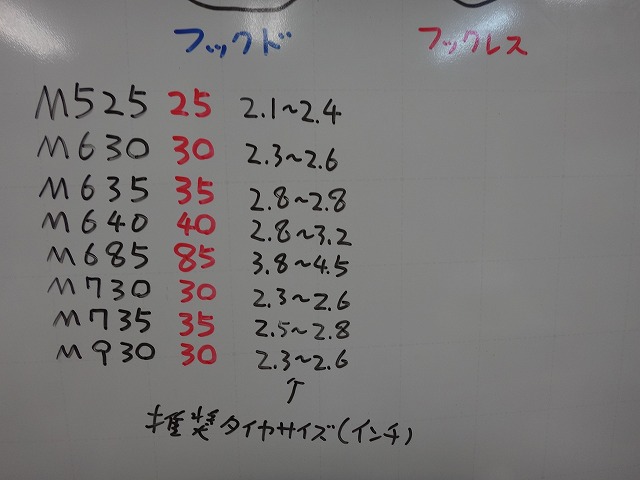
I've written out the recommended tire sizes for each rim.
In the chart above, M635 showing 2.8–2.8 is an error.
The correct specification is 2.5–2.8.
With SES (Smart Envi System),
the design is based on aerodynamic characteristics when tires are mounted, as advocated by Smart-san,
but MTB rims don't have anything like that.
What I want to note here is that if the rim inner width is the same,
the recommended tire sizes are also the same.
Also, for the M525 rim, 2.1–2.4 inches converts to about 53–61mm in metric,
and a hookless rim with 25mm inner width is the same as
the earlier SES 3.4 AR or SES 4.5 AR,
which list compatible tire sizes as 27–31C.
Wait—doesn't this contradict what I just wrote about "same rim width means same recommended tire size"?
It's possible that the design of the hookless flange height or similar differs,
and road and MTB rims may support different tire sizes for the same inner rim width.
Also, road rims may have deliberately different strength characteristics
to achieve higher maximum pressures than MTB rims
(even accounting for rim height differences, road rims tend to be heavier).

Next, the second generation MTB rims.
These have two digits after M,
and as the number gets larger, the intended category
shifts from XC-oriented to DH-oriented, same as the third generation.
When HV (Heavy) is appended at the end, it's a strength-focused spec
with wider rim width and heavier weight.
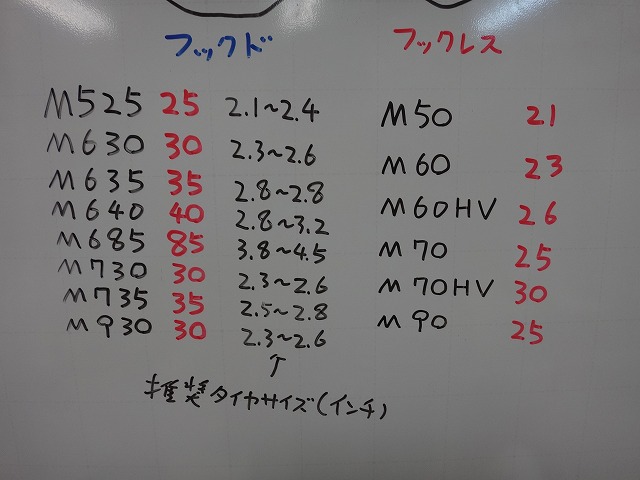
I've written out the rim inner widths.
Regarding recommended tire sizes,
they weren't listed in the manufacturer's archived website,
but even the narrowest M50 should be able to mount tires around 2 inches.
It's an MTB rim after all.
Compared to third generation rims, it's strange that
M90 and M525 have the same inner width.
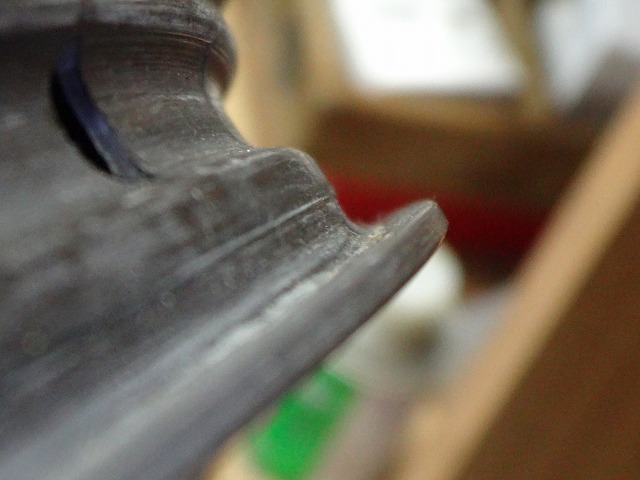
↑This is the SES 4.5 AR, and it has a flat hump.
The third generation MTB rims have this feature too.
On the second generation M50 rim, by contrast,
while there are indentations for tire bead clearance,
there is no hump.
Also, the flank height is quite tall.
Regarding rims with low flanks (→here)
Finally, ENVE's first generation MTB rims.
With simple model names—XC for cross-country, AM for all-mountain,
and DH for downhill—
they offered three models.
The rim inner widths are as follows.
By the way, all of them are hooked rims.
These rims were produced during these periods:
XC from 2008–2014, AM and DH from 2008–2013.
Starting with the 2012 model, only XC and AM became tubeless-compatible rims.
Further, the XC even had a tubular rim version,
with tires available from TUFO and Challenge.
What I'm trying to say after all this is
that ENVE's basis for determining compatible tire widths for a given rim
seems to depend more on the intended role of the rim
rather than purely on inner rim width.
From this, the DH rim width from over 10 years ago
has become the rim width of current XC rims and disc road rims.
(It's also strange that XC and disc road have the same width.)
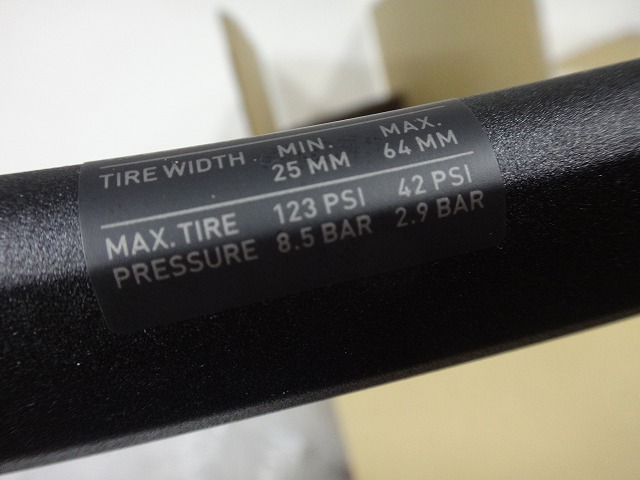
With DT (at least aluminum) rims,
compatible tire size and maximum pressure are determined solely by inner width.
The image above shows the XR331 rim.
Just because it's nominally an MTB rim doesn't mean
you can't fit narrow tires or use high pressure—
there's no such limitation.
This rim has only slightly wider inner and outer widths than DT's road RR411 series,
and it's actually narrower than some recent road rims designed for 28C tires.
Taking a 25C tire at the lower limit of the compatible size,
if it's a tubed setup, as shown in the table above, you can go up to 8.5 bar.
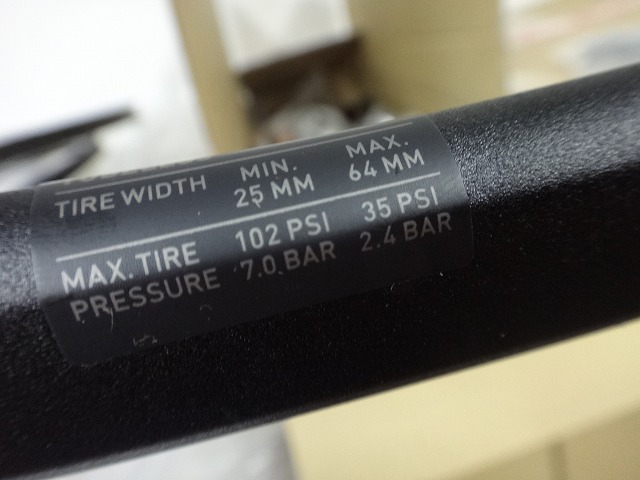
And here's the chart for tubeless,
which allows up to 7 bar.
Of course I follow the manufacturer's instructions,
but when the same manufacturer and same generation
has a flat-hump-equipped hookless 25mm inner width rim,
the SES AR series is compatible with 27–31C
while third generation MTB rims are compatible with 53–61C—
that does seem a bit odd.
Also, many recent road bike clincher tires,
with so-called appropriate tire sizing, tend to have
slightly pulled-tight outer diameters (especially 28C),
and I'm aware that newer ETTRTO follows this trend too,
yet it still feels counterintuitive to me
(like, does it really ride better than narrow rims + 23C tires?).
If wider tires are aerodynamically advantageous (including total rim design),
then for time trials
with higher competition speeds and far greater aerodynamic importance
and wheels that benefit from somewhat heavier rim weight—
like 1000m TT (averaging over 60 km/h from a standstill over one minute)
or hour records (averaging around 50 km/h over one hour)—
world records should be set soon enough
with tires around 28C wide (rolling resistance is lighter too, right?).