A customer brought in a Bora Ultra WTO—not just the regular Bora WTO—the 45mm high rim model for service.
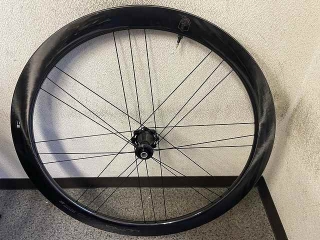
The Ultra only comes in disc brake versions.
The front hub body is carbon, and whereas the WTO uses USB bearings,
the Ultra uses CULT bearings instead.
But more importantly, this is truly what deserves to be called WTO (wind tunnel optimization, not the World Trade Organization)
and because of a certain new specification on the Ultra, the work was extremely tedious.
The image shows only the front wheel, but I was inspecting both front and rear wheels as new units.
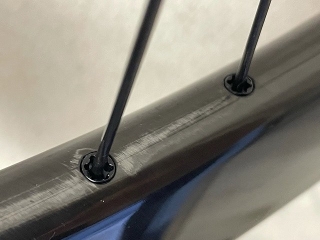
That certain new specification is this.
The WTO uses 4mm across-flats (3.95mm) square nipples,
but the Ultra WTO adopts special Torx-head nipples
that are aerodynamically nearly equivalent to internal nipples.
If we ignore tire contact patch deformation,
if X is the height from the ground to the center of the rear hub axle,
then the height of the tire's apex is 2X.
If the rear hub (and the frame it's mounted to)
is traveling at 40 km/h,
the speed of any point on the rotating wheel is proportional to its height,
so the wheel's apex (2X) travels at 80 km/h.
The upper half of the wheel is moving forward faster
than the hub or frame speed.
At 40 km/h, the portions of the rim side and nipples on the upper side of the wheel
are cutting through air at 60–70 km/h.
For this reason, to reduce air resistance at the wheel's outer perimeter
(to suppress turbulence generation)
rims are made taller and the number of spokes is reduced.
Recently, rims have shifted from V-section narrow rims
to U-section wide rims, and the cross-sectional shape
including the tire and rim together is
considered more aerodynamically superior,
so such rim shapes have become more common.
But if you're going to care about that, then exposed nipples—
square prisms, hexagonal prisms, or serrated cylinders—are
actually a considerable source of air resistance (or turbulence generation).
This has been understood for a long time,
so from the early days of complete aerodynamic wheels,
many adopted internal nipples.
Internal nipples have advantages like higher rim tension limits compared to exposed nipples,
but with tubular rims you need to peel off the tire for truing,
and with tubeless rims you need to remove non-reusable
tape-type rim tape, and so on—
serviceability is extremely poor.
If you believe that "maintainability is part of performance,"
you shouldn't go with internal nipple specifications.
Campagnolo's Bora and Mavic's Cosmic Carbon both have histories
of once using internal nipples and then moving away from them.
In Bora's case, the Colima rim that was the base of the original model
used internal nipples, which is partly why.
It's somewhat different from internal nipples,
but the WH-7800 series hub-side nipples were also
so poor in serviceability that pro team mechanics hated them,
so they weren't carried over to the WH-7900 series.
Now, regarding this Torx-head method,
with a rim that has no holes on the outer perimeter except the valve hole,
making it essentially an internal nipple is
something that, from a performance perspective alone, can be rated as excellent work.
However, serviceability is abysmal, and even though these are new,
the nylon lock nuts are quite tight and
the nipples don't turn smoothly—when you apply force,
many have that feel of suddenly breaking free with a snap,
which made my heart skip a beat.
On top of that, both wheels had center runout exceeding a sheet of paper,
and it became clear I'd need to touch every nipple on both sides,
so I had a bit of a struggle.
This Torx hole will definitely become even harder to service
if sand gets packed in it or the nipdles seize up from long-term use.
The structure itself is very well executed, though. Hmm.

The Ultra only comes in disc brake versions.
The front hub body is carbon, and whereas the WTO uses USB bearings,
the Ultra uses CULT bearings instead.
But more importantly, this is truly what deserves to be called WTO (wind tunnel optimization, not the World Trade Organization)
and because of a certain new specification on the Ultra, the work was extremely tedious.
The image shows only the front wheel, but I was inspecting both front and rear wheels as new units.

That certain new specification is this.
The WTO uses 4mm across-flats (3.95mm) square nipples,
but the Ultra WTO adopts special Torx-head nipples
that are aerodynamically nearly equivalent to internal nipples.
If we ignore tire contact patch deformation,
if X is the height from the ground to the center of the rear hub axle,
then the height of the tire's apex is 2X.
If the rear hub (and the frame it's mounted to)
is traveling at 40 km/h,
the speed of any point on the rotating wheel is proportional to its height,
so the wheel's apex (2X) travels at 80 km/h.
The upper half of the wheel is moving forward faster
than the hub or frame speed.
At 40 km/h, the portions of the rim side and nipples on the upper side of the wheel
are cutting through air at 60–70 km/h.
For this reason, to reduce air resistance at the wheel's outer perimeter
(to suppress turbulence generation)
rims are made taller and the number of spokes is reduced.
Recently, rims have shifted from V-section narrow rims
to U-section wide rims, and the cross-sectional shape
including the tire and rim together is
considered more aerodynamically superior,
so such rim shapes have become more common.
But if you're going to care about that, then exposed nipples—
square prisms, hexagonal prisms, or serrated cylinders—are
actually a considerable source of air resistance (or turbulence generation).
This has been understood for a long time,
so from the early days of complete aerodynamic wheels,
many adopted internal nipples.
Internal nipples have advantages like higher rim tension limits compared to exposed nipples,
but with tubular rims you need to peel off the tire for truing,
and with tubeless rims you need to remove non-reusable
tape-type rim tape, and so on—
serviceability is extremely poor.
If you believe that "maintainability is part of performance,"
you shouldn't go with internal nipple specifications.
Campagnolo's Bora and Mavic's Cosmic Carbon both have histories
of once using internal nipples and then moving away from them.
In Bora's case, the Colima rim that was the base of the original model
used internal nipples, which is partly why.
It's somewhat different from internal nipples,
but the WH-7800 series hub-side nipples were also
so poor in serviceability that pro team mechanics hated them,
so they weren't carried over to the WH-7900 series.
Now, regarding this Torx-head method,
with a rim that has no holes on the outer perimeter except the valve hole,
making it essentially an internal nipple is
something that, from a performance perspective alone, can be rated as excellent work.
However, serviceability is abysmal, and even though these are new,
the nylon lock nuts are quite tight and
the nipples don't turn smoothly—when you apply force,
many have that feel of suddenly breaking free with a snap,
which made my heart skip a beat.
On top of that, both wheels had center runout exceeding a sheet of paper,
and it became clear I'd need to touch every nipple on both sides,
so I had a bit of a struggle.
This Torx hole will definitely become even harder to service
if sand gets packed in it or the nipdles seize up from long-term use.
The structure itself is very well executed, though. Hmm.