I recently replaced the bearings in the front hub of a CLX50 that I'd rebuilt.

↑Right side (disc rotor mounting side)
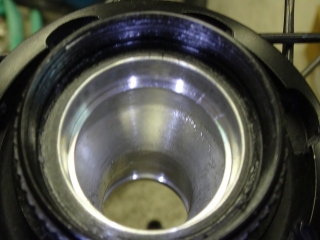
↑Left side (rotor mounting side)
I've written about this many times before, but
DT manufactures hubs for Roval,
and I can't understand the reasoning behind why
these stupid hub designs from Roval and GIANT's SLR wheels
didn't unnecessarily downsize the bearing dimensions compared to DT's own hubs.
This CLX50 hub had CeramicSpeed bearings installed,
but the hub endcaps were so stiff they couldn't be turned by hand—
the internal components were damaged.
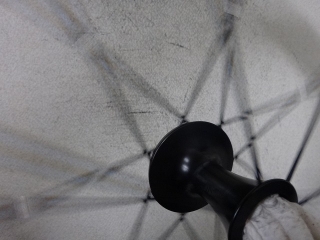
In the image above, I inserted my finger covered with a paper towel
into the hub shell after removing the bearing and spun it,
and the spin time with the bearing removed
actually lasted longer than the hub's rotation before bearing removal.
Roval hubs, especially the front wheel hubs, very frequently develop rough, grinding rotation.
This is mainly caused by over-tightening the thru-axle
(I've even seen bearings fail in bikes that haven't ridden in rain and aren't even six months old from purchase),
but the frequency isn't just because there are many of them in circulation
or just because Roval hub bearings are undersized.
Specialized's adoption of the "X-12 standard" thru-axle is probably also a factor.
But before that.
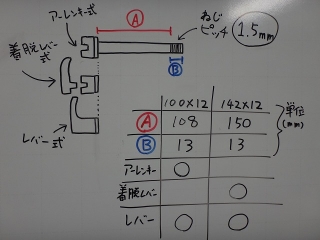
Excluding the BOOST standard, DT offers three different specifications
for the end of the thru-axle on the non-threaded side.
There's the Allen key type, the removable lever type,
and the fixed lever type.
The removable lever is called the "plugin type" by the manufacturer,
but when you remove the plugin portion, it's the same as the Allen key style,
so strictly speaking the head shape is two types, not three.
Most thru-axles have a thread pitch of 1.5mm,
and the diagram above summarizes what DT makes
for 1.5mm pitch thru-axles.
In the diagram above, length A is the non-threaded portion of the axle,
and length B is the length of the threaded portion.
Apart from the lever type, DT only makes front axles in Allen key style
and rear axles in removable lever style,
but it's possible to use the rear removable lever to turn a front axle,
and the removable lever portion is also sold separately.
With 1.5mm pitch axles,
the surface that contacts the fork or frame is flat.
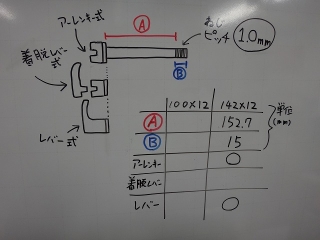
In Japanese DT wholesaler catalogs,
there's a lever with 1.0mm thread pitch and a flat frame contact surface
listed only for 142mm width.
There's no 100mm version of this pitch (at least not from DT).
On DT's website, it doesn't come up when searching for 142×12mm road axles
and is instead listed as 142mm non-BOOST MTB axles,
so it appears to be a specification that exists only on MTB side (probably in a transitional period).
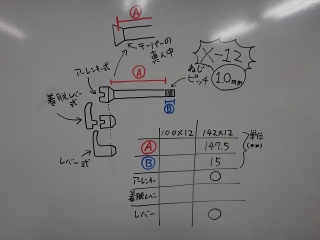
So, about the X-12 standard.
This is a thru-axle standard proposed by Syntace,
famous for lightweight stems and extension bars,
and is characterized by a 1.0mm thread pitch with a tapered contact surface at the fork and frame interface.
The tapered portion can be either the axle itself shaped that way
or a split spacer of that shape fitted over it.
The head-side end of shaft length A
is positioned at the middle of the taper at DT.
The diagram only shows the rear in both Allen key and lever styles,
but Specialized offers lever-type axles with the Specialized logo (made by DT)
for both front and rear, not just rear.
Actually, the A and B lengths differ slightly between
DT's X-12 standard axles and the Allen key-type axles that come on Specialized complete bikes,
but there are no compatibility issues.
With this X-12 standard thru-axle,
whether it's because the thread pitch is finer
or because the tapered contact bites in,
you can keep tightening well beyond the point where the wheel is adequately secured,
so with a press-fit hub that has small-diameter bearings,
excessive tightening pushes the cartridge bearing inner race too hard,
significantly shortening bearing life.
This isn't just with Allen key types, which often have longer temporary lever lengths than lever types—
even with lever-type axles, excessive tightening is easily achievable,
which I believe is why we commonly see damaged bearings in Roval front wheels.
Tightening the front thru-axle is sufficient once the wheel has no play left and right against the fork,
but even if you're worried about loosening, you should only tighten slightly beyond that point
or the bearings will be damaged rapidly.
The poor compatibility between the thru-axle standard Specialized adopted
and Roval's hub specifications is the cause,
but there's nothing that can be done about it, so users have to protect themselves.

↑Right side (disc rotor mounting side)

↑Left side (rotor mounting side)
I've written about this many times before, but
DT manufactures hubs for Roval,
and I can't understand the reasoning behind why
these stupid hub designs from Roval and GIANT's SLR wheels
didn't unnecessarily downsize the bearing dimensions compared to DT's own hubs.
This CLX50 hub had CeramicSpeed bearings installed,
but the hub endcaps were so stiff they couldn't be turned by hand—
the internal components were damaged.
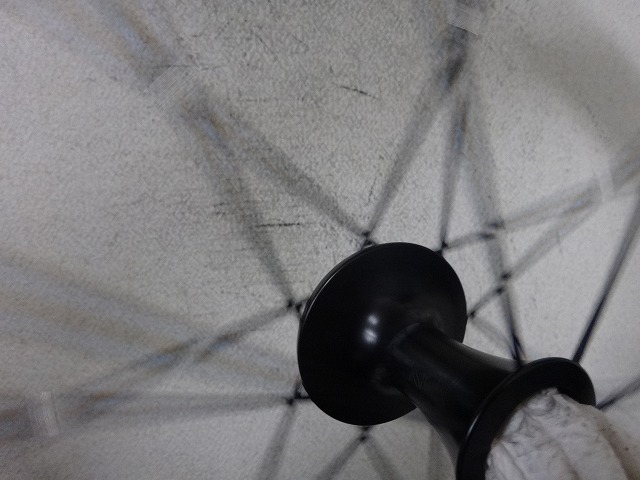
In the image above, I inserted my finger covered with a paper towel
into the hub shell after removing the bearing and spun it,
and the spin time with the bearing removed
actually lasted longer than the hub's rotation before bearing removal.
Roval hubs, especially the front wheel hubs, very frequently develop rough, grinding rotation.
This is mainly caused by over-tightening the thru-axle
(I've even seen bearings fail in bikes that haven't ridden in rain and aren't even six months old from purchase),
but the frequency isn't just because there are many of them in circulation
or just because Roval hub bearings are undersized.
Specialized's adoption of the "X-12 standard" thru-axle is probably also a factor.
But before that.
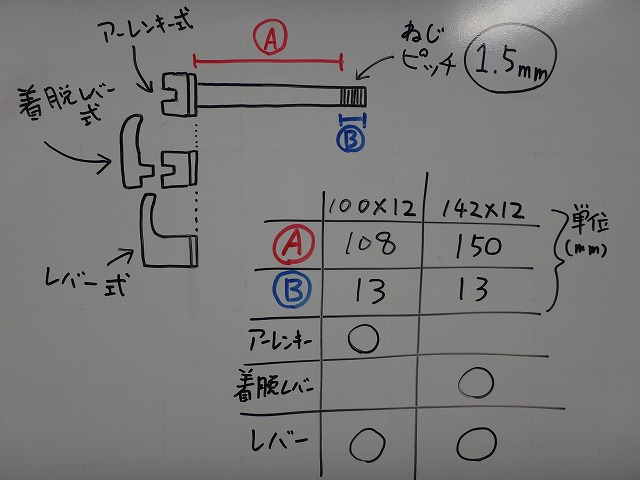
Excluding the BOOST standard, DT offers three different specifications
for the end of the thru-axle on the non-threaded side.
There's the Allen key type, the removable lever type,
and the fixed lever type.
The removable lever is called the "plugin type" by the manufacturer,
but when you remove the plugin portion, it's the same as the Allen key style,
so strictly speaking the head shape is two types, not three.
Most thru-axles have a thread pitch of 1.5mm,
and the diagram above summarizes what DT makes
for 1.5mm pitch thru-axles.
In the diagram above, length A is the non-threaded portion of the axle,
and length B is the length of the threaded portion.
Apart from the lever type, DT only makes front axles in Allen key style
and rear axles in removable lever style,
but it's possible to use the rear removable lever to turn a front axle,
and the removable lever portion is also sold separately.
With 1.5mm pitch axles,
the surface that contacts the fork or frame is flat.
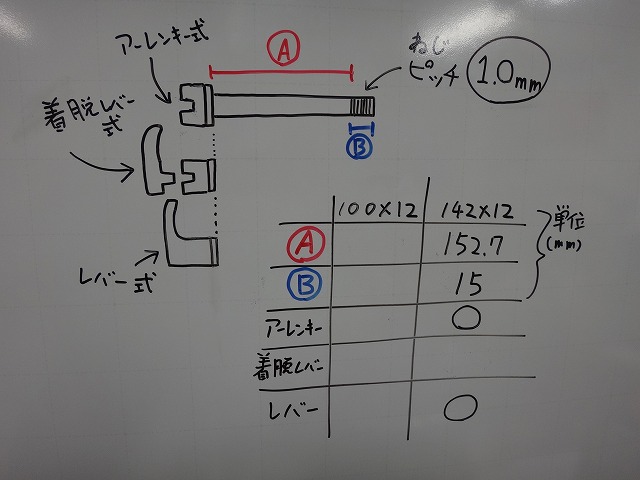
In Japanese DT wholesaler catalogs,
there's a lever with 1.0mm thread pitch and a flat frame contact surface
listed only for 142mm width.
There's no 100mm version of this pitch (at least not from DT).
On DT's website, it doesn't come up when searching for 142×12mm road axles
and is instead listed as 142mm non-BOOST MTB axles,
so it appears to be a specification that exists only on MTB side (probably in a transitional period).
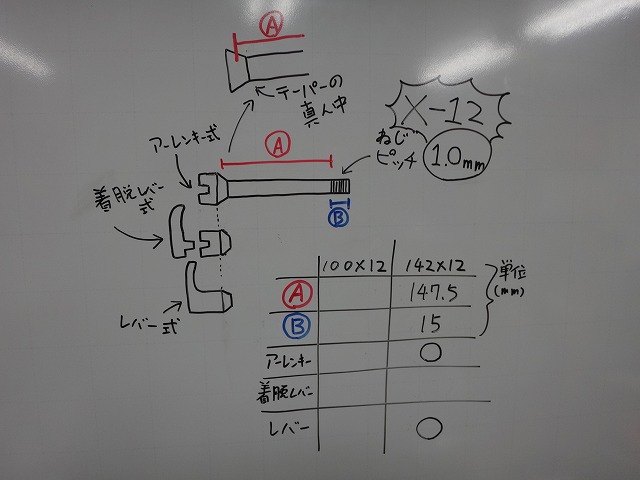
So, about the X-12 standard.
This is a thru-axle standard proposed by Syntace,
famous for lightweight stems and extension bars,
and is characterized by a 1.0mm thread pitch with a tapered contact surface at the fork and frame interface.
The tapered portion can be either the axle itself shaped that way
or a split spacer of that shape fitted over it.
The head-side end of shaft length A
is positioned at the middle of the taper at DT.
The diagram only shows the rear in both Allen key and lever styles,
but Specialized offers lever-type axles with the Specialized logo (made by DT)
for both front and rear, not just rear.
Actually, the A and B lengths differ slightly between
DT's X-12 standard axles and the Allen key-type axles that come on Specialized complete bikes,
but there are no compatibility issues.
With this X-12 standard thru-axle,
whether it's because the thread pitch is finer
or because the tapered contact bites in,
you can keep tightening well beyond the point where the wheel is adequately secured,
so with a press-fit hub that has small-diameter bearings,
excessive tightening pushes the cartridge bearing inner race too hard,
significantly shortening bearing life.
This isn't just with Allen key types, which often have longer temporary lever lengths than lever types—
even with lever-type axles, excessive tightening is easily achievable,
which I believe is why we commonly see damaged bearings in Roval front wheels.
Tightening the front thru-axle is sufficient once the wheel has no play left and right against the fork,
but even if you're worried about loosening, you should only tighten slightly beyond that point
or the bearings will be damaged rapidly.
The poor compatibility between the thru-axle standard Specialized adopted
and Roval's hub specifications is the cause,
but there's nothing that can be done about it, so users have to protect themselves.