A customer brought in a rear wheel from a Racing Zero bike.
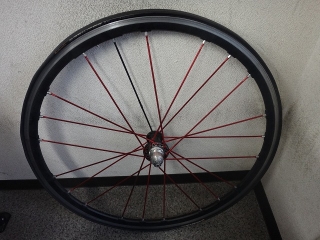
They noticed it was out of true and asked me to fix it.
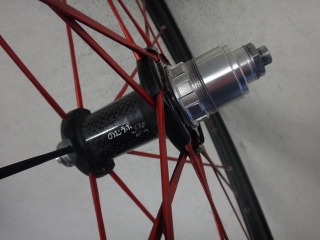
This wheel had its freebody swapped to an XDR (Shimano freehub standard) here at the shop back in the day,
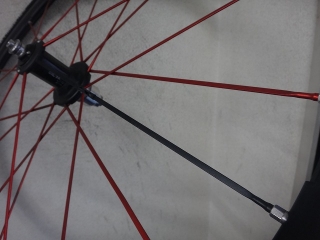
and it's got a computer magnet on it too,
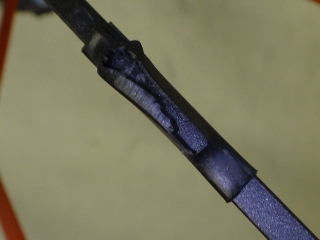
but the heat-shrink tubing that was supposed to hold the magnet in place—which was installed at the same time as the freebody swap—has torn and the magnet has gone missing.
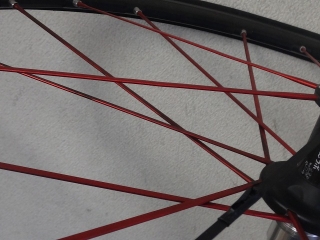
The wheel hadn't been used for a while, and the customer noticed the runout just recently, but it's not your typical lateral wobble. Several of the seven spokes on the non-drive side are clearly bent. There's virtually no fore-aft deformation, so it doesn't look like something got caught in the spinning wheel. There's definitely some specific cause that led to this, but when I asked the customer, they had no recollection of what happened. They say they haven't crashed either. I believe they're not making excuses or lying, but even just the bike falling over from its own weight wouldn't cause this kind of damage. Actually, it looks like some significant force was applied to the wheel itself. If this happened while the wheel was mounted in the rear triangle of the frame, the frame would also be damaged.
You can feel the deformation in the spokes if you run your finger along them,
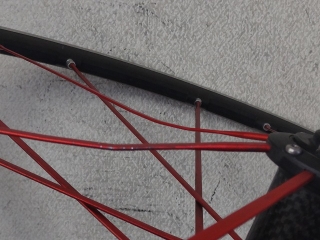
↑but when I released the tension, it looked like this. See the spoke in the center of the image?
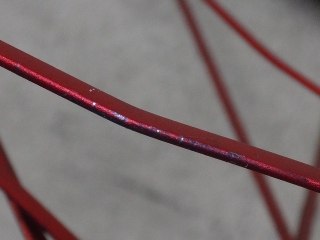
This spoke had a distinctive impact mark in the deformed section.
In the end, five of the seven spokes on the non-drive side needed replacement,
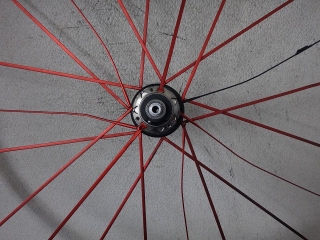
After removing the bent spoke from the flange and rotating it 90° in the same rotational direction, here's what you get.
This isn't quite like the Buffon needle problem, but if you drew a line across a side-view image of the wheel and noted where deformed spokes intersect that line, the phase of the deformed spokes wouldn't span more than a 180° range. What I'm getting at is that this isn't caused by a single incident—like, say, a car backing into a wheel leaning in a garage. The deformation pattern looks like that could be the case, but to cause damage across this range of the wheel, you'd need to apply force at different positions—hitting it two or three times at minimum (which is like drawing two or three lines across the wheel).
It's also suspicious that the heat-shrink tubing with the magnet got scraped off entirely. If, for example, someone in the household wasn't happy about the cycling hobby and unhesitatingly hammered the spokes repeatedly, that would explain the state of things.
Oops, I made a mistake (oops, as in what fell off). If I write "someone in the household," I'm basically revealing who the culprit is. But since I don't know whether this wheel's owner is married or not, it's not like I'm accusing any specific person, so I'm in the clear.
But there's definitely a specific cause here, and since the customer has no recollection, I'm forced to assume some malicious actor did this.
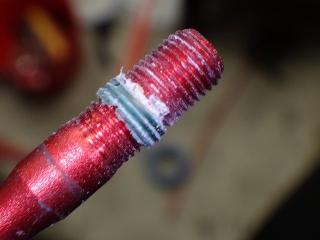
The removed spokes had a permanent threadlocker applied with surprising strength, but it does seem to prevent fine sand from getting into the spoke threads—like preventing sand from getting into a gum pocket. Maybe it's not entirely wasteful after all.
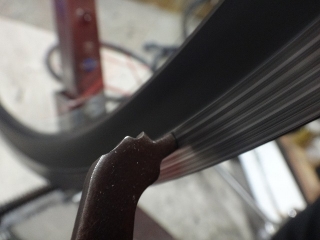
↑The wheel in this image is spinning. After replacing the spokes, I trued the lateral runout by adjusting only the non-drive side. I didn't touch a single nipple on the drive side. Since I previously centered this wheel perfectly, returning it to the state it was in one second before the hammer woman got to it should theoretically be possible with just non-drive side spoke adjustments.
※The cause is unclear, so I've made up an urban legend about the hammer woman. She's over 2 meters tall, sways her body in a writhing motion, chases you at 100 km/h if you run, and flees if you shout "Pomade!"
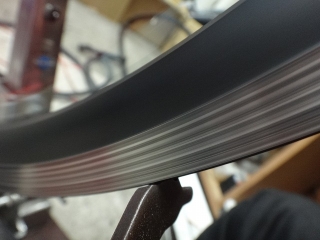
↑The wheel in this image is spinning. After doing a rough lateral true, there's virtually no radial runout. That's because I haven't touched a single nipple on the drive side's 14 spokes, so they're still functioning as the radial guide.
At this point, the wheel center was
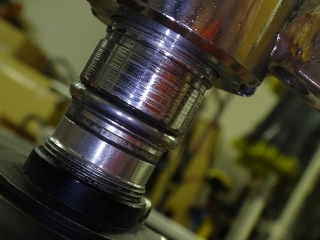

The rim is way off toward the drive side, but from here, simply tightening the non-drive side spokes will get it almost back to where it was.
Centering in progress... Still offset.

After further tightening the non-drive side, the center shifted past midpoint toward the drive side. Also, at this point I turned one nipple on the drive side just once. Radial runout never appeared. Since the rim has rest-phase holes, the naturally occurring outward radial runout at those points is much larger anyway.
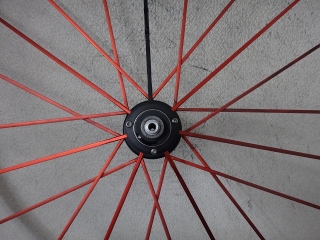
Centered.
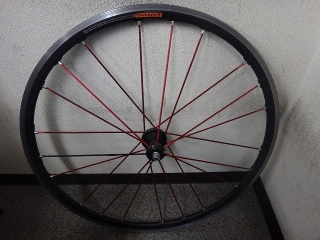
Fixed.
Five spokes were replaced, but I didn't apply my usual marking tape, and there's a reason for that.

Going back in the timeline, this is when I was trying to seat the head of a new spoke into the hub flange. I'm holding the spoke with just a turn or two on the nipple and pulling toward the hub, but it's nowhere near seating. These are Campagnolo-Fulcrum aluminum spokes, and when you remove several consecutive spokes from one side at once, the remaining tensioned spokes pull on the hub flange, making it impossible to seat new spokes. This usually doesn't happen if you replace one at a time, but I removed all five at once because I wanted that dramatic shot of "five bent spokes."
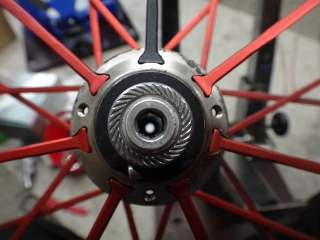
So to get the spoke heads to seat, I also loosened the two unbent spokes, which meant that "spokes I've removed or loosened" covered all seven non-drive side spokes, making the marker tape unnecessary.
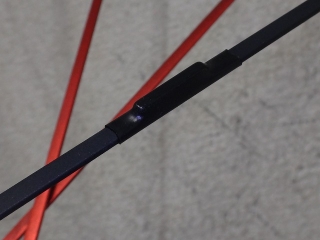
The customer had left the wheel magnet with me separately, so I reinstalled it at the designated position. The magnet is now in a different position than it was on the previous spoke.
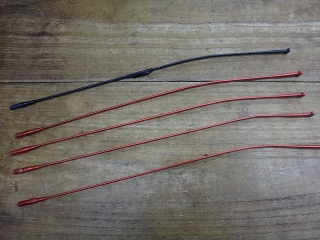
↑The replaced spokes. Spokes with fore-aft deformation have an effective length determined by the shortest distance of their bent shape when straightened by spoke tension, so mixing in shorter spokes creates a situation where truing the lateral runout causes excessive radial runout inward, and fixing the radial runout creates lateral runout and loses spoke tension—requiring spoke replacement. However, in this case the deformation was almost purely lateral, so the spokes could theoretically be re-straightened by hand and reused. In the image above, the three red spokes in the middle are the kind I could get away with reusing as a makeshift measure if we were out of spoke stock. This time, I went ahead and replaced them all.
But I really can't figure out the cause. If the wheel had been dropped from a height (like out a second-story window), the rim would be damaged, but there's none of that. The impact marks don't fit that scenario either, but if someone intentionally stomped and kicked the wheel while it was in a wheel bag with some force or malice, yeah, it could look like this... Maybe it really was the hammer woman after all. This kind of unexplainable phenomenon is what gives birth to "yokai" (spirits/demons).
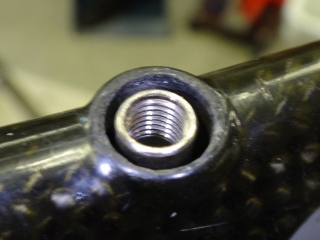
The same customer also left me a Bora wheelset (tubular-type) on a separate matter, and on both the Racing Zero and the Bora, the valve core extenders have been removed. The Racing Zero has a short valve, so as you can see in the opening image, even without an extender you'd only see the valve core area, which is why a very short extender is used.
But this Bora is missing its valve bushing. Whether it was removed when I took off the valve extender or if it got lost is unclear, but since the tire valve passes through almost the center of the valve hole, maybe it was just removed and not lost. And what I can say for certain is that among the current three generations of valve bushings, only the second generation can be removed and attached while the valve is threaded through the rim, and thus is prone to being lost. (See →here for details.)
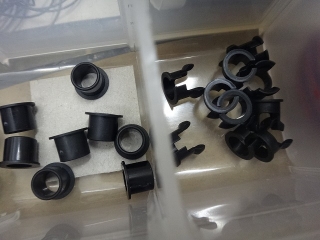
The second generation is discontinued and unobtainable, but I have them in stock (the one on the left in the image), so
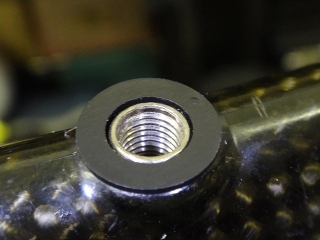
I installed one. Since the customer is from out of town, hopefully the valve bushing wasn't lost. But if it was, it could be a real hassle. If it turns out it wasn't lost and just came off, please keep it as a spare. The second generation tends to disappear unexpectedly.
If you attach a valve nut to a valve or valve extender with a threaded stem, it won't get lost, but tubular tire valve extenders generally don't have threads, so you can't attach a valve nut. The second-generation valve bushing often ends up sitting slightly loose on the rim rather than flush. Even if the tire were removed and replaced with a third-generation valve bushing, that would solve it, but this tire is glued on with rim cement, and considering the labor to peel it off and the service charge, I think this is fine as-is. A Continental German-made tubular tire was glued on, and if a different Continental or other tubular tire were applied with tubular tape instead, the adhesion to the black cotton rim tape would be abnormally strong, making removal essentially impossible. So for this case, even if it were glued with tubular tape, I'm replacing the valve bushing with the third generation, not just inserting the second generation.
※Since these might be thought to be typos, I'm linking to the originals for the first time in a while:
Tori-ae-su (鶏和え酢, "chicken and vinegar"—an old inside joke) (→here)
Tubular tape (チューベラーテープ) (→here)
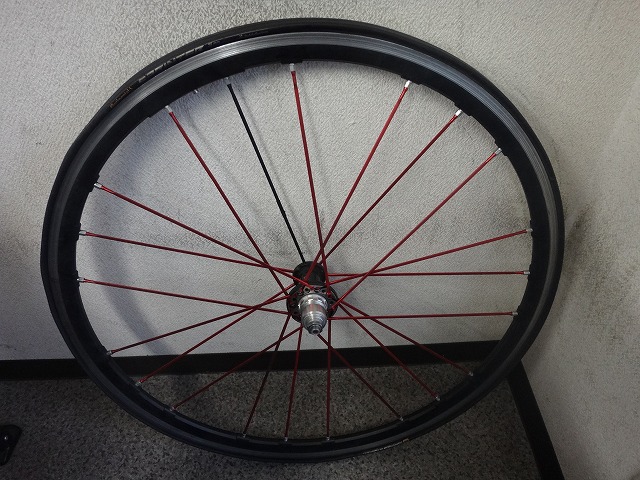
They noticed it was out of true and asked me to fix it.
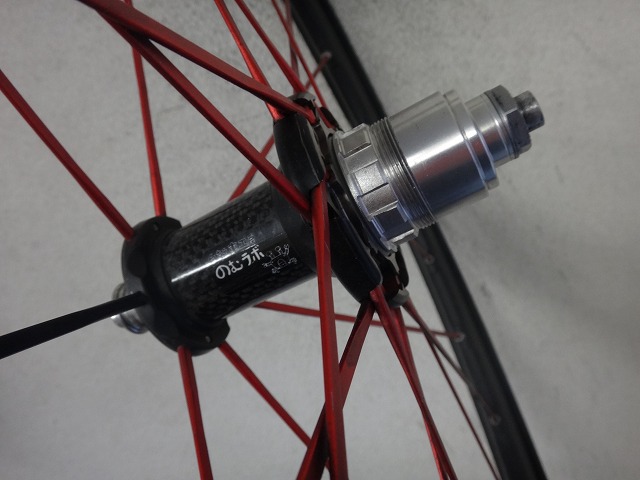
This wheel had its freebody swapped to an XDR (Shimano freehub standard) here at the shop back in the day,
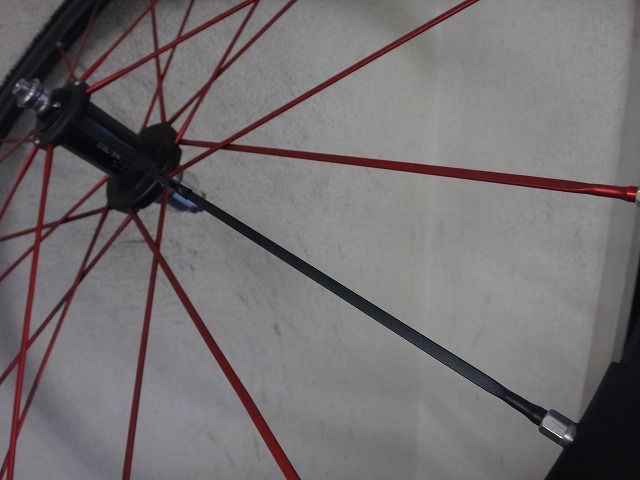
and it's got a computer magnet on it too,
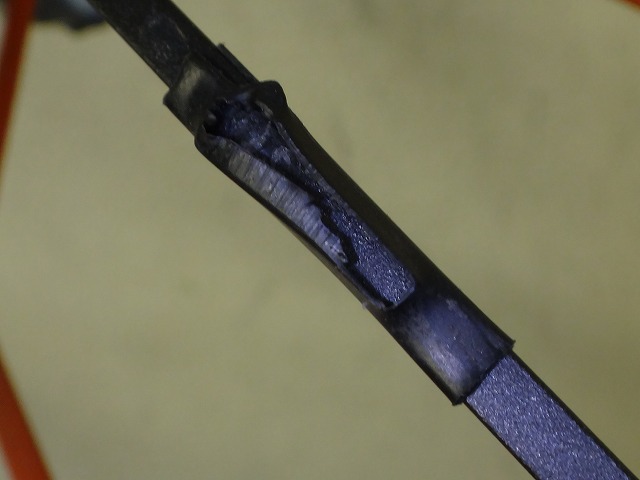
but the heat-shrink tubing that was supposed to hold the magnet in place—which was installed at the same time as the freebody swap—has torn and the magnet has gone missing.
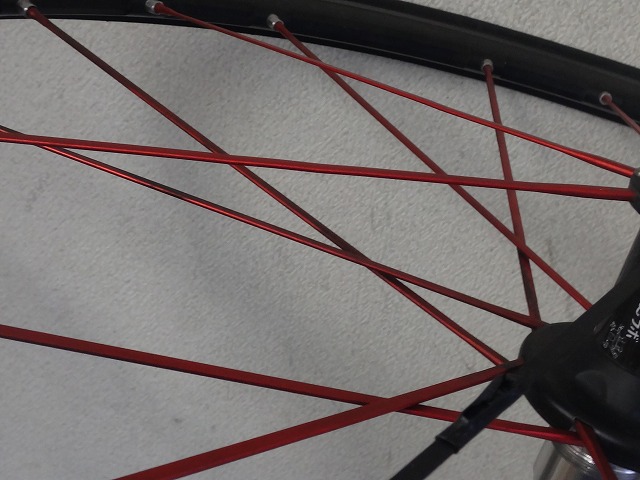
The wheel hadn't been used for a while, and the customer noticed the runout just recently, but it's not your typical lateral wobble. Several of the seven spokes on the non-drive side are clearly bent. There's virtually no fore-aft deformation, so it doesn't look like something got caught in the spinning wheel. There's definitely some specific cause that led to this, but when I asked the customer, they had no recollection of what happened. They say they haven't crashed either. I believe they're not making excuses or lying, but even just the bike falling over from its own weight wouldn't cause this kind of damage. Actually, it looks like some significant force was applied to the wheel itself. If this happened while the wheel was mounted in the rear triangle of the frame, the frame would also be damaged.
You can feel the deformation in the spokes if you run your finger along them,
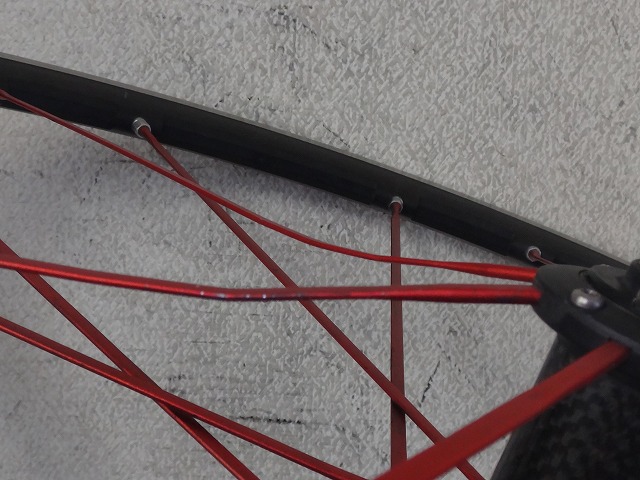
↑but when I released the tension, it looked like this. See the spoke in the center of the image?
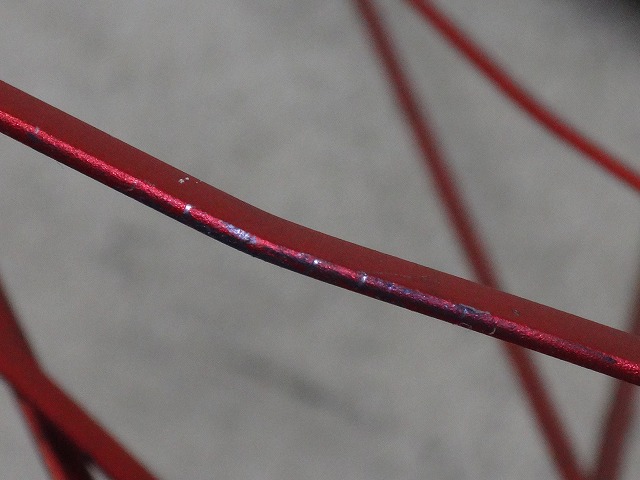
This spoke had a distinctive impact mark in the deformed section.
In the end, five of the seven spokes on the non-drive side needed replacement,
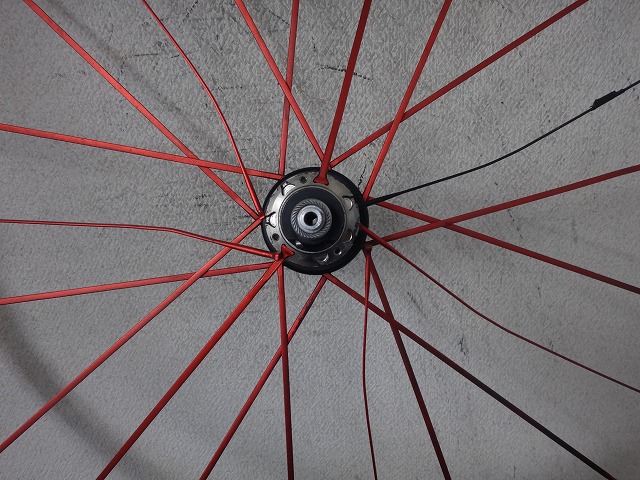
After removing the bent spoke from the flange and rotating it 90° in the same rotational direction, here's what you get.
This isn't quite like the Buffon needle problem, but if you drew a line across a side-view image of the wheel and noted where deformed spokes intersect that line, the phase of the deformed spokes wouldn't span more than a 180° range. What I'm getting at is that this isn't caused by a single incident—like, say, a car backing into a wheel leaning in a garage. The deformation pattern looks like that could be the case, but to cause damage across this range of the wheel, you'd need to apply force at different positions—hitting it two or three times at minimum (which is like drawing two or three lines across the wheel).
It's also suspicious that the heat-shrink tubing with the magnet got scraped off entirely. If, for example, someone in the household wasn't happy about the cycling hobby and unhesitatingly hammered the spokes repeatedly, that would explain the state of things.
Oops, I made a mistake (oops, as in what fell off). If I write "someone in the household," I'm basically revealing who the culprit is. But since I don't know whether this wheel's owner is married or not, it's not like I'm accusing any specific person, so I'm in the clear.
But there's definitely a specific cause here, and since the customer has no recollection, I'm forced to assume some malicious actor did this.
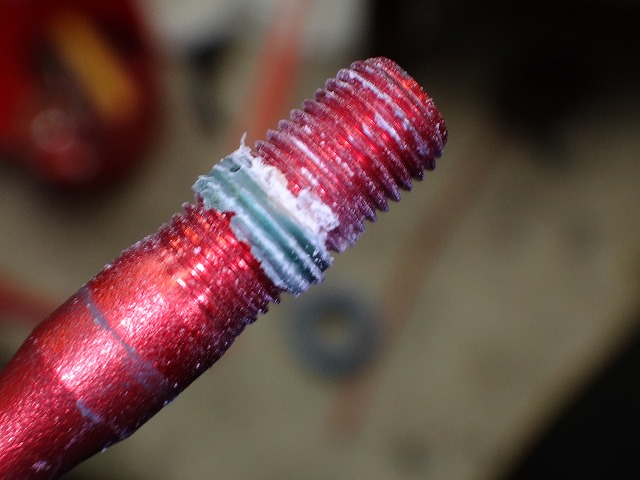
The removed spokes had a permanent threadlocker applied with surprising strength, but it does seem to prevent fine sand from getting into the spoke threads—like preventing sand from getting into a gum pocket. Maybe it's not entirely wasteful after all.
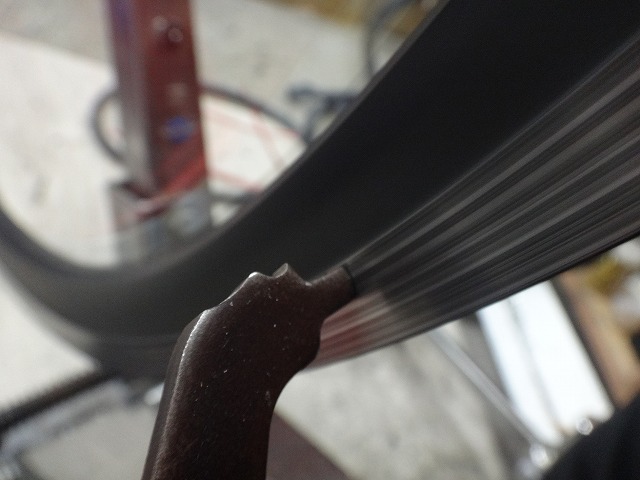
↑The wheel in this image is spinning. After replacing the spokes, I trued the lateral runout by adjusting only the non-drive side. I didn't touch a single nipple on the drive side. Since I previously centered this wheel perfectly, returning it to the state it was in one second before the hammer woman got to it should theoretically be possible with just non-drive side spoke adjustments.
※The cause is unclear, so I've made up an urban legend about the hammer woman. She's over 2 meters tall, sways her body in a writhing motion, chases you at 100 km/h if you run, and flees if you shout "Pomade!"
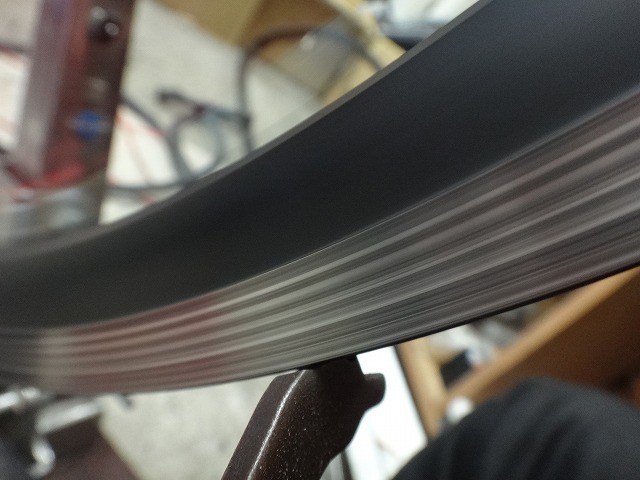
↑The wheel in this image is spinning. After doing a rough lateral true, there's virtually no radial runout. That's because I haven't touched a single nipple on the drive side's 14 spokes, so they're still functioning as the radial guide.
At this point, the wheel center was

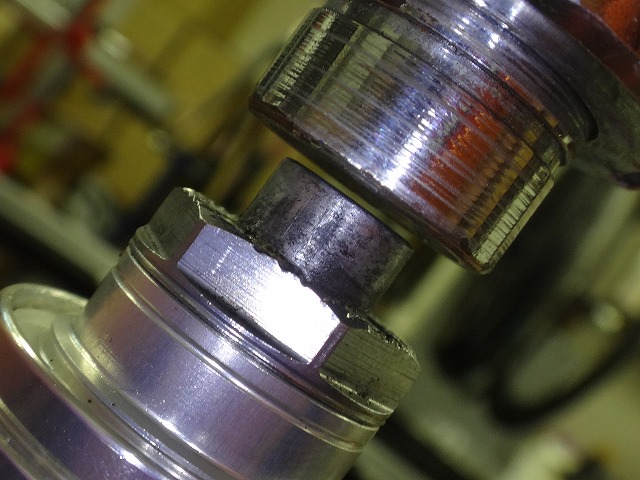
The rim is way off toward the drive side, but from here, simply tightening the non-drive side spokes will get it almost back to where it was.


Centering in progress... Still offset.
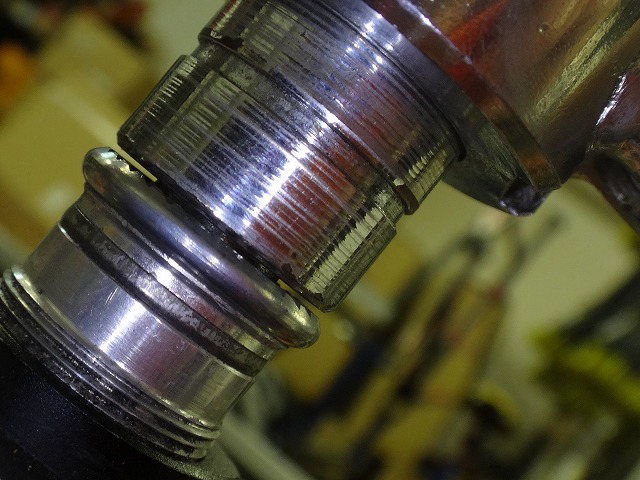

After further tightening the non-drive side, the center shifted past midpoint toward the drive side. Also, at this point I turned one nipple on the drive side just once. Radial runout never appeared. Since the rim has rest-phase holes, the naturally occurring outward radial runout at those points is much larger anyway.

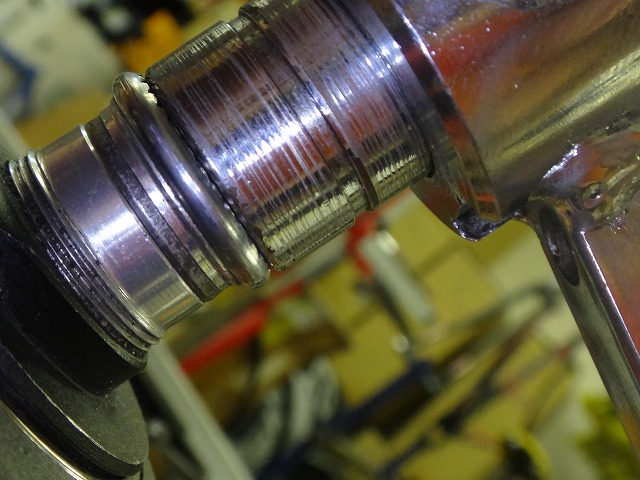
Centered.
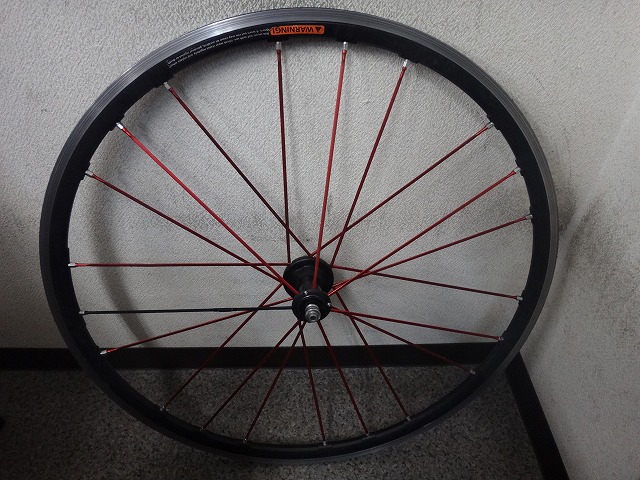
Fixed.

Five spokes were replaced, but I didn't apply my usual marking tape, and there's a reason for that.
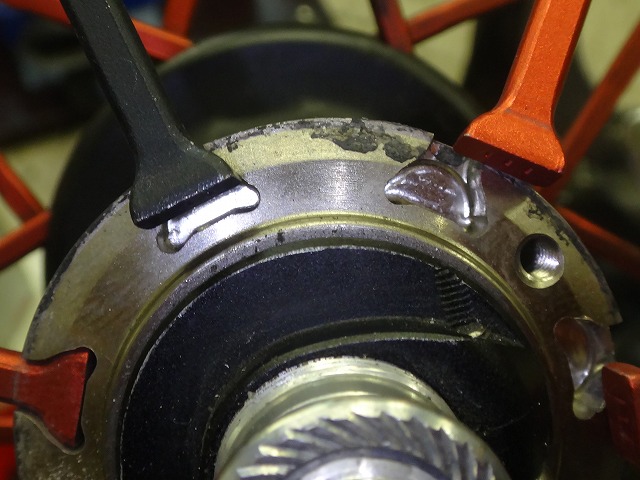
Going back in the timeline, this is when I was trying to seat the head of a new spoke into the hub flange. I'm holding the spoke with just a turn or two on the nipple and pulling toward the hub, but it's nowhere near seating. These are Campagnolo-Fulcrum aluminum spokes, and when you remove several consecutive spokes from one side at once, the remaining tensioned spokes pull on the hub flange, making it impossible to seat new spokes. This usually doesn't happen if you replace one at a time, but I removed all five at once because I wanted that dramatic shot of "five bent spokes."

So to get the spoke heads to seat, I also loosened the two unbent spokes, which meant that "spokes I've removed or loosened" covered all seven non-drive side spokes, making the marker tape unnecessary.
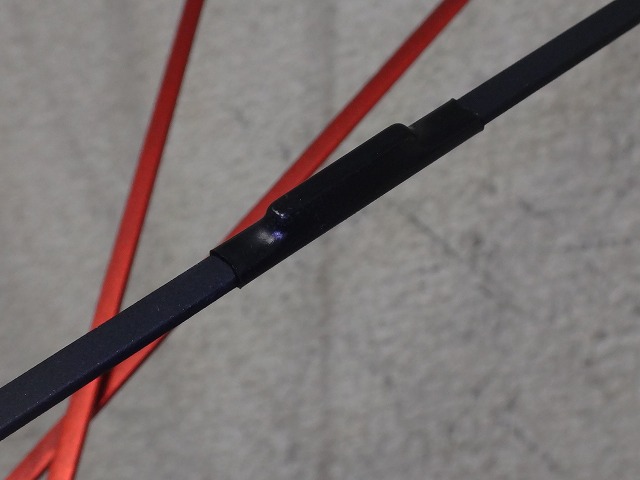
The customer had left the wheel magnet with me separately, so I reinstalled it at the designated position. The magnet is now in a different position than it was on the previous spoke.
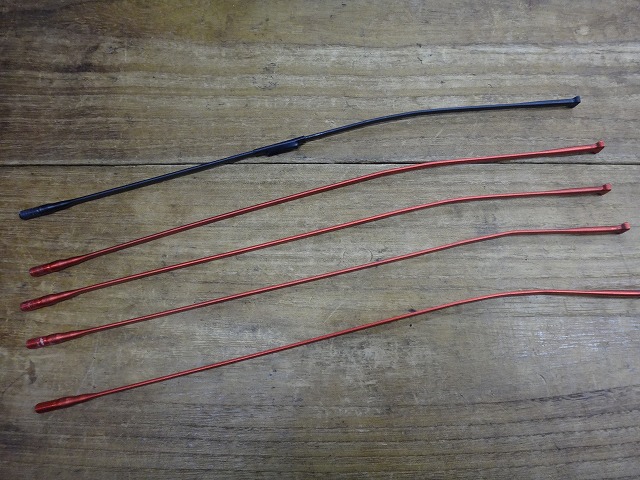
↑The replaced spokes. Spokes with fore-aft deformation have an effective length determined by the shortest distance of their bent shape when straightened by spoke tension, so mixing in shorter spokes creates a situation where truing the lateral runout causes excessive radial runout inward, and fixing the radial runout creates lateral runout and loses spoke tension—requiring spoke replacement. However, in this case the deformation was almost purely lateral, so the spokes could theoretically be re-straightened by hand and reused. In the image above, the three red spokes in the middle are the kind I could get away with reusing as a makeshift measure if we were out of spoke stock. This time, I went ahead and replaced them all.
But I really can't figure out the cause. If the wheel had been dropped from a height (like out a second-story window), the rim would be damaged, but there's none of that. The impact marks don't fit that scenario either, but if someone intentionally stomped and kicked the wheel while it was in a wheel bag with some force or malice, yeah, it could look like this... Maybe it really was the hammer woman after all. This kind of unexplainable phenomenon is what gives birth to "yokai" (spirits/demons).
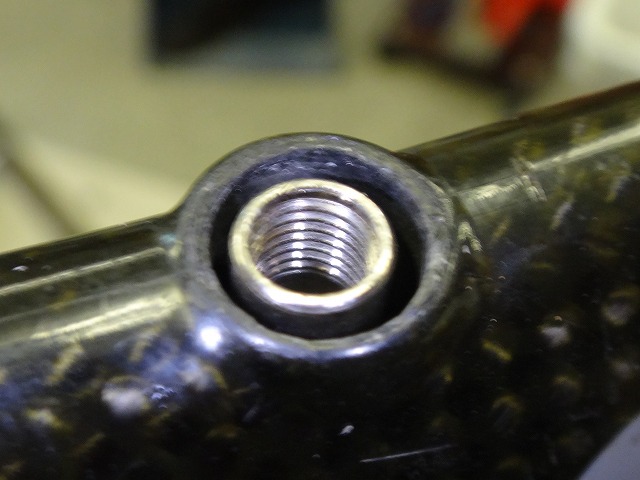
The same customer also left me a Bora wheelset (tubular-type) on a separate matter, and on both the Racing Zero and the Bora, the valve core extenders have been removed. The Racing Zero has a short valve, so as you can see in the opening image, even without an extender you'd only see the valve core area, which is why a very short extender is used.
But this Bora is missing its valve bushing. Whether it was removed when I took off the valve extender or if it got lost is unclear, but since the tire valve passes through almost the center of the valve hole, maybe it was just removed and not lost. And what I can say for certain is that among the current three generations of valve bushings, only the second generation can be removed and attached while the valve is threaded through the rim, and thus is prone to being lost. (See →here for details.)

The second generation is discontinued and unobtainable, but I have them in stock (the one on the left in the image), so
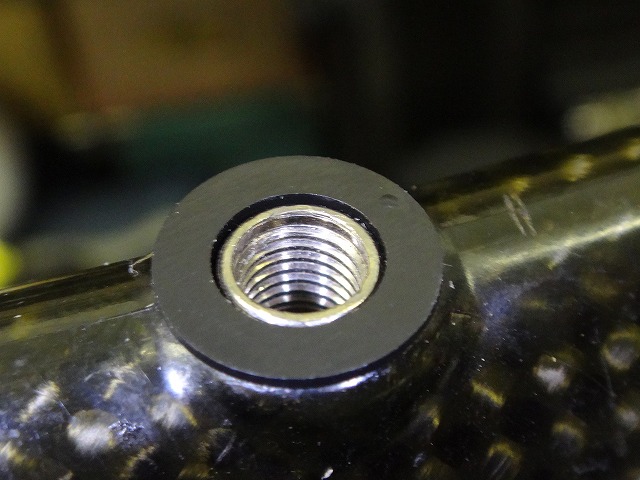
I installed one. Since the customer is from out of town, hopefully the valve bushing wasn't lost. But if it was, it could be a real hassle. If it turns out it wasn't lost and just came off, please keep it as a spare. The second generation tends to disappear unexpectedly.
If you attach a valve nut to a valve or valve extender with a threaded stem, it won't get lost, but tubular tire valve extenders generally don't have threads, so you can't attach a valve nut. The second-generation valve bushing often ends up sitting slightly loose on the rim rather than flush. Even if the tire were removed and replaced with a third-generation valve bushing, that would solve it, but this tire is glued on with rim cement, and considering the labor to peel it off and the service charge, I think this is fine as-is. A Continental German-made tubular tire was glued on, and if a different Continental or other tubular tire were applied with tubular tape instead, the adhesion to the black cotton rim tape would be abnormally strong, making removal essentially impossible. So for this case, even if it were glued with tubular tape, I'm replacing the valve bushing with the third generation, not just inserting the second generation.
※Since these might be thought to be typos, I'm linking to the originals for the first time in a while:
Tori-ae-su (鶏和え酢, "chicken and vinegar"—an old inside joke) (→here)
Tubular tape (チューベラーテープ) (→here)