Regarding the R9200 series Dura-Ace,
it quietly pretends that various problems
which were commonly seen up through the R9100 series don't exist.
First, there's the issue of the seams on the monakas-structure crank arms peeling back (→here),
but the R9200 crank arms have switched from adhesive construction to hollow forging.
Or rather, they've reverted to the old spec.
As for the spider arms on cassette sprockets cracking (→here),
they're now aluminum and the machining profile has changed too.
The spider arm cracking problem
occurred even back when they were aluminum,
so it's unclear whether this redesign will prevent it from happening again.
The disc rotors with large cooling fin area when viewed from the side,
the SM-RT900 and 800,
have been discontinued for a while now, and I had a hunch that would happen,
but the disc rotors compatible with R9200 and R8100
have become the MTB-use (formerly) RT-MT900 and 800.
The SM-RT900 and 800
were prone to rubbing under hard acceleration or getting caught by crosswinds,
so using MTB-style rotors was supposed to be a hack,
but apparently everyone's been doing it for a while now,
so it's rather refreshing that Shimano's officially acknowledged it.
The 12-speed sprockets can be installed on conventional 11-speed HG freebodies,
but only the rear wheel on the new Dura-Ace complete wheelsets
is compatible with 12-speed sprockets exclusively—
this is Shimano's typical move, so watch out
(Altegra-level new wheelsets can use 11-speed sprockets).
Both the shift to 11-speed and 12-speed happened earlier with Campagnolo,
but with the 11-speed transition, Shimano unofficially provided compatibility
by effectively matching sprocket spacing after the fact (→here),
which really helps my personal mischief projects,
so I'm grateful, but how will it go this time?
If we're just squeezing one more tooth in without redesigning the freebody,
I'd think it has to end up with similar dimensions.
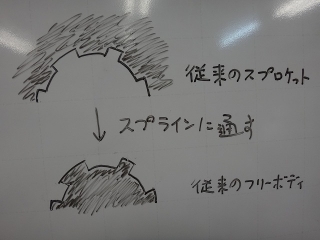
↑The relationship between the conventional HG freebody and sprocket is like this.
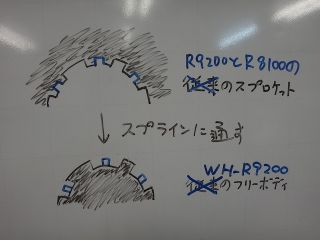
↑With 12-speed HG+, the sprocket-side cutouts have increased, but
more precisely, the spline projections on the freebody side are what increased,
and the goal seems to be reducing the damage when the sprocket digs into the freebody spline in the direction of rotation
by increasing the contact area.
I almost forgot to mention: the freebody on the WH-R9200 series wheels
is now aluminum instead of titanium.
With more projections, it's easy to mistake it at first glance for Microspline.

↑It's possible to thread a 12-speed sprocket onto the older freebody like this,
but the reverse won't work.
The thing to watch out for here is that Shimano's guaranteed compatibility
is only for Shimano wheels or Shimano hubs of the 11-speed era.
Since Campagnolo's 12-speed hasn't caused particularly serious issues,
I might be overthinking this, but even if third-party rear hubs
can accommodate Shimano 12-speed sprockets without problems,
there's no guarantee against issues like the sprocket contacting the hub body
or the chain touching spokes when the sprocket is on the low gear.
A real example: the original R-SYS rear wheel,
when Campagnolo's 11-speed sprockets (which weren't anticipated at the time) are installed,
the sprocket and hub flange contact (→here).
Also, if you take an Evolite hub, convert it to Campagnolo freebody,
and install a Campagnolo 12-speed sprocket,
the spokes and chain get pretty close together.
As for the new complete wheelsets, though I haven't seen them in person,
on paper and in terms of construction they're better than the previous generation.
I guess they've at least become better than Roval.
One website says about the new Dura-Ace wheels
"traditionally 40mm and 60mm rim heights were offered~" but
this is partially (about three-quarters) wrong.
The R9100 series wheels have so-called C60 and C40,
and among these, the WO rim models use the same rims as the earlier C50 and C35,
so the rim heights are actually 50mm and 35mm despite what the names suggest.
The tubular rim models come as wide rims 28mm outer width, fitting current trends,
but while the C60 has a 60mm rim height,
the C40 has a 37mm rim height,
so actually there's no C40 wheel with a 40mm rim height.
The R9200 series wheels have rim-brake versions in tubular rim spec only,
and disc-brake versions in both tubeless rim spec
and tubular rim spec.
The C36 with 36mm rim height and C50 with 50mm height
are laced with spokes of CX-RAY equivalent spoke weight,
and separately, laced with spokes of slightly higher spoke weight,
there's the C60-HR—"high rigidity"
model with a 60mm rim height.
※↑I've corrected this after receiving a comment pointing out a misspelling (rididry).
Among these, the C36 disc-brake spec has an exceptionally light claimed weight,
and if it's not rigid like crap, I might finally see
the day when I perform a heated hand-flip reversal of my opinion.
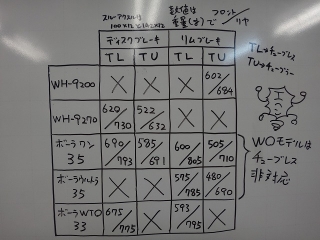
I've compiled the claimed weights for all specs of
R9200 series and the Campagnolo models at similar rim heights,
Bora 35 (One & Ultra) and Bora WTO 33.
The Bora 35 WO rim model isn't tubeless-compatible,
but I've listed it in the tubeless column for convenience.
First, the Bora One, which has all specs available:
when going from rim-brake spec to disc-brake spec,
the rear wheel gets about 20g lighter, but
the front wheel gets 80-90g heavier.
The rim-brake spec has 18/21H spokes front and rear,
and in disc-brake spec it becomes 24/24H,
but with Bora 35's spoke weight (slightly higher than CX-RAY) and
spoke length, one spoke and one nipple weigh
about 5.5g, so the front wheel gains about 33g for six extra spokes,
and considering that the front hub is high-low flange like a
"rear hub without freebody,"
the disc-brake rim is definitely heavier, but
the 80-90g increase isn't all concentrated in the outer periphery.
Comparing the WH-R9200 and WH-R9270
in the tubular rim spec that both offer,
the disc-brake model is dramatically lighter.
It's almost suspicious enough to suggest a typo, but even the
tubeless rim spec is approaching the
rim-brake tubular rim spec weight for the front wheel.
The rim-brake R9200 has 16/21H spokes front and rear,
and the disc-brake R9270 has 24/24H,
so the R9270 front wheel, which has 8 more spokes than R9200,
gains about 30g in spoke weight.
Which means the R9270 tubular rim front wheel
is about 30g heavier than the R9200 in the spoke department,
yet still comes out 80g lighter overall.
If that's true, the disc-brake rim
must be considerably lighter than the rim-brake rim,
so for instance, if you pressed the side of the rim with your finger,
the disc-brake rim would feel noticeably squishy compared to the rim-brake one.
Yet the manufacturer website says
"usable with rim-brake models" about the disc-brake model.
Even the tubeless rim.Yeah right.
With Shimano hubs, like the XT, the 100×15mm front hub
can't be converted to quick-release or BOOST
with just a shaft part swap.
Unfortunately not.
In exchange for this lack of flexibility,
when comparing 142mm and 148mm rear hubs, the 148mm rear hub
broadens the flange width by 6mm—there's real craftsmanship at work.
As I mentioned before, the XT BOOST rear hub
FH-M8110-B, compared to the FH-M8110,
has only 6mm difference in over-locknut width,
yet widens the flange by more than that—6.99mm—
which is pretty amazing (→here).
It's probably impossible, but if you could swap the R9270 hub shaft
for an R9200 one (enabling quick-release conversion),
there's a possibility that using the R9270 would perform better
even when using older rim-brake frames.
Also, most of the time they're brutally heavy,
but there exist road framesets that work with both rim-brake and disc-brake,
and in that case you can run the R9270 with rim brakes.
Though it feels weird having an ochocho on the front wheel with rim brakes.
As a tangent, I only use the front brake on my road bike,
and I've sometimes thought about what it'd be like on a fork
that can accommodate both rim and disc brakes
to install both and have both brake levers work the front brake.
With so-called cable-pull disc brake calipers,
you'd avoid the problem of the levers having different shapes left and right.
But that's illegal under traffic law.
it quietly pretends that various problems
which were commonly seen up through the R9100 series don't exist.
First, there's the issue of the seams on the monakas-structure crank arms peeling back (→here),
but the R9200 crank arms have switched from adhesive construction to hollow forging.
Or rather, they've reverted to the old spec.
As for the spider arms on cassette sprockets cracking (→here),
they're now aluminum and the machining profile has changed too.
The spider arm cracking problem
occurred even back when they were aluminum,
so it's unclear whether this redesign will prevent it from happening again.
The disc rotors with large cooling fin area when viewed from the side,
the SM-RT900 and 800,
have been discontinued for a while now, and I had a hunch that would happen,
but the disc rotors compatible with R9200 and R8100
have become the MTB-use (formerly) RT-MT900 and 800.
The SM-RT900 and 800
were prone to rubbing under hard acceleration or getting caught by crosswinds,
so using MTB-style rotors was supposed to be a hack,
but apparently everyone's been doing it for a while now,
so it's rather refreshing that Shimano's officially acknowledged it.
The 12-speed sprockets can be installed on conventional 11-speed HG freebodies,
but only the rear wheel on the new Dura-Ace complete wheelsets
is compatible with 12-speed sprockets exclusively—
this is Shimano's typical move, so watch out
(Altegra-level new wheelsets can use 11-speed sprockets).
Both the shift to 11-speed and 12-speed happened earlier with Campagnolo,
but with the 11-speed transition, Shimano unofficially provided compatibility
by effectively matching sprocket spacing after the fact (→here),
which really helps my personal mischief projects,
so I'm grateful, but how will it go this time?
If we're just squeezing one more tooth in without redesigning the freebody,
I'd think it has to end up with similar dimensions.

↑The relationship between the conventional HG freebody and sprocket is like this.

↑With 12-speed HG+, the sprocket-side cutouts have increased, but
more precisely, the spline projections on the freebody side are what increased,
and the goal seems to be reducing the damage when the sprocket digs into the freebody spline in the direction of rotation
by increasing the contact area.
I almost forgot to mention: the freebody on the WH-R9200 series wheels
is now aluminum instead of titanium.
With more projections, it's easy to mistake it at first glance for Microspline.

↑It's possible to thread a 12-speed sprocket onto the older freebody like this,
but the reverse won't work.
The thing to watch out for here is that Shimano's guaranteed compatibility
is only for Shimano wheels or Shimano hubs of the 11-speed era.
Since Campagnolo's 12-speed hasn't caused particularly serious issues,
I might be overthinking this, but even if third-party rear hubs
can accommodate Shimano 12-speed sprockets without problems,
there's no guarantee against issues like the sprocket contacting the hub body
or the chain touching spokes when the sprocket is on the low gear.
A real example: the original R-SYS rear wheel,
when Campagnolo's 11-speed sprockets (which weren't anticipated at the time) are installed,
the sprocket and hub flange contact (→here).
Also, if you take an Evolite hub, convert it to Campagnolo freebody,
and install a Campagnolo 12-speed sprocket,
the spokes and chain get pretty close together.
As for the new complete wheelsets, though I haven't seen them in person,
on paper and in terms of construction they're better than the previous generation.
One website says about the new Dura-Ace wheels
"traditionally 40mm and 60mm rim heights were offered~" but
this is partially (about three-quarters) wrong.
The R9100 series wheels have so-called C60 and C40,
and among these, the WO rim models use the same rims as the earlier C50 and C35,
so the rim heights are actually 50mm and 35mm despite what the names suggest.
The tubular rim models come as wide rims 28mm outer width, fitting current trends,
but while the C60 has a 60mm rim height,
the C40 has a 37mm rim height,
so actually there's no C40 wheel with a 40mm rim height.
The R9200 series wheels have rim-brake versions in tubular rim spec only,
and disc-brake versions in both tubeless rim spec
and tubular rim spec.
The C36 with 36mm rim height and C50 with 50mm height
are laced with spokes of CX-RAY equivalent spoke weight,
and separately, laced with spokes of slightly higher spoke weight,
there's the C60-HR—"high rigidity"
model with a 60mm rim height.
※↑I've corrected this after receiving a comment pointing out a misspelling (rididry).
Among these, the C36 disc-brake spec has an exceptionally light claimed weight,
and if it's not rigid like crap, I might finally see
the day when I perform a heated hand-flip reversal of my opinion.

I've compiled the claimed weights for all specs of
R9200 series and the Campagnolo models at similar rim heights,
Bora 35 (One & Ultra) and Bora WTO 33.
The Bora 35 WO rim model isn't tubeless-compatible,
but I've listed it in the tubeless column for convenience.
First, the Bora One, which has all specs available:
when going from rim-brake spec to disc-brake spec,
the rear wheel gets about 20g lighter, but
the front wheel gets 80-90g heavier.
The rim-brake spec has 18/21H spokes front and rear,
and in disc-brake spec it becomes 24/24H,
but with Bora 35's spoke weight (slightly higher than CX-RAY) and
spoke length, one spoke and one nipple weigh
about 5.5g, so the front wheel gains about 33g for six extra spokes,
and considering that the front hub is high-low flange like a
"rear hub without freebody,"
the disc-brake rim is definitely heavier, but
the 80-90g increase isn't all concentrated in the outer periphery.
Comparing the WH-R9200 and WH-R9270
in the tubular rim spec that both offer,
the disc-brake model is dramatically lighter.
It's almost suspicious enough to suggest a typo, but even the
tubeless rim spec is approaching the
rim-brake tubular rim spec weight for the front wheel.
The rim-brake R9200 has 16/21H spokes front and rear,
and the disc-brake R9270 has 24/24H,
so the R9270 front wheel, which has 8 more spokes than R9200,
gains about 30g in spoke weight.
Which means the R9270 tubular rim front wheel
is about 30g heavier than the R9200 in the spoke department,
yet still comes out 80g lighter overall.
If that's true, the disc-brake rim
must be considerably lighter than the rim-brake rim,
so for instance, if you pressed the side of the rim with your finger,
the disc-brake rim would feel noticeably squishy compared to the rim-brake one.
Yet the manufacturer website says
"usable with rim-brake models" about the disc-brake model.
Even the tubeless rim.
With Shimano hubs, like the XT, the 100×15mm front hub
can't be converted to quick-release or BOOST
with just a shaft part swap.
Unfortunately not.
In exchange for this lack of flexibility,
when comparing 142mm and 148mm rear hubs, the 148mm rear hub
broadens the flange width by 6mm—there's real craftsmanship at work.
As I mentioned before, the XT BOOST rear hub
FH-M8110-B, compared to the FH-M8110,
has only 6mm difference in over-locknut width,
yet widens the flange by more than that—6.99mm—
which is pretty amazing (→here).
It's probably impossible, but if you could swap the R9270 hub shaft
for an R9200 one (enabling quick-release conversion),
there's a possibility that using the R9270 would perform better
even when using older rim-brake frames.
Also, most of the time they're brutally heavy,
but there exist road framesets that work with both rim-brake and disc-brake,
and in that case you can run the R9270 with rim brakes.
Though it feels weird having an ochocho on the front wheel with rim brakes.
As a tangent, I only use the front brake on my road bike,
and I've sometimes thought about what it'd be like on a fork
that can accommodate both rim and disc brakes
to install both and have both brake levers work the front brake.
With so-called cable-pull disc brake calipers,
you'd avoid the problem of the levers having different shapes left and right.
But that's illegal under traffic law.