I'm currently running my everyday road bike as a front single chainring
(actually, I've been doing this since before narrow-wide chainrings became widespread),
and I'm using a Campagnolo Ecal crank,
but I discovered that the chain drops to the outside in specific riding conditions.
When I hit a road gap at around 50 km/h while in the top gear on a descent,
the chain drops off.
There's a particular section on a certain mountain pass descent where it always happens,
but if I maintain smooth pedaling with tension in the chain, it won't drop.
Also, if I'm in a lower gear, the chain stays tensioned,
so it won't flail off the chainring,
but on descents I don't want to be in such a light gear
because it's too easy to pedal.
So I was looking for a chain drop prevention guide,
and I found that Forlears' CT-FD007 model was cheap,
so I bought it.
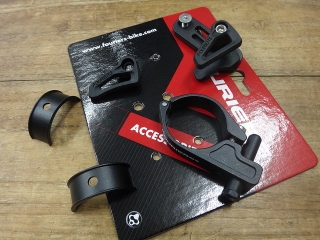
↑This is it.
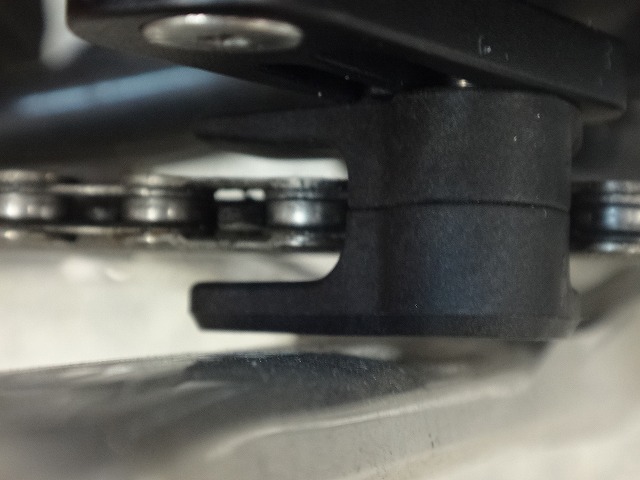
It's the type that surrounds the chain in a U-shape on three sides, except below.
Separately, there's also a CT-FD002 model that works like the outer plates of a front derailleur,
surrounding it on all four sides.
The list price without tax is ¥3,300 for the CT-FD002 and ¥3,500 for the CT-FD007.
It might be cheap because there are lots of plastic parts,
but even so, it's incredibly affordable.
I don't know if the effect is equivalent despite the different materials(mainly aluminum),
but Wolf Tooth's "GnarWolf"
is ¥10,800 in Japanese yen on the maker's official site,
K-EDGE's "K13-080" has a list price of ¥12,545 without tax,
and Wickworks' "Sentinel," which has a structure like a chain watcher on the outside too,
has a list price of ¥5,200 without tax.
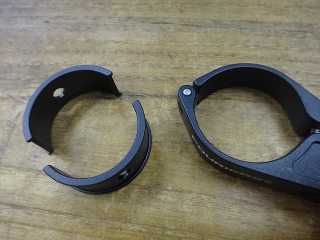
The band is 34.9mm, and it comes with a spacer for 31.8mm.
The measured weight in the 34.9mm configuration is 58g,
but the manufacturer's stated weight is 76g.
It might be the combined weight of all the unused small parts.
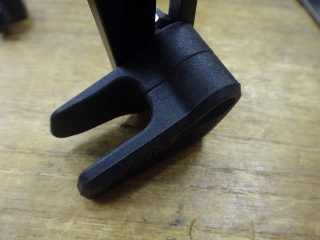
↑You mount the chain on this U-shaped part.
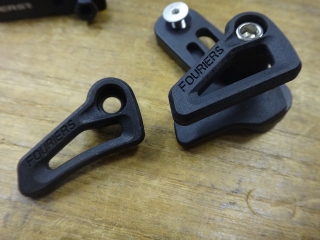
The outer plate has two shape options to choose from.
Either one seems to make no major difference.
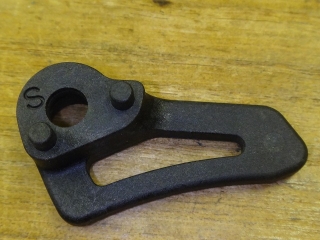
The outer plate has a pin
so it won't rotate or shift relative to the inner plate,
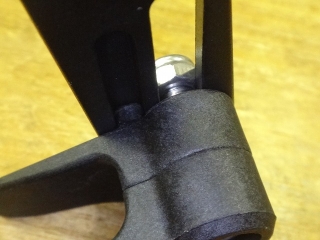
and the part that slides the plates up and down also has a pin in addition to the slot,
so it can only move along the slot.
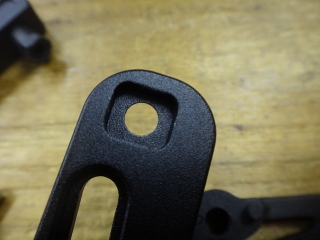
The mounting hole in the slot part to attach to the band is a square hole,
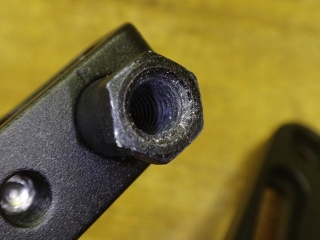
but the protruding part from the band side is hexagonal.
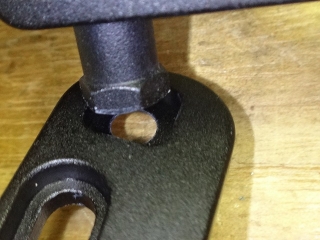
The hex's flat-to-flat dimension and the square's side-to-side dimension are the same, or rather,
the hex has a large positive tolerance(or the square has a small negative tolerance)—
it won't go in even if you push by hand,

but tightening the bolt pressed it in.
Since there's zero play and it's rock solid, they might have done this intentionally.
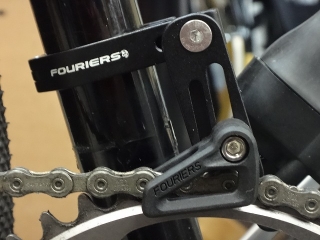

↑This is what it looks like installed.
This is a cyclocross bike,
and the crank is a Sugino Superb with PCD 144mm,
and it has a lug on the back side for mounting an inner ring,
so it's not for fixed-gear bikes but for old-school road bikes.
I've mounted a thin-toothed 45T Dura-Ace Track ring on it
and run a 10-speed chain.
Based on what I said at the beginning, it was supposed to go on the road bike,
but even so, the Forlears was necessary.
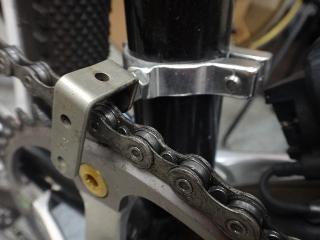
Rewinding in time a bit,
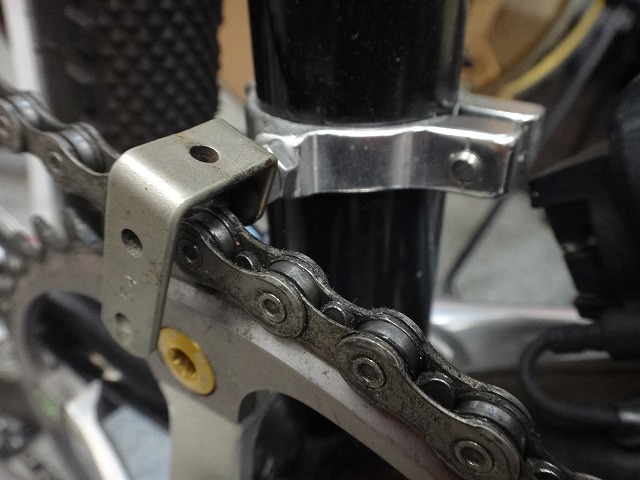
here's the homemade chain guide that was originally on the cyclocross bike.
It measured 21g and was light, and when I converted to front single,
narrow-wide chainrings didn't exist yet,
so this kind of guide was essential.
There were simpler options to prevent drops to the inside only,
but chain bounce usually caused it to drop to the outside,
and back then the only options were either a bulky MTB-style chain guide or
mounting a road bike front derailleur as-is or with some modification,
which looked messy, so I made something
that protected only the absolutely necessary areas.
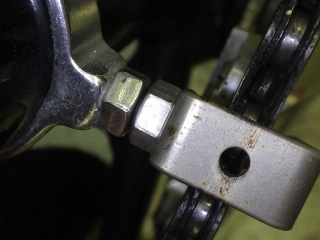
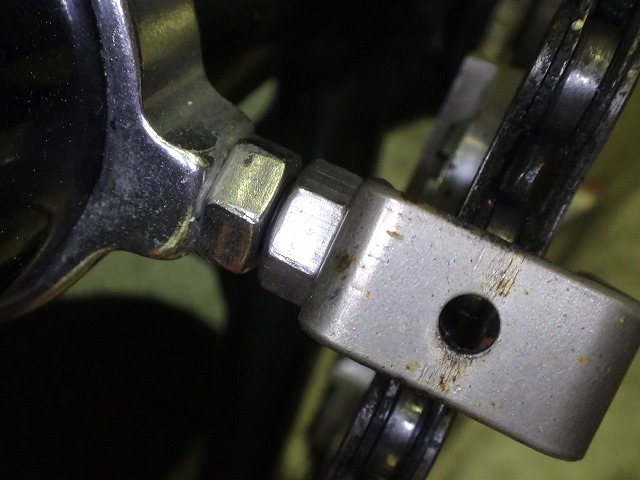
The band is an E-type front derailleur stop-bracket band,
but even after E-type fell out of use on MTB front derailleurs,
34.9mm versions were sometimes used as bands for mounting bottle cages
on the steering column of BD-1 bikes.
Otherwise, they're used as retrofit bands for mounting a pulley
that reverses the cable direction when installing a down-pull front derailleur
on cyclocross frames designed for up-pull cables
(road bike front derailleurs are down-pull)
on frames without M5 threaded holes for the pulley.
¥
The two nuts tighten against both the plate and the band,
allowing you to adjust the angle and horizontal position of the plate.
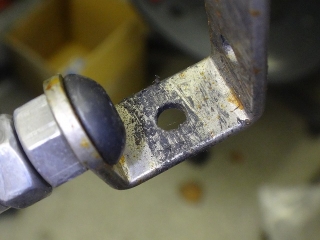
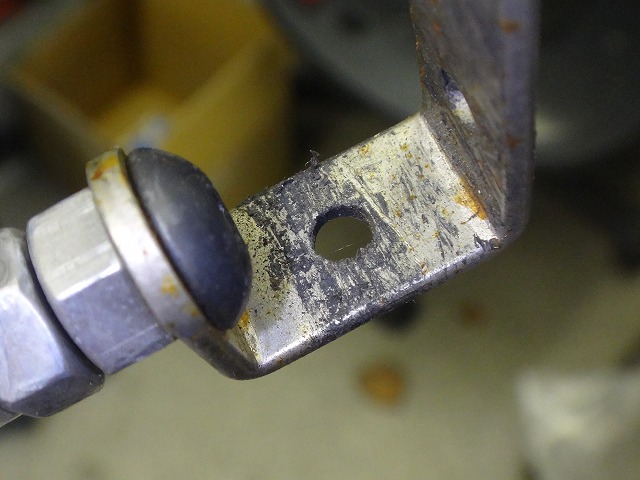
↑You can see the marks from it doing its job.
After I installed this(more precisely, after I got the adjustment dialed in),
it hasn't dropped the chain even once.

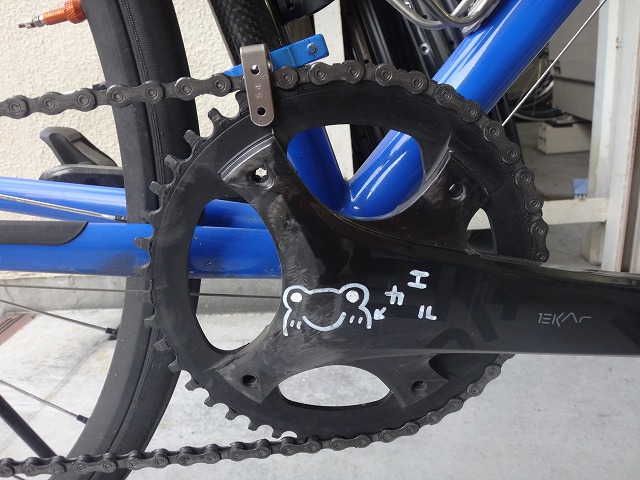
I transferred it to the road bike.
The unofficial Campagnolo Ecal character
"Frog-kun" that I used to draw on the left crank
I moved to the right crank.
The left eye is the North Star, positioned roughly at the center of the crank when rotating,
but there's no deeper meaning to it.
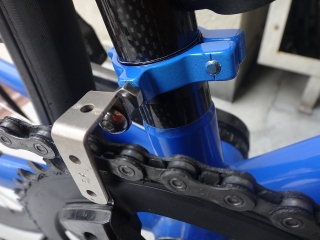
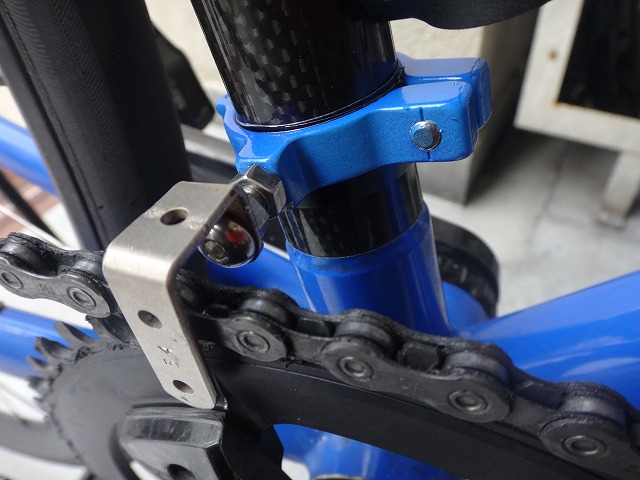
I repainted the 31.8mm band.
Because the original 34.9mm band had surface rust on it.
Actually, this frame has a 30mm seat tube diameter,
so I'm using a spacer in between.
The wrinkles at the top of the plate are because
I had to bend it slightly when threading the bolt through.
The bolt head needs to be low-profile, either truss or pan head.
A cap screw would interfere with the chain.
But that's only a concern with this particular bracket.
You can do most of the horizontal position adjustment with bolt length,
and fine-tuning with how much of the thread is engaged.
The thing to watch out for is that if you use up all the threads on the band,
it will hit the frame, so you need to be careful that doesn't happen.
I want a 46T front chainring,
but Ecal only comes in 38–44T in 2T increments,
and there don't seem to be any aftermarket options either, so I'm forced to use a 44T.
I use either an 11-28T or 11-30T cassette, and right now it's 11-30T.
A 44×30T gives a gear ratio equivalent of 39×26.59T in theory,
which is just slightly easier than 39×26T,
so I don't have any trouble except on really steep hills.
The top gear is 44×11T, which is exactly 4:1,
about the same as a 52×13T with the same ratio
but with a small reduction from having a smaller chainring.
I've confirmed I can push up to around 55 km/h on descents.(※)
As long as it's not a race descent, that's fine.
※When I calculated it just now, it was about 108 rpm cadence.

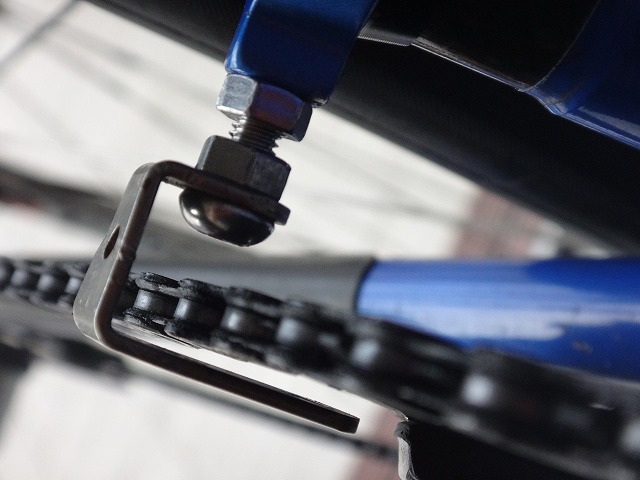
↑Top gear
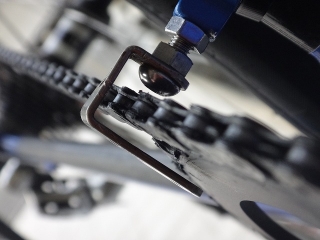
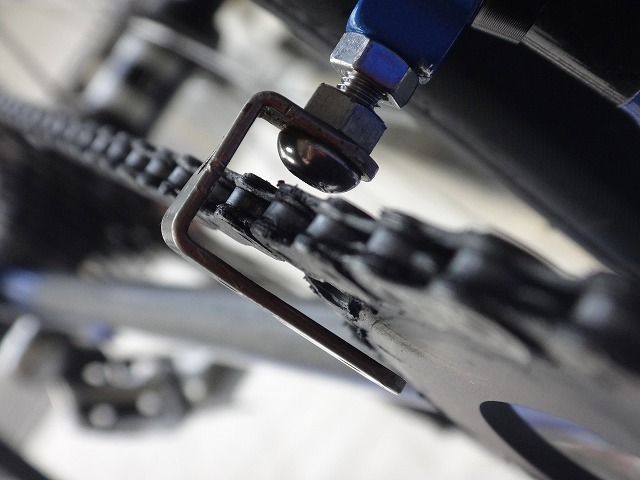
↑Low gear
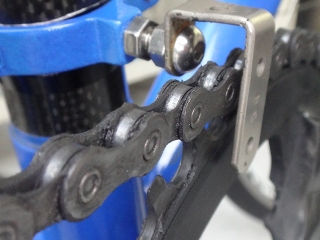
↑Top gear
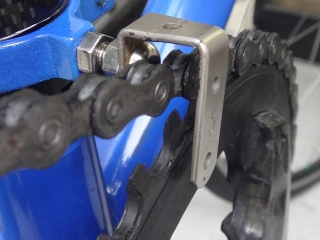
↑Low gear
I took these photos on August 22 this year.
The chain was dirty, but after I washed it
and rode it in various conditions, including that descent on the pass
where chain drops were guaranteed to happen, the chain hasn't dropped once.
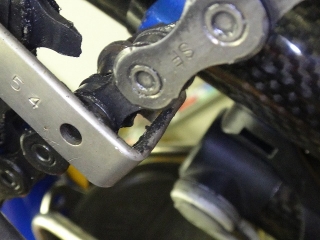
↑This is how it looks today, September 28.
The plate is dirty from chain bounce. It's really working hard.
Even while riding, I can tell when "it just did its job."
(actually, I've been doing this since before narrow-wide chainrings became widespread),
and I'm using a Campagnolo Ecal crank,
but I discovered that the chain drops to the outside in specific riding conditions.
When I hit a road gap at around 50 km/h while in the top gear on a descent,
the chain drops off.
There's a particular section on a certain mountain pass descent where it always happens,
but if I maintain smooth pedaling with tension in the chain, it won't drop.
Also, if I'm in a lower gear, the chain stays tensioned,
so it won't flail off the chainring,
but on descents I don't want to be in such a light gear
because it's too easy to pedal.
So I was looking for a chain drop prevention guide,
and I found that Forlears' CT-FD007 model was cheap,
so I bought it.
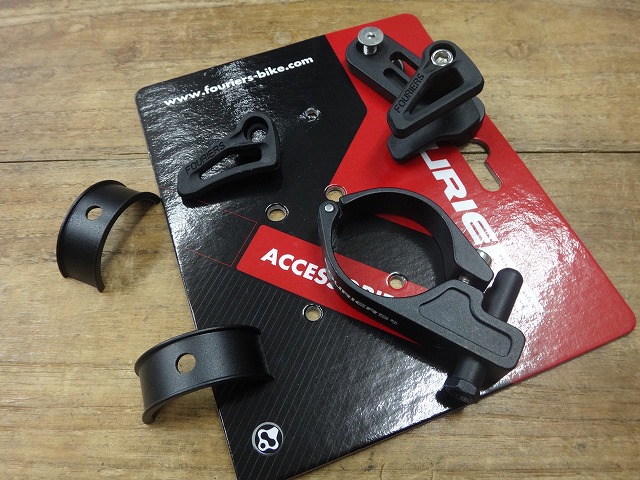
↑This is it.
It's the type that surrounds the chain in a U-shape on three sides, except below.
Separately, there's also a CT-FD002 model that works like the outer plates of a front derailleur,
surrounding it on all four sides.
The list price without tax is ¥3,300 for the CT-FD002 and ¥3,500 for the CT-FD007.
It might be cheap because there are lots of plastic parts,
but even so, it's incredibly affordable.
I don't know if the effect is equivalent despite the different materials(mainly aluminum),
but Wolf Tooth's "GnarWolf"
is ¥10,800 in Japanese yen on the maker's official site,
K-EDGE's "K13-080" has a list price of ¥12,545 without tax,
and Wickworks' "Sentinel," which has a structure like a chain watcher on the outside too,
has a list price of ¥5,200 without tax.
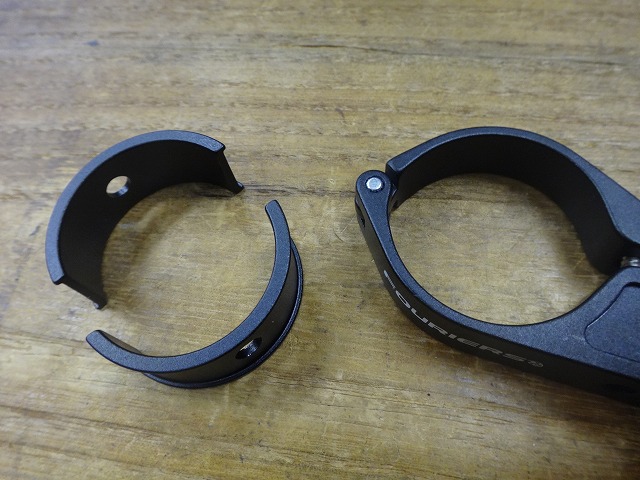
The band is 34.9mm, and it comes with a spacer for 31.8mm.
The measured weight in the 34.9mm configuration is 58g,
but the manufacturer's stated weight is 76g.
It might be the combined weight of all the unused small parts.
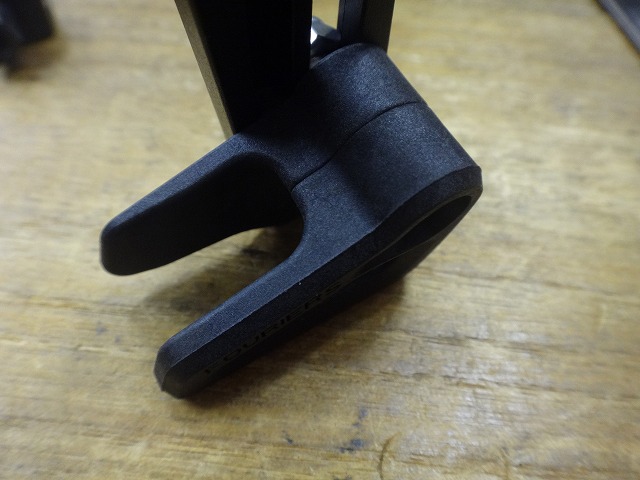
↑You mount the chain on this U-shaped part.

The outer plate has two shape options to choose from.
Either one seems to make no major difference.
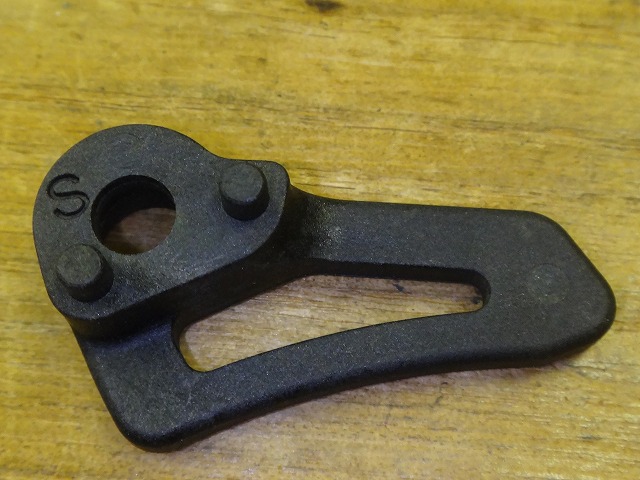
The outer plate has a pin
so it won't rotate or shift relative to the inner plate,

and the part that slides the plates up and down also has a pin in addition to the slot,
so it can only move along the slot.

The mounting hole in the slot part to attach to the band is a square hole,

but the protruding part from the band side is hexagonal.
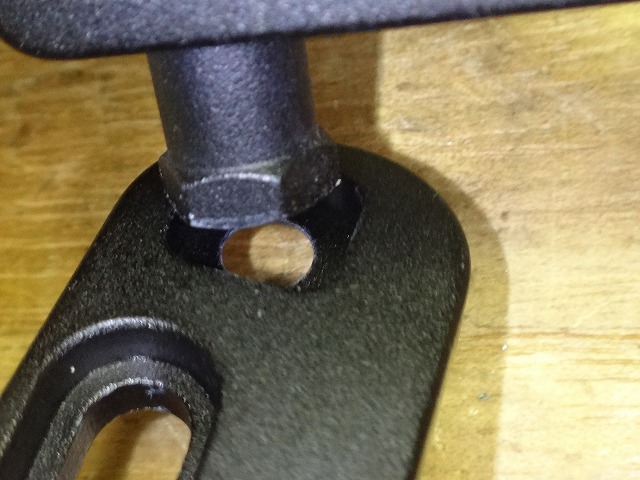
The hex's flat-to-flat dimension and the square's side-to-side dimension are the same, or rather,
the hex has a large positive tolerance(or the square has a small negative tolerance)—
it won't go in even if you push by hand,

but tightening the bolt pressed it in.
Since there's zero play and it's rock solid, they might have done this intentionally.
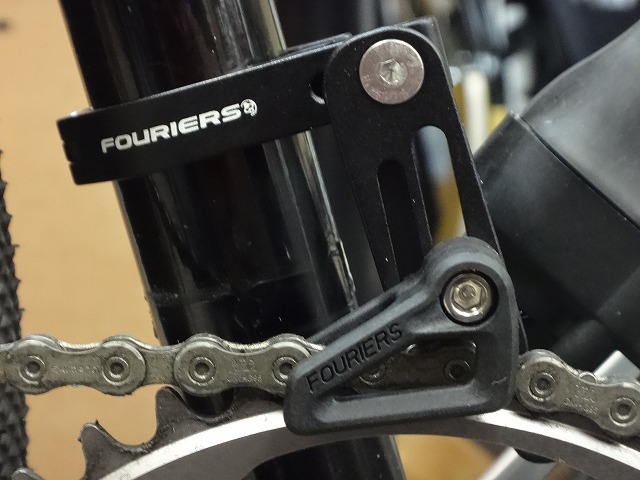
↑This is what it looks like installed.
This is a cyclocross bike,
and the crank is a Sugino Superb with PCD 144mm,
and it has a lug on the back side for mounting an inner ring,
so it's not for fixed-gear bikes but for old-school road bikes.
I've mounted a thin-toothed 45T Dura-Ace Track ring on it
and run a 10-speed chain.
Based on what I said at the beginning, it was supposed to go on the road bike,
but even so, the Forlears was necessary.
Rewinding in time a bit,
here's the homemade chain guide that was originally on the cyclocross bike.
It measured 21g and was light, and when I converted to front single,
narrow-wide chainrings didn't exist yet,
so this kind of guide was essential.
There were simpler options to prevent drops to the inside only,
but chain bounce usually caused it to drop to the outside,
and back then the only options were either a bulky MTB-style chain guide or
mounting a road bike front derailleur as-is or with some modification,
which looked messy, so I made something
that protected only the absolutely necessary areas.
The band is an E-type front derailleur stop-bracket band,
but even after E-type fell out of use on MTB front derailleurs,
34.9mm versions were sometimes used as bands for mounting bottle cages
on the steering column of BD-1 bikes.
Otherwise, they're used as retrofit bands for mounting a pulley
that reverses the cable direction when installing a down-pull front derailleur
on cyclocross frames designed for up-pull cables
(road bike front derailleurs are down-pull)
on frames without M5 threaded holes for the pulley.
¥
The two nuts tighten against both the plate and the band,
allowing you to adjust the angle and horizontal position of the plate.
↑You can see the marks from it doing its job.
After I installed this(more precisely, after I got the adjustment dialed in),
it hasn't dropped the chain even once.
I transferred it to the road bike.
The unofficial Campagnolo Ecal character
"Frog-kun" that I used to draw on the left crank
I moved to the right crank.
The left eye is the North Star, positioned roughly at the center of the crank when rotating,
but there's no deeper meaning to it.
I repainted the 31.8mm band.
Because the original 34.9mm band had surface rust on it.
Actually, this frame has a 30mm seat tube diameter,
so I'm using a spacer in between.
The wrinkles at the top of the plate are because
I had to bend it slightly when threading the bolt through.
The bolt head needs to be low-profile, either truss or pan head.
A cap screw would interfere with the chain.
But that's only a concern with this particular bracket.
You can do most of the horizontal position adjustment with bolt length,
and fine-tuning with how much of the thread is engaged.
The thing to watch out for is that if you use up all the threads on the band,
it will hit the frame, so you need to be careful that doesn't happen.
I want a 46T front chainring,
but Ecal only comes in 38–44T in 2T increments,
and there don't seem to be any aftermarket options either, so I'm forced to use a 44T.
I use either an 11-28T or 11-30T cassette, and right now it's 11-30T.
A 44×30T gives a gear ratio equivalent of 39×26.59T in theory,
which is just slightly easier than 39×26T,
so I don't have any trouble except on really steep hills.
The top gear is 44×11T, which is exactly 4:1,
about the same as a 52×13T with the same ratio
but with a small reduction from having a smaller chainring.
I've confirmed I can push up to around 55 km/h on descents.(※)
As long as it's not a race descent, that's fine.
※When I calculated it just now, it was about 108 rpm cadence.
↑Top gear
↑Low gear

↑Top gear

↑Low gear
I took these photos on August 22 this year.
The chain was dirty, but after I washed it
and rode it in various conditions, including that descent on the pass
where chain drops were guaranteed to happen, the chain hasn't dropped once.
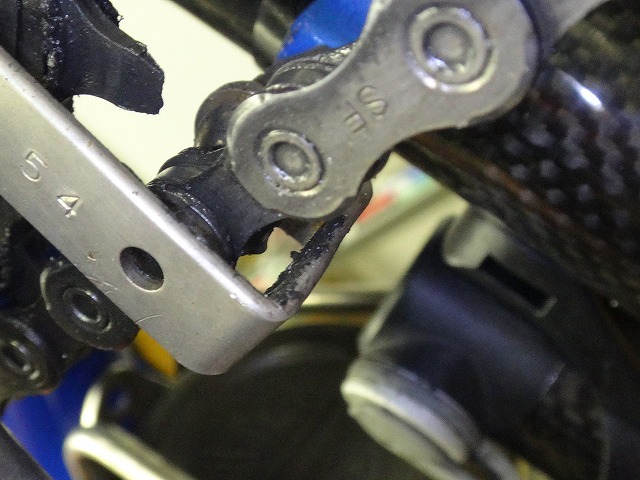
↑This is how it looks today, September 28.
The plate is dirty from chain bounce. It's really working hard.
Even while riding, I can tell when "it just did its job."