Another day, another wheel (etc.).

A customer left me a front wheel built with a Mavic GP4.
Since there was a shop name sticker on the rim,
I'm being considerate and blocking it out.
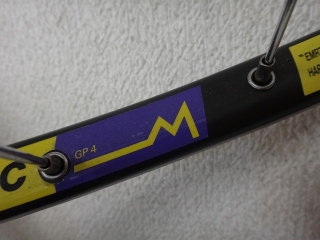
It's from the M-label era—if it's a GP4, the label color is purple.
Mavic rims from this period had different label colors depending on the model: light blue for GEL280, pink for GL330,
yellow-green for MACH2 CD2 (Mach Two CD Two), and so on.
You can tell them apart from a distance just by the label color.
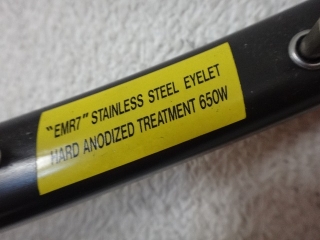
The hard anodize marking here says
the electrolytic treatment was done at 650W,
but you also see versions of the same label that read 650V instead,
which tells you it was 1A.
Recently though, I found one where this marking was neither W nor V.
I'll write about that in the next post. ←Once you write this, you can't back out.
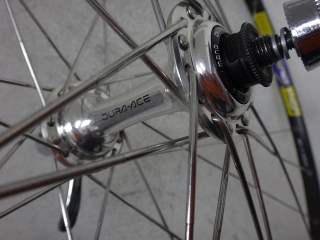
The hub is an HB-7400 with 32 holes, laced all Italian style,
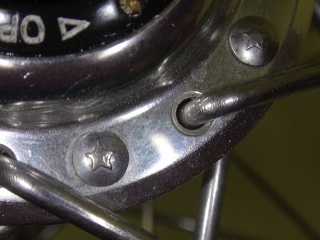
The spokes are star-marked stainless.
Not the generic term "stainless," but a product called "Stainless"—
there's a separate product line called Starlight too,
which corresponds to what people generally call stainless steel spokes.
Star-marked spoke heads are "Stainless," and
these were actually genuine stainless from way back,
so they didn't react to a magnet at all.
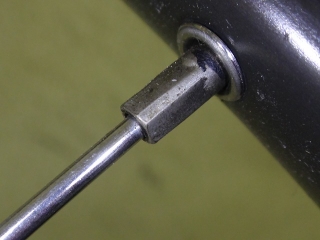
The rear wheel built with the same rim is also in my care,
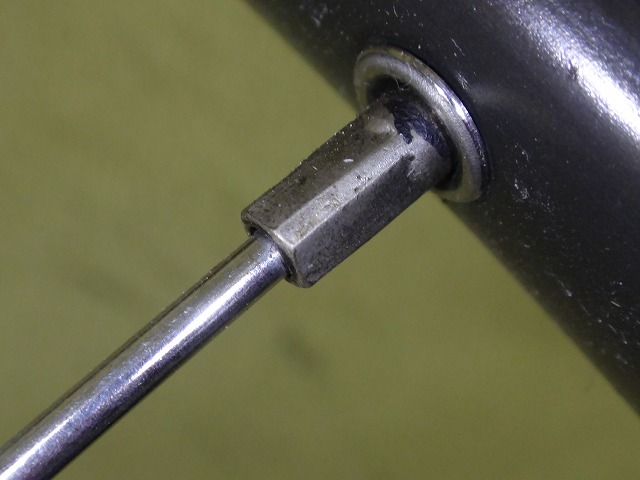
but depending on when it was built, that one had brass nipples instead.
Since the front wheel was specially built with brass nipples,
I thought they might be 15-gauge base spokes, but they turned out to be 14-gauge butted
(because shops don't usually stock 15-gauge color aluminum nipples in large quantities).
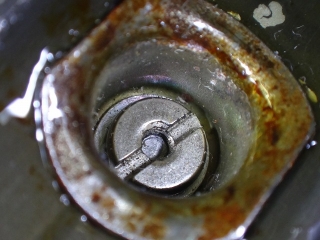
The spoke length was short, but
the new CX22 rim has a smaller inner diameter,
and while the difference wasn't huge,
I was able to carefully disassemble this wheel, distinguish the original inpokes from the original outpokes,
cut them to the right length, and reuse them.
If it had been clearly under a year since assembly, or
if the spokes had been true Starlight, I would have done that.

It's built.
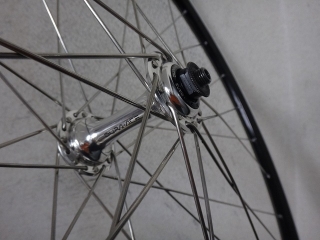
HB-7400, 32 holes, completely all-Italian laced.
The rim weight is essentially the same, the spoke specific gravity is essentially the same, and
the lacing method is the same, so the spoke count is essentially the same too.
The difference is that the customer will use this for cyclocross, but
because of the rim width and shape, the tire contact patch is wider,
which means the braking is more effective on this one.
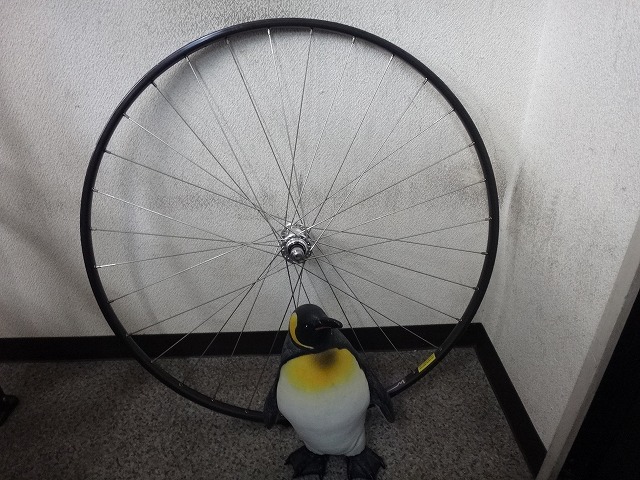
A customer left me a front wheel built with a Mavic GP4.
Since there was a shop name sticker on the rim,
I'm being considerate and blocking it out.
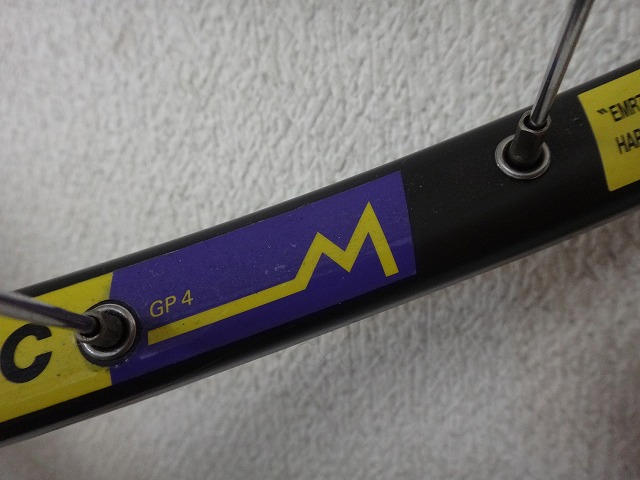
It's from the M-label era—if it's a GP4, the label color is purple.
Mavic rims from this period had different label colors depending on the model: light blue for GEL280, pink for GL330,
yellow-green for MACH2 CD2 (Mach Two CD Two), and so on.
You can tell them apart from a distance just by the label color.
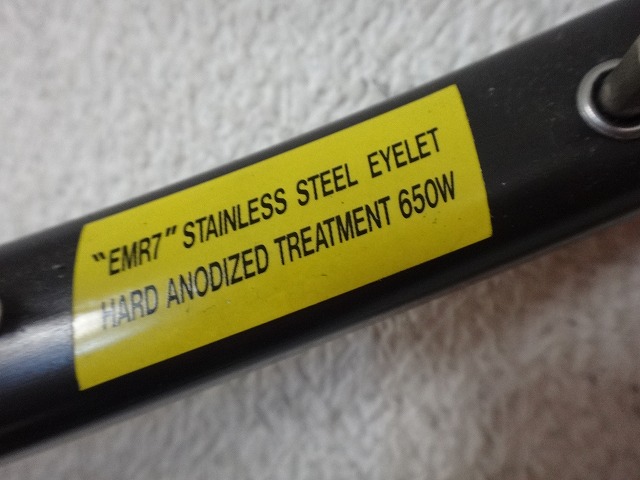
The hard anodize marking here says
the electrolytic treatment was done at 650W,
but you also see versions of the same label that read 650V instead,
which tells you it was 1A.
Recently though, I found one where this marking was neither W nor V.
I'll write about that in the next post. ←Once you write this, you can't back out.
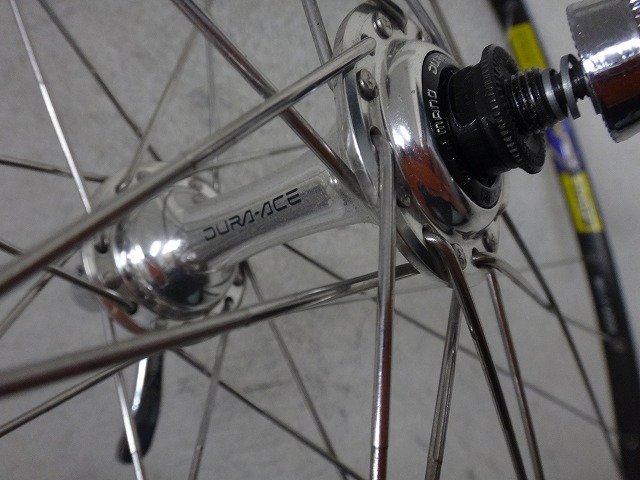
The hub is an HB-7400 with 32 holes, laced all Italian style,

The spokes are star-marked stainless.
Not the generic term "stainless," but a product called "Stainless"—
there's a separate product line called Starlight too,
which corresponds to what people generally call stainless steel spokes.
Star-marked spoke heads are "Stainless," and
these were actually genuine stainless from way back,
so they didn't react to a magnet at all.
The rear wheel built with the same rim is also in my care,
but depending on when it was built, that one had brass nipples instead.
Since the front wheel was specially built with brass nipples,
I thought they might be 15-gauge base spokes, but they turned out to be 14-gauge butted
(because shops don't usually stock 15-gauge color aluminum nipples in large quantities).
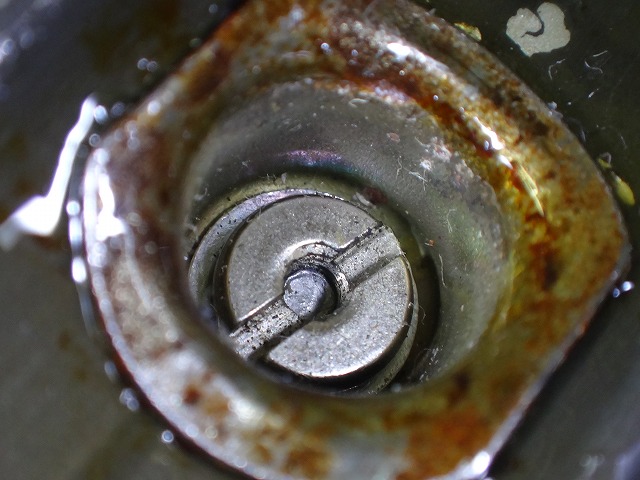
The spoke length was short, but
the new CX22 rim has a smaller inner diameter,
and while the difference wasn't huge,
I was able to carefully disassemble this wheel, distinguish the original inpokes from the original outpokes,
cut them to the right length, and reuse them.
If it had been clearly under a year since assembly, or
if the spokes had been true Starlight, I would have done that.

It's built.
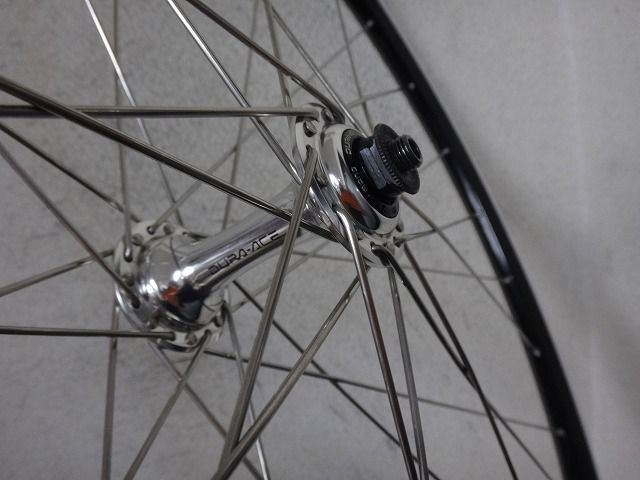
HB-7400, 32 holes, completely all-Italian laced.
The rim weight is essentially the same, the spoke specific gravity is essentially the same, and
the lacing method is the same, so the spoke count is essentially the same too.
The difference is that the customer will use this for cyclocross, but
because of the rim width and shape, the tire contact patch is wider,
which means the braking is more effective on this one.