Another wheel day (and so on).
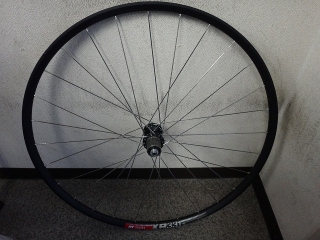
I built a rear wheel with an XR331 rim and a 9000 Dura-Ace rear hub.
As you can probably tell from the combination of a disc brake rim with a non-disc-compatible hub,
this is my personal bike.
Got a problem with that? (defensive).
Conceptually, this rear wheel has had the rim replaced once,
and now the hub is changing from a DT 350, so
almost none of the original wheel's parts remain.
Just some of the Squorx nipple washers.
It's truly the "Ship of Theseus."
The state right before disassembly was a semi-comp with full lacing both sides,
so the freewheel side comp couldn't be reused.

FH-9000 28H semi-CX sprint 46-lacing, with lacing.
I did the lacing the way I always do—only on the non-freewheel side.
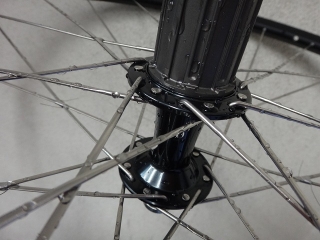
The semi-comp has some pretty important secrets,
and I believe that for the freewheel side spokes,
it's better not to use flat spokes.
The exception is flat spokes with roughly 100% spoke specific gravity that need slotted holes—
specifically, Sapim's CX spokes.
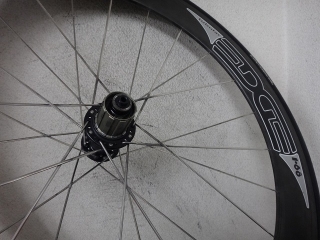
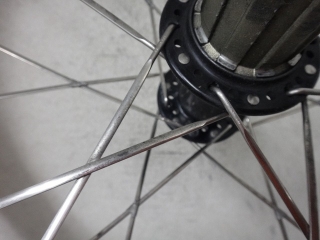
↑Example of semi-CX on my personal wheel
For customers under 50kg or female riders,
I sometimes do all CX-RAY—meaning using CX-RAY on the freewheel side too
(though all CX-RAY always requires lacing regardless of weight).
This wheel is 28H, meaning 14H on the freewheel side, so
I thought CX-RAY aside, maybe CX Sprint could work,
and decided to try it.
Comparing one side 12H of CX versus one side 14H of CX Sprint for spoke volume:
the former is 100×12 = 1200, the latter is 78×14 = 1092.
So, if the rim, hub, and lacing method were the same,
the latter would be about 10% lighter in both spoke volume and weight.
When I actually built it,
I became quite certain during the build itself,
but even at left-right 28H, semi-comp is definitely better.
The freewheel side of a 24H semi-comp is 85×12 = 1020,
smaller than 78×14 = 1092, but
the round cross-section spoke shape
has a pretty significant effect.
With 32H, semi-CX Sprint might work.
If after using this wheel I'm unhappy with how it feels,
I'll try lacing the freewheel side first rather than replacing all those spokes, which would be tedious.
They don't exist in stable supply ranges, but
if there were round-butted spokes with 78% specific gravity (comp is 86.5%, but roughly 85% is fine),
would I use them? Probably not. 85% is an incredibly precise sweet spot from experience.
Conversely, if there were 85% flat spokes?
Sapim's current Aero Star Bright is 91%,
and I judge there's no problem using it on the freewheel side,
so we might just barely make it.
Semi-CX Sprint isn't terribly bad,
but it's right at the edge of being not good enough.
With straight-gauge spoke hubs, there are few asymmetric diameter options,
so you can only choose 2 from the 3 of 100% round, 78% flat, and 65% flat,
which is why we're forced to use semi-CX Sprint.
This is for rear wheels; for something like a disc brake front wheel's slight wobble,
a specific gravity difference around semi-CX Sprint is actually optimal.
Note: if the freewheel body's ratchet sound isn't like DT's Star Ratchet
or a Chris King hub,
the value of a triple valve setup is thin,
but since the rim already has three valve holes,
I'll keep the triple valve configuration.
You could cut just one hole in the tubeless tape
and seal the two inner rim holes with tape
to operate it as a single valve, though.
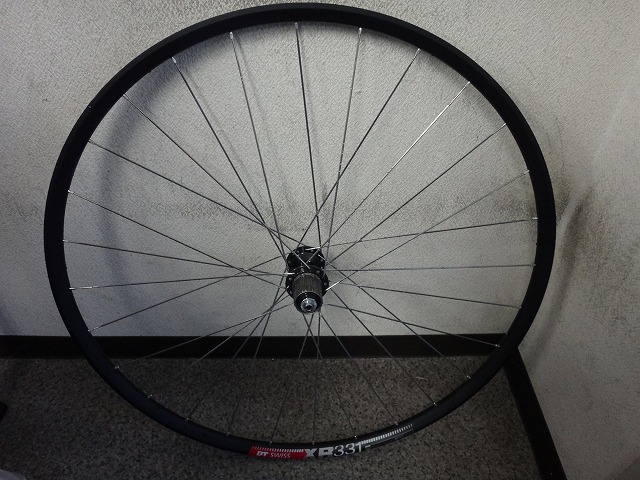
I built a rear wheel with an XR331 rim and a 9000 Dura-Ace rear hub.
As you can probably tell from the combination of a disc brake rim with a non-disc-compatible hub,
this is my personal bike.
Conceptually, this rear wheel has had the rim replaced once,
and now the hub is changing from a DT 350, so
almost none of the original wheel's parts remain.
Just some of the Squorx nipple washers.
It's truly the "Ship of Theseus."
The state right before disassembly was a semi-comp with full lacing both sides,
so the freewheel side comp couldn't be reused.
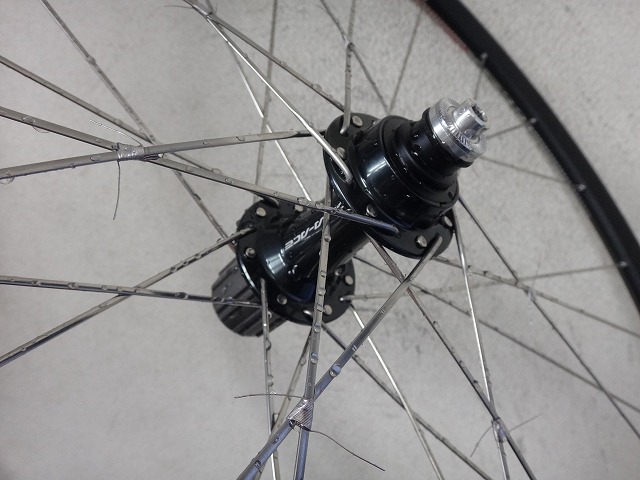
FH-9000 28H semi-CX sprint 46-lacing, with lacing.
I did the lacing the way I always do—only on the non-freewheel side.
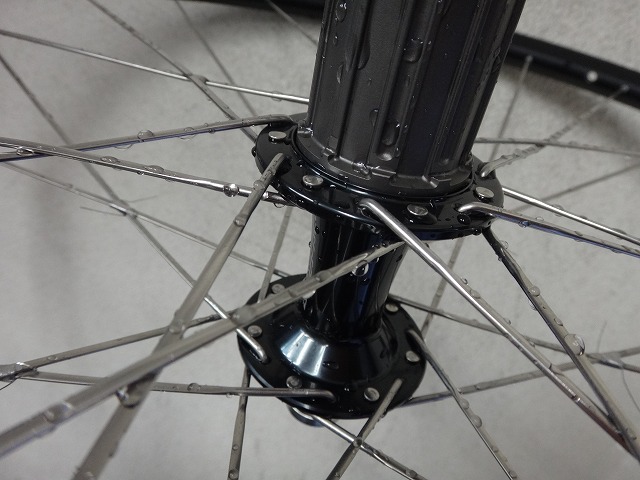
The semi-comp has some pretty important secrets,
and I believe that for the freewheel side spokes,
it's better not to use flat spokes.
The exception is flat spokes with roughly 100% spoke specific gravity that need slotted holes—
specifically, Sapim's CX spokes.

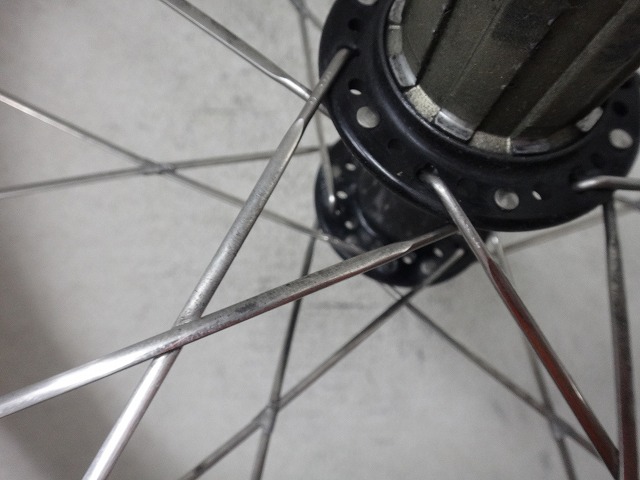
↑Example of semi-CX on my personal wheel
For customers under 50kg or female riders,
I sometimes do all CX-RAY—meaning using CX-RAY on the freewheel side too
(though all CX-RAY always requires lacing regardless of weight).
This wheel is 28H, meaning 14H on the freewheel side, so
I thought CX-RAY aside, maybe CX Sprint could work,
and decided to try it.
Comparing one side 12H of CX versus one side 14H of CX Sprint for spoke volume:
the former is 100×12 = 1200, the latter is 78×14 = 1092.
So, if the rim, hub, and lacing method were the same,
the latter would be about 10% lighter in both spoke volume and weight.
When I actually built it,
I became quite certain during the build itself,
but even at left-right 28H, semi-comp is definitely better.
The freewheel side of a 24H semi-comp is 85×12 = 1020,
smaller than 78×14 = 1092, but
the round cross-section spoke shape
has a pretty significant effect.
With 32H, semi-CX Sprint might work.
If after using this wheel I'm unhappy with how it feels,
I'll try lacing the freewheel side first rather than replacing all those spokes, which would be tedious.
They don't exist in stable supply ranges, but
if there were round-butted spokes with 78% specific gravity (comp is 86.5%, but roughly 85% is fine),
would I use them? Probably not. 85% is an incredibly precise sweet spot from experience.
Conversely, if there were 85% flat spokes?
Sapim's current Aero Star Bright is 91%,
and I judge there's no problem using it on the freewheel side,
so we might just barely make it.
Semi-CX Sprint isn't terribly bad,
but it's right at the edge of being not good enough.
With straight-gauge spoke hubs, there are few asymmetric diameter options,
so you can only choose 2 from the 3 of 100% round, 78% flat, and 65% flat,
which is why we're forced to use semi-CX Sprint.
This is for rear wheels; for something like a disc brake front wheel's slight wobble,
a specific gravity difference around semi-CX Sprint is actually optimal.
Note: if the freewheel body's ratchet sound isn't like DT's Star Ratchet
or a Chris King hub,
the value of a triple valve setup is thin,
but since the rim already has three valve holes,
I'll keep the triple valve configuration.
You could cut just one hole in the tubeless tape
and seal the two inner rim holes with tape
to operate it as a single valve, though.